Let be a discrete random vector, and let be a collection of subsets of in which every index occurs at least times. ThenApply the chain rule for information entropy to each projection and use conditioning reduces entropy to compare every term with the corresponding conditional entropy in the full chain rule.
Every nonconstant entire function takes every complex value with at most one exception. Equivalently, its image is either or for one complex number . The hypothesis of being nonconstant matters: a constant function has only one value. The Little Picard theorem guarantees existence of preimages, without requiring infinitely many preimages for each attained value. [ref]
https://terrytao.wordpress.com/2016/10/11/math-246a-notes-4-singularities-of-holomorphic-functions/. Terence Tao, Math 246A Notes 4 (2016), Theorem 56
For a nonconstant polynomial , the fundamental theorem of algebra applied to supplies a preimage for every . The complex exponential function has precisely one omitted value, zero, as the explicit formula for its preimages shows. In contrast, the complex sine function has no omitted value. To solve , set and rearrange to the quadratic equationIts roots have product , so they are nonzero. Every such root has a preimage under the complex exponential function, giving a solution for . Adding supplies further solutions by the periodicity of the complex sine.
The force of the Little Picard theorem is that it applies to every nonconstant entire function, without an explicit formula. The Liouville theorem already gives a dense image of a nonconstant entire function, but a dense subset could still leave out many individual points. The Little Picard theorem limits these missing points to one. In particular, establishing two omitted values proves that an entire function is constant.
For a nonconstant meromorphic function on the complex plane, the corresponding bound is two omitted values in the Riemann sphere , where poles take the value infinity. [ref]
https://numdam.org/articles/10.24033/asens.187/. Picard, Mémoire sur les fonctions entières (1880), section 7, pp. 152-153
For example,omits zero and one, and has poles at for . Every other finite value is attained by solving . For an entire function, infinity is already an omitted value in the Riemann sphere, leaving at most one additional finite omitted value.Proof outline: use the version of Montel's theorem for two fixed finite omitted values. [ref]
https://terrytao.wordpress.com/2016/10/11/math-246a-notes-4-singularities-of-holomorphic-functions/. Tao, Math 246A Notes 4, Exercise 58
It makes the rescaled holomorphic functions a normal family on the unit disc. The fixed value gives pointwise anchoring of a holomorphic normal family, hence a subsequence with a finite holomorphic function as its locally uniform convergence limit. The Cauchy integral formula bounds its derivatives at zero, whereas . Consequently ; arbitrary makes constant.Entanglement concentration probabilistically converts partially entangled pure states into fewer maximally entangled states by local operations and classical communication.
Entanglement criterion for a two-term correlated state by  Codex 0 Created 2026-09-24 Updated 2026-09-28
Codex 0 Created 2026-09-24 Updated 2026-09-28The p-energy of a Sobolev function isIts stationary points under fixed boundary data are weak solutions of the p-Laplacian equation.
The hypothesis is transversality: tangent spaces to the two submanifolds span the ambient tangent space at each intersection point.
The charged electroweak gauge fields are . After electroweak symmetry breaking they have electric charges and mass .
Surface charge density is electric charge per unit area. At a conductor in electrostatic equilibrium it equals for the normal pointing out of the conductor.
For signature and a consistent orientation,Overall signs depend on tensor and orientation conventions, while their vanishing does not.
The Lorentz force is the force exerted by an electric field and a magnetic field on a body with electric charge and velocity . In SI units its form in nonrelativistic classical mechanics, using mass and Newton's second law, isBoth fields are evaluated at the body's position at the current time. The electric field contributes even at rest, whereas the magnetic force depends on velocity through a cross product. [ref]
https://openstax.org/books/university-physics-volume-2/pages/5-4-electric-field. OpenStax, electric force and field
; [ref]https://openstax.org/books/university-physics-volume-2/pages/11-2-magnetic-fields-and-lines. OpenStax, magnetic force on moving charge
.For a concrete charged particle in a uniform magnetic field, use nondimensionalization to stipulate , magnetic field , zero electric field, initial position , and initial velocity . These are rescaled quantities, not an assertion that the mass, electric charge, and magnetic field have the same physical units. At the start, , so the magnetic acceleration points toward . The resulting circular motion isAt the position is and the velocity is ; at the position is and the velocity is . Thus the circle has center and radius one. Viewed from toward the plane, the motion is clockwise. Changing only the electric charge to gives position and reverses the bending to counterclockwise.
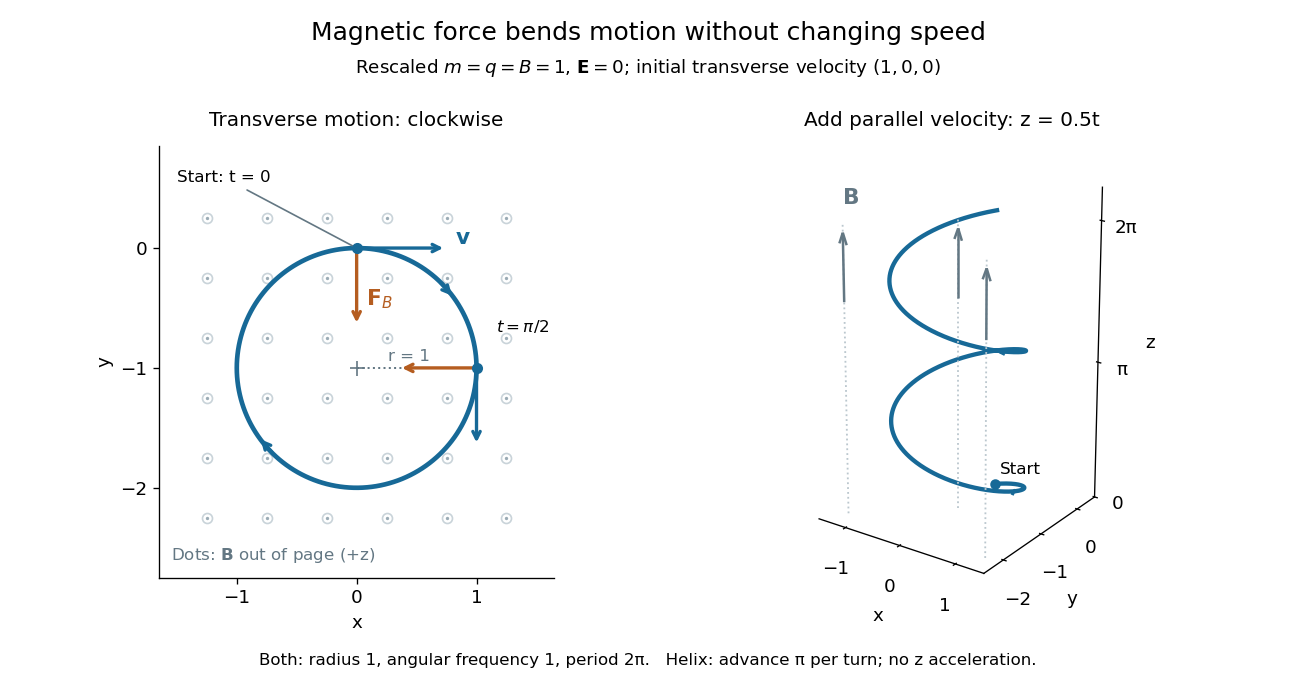

Adding initial velocity leaves the transverse circular motion unchanged and givesThis is a helix of transverse radius one, cyclotron frequency , and transverse period ; the advance along in one turn is . The parallel component of velocity stays constant because the magnetic force has no parallel component: there is no magnetic acceleration along the magnetic field. If the initial velocity were entirely parallel to the magnetic field, the magnetic force would vanish and the path would be straight. [ref].
More generally, with zero electric field, no other forces, and a uniform constant magnetic field of magnitude , decompose velocity into perpendicular and parallel components. For nonzero electric charge , the perpendicular speed determines the gyroradius, while the cyclotron frequency is an angular frequency:These are nonrelativistic formulas; see the relativistic cyclotron orbit for the correction. The beauty is that increasing perpendicular speed increases the radius in exactly the proportion needed to leave the period unchanged. Conversely, known magnetic field, perpendicular speed, and measured radius determine the magnitude of the electric charge divided by mass. This makes the same geometry useful for comparing bodies with different electric charge and mass.
Two short checks explain the result. First, the cross product gives for both stipulated positive-electric charge paths, exactly their acceleration. Second, the transverse magnetic force supplies the centripetal acceleration, so ; for this gives the gyroradius, and gives the cyclotron frequency.
Magnetic forces do no work: the instantaneous power of the magnetic part of the Lorentz force vanishes because a cross product is perpendicular to its first argument. The work-energy theorem therefore givesThe dot product is zero at every instant, rather than only after a full turn. With zero electric field and no other forces, the kinetic energy and speed remain constant; the electric field can increase or decrease kinetic energy according to the sign of . In the two stipulated examples the constant kinetic energy is respectively and in rescaled units. The extra parallel velocity raises kinetic energy without changing the gyroradius or the cyclotron frequency.
For an electric example in rescaled units, stipulate , zero magnetic field, constant electric field , no other forces, and rest at . The Lorentz force gives acceleration and velocity , hence kinetic energy and power . At , the kinetic energy has risen from zero to two: the electric field has done positive work.
The existing electromagnetic field tensor formulation expresses the same interaction covariantly. For four-momentum and four-velocity , using proper time , the Lorentz force law isIts spatial and temporal components are
Ohm's law states that an Ohmic conductor has electric current proportional to its applied electric potential difference, with constant electrical resistance under fixed material conditions:Here is the terminal electric potential difference, and positive enters at and exits at . This sign convention makes the electrical power absorbed. The straight-line relation through the origin lets one constant predict the response at many applied electric potential differences. Merely defining at one nonzero operating point does not establish Ohm's law: a component may have a ratio that varies with applied electric potential difference. Material and temperature must be specified and held fixed; many components have a nonlinear response. [ref]
https://openstax.org/books/university-physics-volume-2/pages/9-4-ohms-law. Ling, Sanny and Moebs, §9.4: Ohmic and non-Ohmic responses
.For the ideal resistor model at electric potential difference ,This power is converted to internal energy by Joule heating; a watt is a joule per second. If the model holds for time , the transferred energy is . Doubling electric potential difference doubles electric current and quadruples power for the same fixed . The model keeps material temperature fixed even while calculating Joule heating; appreciable changes in temperature may require a changing electrical resistance. [ref].
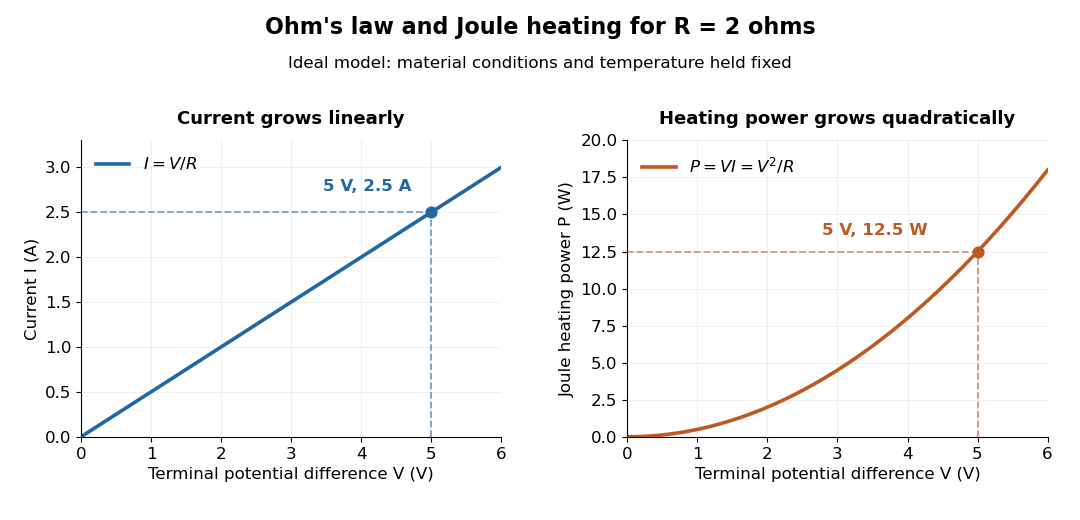
Ohm's law gives linear electric current and quadratic Joule heating power at fixed electrical resistance
. The ideal model holds fixed. At , the marked values are and . Source. Details.
In 1827, Georg Ohm published his mathematical account of electrical transport in Die galvanische Kette, mathematisch bearbeitet. On printed page 36, his relation expresses electric current in terms of total driving tension and a reduced length incorporating electrical conductivity and geometry. This is historical notation: his is not the wire cross-sectional area used here, and his is not simply the wire's physical length. The striking idea is that material response and geometry can be combined into one quantity governing an electrical circuit. [ref]
https://archive.org/details/diegalvanischek00ohmgoog. Ohm, Die galvanische Kette, mathematisch bearbeitet (1827), p. 36, original edition
.The acoustic impedance of a fluid is . For a progressive plane acoustic wave, pressure amplitude and velocity amplitude in its propagation direction satisfy . At an oblique planar interface, zero reflection requires a matching condition involving the normal impedances or, equivalently for displacement amplitudes, .
An obliquely incident in-plane P- or SV-wave generally produces reflected and transmitted P- and SV-waves. Continuity of displacement and traction supplies four scalar conditions for their four amplitudes, while frequency and tangential wavenumber are shared.
Acoustic reflection and transmission at an interface by Codex 0 Created 2026-09-24 Updated 2026-09-24
Codex 0 Created 2026-09-24 Updated 2026-09-24For two inviscid media, continuity of normal displacement and normal stress determines the reflected and transmitted longitudinal amplitudes.
At a perfectly bonded interface, all displacement and traction components are continuous.
There are unlisted articles, also show them or only show them.