For a jump process with rate from state to , probability balance givesThe first term is inflow from and the second is outflow from .
For jumps at rate and at rate , the diffusion approximation hasThe stable deterministic population is . Its linear-noise stationary approximation is normal with mean and variance .
The inverse-scattering spectral problem associated with this KdV convention isFordifferentiation gives the Wronskian identity
A link is a smooth embedding of a finite disjoint union of circles in , considered up to ambient isotopy. A one-component link is a knot.
The Seifert longitude is the zero-linking parallel of a knot on the boundary of its tubular neighborhood. It is the framing induced by a Seifert surface.
A surface knot is a smooth embedding of a closed connected surface in a four-manifold. In the narrow standard usage, a 2-knot is an embedded two-sphere in .
It extends the embedding viewpoint of knot theory to two-dimensional domains.
The Arf invariant is a -valued concordance invariant obtained from the quadratic refinement of the mod-two intersection form on a Seifert surface.
An amphichiral knot is ambient-isotopic to its mirror. Positive and negative amphichirality distinguish whether the symmetry preserves or reverses the knot orientation.
The two-fold branched cover of a knot is the double cover of branched along the knot. Its first homology has a nonsingular linking form and, when finite, has order .
Away from the knot this is a two-sheeted covering space; at the knot it has the standard local model of a branched covering.
Two knots are concordant when they cobound a smoothly embedded annulus in . Connected sum makes concordance classes into an abelian group.
A knot is the image of a smooth embedding , considered up to ambient isotopy. The circle supplies a closed loop with no free ends; the smooth embedding condition rules out self-intersections and requires a nonzero tangent vector in a regular parametrization. The equivalent convention uses the three-sphere: removing a point outside the knot identifies the remaining space with three-dimensional Euclidean space by stereographic projection.
More precisely, knots are equivalent if there is a smooth family of diffeomorphisms of the ambient space, for , such that is the identity and . Every intermediate remains a smooth embedding. This ambient isotopy allows bending, stretching and moving a loop, but neither cutting it nor letting strands cross through each other. We compare the embedded images rather than their parametrizations; an oriented knot additionally remembers a direction of travel.
For a worked example, start with , where is taken modulo , and useBoth scale factors stay positive, so each is a diffeomorphism. At the circle becomes the ellipse , yet its knot type is still the unknot. Exact lengths and angles are therefore irrelevant to knot type; self-intersection is the obstruction that the deformation must avoid.
For a small boundary displacement and weak disturbance, evaluate boundary data on the undisturbed surface and discard products of small quantities.
Kinematic boundary condition for a free-surface graph by  Codex 0 Created 2026-09-24 Updated 2026-09-24
Codex 0 Created 2026-09-24 Updated 2026-09-24 Geodesic conserved quantity from a Killing vector by Codex 0 Created 2026-09-24 Updated 2026-10-14
Codex 0 Created 2026-09-24 Updated 2026-10-14Each Killing vector field supplies a conserved quantity for freely moving test particles: it turns a geometric symmetry into a first integral of the geodesic equation. Let be a geodesic with affine parameter , tangent vector , and . Wherever a Killing vector field is defined along the geodesic,The statement applies to Riemannian manifolds and to timelike geodesics, null geodesics and spacelike geodesics in a Lorentzian manifold. It requires an affine parameter; for a massive test particle, proper time is one choice. See Tong, section 4.3.2, equation (4.32).
For a worked example in the Euclidean plane, take with affine parameter and velocity . The Euclidean Killing vector fields for translation and rotation giveThe rotational field along the geodesic is : it changes from at to at , yet its pairing with stays . With toy mass and interpreted as time, the first constant is the component of linear momentum, and the second is the signed component of angular momentum about the origin. Their numerical values use toy units. The geodesic is straight; the rotation flow orbits are circles.
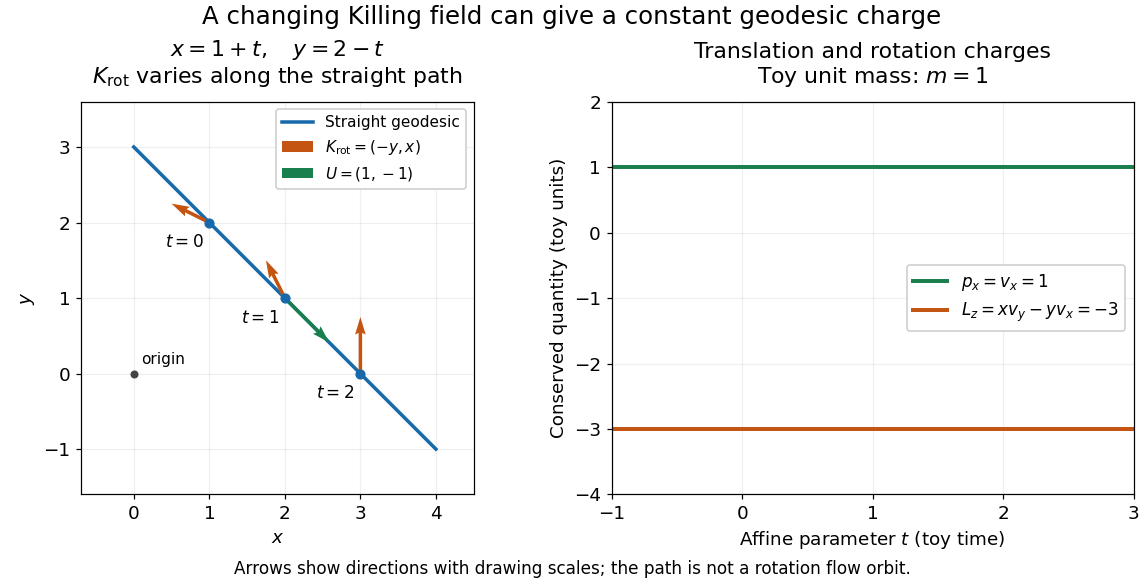
One straight Euclidean geodesic: the rotational Killing field varies while translation momentum and angular momentum stay constant for toy unit mass
. Details. 
This conservation law follows from metric compatibility and the Killing equation:The geodesic equation kills the acceleration term, and the symmetric product selects the vanishing symmetric derivative. This tensor contraction is the whole proof outline; see Carroll, equation (5.43).
In a stationary spacetime, a chosen time-translation Killing vector field gives Killing energy. With metric signature , , and a massive test particle's four-momentum , the physical normalization isHere generates the axial rotational symmetry when one exists. In coordinates with and , these are and . Both are conserved quantities along the geodesic, even if the metric has a time-angle cross term. A future timelike makes positive for a future massive particle; the scale of depends on the normalization of . Not every spacetime has a global timelike Killing vector field, and a stationary field can become spacelike in an ergoregion of a stationary spacetime. Conservation on the field's domain does not imply a universal global positive energy; see Tong, sections 4.3.1-4.3.2 on the timelike-domain qualification and conserved charges.
Active-set transition in capped resource allocation by Codex 0 Created 2026-09-24 Updated 2026-10-14
Codex 0 Created 2026-09-24 Updated 2026-10-14 There are unlisted articles, also show them or only show them.