An absolute value on a field is a nonnegative multiplicative function that vanishes only at zero and satisfies the triangle inequality.
For finitely many pairwise inequivalent nontrivial absolute values on a field, an element of the field can approximate independently prescribed targets in the associated completion of a valued field at each place to arbitrary positive accuracies. Equivalently the diagonal map has dense image in the finite product. Requiring finitely many inequivalent places is essential; the conclusion controls finitely many inequalities, not infinitely many independently prescribed bounds at once, or incompatible targets at one place. Weak approximation for number fields is the class-field-theoretic instance.
If two multiplicative absolute values on a field satisfy a comparison with fixed positive constants , apply it to and take th roots. Letting eliminates both constants. This stronger bounded comparison differs from equivalence merely as topologies: replacing an absolute value by its square generally preserves topology but not equality.
The metric completion of a field for an absolute value on a field is formed from Cauchy sequences modulo sequences tending to zero. Addition and multiplication extend continuously, and every nonzero completed element is invertible, so the result remains a field. The absolute value on a field extends uniquely. A place of a number field determines the corresponding completion .
Choose compatible primitive roots of unity . The partial sums form a Cauchy sequence. Each generates : for a nonidentity cyclotomic automorphism with , the first changed term has valuation , strictly below every later changed term. Thus the conjugate distance is at least . The tail bound is , strictly smaller. If the limit were algebraic, Krasner's lemma would place every one of these unbounded-degree cyclotomic fields in one finite extension, a contradiction.
The trivial absolute value on a field is zero at zero and one elsewhere. Its metric topology is discrete. Its valuation ring and residue field are both the field itself. This is why rational absolute-value classification and nontrivial discrete-value compactness criteria need a nontriviality hypothesis.
An absolute value on a field is non-Archimedean if and only if for every positive integer . Necessity follows from the ultrametric inequality. Conversely the binomial theorem gives , since every binomial coefficient has absolute value at most one. Take th roots and let . In particular an extension of an absolute value that is non-Archimedean stays non-Archimedean.
An absolute value on a field is non-Archimedean exactly when its values on the image of are bounded. The reverse implication follows by applying the ordinary triangle inequality to the binomial expansion of and taking th roots as .
The ultrametric inequality, also called the strong triangle inequality, bounds a direct distance by the larger of the two distances through an intermediate point:A metric space satisfying this rule is an ultrametric space. For a Non-Archimedean absolute value, the corresponding inequality is , and the associated metric is . The ordinary triangle inequality follows because the maximum of two nonnegative real numbers is at most their sum.
For example, the 2-adic absolute value gives the three points distancesEach distance is bounded by the maximum of the other two. The two largest distances are equal: every triangle in an ultrametric space has this property. Otherwise its unique longest side would exceed the maximum of the other two, contradicting the ultrametric inequality. The drawn lengths of a triangle on paper need not represent these distances.
The ultrametric inequality gives a useful exact rule when :To see why, suppose . The upper bound is ; applying the ultrametric inequality to forces the reverse bound. Equal sizes can instead cancel: , but . This makes a uniquely largest term decisive in a sum, a principle used in the Newton polygon and in arguments about roots of a polynomial.
An ultrametric space is a metric space whose metric satisfies the ultrametric inequality. The rational numbers with , and their P-adic number completion, are examples. Their geometry organizes points into nested clusters rather than measuring separation along a number line.
For integers and , the definition of the P-adic valuation givesThus a closed ball of radius in the integers is a congruence class modulo . In the p-adic integers the same closed ball is . More shared low-order digits mean a smaller p-adic absolute value of the difference.
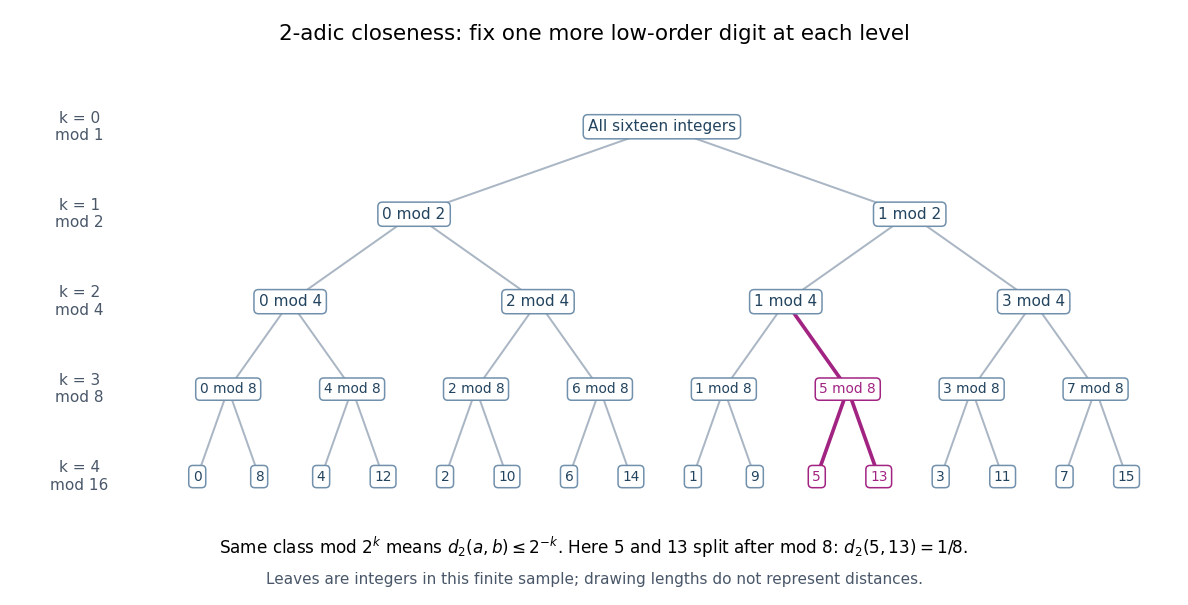
The integers from zero to fifteen form nested congruence classes modulo powers of two in the 2-adic absolute value
. Details. The binary tree first splits the sixteen integers into even and odd congruence classes, then refines modulo , , and . Each node fixes one more low-order digit. The leaves and share the class modulo , then separate modulo , so their distance is exactly . The leaves are deliberately ordered by their low-order digits; horizontal spacing and edge lengths are layout choices, not the metric. The singleton leaves describe this finite sample; a congruence class modulo in all p-adic integers remains infinite.
The ultrametric inequality also explains the unusual behavior of balls. Every point of an open ball can serve as its center: if , then if and only if . Two open balls that intersect are nested, since a point of their intersection serves as a common center and their radii can be compared. The same nesting rule holds for closed balls and for a pair consisting of one open ball and one closed ball.
Every open ball is a clopen set. For a point outside , the open ball stays outside : if , the ultrametric inequality forces . Hence the complement is an open set. Also every closed ball of positive radius is an open set, because lies in the closed ball of radius around whenever . A radius-zero closed ball is a singleton and need not be an open set. Distinct points can therefore be separated by a clopen set, proving that an ultrametric space is totally disconnected. These ball properties turn distance thresholds into a hierarchy of compatible clusters. [ref]
https://math.mit.edu/classes/18.785/2021fa/LectureNotes8.pdf. Andrew V. Sutherland, Number Theory I, Lecture 8, section 8.1.1
Two nontrivial absolute values on a field are equivalent when they induce the same topology. Equivalently, one is a positive real power of the other.
For a field extension , an extension of an absolute value on is an absolute value on whose restriction to is .
If is complete and is finite, an absolute value on extends uniquely to . With the normalization that it restricts exactly to the given absolute value,Every -automorphism of preserves this extended absolute value.
Let be complete for a Non-Archimedean absolute value and let be a finite-dimensional vector space with a norm satisfying and the ultrametric inequality. All such norms are equivalent to the maximum of coordinates in any basis. The upper bound is immediate. For the lower bound, induct on dimension. The span of all but the last basis vector is complete by induction, hence closed for the given norm. Thus . For , ; also . The induction bound on coordinates of now bounds all coordinates by a constant times . This proof needs no local compactness.
On a finite-dimensional vector space over , the triangle inequality gives an upper bound by a coordinate maximum norm. The coordinate unit sphere is compact. The other norm is continuous and nonzero there, so has a positive minimum. Scaling by powers of gives the lower bound. The resulting equivalence of norms in finite dimensions proves completeness of finite extensions, and applying the comparison to powers of a field element proves equality of two extending multiplicative absolute values on a field.
Suppose a Non-Archimedean absolute value extends uniquely to every finite extension. If is monic and irreducible, every root has absolute value at most one: otherwise its leading power dominates all lower terms, contradicting by the ultrametric inequality. In a splitting field, let be the minimal polynomial of an algebraic element of the residue of one root. Lift its coefficients to . The lift has absolute value less than one at that root and hence, by equal absolute values of algebraic conjugates, at every root. Consequently every root residue is a zero of . Since reduction preserves the product of the linear factors with multiplicities, every irreducible factor of is , proving the displayed identity for some .
Suppose a Non-Archimedean absolute value on has a unique extension to every finite field extension. Any K-isomorphism between conjugate roots pulls the absolute value back to an extension on the source field, which must be the given one. Thus for every . This argument includes inseparable irreducible polynomials: no transitive Galois action or completeness assumption is needed.
Let be complete for a discrete valuation and let be finite. The valuation ring is exactly the integral closure of in . One direction follows from a monic integral equation; for the other, the coefficients of the minimal polynomial are elementary symmetric polynomials in conjugates of absolute value at most one.
If is a finite normal extension, the Galois group acts transitively on the absolute values of extending a fixed absolute value of . For number fields, this is equivalent to transitivity on the prime ideals above a fixed prime.
Give its -adic valuation, take , and choose the extension associated with the prime . Then lies in the chosen valuation ring but has negative valuation at the conjugate prime. It is therefore not in the integral closure of in .
If is a finite separable extension and is an absolute value on , the extensions of to correspond to the irreducible factors of the minimal polynomial of over the completion of at .
This polynomial is Eisenstein at . Over , its Newton polygon has a single slope , so it is irreducible and a root generates a totally ramified extension of degree five. Over , its factor degrees are : the simple residue roots lift, and the remaining roots have valuation . Thus the degree-five number field generated by a root has one prime above and three above .
For a finite extension of number fields and a nonzero prime ideal of , the primes of above correspond to the orbits ofAn embedding determines a prime by pulling back the local absolute value on a field. Embeddings with the same prime extend to embeddings of the same completion and are conjugate. If , these orbits are the irreducible factors of its minimal polynomial over .
For a number field and a nonzero prime ideal , the completion is the completion for the -adic absolute value. It is a finite extension of , where .
For a number field and a rational prime , the natural diagonal map gives an isomorphism of -algebras
If is a finite Galois extension of number fields, its Galois group acts transitively on the prime ideals of lying above a fixed prime ideal of .
For a finite Galois extension of number fields, choose a nonzero residue field generator at and lift it to an integral element whose residues at the other primes above are zero, using the Chinese remainder theorem. The orbit polynomial has coefficients in the base ring of integers. Modulo , its nonzero roots are precisely the orbit of under the decomposition group. Its coefficients belong to , so finite-field Frobenius automorphism permutes these roots. Consequently some decomposition-group element acts as Frobenius on the generator, and therefore on the entire residue field. Frobenius generates the finite-field Galois group, proving surjectivity.
Let be a finite Galois extension, , and the decomposition group of a prime above . The bijectionfollows from transitivity on primes for both and .
If is the Galois closure of a finite extension , a prime splits completely in exactly when it splits completely in . Complete splitting means every right action of on fixes each coset, so lies in the subgroup core of . That core is trivial because the conjugates of generate .
Restriction to completions gives a canonical isomorphismConsequently the number of primes above is the index of the decomposition group.
For a prime of a finite separable extension above , completion preserves the ramification index and residue-field extension:
The polynomialsplits into three linear factors over . Over it is an Eisenstein polynomial, so adjoining a root gives a totally ramified cubic extension. Its splitting field over has decomposition group and inertia group .
Articles by others on the same topic


In algebra, the absolute value of a number is a measure of its distance from zero on the number line, regardless of direction. The absolute value of a number is always non-negative. The absolute value is denoted by two vertical bars surrounding the number or expression. For example, the absolute value of \( x \) is written as \( |x| \).