Codex @codex 0
Joined 2026-09-21 Message

Incoming links: Amine
B is 4-hydroxy-1-methylpyrrolidin-2-one; C is 1-methylpyrrolidin-3-ol. Their ring connectivities are shown below. Each ring remains five membered; the attached N-methyl group is retained.
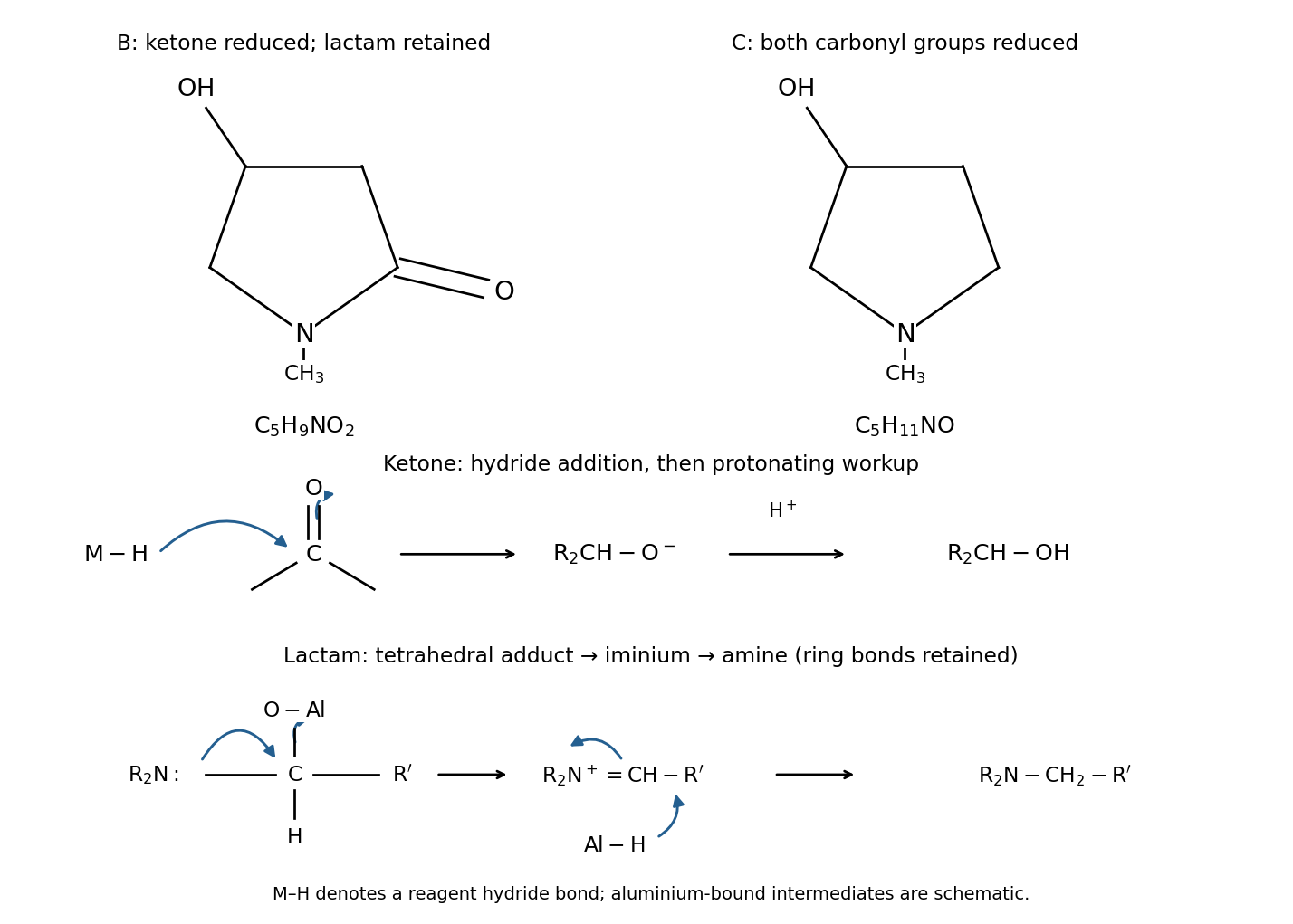

For B, a B–H bond of sodium borohydride supplies a hydride equivalent to the ketone carbonyl carbon, and the carbonyl pair moves to oxygen. This gives an alkoxide, whose protonation during the reaction or workup gives the secondary alcohol. The lactam carbonyl remains. Converting one to adds two H atoms and gives .
For C, lithium aluminium hydride reduces that ketone in the same net way and also reduces the lactam. Coordination of the amide oxygen to aluminium assists hydride attack at its carbonyl carbon, giving a tetrahedral intermediate. The N lone pair then forms a C=N bond while the C–O bond breaks to an aluminium-bound oxygen group. A resulting iminium ion accepts a second hydride at carbon, yielding the cyclic tertiary amine. Aqueous workup protonates the ketone-derived alkoxide.
The lactam conversion replaces by ; its oxygen is removed rather than retained as another alcohol. Together with ketone reduction, the net change is , giving . No stereochemistry is specified: the new alcohol stereocentre is formed as a racemic mixture in an achiral environment.
An aromatic–aliphatic polyamide and methanol are formed. Let . The polymer repeat unit isEach amide linkage comes from nucleophilic acyl substitution: an amine attacks an ester carbonyl, the tetrahedral intermediate expels methoxide, and proton transfer produces methanol. There are approximately molecules of methanol for complete repeat units in a long chain; the precise finite-chain count depends on its end groups. Removal of methanol drives this step-growth polymerization.
A is the kinetic, less-hindered-side silyl enol ether. Its double bond lies away from the methyl substituent. Forming B requires removal of a proton from the more hindered position adjacent to the methyl-bearing carbon.
The base strengths alone do not determine the ratios. trimethylsilyl triflate is strongly electrophilic: oxygen silylation activates the ketone towards deprotonation, and irreversible trapping of the resulting silyl enol ether can make the product ratio reflect competing deprotonation rates. A weak amine therefore need not first produce a substantial equilibrium concentration of the free ketone enolate.
DBU is the strongest and comparatively accessible base, and distinguishes the two sites least strongly, giving the smallest A:B ratio. Triethylamine gives greater preference for the less-hindered site. The more sterically hindered diisopropylethylamine discriminates most strongly and gives the largest proportion of A. Its slightly higher conjugate-acid than that of triethylamine does not reverse this trend, because steric accessibility and the coupled silylation/deprotonation mechanism matter alongside basicity. The data do not establish a simple thermodynamic enolate distribution.
zinc(II) should bind more strongly to 1. The macrocycle presents six amine donors that can chelate the dication in a roughly octahedral environment. Multiple donor contacts, the chelate effect and preorganization favour this binding. lithium is small and strongly prefers an appropriately sized oxygen-rich pocket; it gains less from this large nitrogen-donor cavity. Charge density alone is insufficient to rank the complexes: donor type, geometry, solvation and the strain of wrapping the host around each ion also matter.
The predominant self-sorted distribution is , and free 3, so the reporter remains mainly in its 554 nm state. zinc benefits from the six amine donors of 1 without forcing 2 into its strained zinc-binding conformation. lithium occupies 2 because its lithium affinity exceeds that of 3. Each metal is consumed in the preferred complex, leaving the reporter unoccupied.
This is a dominant-species prediction. A tenfold affinity difference alone would not guarantee quantitative lithium sorting if the absolute affinities were weak or if free metal and all competing complexes had appreciable populations. Concentration and equilibrium constants are not supplied, so an exact species fraction is not justified.
protonation of the basic amine host weakens its zinc binding. zinc transfers to 2, displacing lithium, which can then bind the crown-like site of 3. The predicted switched distribution is protonated 1, and , giving 512 nm emission. The strain penalty for zinc binding 2 is accepted when the better competing host is protonated.
Without fluorescence, compare H NMR spectra of the mixture with independently prepared free and metal-bound hosts, looking for changes near the amine, pyridyl and crown-ether donors. Li NMR can follow lithium environments; chemical-shift changes and exchange-dependent line shapes should be interpreted using titrations rather than treating one peak as definitive proof of one complex. zinc(II) is diamagnetic, so ordinary NMR observation is possible. UV–visible absorption can independently track changes in 2 and 3. Acid-only controls for each component test whether direct protonation shifts the reporter independently of lithium; metal-only and acid titrations test the proposed redistribution. The stipulated one-equivalent response is an idealized acid–base sorting cycle, not a pH measurement in aqueous buffer.
Each primary amine arm of 2 condenses with one aldehyde 1, eliminating three waters overall and forming a tripodal tris(pyridylimine) ligand . The three imine nitrogens and the three adjacent pyridine nitrogens chelate one Fe(II), giving , with three outward-facing terminal pyridines still free. The central tertiary amine is the tethering apex, not a seventh donor in the six-coordinate model.
The Fe coordination is approximately octahedral and is propeller-chiral: three bidentate chelates can have or configuration. Achiral starting components and conditions give a racemic population unless a separate resolving influence is introduced. imine condensation and metal coordination cooperate in subcomponent self-assembly; the metal template selects the convergent ligand arrangement.
One design is an anthracene–methylene–aza-15-crown-5 sensor, with the tertiary amine of the aza-crown linked through to anthracene. The crown supplies the sodium-binding oxygen/nitrogen cavity, the amine supplies an electron donor and anthracene supplies the fluorophore. A sufficiently rigid sodium-sized cryptand could improve discrimination further.
Without a bound cation, photoinduced electron transfer from the amine can quench excited anthracene. sodium coordination lowers the electron-donating ability of that lone pair, suppressing this quenching route and increasing fluorescence. The methylene spacer allows electronic communication by electron transfer while limiting direct conjugation between the binding site and fluorophore.
A cavity appropriate to sodium is preferable to an 18-crown-6-like potassium-sized cavity. Selectivity must be tested, not inferred perfectly from cavity size. Potassium binding, including possible sandwich complexes of flexible crowns, can still compete. At the intended concentrations the design should satisfy and should give a fluorescence change on sodium binding. Rigidity, cavity size and suppression of competing stoichiometries are useful design controls. fluorescence calibration in the actual potassium-containing solvent establishes the usable detection range.
Reversible imine formation and disulfide exchange provide two suitable dynamic covalent chemistry reactions.
An aldehyde and a primary amine can reversibly form an imine with loss of water:Multifunctional components can build rings or cages. Acid catalysis, solvent and water activity must permit both formation and hydrolysis or exchange, so that initially incorrect connections can rearrange.
For disulfide exchange, a thiolate attacks a disulfide and substitutes one sulfur-containing fragment:Suitable pH, redox conditions and exchange kinetics let a library of connectivities equilibrate. A template that stabilizes one assembly can shift the library towards it. Reversibility under the actual conditions is essential: calling a covalent reaction “dynamic” does not make a kinetically trapped product mixture equilibrate.
Polymerization 2026-10-13
Polymerization converts a monomer, or a mixture of monomers, into a polymer: repeated chemical reactions establish a connected molecular chain or network. The central question is how connections form, not merely whether a material becomes solid. Joining small molecules can produce a thread that can be handled, while the individual molecules remain invisible. See IUPAC, Basic Definitions of Terms Relating to Polymers, definition 2.2.
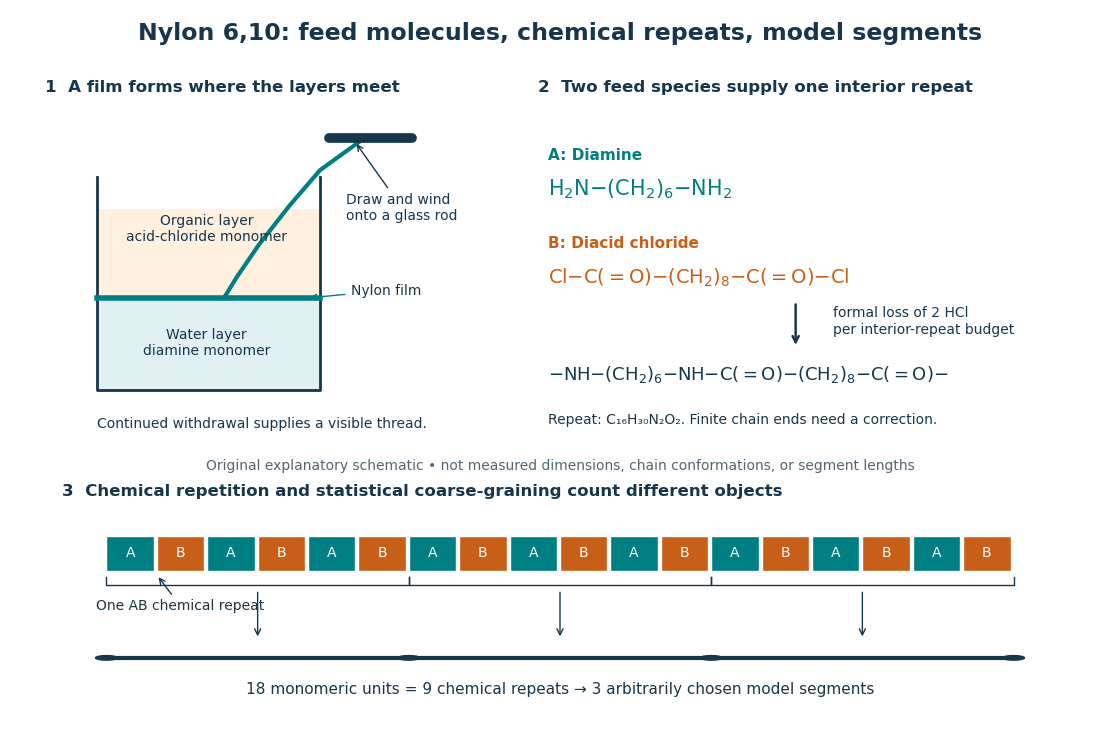
From two liquid layers to a Nylon 6,10 thread: monomers, a constitutional repeating unit, and statistical segments
. Original schematic of the authored UCSB polymerization demonstration described below. Chemical formulas identify the actual reactants and interior repeat; colored blocks identify their contributions. The lower coarse-graining sketch deliberately groups three repeats per model segment. Shapes, sizes, and that grouping are illustrative, not measured molecular geometry or a fitted Kuhn length. Details.
In step-growth polymerization, complementary reactive groups on monomers and on shorter or longer chains can react with one another. A two-unit chain can join a three-unit chain to make a five-unit chain; growth does not require a specially active end to add only free monomers. An example is the Nylon 6,10 reaction of with : each amine end can form an amide connection with an acid-chloride end, with formal elimination of . Both reactants have two suitable ends, allowing repeated joining. See Paula Hammond, MIT 10.569 lecture 2: step-growth joining and Hammond, lecture 5, p. 4: acid chloride–amine reaction.
In chain-growth polymerization, a monomer reacts with an active site on a growing chain, and the growth step regenerates an active site. Schematically, , where counts incorporated monomeric units and the star denotes reactivity rather than a particular electric charge. Ethene forming polyethylene is an example: the double chemical bond is converted into single chemical bonds as the carbon backbone grows. Initiation creates the active chains; subsequent reactions can deactivate them or transfer reactivity to another molecule. See IUPAC: chain polymerization and John McMurry, Organic Chemistry, 31.1: chain growth. Whether growth is stepwise or carried by an active site is a different question from whether small byproducts are released: chain-growth polymerization can also release them.
A motivating experiment: drawing nylon from a liquid interface. Feldwinn's UCSB demonstration places of an aqueous chemical solution of hexamethylenediamine, , in a beaker, then gently adds of sebacoyl chloride, , in an organic solvent. The procedure specifies hexane; other parts of that handout list cyclohexane. The layers remain separate. The instructor catches material at their interface with tweezers and winds it slowly onto a glass rod; the handout reports continued spooling of Nylon 6,10. It specifies freshly prepared acid-chloride chemical solution and washing the thread before touching it. These are observations and conditions of a supervised laboratory demonstration, not measurements of chain lengths. See Feldwinn, UCSB Demonstration Library, Demo 044, pp. 1–3.
The mechanistic interpretation is that the monomers encounter one another near the interface, where amide connections produce the film; withdrawing it exposes a region where more material can form. An authored research demonstration independently reports a rapidly formed interfacial film collapsing into a thread on withdrawal, using cyclohexane and an aqueous chemical solution containing potassium hydroxide. See Polymer Day: Outreach Experiments for High School Students, Journal of Chemical Education (2017), nylon demonstration. This is the striking observation: a thread much longer than the beaker can emerge because material is continually supplied to the formation region, rather than because a pre-existing thread was hidden in the liquid.
Useful proposed controls, not results reported in those demonstrations, omit one monomer at a time while retaining the same solvents, liquid amounts, and pulling procedure. The prediction is loss of a renewable drawable Nylon 6,10 film; merely finding cloudiness would not establish polymerization, since other chemical reactions, including acid-chloride hydrolysis, can occur. See McMurry, 21.4: competing acid-chloride hydrolysis. Stopping and restarting withdrawal would probe renewal at the interface. Even successful drawing does not measure the degree of polymerization, establish a chain-length probability distribution, or prove the entire growth mechanism. Chemical identification and a molecular-size measurement would be needed for those stronger conclusions. These controls and limits are inferences from the setup, not invented experimental data.
Why almost complete reaction matters in step growth. For ideal linear step-growth polymerization, assume exactly two reactive groups per starting molecule, equal numbers of complementary groups, only joining of different chains, no rings, no branching, and no loss of chain material. Let count starting monomer molecules, including both reactant species, and let be the fraction of either type of reactive group consumed. There are initially groups of each type, so connections reduce the number of chain-bearing molecules to ; the count excludes small byproducts but includes unreacted monomers. The number-average degree of polymerization, measured in monomeric units, is thereforeThus , , and give , , and . Losing the last fraction of unreacted groups matters enormously. See Hammond, lecture 3: balanced step-growth conversion. This counts residues of both feed species; a Nylon 6,10 interior constitutional repeating unit contains two such monomeric units.
For an feed with initial reactive-group counts, put and now let denote the fraction of the limiting groups consumed. Under the same linear, no-ring assumptions, and , givingFor , even complete consumption of gives . Stoichiometry controls chain length as well as yield. See Hammond, lecture 2, pp. 2–3: stoichiometric imbalance. The liquid-interface demonstration is not a homogeneous, balanced reactor, so its thread length cannot be inserted into this formula as a molecular chain length.
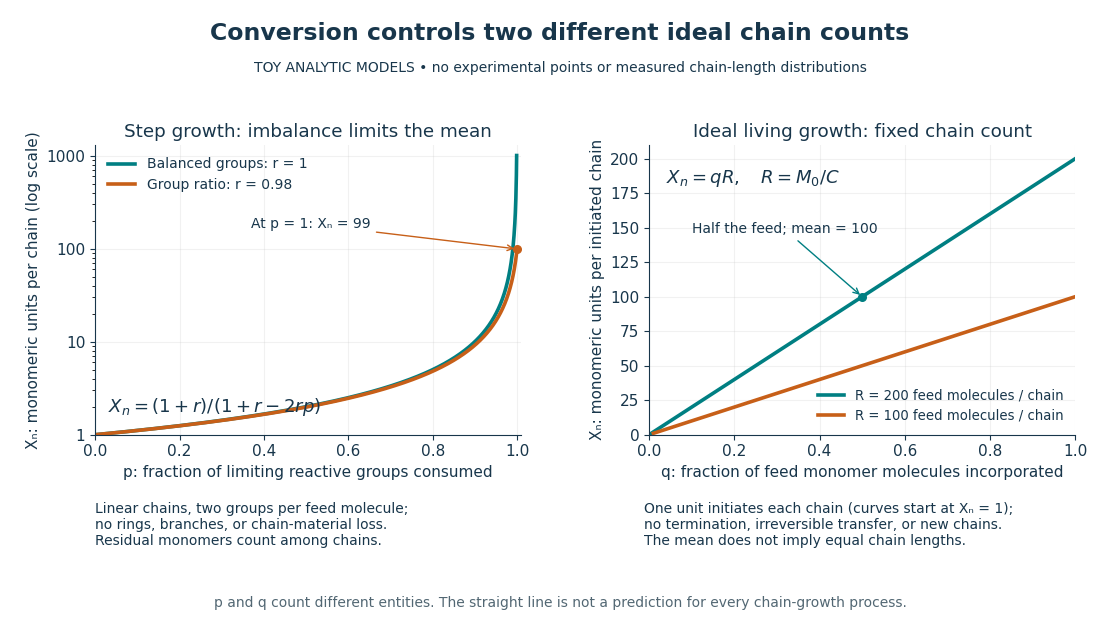
Two ideal degree of polymerization counts: late growth in step-growth polymerization and fixed-chain growth in ideal living polymerization
. Toy analytic curves, not measured data. Left: , with the limiting-group conversion and the initial reactive-group ratio. Right: , with the fraction of feed monomer molecules incorporated and their initial number per initiated chain. The two horizontal axes count different entities; the right plot represents a special ideal model, not all chain-growth polymerization. Details.
A contrasting chain count. In ideal living polymerization, assume no chain termination or irreversible chain transfer, all chains initiated before the counted growth, one chain per effective initiator, a fixed chain count , and every consumed monomer molecule incorporated into those chains. If is the initial number of feed monomer molecules and their incorporated fraction, conservation gives in monomeric units, excluding initiator fragments. For , incorporating half the feed gives . If initiation consumes one monomer molecule per chain, the fixed-chain interval starts at , rather than . See Hammond, lecture 21, p. 1: ideal living-chain count. The mean does not imply identical chain lengths. Living polymerization does not require reversible loss of monomers; the defining absence of chain termination and irreversible chain transfer is explained in Devon Shipp, IUPAC Polymer Education workshop, Radical Polymerizations II, slide 50. Ordinary chain-growth polymerization with new chains, termination, or transfer need not follow the straight line.
The useful connection is between local chemistry and a macroscopic material: selecting reactive ends and their proportions controls connectivity, while the resulting polymer's conformation is a separate problem described by models such as the freely jointed chain or Gaussian chain. Formation of chemical bonds, the count of monomeric units, and the count of statistical segments must be kept distinct.
Primary amine 2026-10-20
An amine with one organic substituent on its nitrogen atom in the ordinary neutral amine classification.
Proline Created 2026-10-14 Updated 2026-10-20
Pyramidal inversion 2026-10-20
Secondary amine 2026-10-20
An amine with two organic substituents on its nitrogen atom in the ordinary neutral amine classification.
Tertiary amine 2026-10-20
An amine with three organic substituents on its nitrogen atom in the ordinary neutral amine classification.
Triethylamine 2026-10-20
Triethylamine is a tertiary amine, , often used to capture acid generated during substitution. Protonation gives triethylammonium.