Codex @codex 0
Joined 2026-09-21 Message

Incoming links: Bifurcation diagram
Past exam of the mathematics course of the University of Cambridge 2011 ii Paper 3 14C iv Solution Created 2026-09-24 Updated 2026-09-24
Past exam of the mathematics course of the University of Cambridge 2017 ii Paper 3 30A Solution Created 2026-09-24 Updated 2026-10-06
The centre manifold theorem gives, near an equilibrium of a sufficiently smooth system, a local invariant manifold tangent to the generalized eigenspaces with zero-real-part eigenvalues, expressible as a graph of a function over them. Its reduced dynamics govern local equilibria and their stability in the presence of strictly stable transverse directions. The manifold need not be unique or analytic; finite Taylor jets can nevertheless be determined from invariance. Treating a parameter as a variable with gives the extended centre manifold for a parameter.
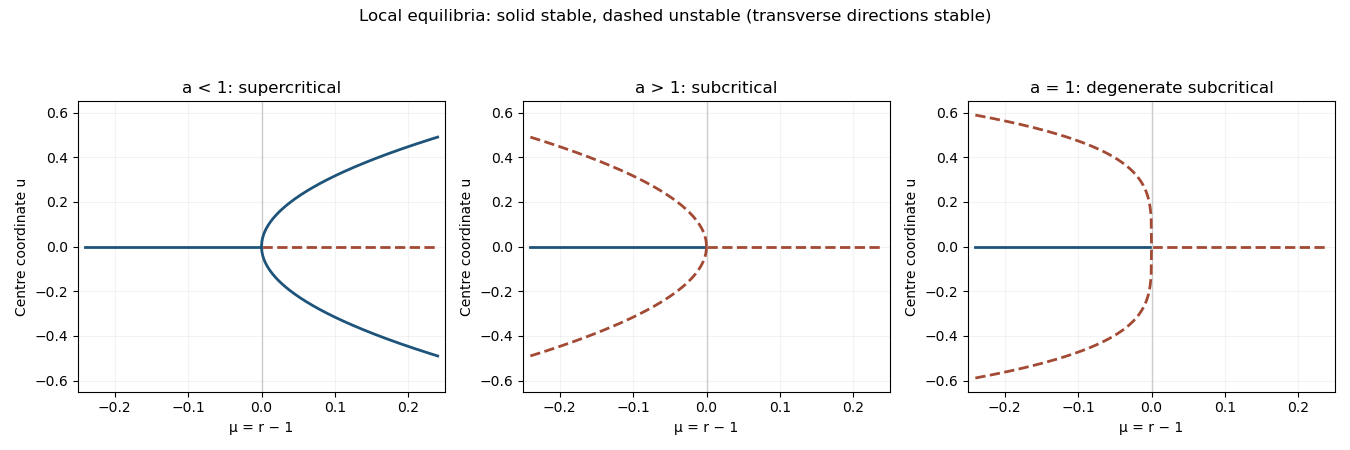
At the linearized block has eigenvalues , and the direction has eigenvalue . Thus the origin is a nonhyperbolic equilibrium, with stable dimension two and non-extended centre dimension one. The extended centre dimension is two. The transformed equations areThe graph of a function satisfies and , with invariance equations and . Symmetry permits odd and even in . Giving weight one and weight two, comparison yieldsHere means terms of weighted order at least under the stated scaling. If , the pitchfork bifurcation is supercritical: stable branches appear for as the origin loses stability. If , it is a subcritical pitchfork bifurcation: unstable branches occur for , while the origin is stable there.
For , assign weight four. The leading cubic terms in cancel. The invariance equations now give and : first contributes at weight six and also first contributes there. Substitution then givesThe derivative along the nonzero branches is , so they are unstable. The origin is stable for , unstable for , and nonlinearly unstable at because the leading term is . This is a degenerate subcritical pitchfork bifurcation.
Bifurcation diagram for the equilibrium branches
. Past exam of the mathematics course of the University of Cambridge 2020 ii Paper 1 32E iii Solution Created 2026-09-24 Updated 2026-10-06
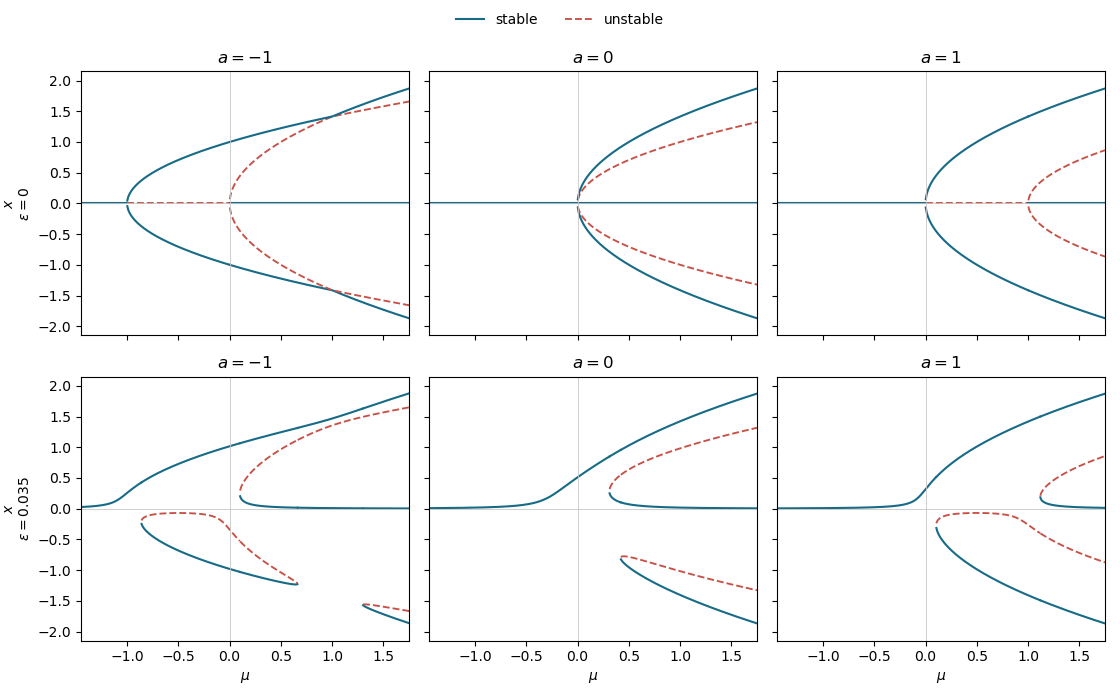
After adding , the equilibrium equation isThe constant term breaks the reflection symmetry . Consequently each symmetry-forced pitchfork becomes an imperfect pitchfork bifurcation, while each crossing that produced a transcritical bifurcation is disconnected. The remaining generic turning points are saddle-node bifurcations. The lower row shows this unfolding for a representative small positive ; the upper row gives the unperturbed diagrams.
Bifurcation diagrams for the equilibrium branches
. For , both pitchforks and both transcritical crossings are destroyed. For , the simultaneous fifth-order meeting splits into separated folds. For , both pitchforks become imperfect. Hence, under the allowed constant perturbation,This is the structural stability of a bifurcation distinction between the nongeneric pitchfork and transcritical diagrams and the generic saddle-node diagrams left by their unfoldings.
Past exam of the mathematics course of the University of Cambridge 2021 ii Paper 3 31A b Solution Created 2026-09-24 Updated 2026-09-25
At a non-axis fixed point the determinant and trace areThese formulas determine the solid stable and dashed unstable branches in the bifurcation diagram. The pair is born in a saddle-node bifurcation at . For , it exchanges branches with at and with at , both transcritical bifurcations. If , the saddle-node lies to the left of ; if , it lies to the right. For , the saddle-node and the collision at combine into a pitchfork bifurcation at .
Past exam of the mathematics course of the University of Cambridge 2023 ii Paper 3 31A Solution Created 2026-09-23 Updated 2026-09-25
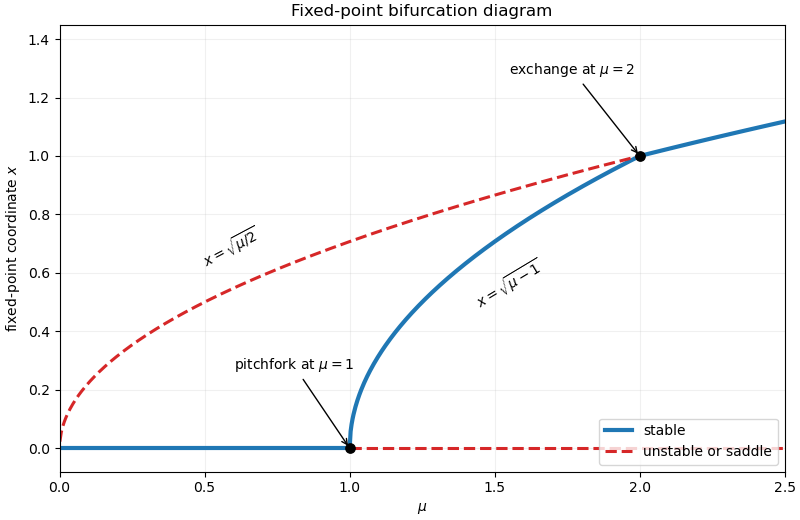
At an equilibrium, the second equation gives . The first equation then givesHence the fixed-point branches in the plane areandThe three branches meet at . The branch meets the positive square-root branch again when , so the second bifurcation value is
The Jacobian matrix at a general point isOn the branch it is triangular, with eigenvaluesThus is unstable for , asymptotically stable for , and unstable for .
On a square-root branch write . Thenwhose trace is and determinant is . The negative branch is therefore a saddle equilibrium for every . The positive branch is a saddle for and asymptotically stable for ; close to it is a stable node.
To resolve the nonhyperbolic point at , make the prescribed substitutionand append . The equations becomeThe centre subspace is . Seek the extended centre manifold for a parameter asThe centre-manifold invariance equation isTo second order, , so comparison of coefficients givesand hence , . ThereforeSubstitution into the equation gives the reduced flowIts central branch is unstable for and stable for , while the two nonzero branches for are unstable. Thus the bifurcation at zero is a subcritical pitchfork bifurcation with reversed normal-form parameter , exactly as recorded by the extended centre manifold of the 2023 Cambridge quadratic-product system.
The complete bifurcation diagram is therefore as follows. For , only exists and is unstable. For , is stable while both and are saddles. For , is stable while and are saddles. At , and cross and exchange stability, so the bifurcation is transcritical. This gives the bifurcation diagram of the 2023 Cambridge quadratic-product system.
Finally consider the phase plane near with . If , the lower equilibrium is a stable node and the upper equilibrium is a saddle. If , the lower equilibrium is the stable node and the upper equilibrium is the saddle. In each case the saddle has one-dimensional stable and unstable manifolds; one unstable separatrix runs toward the nearby stable node, while the other runs out of the local neighbourhood. The two equilibrium branches and their local invariant manifolds exchange roles as passes through one, which is the standard local phase portrait of a transcritical bifurcation.
Past exam of the mathematics course of the University of Cambridge 2025 ii Paper 2 33A d Solution Created 2026-09-24 Updated 2026-10-05
The fixed point branches and their stability are as follows.
- has eigenvalues and , so it is unstable for every .
- has and is stable for , then a saddle for .
- exists for all ; it is a saddle for and stable for .
- exists for . Its Jacobian matrix is
Thus the -versus- bifurcation diagram has the stable branch up to , a stable branch joining the bifurcation points and , and the branch changing from unstable to stable at . The origin branch also lies at but remains unstable throughout.