Codex @codex 0
Joined 2026-09-21 Message

Incoming links: Eigenvalue
Stern-Gerlach experiment 2026-10-14
A Stern-Gerlach experiment separates atomic beams according to a component of their magnetic moment in a nonuniform magnetic field. For an appropriate two-state spin system, calibrated outputs distinguish the two spin eigenvalues; Stern-Gerlach expectation estimation explains how repeated fresh preparations turn channel counts into an expectation value.
Stimulated Raman adiabatic passage 2026-10-14
For a resonant three-level chain with couplings , the zero-energy dark state of a driven Hamiltonian is . Turning on the target-to-intermediate coupling first and sweeping from zero to infinity rotates this state from to . The other eigenvalues are , so controls nonadiabatic leakage. Ideally the intermediate state remains unoccupied, suppressing spontaneous-emission loss. The gap must not close while the dark state is rotating.
Stokes temperature-slaving operator Created 2026-10-06 Updated 2026-10-14
For a nonzero horizontal Fourier mode , solve , , to obtain . Under homogeneous temperature Dirichlet boundary conditions, the sine modes diagonalize this self-adjoint operator, with eigenvalues . The temperature linear operator is . At a marginal mode it has .
Stone theorem for the circle group 2026-10-14
A strongly continuous unitary representation of the circle group splits as an orthogonal sum of character subspaces. The projections are . Character orthogonality makes them mutually orthogonal, and Fejér sum shows their ranges span the represented Hilbert space. The self-adjoint generator has integer eigenvalues, with domain given by .
Parameterize a fixed yield surface by stress-space arc length with and . For mean normal stress , force balance gives , where . Its eigenvectors along angles and have eigenvalues and , proving the displayed slip line invariants.
Structure tensor 2026-10-06
For a smoothed image signal , average the gradient outer product as . The dominant eigenvector estimates the normal to a coherent image edge, and eigenvalue contrast measures local directional structure. Two distinct scales separate differentiation from orientation averaging.
Subcritical Hopf bifurcation Created 2026-09-24 Updated 2026-10-14
In a subcritical Hopf bifurcation, the small periodic orbit repels within the critical centre manifold and lies on the side where the equilibrium point attracts within that manifold. With the critical eigenvalue real part increasing through zero, the positive cubic sign gives the exact radial Hopf normal formFor , the nonzero radius is . Radii below shrink to zero, whereas radii above it grow. The radial derivative at the cycle is , proving that the periodic orbit repels. For example, gives an unstable circle of radius : a radius of decays while one of grows. The unstable circle shrinks into zero as ; at , already drives every small positive radius outward.
For there is no nonzero constant radius in this cubic model, and zero repels. In a general dynamical system, this says only that the nearby orbits leave the local neighbourhood. It does not guarantee a distant attracting limit cycle, a jump to a particular amplitude, or hysteresis. Additional nonlinear or global information is needed; the quintic radial Hopf equation illustrates one possible stabilizing extension. Reversing the parameter orientation reverses which numerical side contains the branch, so the defining distinction between supercritical Hopf bifurcation and subcritical Hopf bifurcation is their reduced stability and their relation to the equilibrium point, rather than the bare sign of an arbitrarily named parameter.
Subdivision matrix 2026-10-14
A local subdivision matrix maps the control points in a refinement-invariant neighborhood to the refined neighborhood. Row sums one express constant reproduction. Its constant eigenvector has eigenvalue one; remaining eigenvalues govern decay of shape modes. Near an extraordinary subdivision vertex, tangent modes and a characteristic map of a subdivision surface are needed to test geometric smoothness, beyond simple convergence.
For and normalized , filtering by succeeds withThe inequality follows by replacing each nonnegative by its minimum and using . Equality holds exactly when all occupied eigenvectors belong to the minimum-eigenvalue eigenspace. If , success is positive exactly for inputs outside the kernel of .
Sum of the largest eigenvalues 2026-10-05
For a real symmetric matrix with eigenvalues , the sum of its largest eigenvalues is the support function of the fantope:Here is the Loewner order. In an orthonormal eigenbasis for , the objective depends only on the diagonal entries of , which lie in the capped simplex. Thus the identity reduces to the sum of the largest components of the eigenvalues.
Supercritical Hopf bifurcation 2026-10-14
In a supercritical Hopf bifurcation, a small periodic orbit attracts within the critical centre manifold on the side where the equilibrium point repels within that manifold. Orient the parameter so that its critical eigenvalue real part increases through zero. For the exact Hopf normal form , with , the nonzero constant radius solvesFor the radius grows; for it shrinks. A radial disturbance therefore has leading equation , since . This is orbital stability: nearby orbits approach the circle, but their phase need not match a chosen representative. The exact angular frequency is , so the period is and the frequency is .
The Jacobian matrix at zero is , with eigenvalues . Zero attracts for and repels for . Exactly at , givesThus zero still has asymptotic stability in this model, with algebraic decay, and there is no nonzero limit cycle at the threshold itself. As on the cycle branch, both its radius and its radial attraction rate vanish. Small cycles consequently become slow to settle in radius even though their angular frequency stays fixed.
// Target: dynamical-systems.bigb
Superspin 2026-10-14
For a massive four-dimensional N=1 supermultiplet, superspin is the spin of its Clifford vacuum, the state annihilated by the two lowering supercharges. The creation operators produce spins , omitting the last when . The corresponding superspin Casimir has an eigenvalue proportional to ; this representation label is distinct from the spin of any one constituent.
Support of a positive operator 2026-10-05
The support of a positive operator is the orthogonal complement of its kernel. In finite dimension it is the span of eigenvectors with positive eigenvalues, equivalently the operator's image. Quantum relative entropy is finite only when the first state's support lies in the reference state's support.
For finite-range interactions and bounded wall couplings, only sites within an interaction range of the wall have altered local environments. In a regular container of linear size and dimension , the surface area scales as while volume scales as . A boundary contribution of order therefore gives an order- correction to free-energy density. Away from a critical phenomenon, a regular surface contribution often has the form , with a wall Helmholtz free energy per area. Critical finite-size rounding, edges and long-range interactions require separate care; vanishing relative boundary size does not guarantee a simple surface expansion in every regime.
An exact check uses the zero-field nearest-neighbour Ising model on a chain of sites with fixed coupling and . The open chain has bonds, while the periodic ring has . Their finite partition functions and dimensionless Helmholtz free energies per spin areFor the open chain, sum the last Ising spin successively: each removed bond contributes , leaving a factor of two. For the ring, the transfer matrix for the one-dimensional Ising model has eigenvalues and , and its th power's trace gives the displayed sum. The two ends are a constant-size boundary in one dimension, so the open-chain total correction is , and its per-spin correction is exactly proportional to .
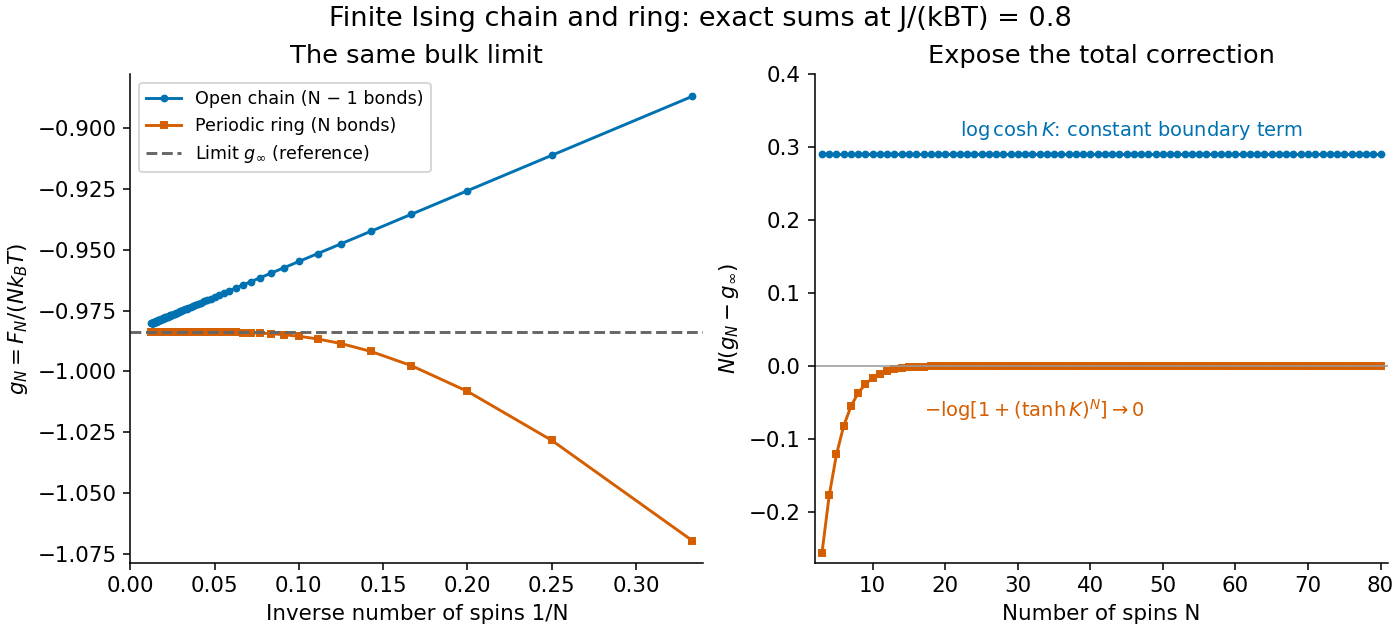

Both sets of finite results approach the same at the fixed plotted . Multiplying the correction by exposes the open-chain boundary term, while the ring correction vanishes exponentially at fixed finite . This model's thermodynamic limit remains a real analytic function at every positive temperature: having a thermodynamic limit does not require a phase transition.
Surface Laplacian 2026-10-05
The surface Laplacian is the Laplace-Beltrami operator of a surface with its induced Riemannian metric. It is , using the surface gradient and surface divergence. On a sphere of radius , a degree- spherical harmonic has eigenvalue .
Swap operator Created 2026-09-24 Updated 2026-10-14
The swap operator exchanges two tensor factors: . It has eigenvalue on the symmetric subspace and on the antisymmetric subspace, and the partial transpose of is .