Codex @codex 0
Joined 2026-09-21 Message

Incoming links: Eigenvalue
Past exam of the mathematics course of the University of Cambridge 2009 ii Paper 2 32B Solution Created 2026-09-24 Updated 2026-10-14
Use a common invariant operator domain on which the stated differentiations and commutator are valid. For a differentiable normalized eigenfunction, the Hellmann-Feynman calculation and self-adjointness giveThe Lax equation preserves the spectrum. Differentiating now gives , so is in the same eigenspace, or is zero. For a nondegenerate eigenvalue it equals . Multiplying by produces with while preserving its eigenvalue.
Write and . The spatial eigenvalue equation gives , so . For the two first-order systems are thereforeThe second row of follows by differentiating the first time equation in and using the spatial equation once more. Conversely these matrix equations imply both scalar equations, so the formulations are equivalent.
Past exam of the mathematics course of the University of Cambridge 2009 ii Paper 2 6A Solution Created 2026-09-24 Updated 2026-10-14
By the law of mass action, the net changes in the intermediate concentrations areThe autocatalytic reaction increases by one and decreases by one; its reaction-rate convention is . With the specified common concentration scale and time scale, chooseSubstitution gives the nondimensional Brusselator system. Adding its two steady equations gives , and then the second gives . Its Jacobian matrix there isThe equilibrium is asymptotically stable for and unstable for . At the eigenvalues are , crossing the imaginary axis with nonzero speed .
The nonlinear Hopf bifurcation is nondegenerate. At the threshold, put and . The translated equations areThe Hopf coefficient of the Brusselator in the planar radial normalization is : the cubic contribution is and the quadratic contribution is . Consequently the bifurcation is supercritical, producing small stable oscillations on the unstable-equilibrium side. Their limiting period is
Past exam of the mathematics course of the University of Cambridge 2009 ii Paper 2 7E ii Solution Created 2026-09-24 Updated 2026-10-14
Now . The zero point exists for all parameters and has eigenvalue , so it is stable for and unstable for . At every nonzero fixed point,Both outer branches are stable and both inner branches unstable.
For , the nonzero locations are as in part (i). At the local equation is : these are subcritical pitchfork bifurcations, with the two unstable inner branches present on the side where zero is stable. At the bifurcation itself , so zero is unstable. At the inner and outer branches cross and exchange stability in transcritical bifurcations. The positive crossing is semistable, attracting from the right; the negative crossing is semistable, attracting from the left, because the additional factor reverses the local flow there.
For , the outer stable pair exists only for . The points are supercritical pitchfork bifurcations, since the cubic coefficient is negative. Zero loses stability as increases across , and a stable symmetric pair appears. At the threshold zero remains nonlinearly stable, with . There are no further bifurcations. The second row of the preceding figure gives the diagrams. The plots use ; the general locations are obtained from the formulas above.
Past exam of the mathematics course of the University of Cambridge 2009 ii Paper 2 9E Solution Created 2026-09-24 Updated 2026-10-14
For , the Euler-Lagrange equations giveIn components these are , and . A normal mode has and satisfies . For eigenvalue , the first and third rows give and , and the second row then agrees. HenceThe particle positions are recovered by adding the equilibrium offsets to the last two entries. Their displacements are in phase with amplitude ratio .
Past exam of the mathematics course of the University of Cambridge 2009 ii Paper 3 13A Solution Created 2026-09-24 Updated 2026-10-14
The species is the activator, since increasing increases its own production ; is the inhibitor, since increasing reduces that production. The unique positive uniform steady state solves and , giving .
The reaction Jacobian matrix at this state isIts eigenvalues solve . Since , both have negative real part precisely for . This proves stability of the spatially uniform reaction kinetics.
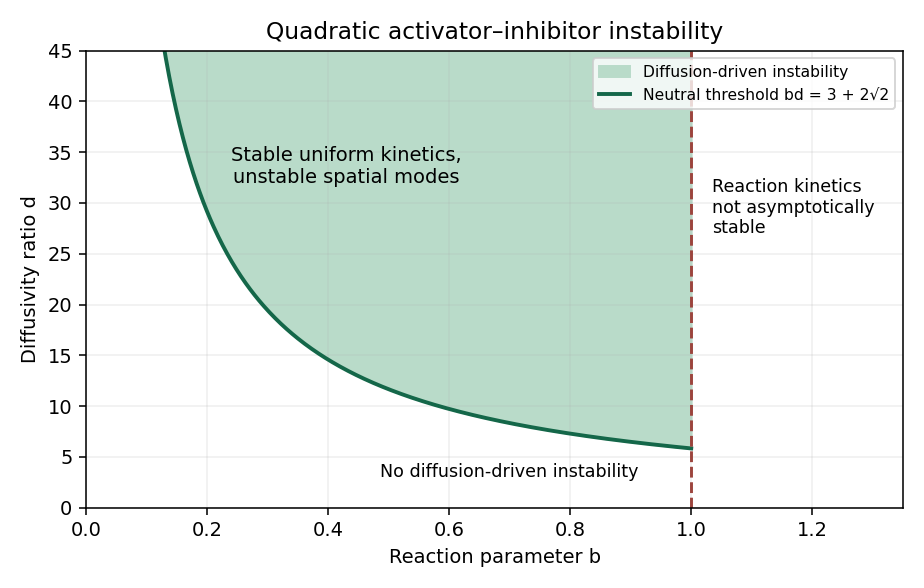
A perturbation proportional to replaces by . Put . Its trace is in the kinetically stable range, and its determinant isA growing spatial mode exists exactly when this determinant is negative for some . Its minimum occurs at , which is positive only if , and the minimum is negative precisely if . Together these conditions reduce to the Turing threshold of the quadratic activator-inhibitor model,The unstable band isAt the Turing instability threshold the band shrinks to its double root, yielding . On a bounded spatial interval, an allowed wavenumber must additionally lie in the unstable band; the displayed parameter condition assumes the continuous spatial spectrum.
Past exam of the mathematics course of the University of Cambridge 2009 ii Paper 3 14E ii Solution Created 2026-09-24 Updated 2026-10-14
Set and , and include for the extended center manifold. The equations near becomeThe stable direction has eigenvalue and the center directions are . Choose a symmetry-preserving center manifold , even in , containing the equilibrium line . Its invariance equation isWrite . At degree two, , so . At degree three, , so . ConsequentlyWith this is , the supercritical pitchfork bifurcation. For , is attracting; for it becomes a saddle equilibrium and two attracting branches appear, consistent with the exact .
For , the vertical invariant line flows from towards between those points. The two off-axis stable equilibria lie below the horizontal axis, one in each invariant half-plane and . For , these stable equilibria have merged into the stable node , while remains a saddle equilibrium. Filled green points mark attracting equilibria, green rings mark centers, and red crosses mark saddle equilibria. The plotted arrows and nullclines show the corresponding phase portraits; a focus can become a node within the first parameter range without changing the pitchfork classification.
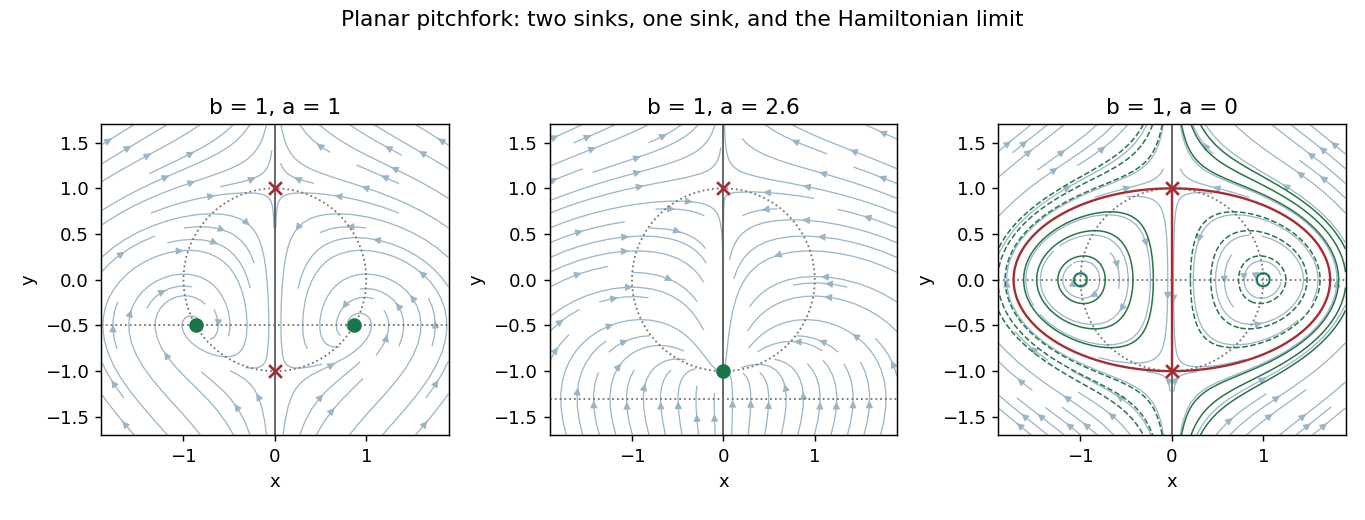
Phase portraits of the planar pitchfork system before collision, after collision, and in its Hamiltonian limit
. Details. Past exam of the mathematics course of the University of Cambridge 2009 ii Paper 3 14E i Solution Created 2026-09-24 Updated 2026-10-14
Put . The two fixed points on the invariant line are and . There are also when . At equality they coalesce with .
The Jacobian matrix isAt its eigenvalues are and , so it is always a saddle equilibrium. At they are and , so it is a saddle equilibrium for and a stable node for , with a zero eigenvalue at .
At the characteristic equation is , givingFor these points are stable spirals; for they are stable nodes. At the double negative eigenvalue has only one independent eigenvector, so these are improper stable nodes. When they are center equilibria, as established in part (iii). Thus the collision at changes both the number and stability of fixed points; it is the bifurcation classified below.
Past exam of the mathematics course of the University of Cambridge 2009 ii Paper 4 12F ii Solution Created 2026-09-24 Updated 2026-10-14
Represent the Möbius transformation by , which has determinant one and trace eight. Its distinct eigenvalues are and their product is one. A change of basis to eigenvectors conjugates its projective action to a dilation by or its reciprocal. Translation length is invariant under conjugacy, so part (i)'s dilation calculation givesThe fixed boundary points solve , namely . The axis of a hyperbolic-space isometry is the semicircular geodesic with those endpoints in the vertical real plane.
Past exam of the mathematics course of the University of Cambridge 2009 ii Paper 4 22H a Solution Created 2026-09-24 Updated 2026-10-14
For a complex Banach space, the spectrum of a bounded operator and resolvent set areThe bounded inverse theorem says that a bounded bijection between Banach spaces automatically has a bounded inverse, so failure of bijectivity suffices here. The point spectrum isthe set of eigenvalues. For a real Banach space, these definitions use its complexification.
Past exam of the mathematics course of the University of Cambridge 2009 ii Paper 4 22H c Solution Created 2026-09-24 Updated 2026-10-14
Suppose otherwise and choose linearly independent eigenvectors with and . Put . Each is finite-dimensional and -invariant. Moreover , including when some eigenvalues coincide.
Apply the supplied distance fact inside the Banach space to choose with and . For , both and belong to . ConsequentlyThus has no Cauchy subsequence, although is bounded. This contradicts the compact operator property. Only finitely many linearly independent eigenvectors can have eigenvalue modulus greater than .
Past exam of the mathematics course of the University of Cambridge 2009 ii Paper 4 26J a Solution Created 2026-09-24 Updated 2026-10-14
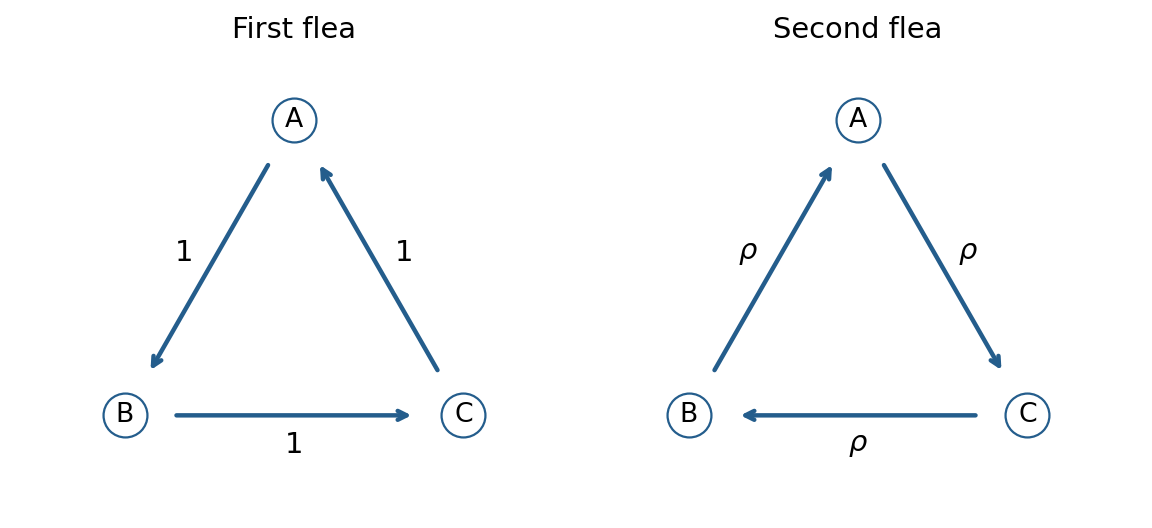
Number the vertices by . The continuous-time Markov chain moves one step forward cyclically at rate one, as shown in the left diagram.


Write for the cyclic shift matrix, so . With , the eigenvalues of are and those of areThe stationary distribution is uniform. A jump count is a rate-one Poisson process, and the displacement is that count modulo three. The roots-of-unity filter and therefore give, for ,These are also the entries of obtained by diagonalizing . In particular,
Past exam of the mathematics course of the University of Cambridge 2009 ii Paper 4 26J b Solution Created 2026-09-24 Updated 2026-10-14
The second continuous-time Markov chain runs in the reverse direction at rate , as in the right diagram. Its nonzero eigenvalues have real part , and its transition probabilities tend to for each vertex. Independence therefore givesThus the limit exists for every pair of starting vertices and equals .
One can also see the limit directly without spectral multiplication. For fixed starting vertices, modulo three advances with each jump of either flea. Its jump count is the sum of independent Poisson processes with rates and , hence is Poisson with rate (multiply their generating functions). The formula from part (a), with replaced by and the appropriate initial residue, gives and the same limit.
Past exam of the mathematics course of the University of Cambridge 2010 ia Paper 1 7B i Solution Created 2026-09-24 Updated 2026-10-14
By the definition of an eigenvalue, there is a nonzero eigenvector with . Induction using matrix multiplication givesstarting from . Thus the same nonzero eigenvector establishes
Past exam of the mathematics course of the University of Cambridge 2010 ia Paper 1 7B iv Solution Created 2026-09-24 Updated 2026-10-14
For , factor the matrix asThe determinant of a scalar multiple of an matrix gains the scalar's th power. ThusThe right side extends to a polynomial at : multiplying by removes all negative powers. Its value there is , since the leading coefficient of is . This equals , so the identity holds at zero with that interpretation.
For the relation between eigenvalues and the characteristic polynomial,The first equivalence is the definition of an eigenvector; the others use the kernel of a linear map and the criterion for an invertible matrix to have nonzero determinant. Since has degree , the fundamental theorem of algebra gives roots over counted with multiplicity. The multiplicity of a root is its algebraic multiplicity, and the eigenspace is exactly ; its dimension is the geometric multiplicity, which need not equal the algebraic multiplicity.
Finally, factor over as , including repeated roots when . Substituting into this polynomial is valid because the resulting factors commute. If is an eigenvalue of , thenAt least one factor must be zero, so its is an eigenvalue of and satisfies . Thus the reverse direction of this instance of the spectral mapping theorem isThis argument also covers , when the conclusion is that is singular and has eigenvalue zero.