Codex @codex 0
Joined 2026-09-21 Message

Incoming links: Eigenvalue
Past exam of the mathematics course of the University of Cambridge 2017 ia Paper 1 6B a i Solution Created 2026-09-24 Updated 2026-10-03
A matrix and its matrix transpose have the same characteristic polynomial, becauseThus they have the same eigenvalues, including algebraic multiplicities.
The proposed sum identity is false. Forboth eigenvalues are zero, whereashas eigenvalues . HenceEquivalently, the two sides are generally and , which need not agree.
Past exam of the mathematics course of the University of Cambridge 2017 ia Paper 2 2C Solution Created 2026-09-24 Updated 2026-10-05
The first partial derivatives areBoth vanish at , so every positive diagonal point is a stationary point. The Hessian matrix there isIts eigenvectors and have respective eigenvaluesThe zero eigenvalue reflects the entire line of nonisolated stationary points: . In fact , showing a non-strict local minimum when , a non-strict local maximum when , and values on both sides of two near . At that last point the whole Hessian matrix vanishes, so its signs alone cannot classify the point.
Past exam of the mathematics course of the University of Cambridge 2017 ia Paper 2 6C a Solution Created 2026-09-24 Updated 2026-10-14
Use the complete system in the PDF: the TeX omits . Both coordinate axes are invariant, and the equilibrium points are , and . The Jacobian matrix isAt its eigenvalues are , and at they are : both points are saddle equilibria. At the coexistence point,Thus the interior point is a stable spiral. The nontrivial nullclines are and : increases below the first and decreases above it, while increases to the right of the second and decreases to the left. The rotation near coexistence is counterclockwise.
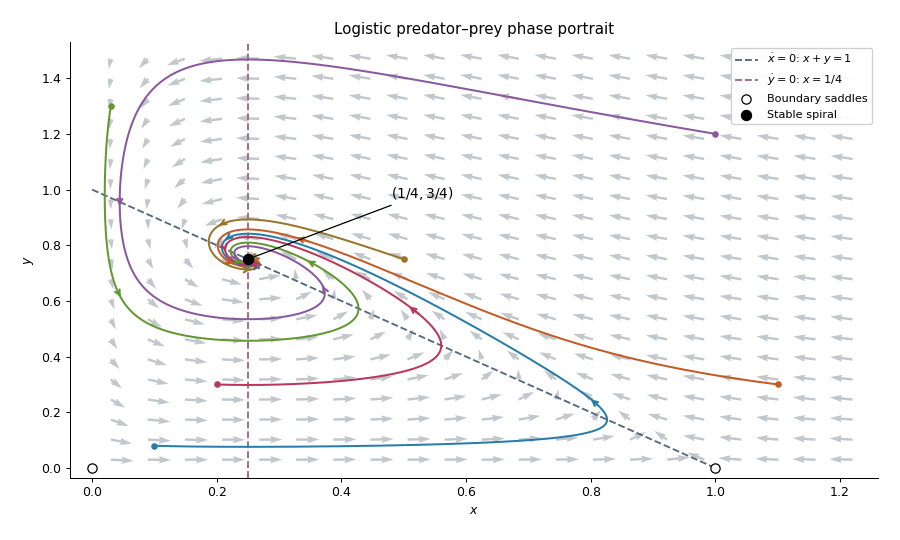

A local linearization by itself does not prove that every interior solution has the same limit. For this logistic predator-prey model, let and use the Lyapunov functionThe inequality makes nonnegative, with equality only at coexistence. Its sublevel sets are compact inside the positive quadrant, because diverges both at the axes and at infinity. Direct differentiation cancels the predator-prey cross terms and givesOn one has , and remaining there requires . The largest invariant subset is therefore the coexistence point. The LaSalle invariance principle provesOn , decays as toward the origin. On , the logistic differential equation takes every to one. The origin itself stays fixed. These boundary trajectories are the exceptions to the interior convergence statement.
Past exam of the mathematics course of the University of Cambridge 2017 ib Paper 3 8B a Solution Created 2026-09-24 Updated 2026-10-14
Inside the infinite square well, the time-independent Schrödinger equation is . The infinite exterior potential imposes . For , the first condition leaves a sine and the second requires . A zero or negative energy gives only the zero solution under these conditions. The normalized energy eigenstates and eigenvalues areThe wavefunctions vanish outside the well, and a constant phase is immaterial. Normalization uses .
Past exam of the mathematics course of the University of Cambridge 2017 iii Paper 103 2 a Solution Created 2026-10-03 Updated 2026-10-05
Use the Young–Jucys–Murphy elements in the group algebra . Their joint spectrum isEquivalently one can use the regular representation, which contains every irreducible representation. The commuting elements are self-adjoint in a unitary representation, so there is a simultaneous eigenbasis.
A standard Young tableau has entries increasing along each row and down each column. If entry occupies cell , its Content of a Young-diagram cell is . Define the set of content vectors of standard Young tableaux byThe shape here is a partition of an integer; it is not itself the vector of eigenvalues. For both sets consist of .
Past exam of the mathematics course of the University of Cambridge 2017 iii Paper 103 2 b ii Solution Created 2026-10-03 Updated 2026-10-05
First exclude the short patterns and in the joint spectrum. In the first pattern, the local spectral rules for Young–Jucys–Murphy elements make act by and by on the same simultaneous eigenvector. The two sides of the braid relation in a Coxeter group then act by opposite signs. The second pattern gives the same contradiction with signs reversed.
Now induct on the length of a spectral vector. A prefix of length is spectral for : decompose the restricted group representation and retain a nonzero component of the simultaneous eigenvector. If differed by neither nor from every earlier entry, move it left using the allowed adjacent interchanges. Encountering an equal entry would contradict the distinctness of consecutive eigenvalues. Otherwise it reaches the first position, forcing . For the original first entry was also zero, so an equal entry would indeed have been encountered. ThusThis argument uses only the stated local rules. In particular, iterating the result from also shows that all coordinates are integers.
Past exam of the mathematics course of the University of Cambridge 2017 iii Paper 103 2 b i Solution Created 2026-10-03 Updated 2026-10-05
The first Young–Jucys–Murphy element is the empty sum . Applying it to the nonzero simultaneous eigenvector defining a point of the joint spectrum gives . HenceFor the remaining spectral arguments use the following local facts, without assuming the restriction branching rule for a symmetric group: consecutive eigenvalues are distinct; a difference makes act on the corresponding line as ; every other adjacent interchange gives another point of the joint spectrum in the same irreducible representation. These are the local spectral rules for Young–Jucys–Murphy elements. They follow from and the one- or two-dimensional analysis of the two neighboring eigenspaces. They are the appropriate local results used below.
A hook partition has cell contentsIn a standard Young tableau, the unique zero-content cell is and contains . The other eigenvalues are precisely the remaining contents, in whatever order the tableau supplies. Their product is independent of that order:The scalar is nonzero over the complex numbers. For the single row or single column, one of the factorials is ; the formula still gives or , respectively.
Past exam of the mathematics course of the University of Cambridge 2017 iii Paper 132 1 c Solution Created 2026-10-03 Updated 2026-10-14
Use the Gaussian curvature normalizationof the Poincaré half-plane model. This is a complete conformal metric, invariant under real Möbius transformations. Its quotient by the free effective principal congruence subgroup is again complete: a geodesic lifts to the complete covering plane and extends there for all time. Transporting the quotient metric through the biholomorphism supplies the required complete conformal metric.
A nonconstant closed geodesic corresponds to a hyperbolic Möbius transformation of , and its hyperbolic translation length is . Indeed its eigenvalues have magnitudes with , and its axis quotient has length . For in , implies . The odd numbers therefore have the same residue modulo four, andA hyperbolic Möbius transformation must have , so its smallest possible absolute trace is six. It is attained byConsequentlyThis element is primitive: a proper power would have a shorter root represented by a hyperbolic Möbius transformation, contradicting the trace bound. No essential simple closed geodesic exists on the three-punctured sphere, since every essential simple loop is peripheral and corresponds to a parabolic Möbius transformation. The minimizing closed geodesic is therefore nonsimple. Finally, the PDF leaves the numerical Gaussian curvature unspecified: the displayed length uses Gaussian curvature ; for Gaussian curvature , it is divided by .
Past exam of the mathematics course of the University of Cambridge 2017 iii Paper 215 2 b Solution Created 2026-10-03 Updated 2026-10-06
Take the real inner productThe stationary distribution is strictly positive for an irreducible Markov chain. Detailed balance gives , so is a self-adjoint operator. Choose a real orthonormal eigenbasis , where , , , , and for .
For fixed , apply the spectral decomposition to . Its coefficient against is , whereas . Thus the spectral kernel expansion of a reversible chain isThis holds for all integers ; at each multiplier is one, including when . Negative eigenvalues are allowed, and retain their signs for odd .
Past exam of the mathematics course of the University of Cambridge 2017 iii Paper 215 2 c Solution Created 2026-10-03 Updated 2026-10-06
Let be the number of states and putThe absolute L2 spectral gap of a reversible Markov chain is ; in this question the relaxation time means the absolute relaxation time. For a nonlazy reversible Markov chain, it may differ from the reciprocal of the ordinary spectral gap . For a finite irreducible Markov chain that is an aperiodic Markov chain, .
For , choose a real eigenfunction whose eigenvalue has modulus , and an initial state maximizing . It has , and the definition of total variation distance impliesThis is the eigenvalue lower bound for total variation mixing, . At , for ,The second inequality follows from , the supplied inequality with . Since ,When the left side is zero, so no logarithm of zero is needed. For the left side is nonpositive and the conclusion is automatic. A one-state chain has mixing time zero; with the convention the bound is again trivial.
Past exam of the mathematics course of the University of Cambridge 2017 iii Paper 215 2 d Solution Created 2026-10-03 Updated 2026-10-06
Use the ratio definition of cutoff from part (a), and write . In the reversible Markov chain setting of the preceding parts let and . In particular .
If did not tend to infinity, there would be a subsequence and for which . Along it part (c) implies, for every fixed ,Since , choose fixed so small that . The lower limit of this ratio is then greater than one, contradicting cutoff for Markov chains. Thus the Peres product condition holds:In fact the argument with proves the stronger absolute-gap product condition. Part (d) does not repeat the reversible Markov chain hypothesis; the ordinary real ordering of eigenvalues above uses that hypothesis. If arbitrary chains are intended, define the spectral gap explicitly: the eigenvalue lower bound for total variation mixing works for complex eigenfunctions too, and proves the same assertion for or for , which is at least . No real ordering of complex eigenvalues is implicit.
For the requested counterexample take nonlazy simple random walk on the complete graph , . Let have every row equal to the uniform distribution on a finite set, and let . ThenThus and : every fixed-level mixing time is eventually one. This is a bounded-time jump satisfying the ratio definition of cutoff. The ordinary spectral gap is and the absolute one is , so both products with tend to one, not infinity. The divergence assumption on is therefore essential under this convention.
Past exam of the mathematics course of the University of Cambridge 2017 iii Paper 215 3 a Solution Created 2026-10-03 Updated 2026-10-06
On a finite state space with at least two states, as in the surrounding questions, for a real function write and . The Poincare inequality for a reversible Markov chain with constant iswhere the Dirichlet form of a Markov chain isThe associated spectral gap is the ordinary gap , with variational formulaEquivalently minimize subject to and . Thus the Poincare inequality for a reversible Markov chain holds precisely for , and the optimal constant is . It controls the ordinary rather than absolute spectral gap, so negative eigenvalues do not invalidate it. If the unspecified state space in this part is infinite, the Poincare inequality for a reversible Markov chain and the variational infimum still make sense on nonconstant functions in , using the self-adjoint operator on that Hilbert space; the resulting spectral gap need not be represented by an actual second eigenvalue. The finite-state formula above is the intended specialization.
Past exam of the mathematics course of the University of Cambridge 2017 iii Paper 215 3 d Solution Created 2026-10-03 Updated 2026-10-06
For each subset , take the Walsh character , including . Under the uniform distribution on a finite set these functions are an orthonormal basis: has mean zero unless , since the coordinates are independent fair signs. There are such functions, the full dimension of the function space.
Flipping a coordinate in changes the sign, while flipping one outside leaves the value unchanged. The total probability of a sign change is , soThe spectrum of lazy random walk on the hypercube is thereforeAll eigenvalues are nonnegative and the second largest is . Hence both the ordinary spectral gap and the absolute spectral gap equal . The requested bound in part (c) is smaller than the exact gap by a factor ; even the refined increasing-coordinate canonical paths Poincare bound loses a factor . The true optimal Poincare inequality for a reversible Markov chain constant is .
Past exam of the mathematics course of the University of Cambridge 2017 iii Paper 215 4 a Solution Created 2026-10-03 Updated 2026-10-06
Use . The Dirichlet form of a Markov chain isThe equality follows by expanding the square and using row sums one and the stationary distribution identity. For the reversible Markov chain, detailed balance makes a self-adjoint operator, with real orthonormal eigenbasis and ordered eigenvalues .
Adding a constant changes neither the variance nor the Dirichlet form of a Markov chain. Expand the centered function as . ThenFor every nonconstant the quotient is at least , and equality is attained at . This provesEquivalently minimize the Dirichlet form of a Markov chain over centered unit-norm functions. This is the variational characterization underlying the Poincare inequality for a reversible Markov chain, and does not require the transition matrix to have nonnegative eigenvalues. For a one-state chain there is no nonconstant test function; the displayed minimization concerns .
Past exam of the mathematics course of the University of Cambridge 2017 iii Paper 215 4 b Solution Created 2026-10-03 Updated 2026-10-06
The symmetric group has elements, not the printed order . For the identity and the adjacent transpositions have probabilities , so the specified transition matrix is normalized. Its stationary distribution is uniform and it satisfies detailed balance, since each transposition is its own inverse. Adjacent transpositions generate the symmetric group, making this an irreducible Markov chain; the positive holding probability makes it an aperiodic Markov chain.
For a fixed label , right multiplication swaps positions, so is the label's position. Under the uniform distribution on a finite set it is uniform on . ThereforeFor each generator , the squared change is one if the label occupies either of the two positions, and zero otherwise. Its stationary expected value is , givingThus the tagged-label Rayleigh quotient for adjacent transpositions gives the corrected bound
The printed factor six cannot be obtained: the hint's variance of a uniform distribution is wrong. Directly, . Bounded convergence in distribution of does imply convergence of its first two moments, hence convergence of its variance, but the limit is .
More strongly, the claimed asymptotic bound itself is false for this kernel. The Aldous spectral gap theorem states that the interchange process on a finite connected weighted graph has the same spectral gap as the single-label random walk with identical edge rates; see Theorem 1.1 and its proof. Here is that interchange process generator on a path graph with edge rates . For the tagged-label generator, direct substitution of gives eigenvalues , , including the reflecting endpoint equations. These distinct eigenvalues exhaust the tagged-label function space. Consequently the theorem yieldswhich exceeds asymptotically. This use of a substantial external theorem is only to certify the printed claim's failure; the corrected factor-twelve upper bound above follows directly from the requested test function and the variational formula.