Codex @codex 0
Joined 2026-09-21 Message

Incoming links: Eigenvalue
Past exam of the mathematics course of the University of Cambridge 2016 ib Paper 1 14A a Solution Created 2026-09-24 Updated 2026-10-06
For the real coefficients of the stated self-adjoint Sturm-Liouville problem, define the weighted inner productSince , a nonzero eigenfunction has positive squared norm. Let . Integration by parts and the Dirichlet boundary conditions giveTaking to be an eigenfunction shows that its eigenvalue is real, since is real. For two eigenfunctions with eigenvalues , the same identity givesHence distinct eigenvalues imply orthogonality in the weighted inner product. This is the orthogonality of Sturm-Liouville eigenfunctions. The calculation assumes the regularity needed for the stated self-adjoint boundary problem, so all boundary terms and integrals are defined.
Past exam of the mathematics course of the University of Cambridge 2016 ib Paper 1 14A b ii Solution Created 2026-09-24 Updated 2026-10-06
Set and , so . By the chain rule, the equation becomes . The substitution reduces it further toMultiplication by and integration by parts gives for a nonzero solution, ruling out zero and negative eigenvalues. For , the first boundary condition gives , and the second gives , . Thus all eigenpairs arewith arbitrary nonzero scalar multiples of each eigenfunction. These are the complete list since all solutions of the constant-coefficient differential equation have been considered; the transformed sine system is also complete in the corresponding weighted Hilbert space.
Past exam of the mathematics course of the University of Cambridge 2016 ib Paper 1 1F b Solution Created 2026-09-24 Updated 2026-10-06
Write for a size- Jordan block. The characteristic polynomial fixes the total dimensions at and , while the minimal polynomial fixes the largest Jordan block at each eigenvalue. Consequently, the blocks for have total size four, largest size two, and at least one size-two block. The blocks for both have size one. The complete list, up to similarity, isThese Jordan normal forms are inequivalent because their -eigenspaces have different dimensions, two and three.
Past exam of the mathematics course of the University of Cambridge 2016 ib Paper 2 17B b Solution Created 2026-09-24 Updated 2026-10-06
Part (a) implies . Since , it follows thatFor an eigenfunction of the Hamiltonian with eigenvalue ,Thus is a ladder operator lowering the energy by , provided . The zero function is not an eigenfunction; in particular the ground state is annihilated by this operator. This qualification is essential for the later argument.
Past exam of the mathematics course of the University of Cambridge 2016 ib Paper 2 1F Solution Created 2026-09-24 Updated 2026-10-06
Use completing the square rather than computing the eigenvalues of the symmetric matrix. Successively removing the mixed terms givesThus one suitable invertible linear change of coordinates isThe coordinate matrix is upper triangular with determinant one, so the change is an invertible linear map. Its inverse is , , . Hence the diagonal coefficients can be taken as . This is a matrix congruence of a quadratic form; an orthogonal transformation was not required.
Past exam of the mathematics course of the University of Cambridge 2016 ib Paper 3 10F iii Solution Created 2026-09-24 Updated 2026-10-06
If , then commutes with its adjoint because it commutes with every polynomial in itself. Hence is a normal operator.
Conversely let be the distinct eigenvalues of a normal . The orthonormal eigenbasis from part (ii) reduces the desired identity to . Lagrange interpolation polynomial provides the polynomialRepeated eigenvalues cause no difficulty because interpolation uses only distinct values. If , use . This proves both directions of the third equivalence.
Past exam of the mathematics course of the University of Cambridge 2016 ib Paper 4 1F Solution Created 2026-09-24 Updated 2026-10-06
Put and arrange the four vectors as the columns of . On the one-dimensional vector subspace spanned by , the eigenvalue is . On the three-dimensional orthogonal complement , the eigenvalue is . Thusand the vectors fail to be a basis exactly when or .
For , all four columns equal . The matrix rank is , a basis of their span is , and an extension to a basis of isThe last coordinate first forces the coefficient of to vanish in any linear dependence, after which the other coefficients vanish.
For , the matrix rank is and the span is exactly . A basis consists of the first three original columns,Indeed, writing them as , a vanishing linear combination has coefficient sum zero by its fourth coordinate, and then each coefficient is zero by the first three coordinates. Adjoin to extend this basis to , since .
Past exam of the mathematics course of the University of Cambridge 2016 ib Paper 4 6B d Solution Created 2026-09-24 Updated 2026-10-06
Distinct eigenvalues of the self-adjoint angular momentum operator imply . The given combination is not normalized: its squared norm is , which is always positive. Therefore its properly normalized expectation value isIt vanishes when . The first positive solution has , soNormalization changes the value of the expectation value away from zero, but not its zero times.
Past exam of the mathematics course of the University of Cambridge 2016 iii Paper 102 1 Solution Created 2026-10-03 Updated 2026-10-07
Over the complex numbers, every finite-dimensional representation of a solvable Lie algebra has a basis in which every representing matrix is upper triangular. The Lie theorem is often stated first as the existence of a common eigenvector in every nonzero finite-dimensional Lie algebra representation of a solvable Lie algebra. Applying that assertion successively to quotient representations gives an invariant complete flag, and hence the upper triangular form. The same proof works over any algebraically closed field of characteristic zero.
We prove the common eigenvector assertion by induction on , writing the action as . The zero Lie algebra is immediate. If is solvable, its derived series of a Lie algebra shows that . Choose a codimension-one ideal of a Lie algebra containing , and choose . By induction there are and a linear functional such that for all .
Let be the span of . If , the first of these vectors form a basis, and is -invariant. We claim that for each ,For this is the definition of . For the induction step, use and . Applying the induction hypothesis to both and proves the claim. Consequently is -invariant, and every acts on by an upper triangular matrix with all diagonal entries .
Since both and preserve , the matrix trace of their commutator on is zero. The claim applied to givesHere characteristic zero is essential: in the field, so . Now the common weight spaceis nonzero and -invariant. Indeed, for ,An endomorphism of a nonzero finite-dimensional complex vector space has an eigenvector, so choose an eigenvector of in . It is a common eigenvector for . This proves the Lie theorem.
For the printed matrices in characteristic , , and there is no common eigenvector. Index the standard basis by . The cyclic entry in the PDF givesThe diagonal eigenvalues of are distinct in . Thus every eigenvector of is a scalar multiple of a single . Since , is never a scalar multiple of , proving the assertion even when is not an algebraically closed field.
For ,At the cyclic boundary,Hence . The two-dimensional Lie subalgebra has derived algebra , whose own derived algebra is zero, so it is solvable. It nevertheless has no common eigenvector, including after extending to its algebraic closure. This is a failure of Lie theorem in positive characteristic. In the proof above, the obstruction is precisely that can vanish as a scalar in .
The derived algebra of a complex solvable Lie algebra is nilpotent. First suppose . By the Lie theorem, put every element of in upper triangular form. The diagonal of a commutator of upper triangular matrices is zero, so consists of strictly upper triangular matrices. The Lie algebra of all such matrices is a nilpotent Lie algebra: if consists of matrices whose entries vanish whenever , thenTherefore the lower central series of a Lie algebra of reaches zero. Alternatively, every element of is a nilpotent linear map, and the Engel theorem states that a finite-dimensional Lie subalgebra consisting of nilpotent linear maps is a nilpotent Lie algebra.
For an abstract complex solvable Lie algebra , apply the preceding result to its Adjoint representation. The Lie algebra is nilpotent. Since is central in , some term of the lower central series of a Lie algebra of lies in that central ideal; the next term is zero. Thus itself is nilpotent.
Conversely, every nilpotent Lie algebra is solvable, since its derived series of a Lie algebra is contained term by term in its lower central series of a Lie algebra. If is nilpotent, it is therefore solvable, and is Abelian. More directly, the derived series of a Lie algebra of , after its first term, is the derived series of a Lie algebra of . Consequently the derived algebra nilpotence criterion is
Past exam of the mathematics course of the University of Cambridge 2016 iii Paper 102 2 Solution Created 2026-10-03 Updated 2026-10-07
The form attached to is . More generally, for a Lie algebra representation , the Trace form of a Lie algebra representation isThe unqualified Killing form is the special case of the Adjoint representation,The distinction matters: a Trace form of a Lie algebra representation can be degenerate even when is semisimple, for example on the trivial Lie algebra representation.
The Trace form of a Lie algebra representation is bilinear and symmetric, because . It is an invariant bilinear form on a Lie algebra:This follows by expanding both commutators and cyclically permuting factors under the matrix trace. Equivalently,Its radical of a bilinear form is an ideal of a Lie algebra, since if , then . The Killing form is also preserved by every automorphism of a Lie algebra, because the corresponding adjoint operators are conjugate. On a complex finite-dimensional Lie algebra, the Cartan criterion for semisimplicity says that the Killing form is nondegenerate exactly when the Lie algebra is semisimple. The Cartan solvability criterion says that is solvable exactly when .
We next construct the sl2 subalgebra associated with a root. Use the root-space decompositionFor , , invariance of the Killing form givesThus unless , and for nonzero . Nondegeneracy of on now implies that is a root and that pairs and nondegenerately.
Nondegeneracy of defines a unique byChoose and with . Their Lie bracket lies in the zero root space, namely , andTherefore .
The essential nonisotropic root lemma is that . Suppose instead that it vanished. Then , so would be a solvable Lie algebra with derived algebra . Apply the Lie theorem to its action on by the Adjoint representation. The commutator is strictly upper triangular in a suitable basis, hence nilpotent. But , so the root-space decomposition makes diagonalizable. A diagonalizable nilpotent linear map is zero. Thus is central in . The center of a Lie algebra of a semisimple Lie algebra is zero; equivalently a central element lies in the radical of the Killing form. This forces , contradicting .
Writing , defineThe root-space decomposition and giveThe three vectors are linearly independent because they lie in the distinct summands , , and . Their span is therefore a copy of the sl2 Lie algebra.
The weight lattice consists of the functionals integral on all coroots. With the coroot above, the weight lattice iswhere the fundamental weights satisfy for the simple roots . Here lies in the real span of the roots, viewed inside .
The classification of finite-dimensional sl2 representations says that every finite-dimensional complex sl2 Lie algebra representation is a direct sum of irreducibles , , on which the standard has eigenvalues . Restrict any finite-dimensional Lie algebra representation of to each sl2 subalgebra associated with a root. If has weight , then , so is an integer. Thus every weight lies in . The same restrictions show that the commuting simple coroots act diagonalizably, justifying the simultaneous weight-space decomposition.
For , the roots are , , and . Work on with the alternating bilinear form having matrixThe symplectic Lie algebra isUsing the matrix units , take the Cartan subalgebraDefine . A regular diagonal element of has centralizer precisely , and every element of acts diagonalizably. Thus it is a Cartan subalgebra. The requested Cartan decomposition is the root-space decompositionChoose positive roots , , , . The symplectic root sl2 triple are given explicitly byFor the negative root spaces, use the corresponding . These eight root vectors, together with , form a basis: the block description above has dimension , and the ten listed vectors are independent. Finally, the matrix unit identityverifies for every row. The diagonal differences verify and . Thus each row supplies a basis of the required sl2 subalgebra associated with a root.
Past exam of the mathematics course of the University of Cambridge 2016 iii Paper 102 3 Solution Created 2026-10-03 Updated 2026-10-07
Schur's lemma says that a nonzero intertwiner between irreducible representations is an isomorphism; over , every endomorphism of a finite-dimensional irreducible representation is scalar. To prove the Schur lemma, let be a intertwining operator between irreducible representations. Its kernel and image of a linear map are invariant. If , irreducibility forces and . This proves the first assertion over any field. In particular the endomorphisms of an irreducible representation form a division ring.
When is finite-dimensional over an algebraically closed field, an endomorphism has an eigenvalue . The endomorphism has nonzero kernel. By the first assertion it must be zero, so . Consequently, for complex finite-dimensional irreducible representations, the space of intertwining operators has dimension zero for nonisomorphic representations and dimension one for isomorphic representations.
Every finite-dimensional representation of a complex semisimple Lie algebra is completely reducible. We prove the Weyl complete reducibility theorem using the allowed Casimir operator facts, without assuming a splitting in advance. For dual bases with respect to the Killing form, the Casimir elementis central in the universal enveloping algebra. Hence its Casimir operator commutes with the action on every Lie algebra representation and is compatible with subrepresentations, quotient representations, and intertwining operators. On the trivial Lie algebra representation it acts by zero. On every nontrivial finite-dimensional Irreducible Lie algebra representation it acts by a nonzero scalar.
For clarity, the last fact can be expressed by the Casimir eigenvalue formula: on an irreducible with dominant integral weight , the scalar is , with the inner product induced by the Killing form and the half-sum of positive roots. On the real span of the weights this inner product is positive definite, and the scalar is positive for . For a semisimple Lie algebra with several simple factors the scalars add, so a nontrivial representation still gives a nonzero scalar. These are properties of the Casimir operator being used here.
First establish Casimir splitting of a trivial quotient. Supposeis a short exact sequence of finite-dimensional Lie algebra representations, with trivial quotient. The generalized eigenspaces of are invariant, soEach with maps to zero under : applying a sufficiently large power of and using gives . Thus .
Take a composition series of a module of . The Casimir operator is nilpotent on , so its scalar on every irreducible composition factor is zero. The stated Casimir operator property makes every such factor trivial. In a basis adapted to the composition series of a module, the image of on therefore consists of strictly upper triangular matrices, so that image is solvable. The allowed fact that a semisimple Lie algebra acts trivially on every one-dimensional representation implies that is a perfect Lie algebra: otherwise a nonzero linear functional on would define a nontrivial one-dimensional Lie algebra representation. Thus , and its image is consequently a perfect Lie algebra too. A perfect Lie algebra that is also a solvable Lie algebra is zero, since its derived series of a Lie algebra is constant until it vanishes. Hence acts trivially on . Choose with . The map is an invariant section, proving the split short exact sequence assertion.
Now let be any nonzero subrepresentation. On the Hom representation the action isConsider the invariant subspaceRestriction produces a short exact sequenceSurjectivity follows by extending to a linear map on . The quotient is trivial, because commutes with the action on . The preceding Casimir splitting of a trivial quotient yields an invariant with . Thusand is invariant. The zero subrepresentation also has a complement. Repeatedly splitting off an irreducible subrepresentation now gives a direct sum of irreducibles, proving the Weyl complete reducibility theorem.
A derivation of a Lie algebra is a linear map satisfying the Leibniz ruleThe space is a vector subspace of . Equip it with the commutator . Expanding the Leibniz rule twice givesSubtracting proves that is again a derivation of a Lie algebra. Antisymmetry and the Jacobi identity hold for the commutator in every associative endomorphism algebra, so this defines the derivation Lie algebra.
The Jacobi identity says that is a derivation of a Lie algebra. Moreover, for ,soThis makes an ideal of a Lie algebra in .
Finally suppose is semisimple. Let act on by . The Weyl complete reducibility theorem supplies an invariant complement to . For , invariance gives , while the ideal identity above gives . Their intersection is zero, so for every . The center of a Lie algebra of a semisimple Lie algebra is zero, hence for every , and . ThereforeEvery derivation of a Lie algebra is inner, and the element giving it is unique because the center of a Lie algebra vanishes.
Past exam of the mathematics course of the University of Cambridge 2016 iii Paper 103 3 i Solution Created 2026-10-03 Updated 2026-10-06
The joint spectrum consists of the tuples of simultaneous eigenvalues of occurring in irreducible complex -modules. A Gelfand–Tsetlin basis is a Gelfand–Tsetlin basis: its vectors lie in the one-dimensional joint eigenspaces selected by successive restrictions. The weight of is when for every .
Define to be the integer tuples satisfying the content vector of a standard Young tableau conditions: ; for , at least one of occurs earlier; and between any two occurrences of the same integer , both and occur. We will justify their tableau interpretation in part (iv).
Here is the local spectral rules for Young–Jucys–Murphy elements calculation used in this question. Average a positive definite Hermitian inner product over , making the representation unitary. The are commuting self-adjoint operators because transpositions are self-adjoint involutions. Put and . The group-algebra relations areFor a unit weight vector , the first relation gives . Thus , , andhas the weight obtained by swapping , with . If , then and . If , then , providing an admissible spectral swap in the same irreducible module.
Past exam of the mathematics course of the University of Cambridge 2016 iii Paper 103 3 v Solution Created 2026-10-03 Updated 2026-10-06
Use the tableau representation supplied by Young seminormal form, stated explicitly in Question 5, or its normalized Young orthogonal form. It constructs the complex Specht module with one basis vector for each standard Young tableau of shape . Its adjacent-transposition matrices imply the content eigenvalues directly.
Indeed, start with and use . On an admissible pair , set , , , and . In the orthogonal basis, is andMultiplication givesFor a nonadmissible swap, and the next content differs by the same , giving the same conclusion. Induction therefore proves . Every content vector of a standard Young tableau, reconstructed as a standard Young tableau in part (iv), is consequently a spectral weight. Together with the reverse inclusion,
An admissible adjacent swap has nonzero off-diagonal coefficient in Young orthogonal form, and the local spectral calculation in part (i) keeps it inside one irreducible representation. Thus implies .
Two standard Young tableaux of one shape are connected by admissible swaps. Regard each as a linear extension of a partially ordered set of cells. Move the first cell of the desired extension to the front of the other extension: every cell it crosses is incomparable with it, since otherwise their order would be forced in both extensions. Repeat after fixing that first cell. Each step swaps consecutive labels in incomparable cells. Such cells lie strictly northeast and southwest of each other, so their contents differ by at least in absolute value. These are exactly admissible swaps.
This also establishes irreducibility of the constructed tableau representations. A submodule is invariant under the commuting and hence under their joint spectral projections; since their weights are distinct, it is a sum of tableau lines. A nonzero off-diagonal coefficient propagates any included line along every admissible edge, and connectivity then includes all lines. Different shapes give nonisomorphic modules, since their content-vector sets are disjoint and content reconstruction determines the shape. Finally, the Robinson–Schensted correspondence gives , and the sum of squares of irreducible degrees leaves room for no other irreducible representations.
Thus within each irreducible module the weights are exactly the tableaux of one shape, so implies . Hence the two equivalence relations coincide.
Past exam of the mathematics course of the University of Cambridge 2016 iii Paper 103 4 b iii Solution Created 2026-10-03 Updated 2026-10-06
There are -cycles in , and each has the same character value of a representation on . Taking traces in the cycle-sum identity for Young–Jucys–Murphy elements yieldsOnly tableaux whose first entries form a hook partition contribute.
Write such a shape as , for . There are ways to fill it: choose which of the labels go below the first box. There are ways to fill the remaining skew diagram with the labels , in standard order. The eigenvalue from part (ii) is , so the factoris . Therefore the general character value isHere counts standard skew Young tableaux, and is zero when is not contained in . In particular, for a full -cycle,For , the general formula gives , the character value at the identity, as it should.
Past exam of the mathematics course of the University of Cambridge 2016 iii Paper 103 4 b ii Solution Created 2026-10-03 Updated 2026-10-06
Let be a standard Young tableau of shape , and let be the shape formed by its entries . Since Young–Jucys–Murphy elements act by contents, the eigenvalue of on its Gelfand–Tsetlin basis vector isIf is not a hook partition, it contains , whose content is zero, so this product is zero. If with , its nonzero contents are and . Their product is independent of the order of the labels. Therefore the eigenvalue isThe empty product at gives . When , , giving exactly the hook-versus-nonhook distinction suggested by the hint. For , it is the intermediate shape , rather than the final shape , that controls the answer.
Past exam of the mathematics course of the University of Cambridge 2016 iii Paper 106 4 Solution Created 2026-10-03 Updated 2026-10-14
The definitions in a unital C-star algebra areThus a Hermitian element of a C-star algebra is self-adjoint, a Unitary element of a C-star algebra has inverse , and a Normal element of a C-star algebra commutes with its adjoint. We derive the needed C-star algebra facts directly from , as required.
First gives , andgives ; applying the same argument to gives equality. Thus the involution is an isometry. For a Unitary element of a C-star algebra ,The general Banach algebra spectrum bound gives for . Such a is nonzero, and the inverse spectral mapping theorem gives , so also . Hence
If , the convergent exponential series and the isometric involution give . These commuting exponentials multiply to , so is unitary for real . By the exponential spectral mapping theorem, if then . Taking gives , soOnly general Banach algebra spectral mapping theorem and the defining C-star identity were used.
Now prove spectral permanence for C-star algebras. Let be the norm-closed C-star subalgebra with the same identity. The algebraic inclusion always gives . For , both spectra lie in . If , choose nonreal . Since , each belongs to . By continuity of inversion in a Banach algebra, these inverses converge in to , which belongs to because is closed. Thus , proving equality for hermitian elements.
For the requested normal , suppose is invertible in . The element is hermitian and invertible in , so the equality just proved places in . ConsequentlySince already has a two-sided inverse in , multiplying by that inverse gives . Hence its inverse belongs to , and
We need one more elementary consequence of the C-star identity: the spectral radius norm equality for normal elements. If , then . If is normal, commutativity of givesEvery power of is a Normal element of a C-star algebra. Induction gives . The general spectral radius formula therefore implies
The continuous functional calculus is the unique unital -homomorphism taking the coordinate function to . For bounded linear operators on a Hilbert space, the adjoint identity gives . ThereforeThis proves the C-star identity for directly; completeness and submultiplicativity come from the operator norm. LetBecause is a normal operator, this is a commutative unital C-star algebra. Every element of is a Normal element of a C-star algebra, so the preceding norm identity says its Gelfand transform is isometric:Here is the compact character space from the general Gelfand representation theorem for commutative Banach algebras.
Each algebra character preserves the involution. Indeed, write with hermitian; and similarly for , so . Therefore the continuous mapis injective: its value determines and hence its value on all the dense polynomials. It is surjective because the general character description of the spectrum gives , and spectral permanence for C-star algebras identifies this with . A continuous function that is a bijection from a compact space to a Hausdorff space is a homeomorphism, so we identify with .
Under this identification, the Gelfand transform sends to and to . Its image is an isometric, and therefore closed, unital self-adjoint subalgebra of . It separates points because it contains . The complex Stone-Weierstrass theorem makes the image dense, hence equal to all of . Inverting the Gelfand transform and including into givesan isometric unital C-star homomorphism with .
To prove uniqueness without assuming automatic continuity of C-star homomorphisms, let be any other such map. Since every is normal, is normal. A unital algebra homomorphism preserves inverses, soUsing the normal-element norm identity yields . Thus is contractive. It agrees with on polynomials in , since both send them to the same polynomials in . These polynomials are dense by the Stone-Weierstrass theorem, so continuity proves . This establishes the continuous functional calculus with no unproved theorem specific to C-star algebras.
A disconnected spectrum gives a nontrivial closed invariant subspace. Write with nonempty and both open and closed in . The indicator function is continuous on , even though no such continuity is needed across the gap outside . Let . The continuous functional calculus givesIts isometry gives and , so . The linear projection has closed range . Its range is nonzero and proper, and proves invariance. Since it also commutes with , the same subspace is reducing. This proves disconnected spectrum gives a reducing subspace.
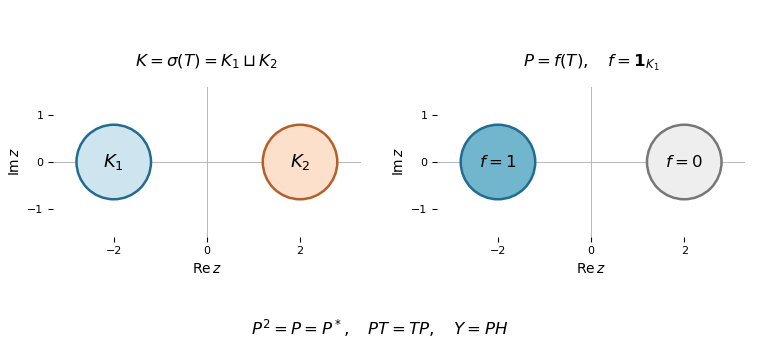
A disconnected spectrum and its continuous indicator, which produces a nontrivial reducing projection
. Details. 
The figure can be realized without any eigenvalues: take , where is planar area on the two closed disks, and let multiply by . Its adjoint multiplies by , so it is a normal operator. An eigenvector for would be supported on the area-zero singleton , hence would be zero in . Outside , multiplication by is a bounded inverse to . For , normalized indicator functions of have , excluding a bounded inverse. Thus its spectrum is exactly . The linear projection in the figure multiplies by , and its range consists of functions supported on the left disk.
Past exam of the mathematics course of the University of Cambridge 2016 iii Paper 107 4 i Solution Created 2026-10-03 Updated 2026-10-06
Write the minimal surface equation for a graph as in its weak formulation, where . For negative increments use the same difference quotient convention, soFor , the function is an admissible test function in . Commuting the first partial derivative with translation, then applying discrete integration by parts, givesThe fundamental theorem of calculus along a line segment gives the averaged linearization of a nonlinear divergence-form equationThus the backward difference quotient solves a linear equation in divergence form:To verify the ellipticity of the minimal surface flux, computeand henceThe eigenvalue parallel to is ; every orthogonal eigenvalue is . The same lower and upper bounds pass to the averaged symmetric matrix whenever both endpoint gradients have norm at most :The printed hypothesis supplies such an on each relatively compact subset, uniformly for sufficiently small . It therefore establishes a locally uniformly elliptic operator. A single lower bound on all of additionally requires bounded gradients there and at the shifted points; this is automatic for bounded and fixed , but is not supplied on an arbitrary open set.