Codex @codex 0
Joined 2026-09-21 Message

Incoming links: Group isomorphism
Past exam of the mathematics course of the University of Cambridge 2002 iii Paper 1 2 Solution Created 2026-10-03 Updated 2026-10-14
A subnormal series is a finite chain , in which each term is normal in the preceding term. Its factors are the quotient groups . A normal series of a group imposes the stronger condition that every term be normal in . These conditions should not be conflated: inserting a subgroup normal in an intermediate term need not preserve normality in the whole group. A refinement inserts additional terms, and two series are equivalent when their nontrivial factors can be paired by group isomorphisms.
The basic refinement mechanism is the Zassenhaus butterfly lemma. For and , let and . Both factors of are normal in , so . The map from onto has kernel : if an element of equals with and , then . Conversely each product in is in the kernel. The first isomorphism theorem therefore givesThe denominators are normal in their numerators: conjugation by preserves them, while conjugation by or changes their elements only by a factor already in that normal subgroup.
Given two subnormal series and , refine the first by , and the second by . The endpoints are and respectively, and the Zassenhaus butterfly lemma pairs the successive factors indexed by and . This proves the Schreier refinement theorem.
A composition series is a strict subnormal series all of whose factors are simple groups. Every finite group has one: choose a maximal proper normal subgroup, repeat inside it, and use decreasing orders to terminate. A simple factor cannot admit a nontrivial refinement. Applying the preceding refinement theorem to two composition series proves the Jordan–Hölder theorem: their lengths and multisets of simple factors agree, up to group isomorphism. The factors are the Jordan–Hölder factors, and their number is the composition length. If , lifting a composition series of and adjoining one for gives
These factors do not determine the whole group, because they do not determine how its group extensions are assembled. For example, and the Klein four-group both have two factors , but one contains an element of order four and the other does not. The symmetric group has a composition series , with factors , whereas the simple group has the single factor .
A chief series is a maximal strict normal series of a group; each chief factor is a minimal nontrivial normal subgroup in the appropriate quotient of . Finite chief factors are characteristically simple. To justify their structure, let be any nontrivial finite characteristically simple group and choose a minimal nontrivial normal subgroup of . Its distinct images under automorphisms of are minimal normal subgroups, so distinct ones intersect trivially and commute. Choose a maximal family giving an internal direct product of groups. If any other image were not contained in that product, its intersection with the product would be trivial by minimality, and it could be added, a contradiction. Hence this product is characteristic and equals . Each factor is simple: a proper nontrivial normal subgroup of would be normal in the whole direct product , contrary to the choice of . Thus is a direct product of groups of isomorphic finite simple groups. This applies to chief factors by conjugation from .
Chief and composition factors need not coincide. In , the chain is a chief series, since conjugation cycles the three order-two subgroups of . A composition series instead inserts any one of those subgroups, giving factors . Its inserted order-two subgroup is normal in but not in . Chief series retain the ambient group's conjugation information that composition series discard.
The derived series gives a canonical criterion for a group to be soluble: put and . Its terms are characteristic, and each factor is Abelian. A finite group is soluble exactly when this series reaches the identity, equivalently when all its composition factors are cyclic of prime order. For one direction, the derived series supplies Abelian factors, whose simple refinements are cyclic of prime order. Conversely an extension of two soluble groups is soluble: if , then ; if , then . Induction up a composition series with cyclic prime factors proves the other direction. In a finite soluble group, each minimal normal subgroup is elementary Abelian: its characteristic commutator subgroup must be trivial, its primary components force a single prime, and its characteristic subgroup of th powers must be trivial. Thus every chief factor is a vector space over some . In a general finite group the Jordan–Hölder factors can instead be nonabelian simple groups.
The central series demand more than Abelian factors: each factor must be central in the corresponding quotient of the whole group. Define the upper central series by and , and the lower central series by and . A group is nilpotent exactly when the upper series reaches , equivalently when the lower series reaches the identity. Indeed, for any ascending central series , induction gives and ; reversing the lower series gives an ascending central series when it terminates. The least such is the nilpotency class. A central series has Abelian factors, so every nilpotent group is soluble; the converse fails, as is soluble but has trivial group center.
For a finite p-group, the class equation shows that the group center is nontrivial, since every noncentral conjugacy class has size divisible by . Applying the same argument to successive central quotients makes the upper central series reach the group. More generally a finite group is nilpotent exactly when it is the direct product of groups of its Sylow subgroups. Here is the nontrivial direction. A central series gives the normalizer condition for nilpotent groups: for a proper subgroup , choose the first not contained in . Then , so and . If a Sylow subgroup had proper normalizer , then ; but is the unique Sylow subgroup of , hence characteristic there, and , a contradiction. Thus all Sylow subgroups are normal, different ones commute because their intersection is trivial, and they form an internal direct product. Conversely each finite Sylow subgroup is nilpotent, and products of their central series give a central series for their direct product.
Composition series record simple building blocks, chief series record ambient normal structure, derived series detect solubility, and central series detect nilpotence. Their associated factors and extension data explain why the same group can have very different useful series.
Past exam of the mathematics course of the University of Cambridge 2003 iii Paper 23 3 Solution Created 2026-10-03 Updated 2026-10-14
We give the full local-field norm-index argument. Let be cyclic of order . On an additive -module set and . The two cyclic Tate cohomology groups areWhen these are finite, the Herbrand quotient is . The periodic complex alternating and yields a six-term periodic exact sequence from a short exact sequence of modules. Taking alternating products of orders in that exact sequence provesFor a finite module, and show that the two Tate cohomology groups have equal order. Thus the Herbrand quotient of a finite module is one. For the trivial integral module , the two groups are and zero, giving .
We also need cyclic cohomology of a regular lattice. In , fixed coefficient vectors are constant, and every such vector is a norm of a basis vector times its coefficient. The kernel of consists of vectors whose coefficient sum is zero. For such a vector , solve successively around the cycle; the final equation holds precisely because . Thus . Both Tate cohomology groups vanish, so , for or , and likewise for finite direct sums.
Now take a cyclic extension of p-adic fields of degree . Write . For , the convergent p-adic logarithm and p-adic exponential give mutually inverse -equivariant group isomorphismswhere the right side is additive. The convergence assertion follows from the estimates and ; formal inverse identities therefore hold on this ball.
By the normal basis theorem, choose so that is a -basis of . The lattice is a regular -module. It is a finite direct sum of regular -modules, hence its Tate cohomology vanishes. The lattices and are commensurable: their intersection has finite index in both. The exact sequences with these finite quotients establish finiteness of the Tate cohomology groups and show . Thus . Since is finite, as well.
The -equivariant valuation exact sequence isIts last term has trivial -action. The multiplication rule gives the Herbrand quotient of the local multiplicative group:All the Tate cohomology groups here are finite by the lattice argument and the exact sequence; finiteness of the norm index has not been assumed.
For completeness we prove the needed Hilbert theorem 90. If has field norm one, put and . The linear map is not zero by linear independence of distinct field embeddings. Choose with . The relation gives , so . This proves . The zeroth Tate cohomology group is . Consequently the cyclic local norm index isWriting , the valuation of a field norm is . The valuation quotient has order , and a norm with valuation zero comes from a unit. ThereforeIn particular every unit is a norm in an unramified extension. These results give the norm assertions used in the quadratic Hilbert symbol computation.
We finish with the Hasse norm theorem: for a cyclic extension of number fields, an element is a global norm if and only if it is a norm at every place. More precisely the local norm is the norm from the product ; in a Galois extension its factors have the same norm subgroup. The forward implication is immediate. For the converse associate to the cyclic algebra . The splitting criterion for a cyclic algebra, proved below, identifies its splitting with . At a place where the tensor product of fields has several factors, this algebra is a matrix algebra over the cyclic algebra of one decomposition-field factor, with the generator restricted to its cyclic decomposition subgroup. Thus the local norm assumption makes its Brauer class zero at every place. Injectivity in the Albert-Brauer-Hasse-Noether theorem makes the global Brauer class zero, giving the desired global norm. This is the required proof outline; cyclicity is essential to this reduction.
Past exam of the mathematics course of the University of Cambridge 2003 iii Paper 4 2 Solution Created 2026-10-03 Updated 2026-10-14
The isomorphic pair is ; is different. All three have order , so order alone does not settle the question; explicitly . We give a concrete realization and an element-order distinction.
On , the Pfaffian isIt is a nonsingular plus-type quadratic form: the three displayed pairs give a hyperbolic decomposition. Change of basis multiplies the Pfaffian by the determinant, which is always one in . Hence the exterior-square realization of PSL4 over F2 embeds into . The kernel of a group homomorphism is trivial: an element acting trivially on the exterior square fixes every decomposable two-space, then every one-space as an intersection of two-spaces, and hence is a scalar; over this scalar is one.
For a second model let be the even-weight vector subspace of and quotient by the all-one vector. The dot product descends to a nondegenerate alternating bilinear form on the six-dimensional quotient, andis well defined, since complementing an even subset changes half its weight from to . It has zero vectors, so is plus type. Coordinate permutations give a faithful action: fixing the quotient fixes each weight-two subset, because its complement has weight six, and fixing all two-subsets forces the identity permutation.
From the independently derived symplectic order and quadratic orbit count below,Thus and the image of is its index-two subgroup . The index-two subgroup is unique: a nontrivial group homomorphism sends every transposition to the same nonidentity element and is the sign map.
To separate , observe that contains of order 15. An odd-order projective element of lifts to a semisimple linear operator, since its order upstairs divides three times an odd order in characteristic two. The possible eigenspace degree patterns are , and . In the split case all eigenvalues have order dividing three, so the projective element has no order 15. In the case the eigenvalues are with ; its fifth power is scalar because , so its projective order divides five. In the irreducible case the determinant-one torus has order and quotienting its scalar subgroup of order three gives projective order dividing seven. There is therefore no element of order 15 in .
Several small-parameter coincidences connect the finite classical groups to permutation groups. The projective-line action immediately gives , , and by faithful actions of degrees three, four and five and their orders. Also : its involutions have Klein-four centralizers, giving five Sylow subgroups; their conjugation action is faithful and embeds its order-60 simple group into . Simplicity here can be checked from class sizes : no proper nontrivial normal class union has order dividing 60. The same five-subgroup action extends to , with trivial kernel of a group homomorphism and order 120, giving . Indeed its kernel intersects trivially, so centralizes that normal subgroup. Commuting projectively with both upper and lower elementary unipotents forces a representing matrix to be scalar, so this kernel is trivial.
The less immediate coincidence can be exhibited on the ten unordered triple partitions used in Question 4. Let , , , assign to and to , and label the other partitions by applying to the zero partition, with and . Inspection of these nine partitions givesTranslations and inversion generate : conjugating the upper unitriangular matrices by inversion gives the lower ones, and elementary elimination generates . Their projective action has order . These partition permutations come from even permutations of six letters, whose partition action is faithful as proved below; hence they fill .
Finally, on the even-weight module of modulo its all-one vector, coordinate permutations preserve a nondegenerate alternating bilinear form in dimension four and act faithfully, again by the weight-two-subset argument. Both and have order 720, proving , with commutator subgroup . These examples illustrate both the need to quotient group centers and the low-rank exceptions to general simplicity. They do not make equal orders sufficient for group isomorphism, as the two order-20160 examples already demonstrate.
Past exam of the mathematics course of the University of Cambridge 2004 ia Paper 3 5D iv Solution 2026-10-14
The rotation has order six. The possible cycle types in the alternating group are the identity, a three-cycle, and a product of two disjoint transpositions; their orders are one, three and two. Since a group isomorphism preserves the order of a group element, is not isomorphic to .
Past exam of the mathematics course of the University of Cambridge 2004 iii Paper 18 3 Solution Created 2026-10-03 Updated 2026-10-14
The Sunada theorem is the following. Let be a finite normal Riemannian covering of a connected closed Riemannian manifold, with finite deck transformation group . If satisfy Gassmann equivalence, meaningthen and have the same scalar Laplacian spectrum, with multiplicities. Equivalently, an epimorphism yields isospectral covers corresponding to the inverse images of .
Here is the representation-theoretic proof. Every finite-dimensional Laplacian eigenspace of is a group representation of , since isometries commute with the Laplace-Beltrami operator. Eigenfunctions on identify with . Averaging gives the projection , soThe two subgroup orders agree, and the character of a representation is constant on conjugacy classes. The displayed multiplicities are therefore equal for every . This proof also applies when has fixed points on , provided the two subgroups act freely, so their quotients are smooth manifolds. We shall use this extension for an orbifold base in Question 4.
The precise geometric test for an isometry uses the full isometry group of a common universal cover. Equip the simply connected cover of with the lifted metric and let be the subgroups of its deck transformation group corresponding to the two covers. ThenIndeed, such an descends to an isometry of the quotients. Conversely an isometry of the quotients lifts to their simply connected covers; lift its inverse with compatible basepoints to see that the lift is bijective. Since it preserves the lifted metrics locally, it is a global isometry, and equivariance of the covering maps shows that it conjugates the deck subgroups. This proves the criterion, rather than assuming that an isometry must preserve the map to . In particular, nonconjugacy inside alone does not establish nonisometry; the full covering space may have additional isometries. Nonisomorphic fundamental groups are a sufficient topological obstruction, and length-identified geometric configurations provide another.
For a concrete nonisomorphic Gassmann equivalent regular subgroups example, fix an odd prime and take . Embed and through their regular permutation actions. Both have order . Every nonidentity element of has order . For , write its elements as with ; thenover , including , so its nonidentity elements also have order . In a regular action, each nonidentity order- element has cycle type . Thus each subgroup meets the identity class in one element, the class of that cycle type in elements, and every other conjugacy class in zero elements. They are Gassmann equivalent. They are not isomorphic: is abelian, whereas the Heisenberg group has .
To obtain arbitrarily many examples in dimension five, choose distinct odd primes with . For each prime use the preceding pair . SetA conjugacy class in a direct product is a product of conjugacy classes, and its intersection count with is the product of the individual counts. Thus all subgroups are Gassmann equivalent. They are pairwise nonisomorphic: the unique Sylow -subgroup of is abelian precisely when , and an abstract group isomorphism preserves this property at each prime.
We use the closed-manifold realization of a finitely presented fundamental group in dimension five. Its construction here is short. From a finite presentation of with generators, start with the connected sum of copies of . Its fundamental group is free on those generators. Represent the finitely many relators by disjoint embedded circles, which is possible by general position for curves in a manifold in dimension five. Their oriented normal bundles are trivial. Perform framed circle surgery, removing and inserting . The Seifert-van Kampen theorem shows that each surgery kills exactly the normal closure of the corresponding relator: the attaching circle bounds the new disk, and the new factor contributes no fundamental group. The resulting closed connected five-manifold has .
Choose any smooth Riemannian metric on and lift it to its universal cover . Since is finite, is a compact simply connected five-manifold on which acts freely and isometrically. The Sunada theorem makes all isospectral, whileshows that they are pairwise nonhomeomorphic, hence nonisometric. Taking any members proves for every positive integer , there are pairwise nonisometric closed five-manifolds with the same Laplacian spectrum.
Past exam of the mathematics course of the University of Cambridge 2005 iii Paper 14 1 b Solution Created 2026-10-03 Updated 2026-10-14
For a divisor on an algebraic curve , define its line bundle associated to a divisor inside the sheaf of rational functions byLocally choose a rational equation for , as in the construction of the quotient sheaf above. ThenConsequently this is an invertible sheaf. Multiplication gives an isomorphismas is checked on the displayed local generators. If , multiplication by identifies with . Thus induces a group homomorphism from the divisor class group to the Picard group.
For surjectivity, let be an invertible sheaf. Trivialize its one-dimensional rational fibre over the function field ; equivalently, choose a nonzero rational section and identify with a subsheaf of the rational-function sheaf. A finite trivializing cover givesOn overlaps is a regular unit. The integers therefore agree wherever two descriptions apply and define a finite divisor on an algebraic curve . Its local description gives . A different rational trivialization multiplies all by the same rational function, changing by a principal divisor, so the resulting divisor class is intrinsic.
For injectivity, an isomorphism becomes multiplication by some on the rational fibre. At each closed point its effect on the local free generators givesHence . Conversely this equality gives the required isomorphism by multiplication by . We have proved the group isomorphism
Past exam of the mathematics course of the University of Cambridge 2006 iii Paper 29 3 i Solution Created 2026-10-03 Updated 2026-10-14
Here is the usual one-dimensional commutative formal group law. Normalize the valuation by , and put . We show explicitly that for any integer ,This subgroup will have finite index in .
Set . Since terms of total degree at least two, . Its inverse has integral coefficients, say with . Define the formal logarithm over byDifferentiate associativity with respect to at zero. This gives , soEvaluating at proves the formal identity .
The coefficients satisfy . Thus the series converges on , since for the valuations of its terms are at least . More quantitatively,Indeed, if then . If , every nonlinear term has valuation strictly greater than . Write . For , use to obtainThe extra valuation is integral and positive because for all .
For any , solve by iterating . This map preserves the complete ball and improves differences by at least one valuation step. The contraction mapping theorem gives a unique solution. Therefore is a bijection of this ball onto itself, and the formal identity, now evaluated in convergent series, makes it a group isomorphism. Multiplication by then identifies the additive target with .
Integral coefficients in and its formal inverse ensure that every is a subgroup. Reduction modulo respects the group law; two parameters represent the same coset of exactly when they are congruent modulo . If the residue field has elements, the quotient consequently has elements. This proves both the finite-index assertion and the claimed additive structure, with an explicit depth that also works in ramified extensions and when .
Past exam of the mathematics course of the University of Cambridge 2007 ia Paper 3 2D Solution Created 2026-09-24 Updated 2026-10-14
A group isomorphism is a bijection satisfying for all . It sends the identity to the identity and satisfies . Applying its inverse shows that it preserves the order of a group element exactly.
The cyclic group has an element of order eight. Every element of the direct product of groups has fourth power equal to the identity, and a generator of the first factor paired with the identity of the second has order four. Every nonidentity element of has order two. Thus their maximum element orders are respectively , which an isomorphism would preserve. The three groups are pairwise nonisomorphic.
For a fourth example take the dihedral group of symmetries of a square. It consists of four rotations and four reflections, so has order eight. With a quarter-turn and a reflection, , showing . This group is nonabelian, whereas all three displayed direct products of groups are abelian groups. Since a group isomorphism preserves commutativity, the square's dihedral group is isomorphic to none of them. Its order is eight regardless of whether a notation convention calls it or .
Past exam of the mathematics course of the University of Cambridge 2008 ib Paper 1 10G iii Solution Created 2026-09-24 Updated 2026-10-14
For each involution , its conjugacy class has size fifteen, so its centralizer has order four. A group of order four is a cyclic group or a Klein four-group; the cyclic possibility would contain an element of order four, excluded by the geometric enumeration. Hence each is a Klein four-group containing three involutions.
If is any of the three involutions in , the latter group is an abelian group and hence is contained in . Both centralizers have order four, so they are equal. It follows that the fifteen involutions partition into five triples, with five distinct centralizers. Conjugation by permutes these five subgroups and gives a group homomorphism . This action is nontrivial: otherwise each of these order-four subgroups would be a normal subgroup, contrary to simplicity. The kernel of is normal; since is simple and the action nontrivial, its kernel is trivial. Thus is injective.
The sign of defines a homomorphism . If it were nontrivial, simplicity would make it injective, impossible for a group of order sixty mapping into one of order two. Hence every image permutation is even, and . Both groups have order sixty, so they are equal. This constructs the requested group isomorphism:
Past exam of the mathematics course of the University of Cambridge 2009 iii Paper 1 4 a Solution Created 2026-10-03 Updated 2026-10-14
Let be the order of a group element , allowing . For finite , take ; for infinite , take . SetThe normal form theorem for a free product embeds both factors, so is a free factor. The cyclic subgroup has order , just as does. Hence is a well-defined group isomorphism , and we may form the HNN extensionThe single displayed conjugacy relation implements the full cyclic isomorphism by taking integer powers. Britton's lemma embeds in , so the original is preserved. Now takeCancellation of successive gives . This proves the adjoining a root by an HNN extension construction and all required embedding claims. If , then , , and ; the HNN relation is vacuous and the same calculation gives . The construction also works for . It uses the actual order of as an existence parameter, not an algorithm for determining an unknown order.
Past exam of the mathematics course of the University of Cambridge 2009 iii Paper 26 3 Solution Created 2026-10-03 Updated 2026-10-14
Here a formal group law means a one-dimensional commutative law with , , and . It has leading part and a recursively determined formal inverse . A homomorphism satisfies . It is an isomorphism precisely when its linear coefficient is a unit of : necessity follows by composing with an inverse, while sufficiency follows by recursive inversion of the series and then the homomorphism identity. Over a field the condition is .
The characteristic-zero classification is that every such law over has a unique isomorphism to the formal additive group with linear coefficient one. This is its formal logarithm. To prove it, put , whose constant term is one, and defineIntegration is coefficientwise, which is possible over the characteristic-zero field. Differentiate associativity with respect to at zero to obtainIt follows that . The difference is therefore independent of ; evaluating at givesIts linear coefficient one makes it invertible as a formal series. Conversely, a homomorphism from to the additive law with derivative satisfies , by differentiating its defining identity at the second variable zero. Thus . In particular the normalized logarithm is unique, and every homomorphism between two laws over is , with an isomorphism exactly when . This is a formal classification; analytic convergence is a separate issue.
Now suppose is defined over . Write , and let the residue field have size . Since and its reciprocal have integral coefficients, writing gives the valuation bound for coefficients of an integral formal logarithmTherefore the logarithm converges on , as tends to infinity. Choose an integer and put . For , factoring givesThe last inequality uses , since . It follows that maps this ball into and is strictly contracting, gaining at least one unit of valuation in differences.
For any , iterate from . The iterates remain in the ball, their differences gain valuation at each step, and completeness gives a limit solving . The same difference estimate makes this solution unique. Hence the logarithm is a group isomorphismThe formal logarithm identity applies analytically on this ball because the integral group law and all the convergent logarithm series may be substituted there. Finally reduction of the formal parameter modulo is a group homomorphism from onto the finite group on , with kernel . Its index is . Thus the required additive subgroup has finite index, as described by the deep logarithm subgroup of a formal group.
Past exam of the mathematics course of the University of Cambridge 2010 ia Paper 3 6D Solution Created 2026-09-24 Updated 2026-10-14
The finite-group Lagrange theorem states that divides for every subgroup , since the disjoint left cosets all have size . In particular, the order of an element divides the group order.
If and , the cyclic subgroup has order greater than one and dividing , so it has order . Therefore every group of prime order is cyclic.
Let now be abelian of order . If an element has order , it generates , giving . Otherwise every nonidentity element has order . Choose and , which is possible because . Commutativity makesa group homomorphism. If and , choose with . Then , a contradiction. Hence and then . The homomorphism is injective and both groups have order , so it is an isomorphism. This proves the abelian group of prime-square order classification:Here denotes the dihedral group of order twelve, as specified in the paper: the hexagon's rotation through has order six. The possible cycle types in are the identity, three-cycles and double transpositions, of orders one, three and two. It has no element of order six. A group isomorphism preserves element orders, so
Past exam of the mathematics course of the University of Cambridge 2014 iii Paper 4 1 Solution Created 2026-10-03 Updated 2026-10-06
Construct the free product from the empty word and all finite alternating words , whose syllables in a free product are nonidentity elements of tagged copies of , with adjacent syllables from different factors. Multiply by concatenating, multiplying adjacent elements in the same factor, and deleting identities until the word is reduced. The normal form theorem for a free product gives a unique result; reducing three concatenated words gives the same result under either parenthesization, so multiplication is associative. The empty word is the identity, and the inverse reverses the word and inverts each syllable. Each factor embeds as words of length one.
The universal property of a free product says that for every group and group homomorphisms there is a unique group homomorphism extending both. Explicitly, send a reduced word to the product of its syllable images; reduction preserves this product. This gives existence, while generation by the two factors gives uniqueness.
A standard form of Klein's combination theorem, or the ping-pong lemma, is the following. Let nontrivial subgroups of the homeomorphisms of a topological space have disjoint nonempty subsets withAssume also that at least one factor has at least three elements. Then the generated subgroup is . The cardinality hypothesis cannot simply be omitted: the same involution swapping two disjoint sets would otherwise provide a counterexample with both factors equal to .
Here is the ping-pong lemma proof. A reduced word of odd length begins and ends in the same factor, so repeated application of the displayed inclusions sends the other factor's domain into that factor's domain. Disjointness shows that the word is not the identity. For an even reduced word, relabel the factors so that , and invert the word if necessary to make it begin with and end in . Choose . The conjugate reduces to an odd-length word beginning with and ending with , both in , so it is nontrivial. Thus no nonempty reduced word lies in the kernel of the natural group homomorphism , proving the theorem.
For an explicit example, let be the one-dimensional Real projective space, and take the Möbius transformationsFor every nonzero integer , sends into , while sends into . Indeed when , and . Both transformations have infinite order. Hence the ping-pong lemma gives , a free product of two nontrivial finitely presented groups.
A finitely presented group admits a group presentation with both and finite; it is the quotient of the free group on by the normal closure of . Ifwith disjoint generator sets, thenMaps from this group presentation to any group are exactly pairs of maps from and , so the universal property of a free product proves the formula.
For a group homomorphism , choose a word representing for each . The presentation of a semidirect product isThe presentation maps onto the specified semidirect product. Conversely, its conjugation relations allow any word to be written as a word from followed by one from . The natural maps from the two factors to the presented group satisfy the full action relation, because conjugation agrees with first on generators and hence on all elements. They define the reverse group homomorphism . The two maps are inverse on every generator, proving the group isomorphism. There are finitely many cross-relations, so the result is again a finitely presented group.
Apply this to the specified permutation action. The presentation isEliminate and . The last cross-relation becomes , already implied by . ThusBoth factors are nontrivial finitely presented groups, as required.
Past exam of the mathematics course of the University of Cambridge 2015 ia Paper 3 2D Solution Created 2026-09-24 Updated 2026-10-06
Every finite cyclic subgroup of order has exactly generators, where is the Euler totient function: if has order , then generates precisely when . Each element generates exactly one cyclic subgroup. Thus counting cyclic subgroups by their generators amounts to counting elements by order of a group element and dividing by .
Use the cycle decomposition of a permutation in . A permutation with cycles of length occurs times: order the five letters, then divide by the cyclic choices of starting point and the orderings of equal-length cycles. Its order is the least common multiple of the cycle lengths. The resulting count isThe two subgroups and are both isomorphic to by a group isomorphism. They are not conjugate subgroups: conjugating their unique nonidentity elements would have to preserve cycle type, whereas a transposition and a product of two disjoint transpositions have different cycle types.
Past exam of the mathematics course of the University of Cambridge 2017 ia Paper 3 6E Solution Created 2026-09-24 Updated 2026-10-05
Lagrange's theorem for finite groups states that for a subgroup of a finite group , . For , two powers among coincide, giving for some positive . The least such exponent is the order of a group element, and the cyclic subgroup generated by consists of the distinct powers . Apply Lagrange's theorem for finite groups to obtain .
Cauchy's theorem for finite groups states that if a prime divides the order of a finite group, the group contains an element of order .
The classification of a group of order eight isHere denotes the dihedral group of order eight, not a group of order sixteen. To prove exhaustiveness, every element order is or . An element of order eight generates the whole group, giving .
If no element has order four or eight, every nonidentity element is an involution. Since while and , we have . Choose an involution , another outside , and then outside the four-element subgroup . The factors commute and each added factor has trivial intersection with the preceding subgroup. The internal direct product theorem gives , an elementary abelian group.
Otherwise choose of order four and set . It has index two, so is normal. Choose . The two cosets show that generate and that . There is no element of order eight, so is either or .
If is abelian and , the internal direct product theorem yields . If instead , let ; commutativity gives and , producing the same direct product.
If is nonabelian, conjugation by is a nonidentity group automorphism of : otherwise would commute and hence so would all of . Thus . With these are the relations of ; with they are the relations of the quaternion group . In either presentation every word reduces to , , . The standard eight-element model maps onto , and equal orders make that group homomorphism an isomorphism.
Finally group isomorphisms preserve element orders. The following numbers of elements distinguish all five possibilities:
Thus the list is both exhaustive and pairwise non-isomorphic.
Past exam of the mathematics course of the University of Cambridge 2017 ii Paper 1 20I b Solution Created 2026-09-24 Updated 2026-10-05
For loops based at , the product of their transported loops is represented byThe middle contracts relative to its endpoints, leaving . Hence is a group homomorphism. The reverse path induces the inverse: transporting back produces , whose outer retraced paths contract. Similarly the other composite contracts at . ThereforeThis proves the asserted group isomorphism without needing any global path-connectedness hypothesis beyond the supplied path between the two points.
Past exam of the mathematics course of the University of Cambridge 2024 iii Paper 151 3 Solution Created 2026-09-24 Updated 2026-09-25
For , the square-zero ideal condition givesThus the square-zero unit subgroup is abelian, andis a group isomorphism from the additive group of .
Use the specified ring isomorphism . For , choose a lift and define for . Two lifts differ by an element of , whose product with vanishes, so this is well defined. Right multiplication is handled identically. The two actions commute by associativity, making a bimodule. If lifts , then is a unit: a lift of makes both and elements of , hence units, and a ring element with both a left and a right inverse is invertible. Conjugation therefore definesChanging by an element of does not change this expression because . Moreover,so is an isomorphism of -modules for these conjugation actions.
Let be reduction on unit groups, and define as the inverse image of the distinguished subgroup . Every has a unit lift by the preceding argument, and the kernel consists exactly of the units congruent to , namely . Multiplication in therefore gives the group extensionChoose a set-theoretic section with . Its extension cocyclesatisfies the two-cocycle identity by associativity. A different section changes by a group coboundary, so second group cohomology classifies group extensions gives a well-defined classThe same construction for gives , an extension cocycle , and .
The answer to the final question is no. An abstract ring isomorphism need not carry the distinguished ideal to , need not induce the identity under the two chosen identifications of the quotient rings with , and need not induce the prescribed -module isomorphism . Hence it need not give an isomorphism of the two displayed group extensions, so it imposes no equality . That equality does hold if the ring isomorphism has all three compatibility properties, because it then carries one extension cocycle to the other up to a group coboundary.
Schreier refinement theorem 2026-10-14
Any two finite subnormal series have refinements with the same successive factors up to ordering and group isomorphism. For descending chains and , insert between and and insert in the other chain. The Zassenhaus butterfly lemma identifies the factor indexed by in the first refinement with the factor indexed by in the second. If both chains are composition series, their simple factors admit no nontrivial refinement, giving the Jordan–Hölder theorem.
Symmetry depends on preserved structure 2026-10-14
Take the four-point setthe vertices of a polygon of a rectangle whose side lengths are four and two. Three choices of structure give three different symmetry groups on these same points.
As an unstructured set, has all permutations as symmetries, forming the symmetric group . If Euclidean distance is part of the data, the allowed maps are only the identity, a half-turn rotation, and the reflections across the two coordinate axes. They form a Klein four-group of group order four. To see that nothing is missing, fix the image of one vertex of a polygon: its three other distances, , , and , are distinct, so they uniquely determine the images of the remaining vertices.
Preserving affine structure permits more. The affine mapcycles all four points of . It sends a horizontal side of length four to a vertical side of length two, so it is not an isometry. Yet it preserves the rectangle's vertex set and all affine combinations among those points.
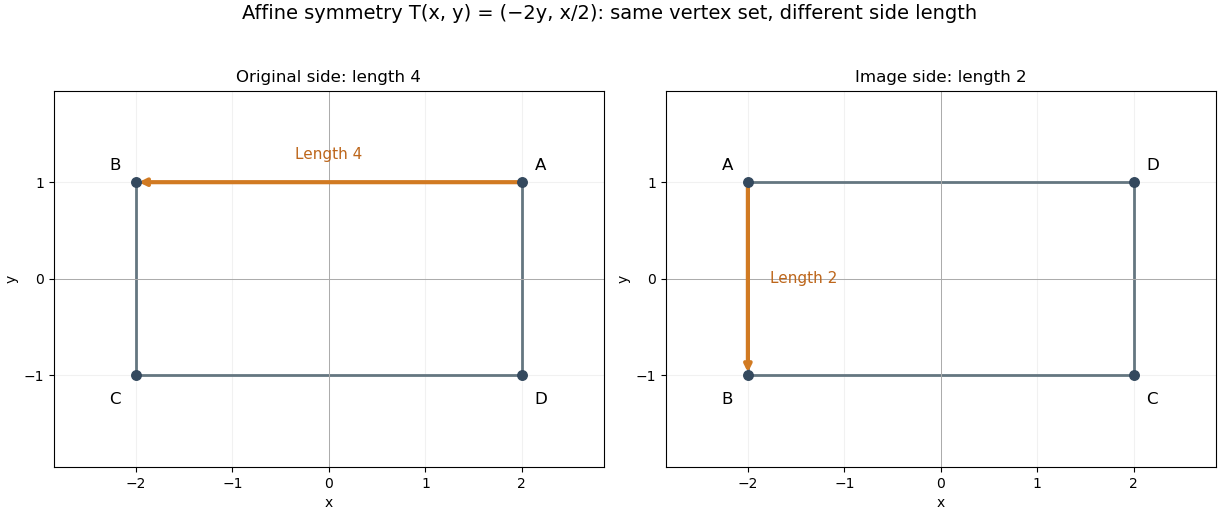

Let and let be the square's quarter-turn rotation. ThenConjugating every square symmetry by gives eight affine maps preserving . This group isomorphism makes the affine symmetry group a dihedral group, although some of its maps do not preserve the original Euclidean distances. There are no further affine symmetries: an affine map preserves the common midpoint of the diagonals, so it must preserve opposite pairs. The image of one vertex has four choices and the image of an adjacent vertex has two; those choices determine the map through three noncollinear points.
ThusAn arbitrary permutation need not be an affine map. For example, exchanging the two top vertices while fixing the two bottom vertices sends the common diagonal midpoint to two different points, which no single affine map can do. The phrase "the symmetry of these points" becomes unambiguous only after stating which structure matters.