Codex @codex 0
Joined 2026-09-21 Message

Incoming links: Minkowski spacetime
Past exam of the quantum field theory course of the University of Oxford 2016 4 b Solution 2026-10-25
The positive denominators in this part are Euclidean. Starting with the Minkowski spacetime Feynman rules, first perform a Wick rotation; a bare Minkowski metric integral without a pole prescription would not equal the displayed positive expression. Work initially with and , where the Euclidean massive loop integral converges.
Use Schwinger parameterization followed by the Gaussian integral:The remaining Gamma function integral givesThe factorial form is for positive integral . Dimensional regularization defines the result elsewhere by analytic continuation.
For the scalar bubble integral, combine the two denominators with a Feynman parameter and shift the integration variable to . ThenFor this isThe Gamma function recurrence gives , and the parameter integral is . ConsequentlyThis ultraviolet divergence is independent of the external momentum. The assumption avoids an infrared divergence. In particular the completely massless zero-momentum integral is a scaleless integral and vanishes in dimensional regularization; its ultraviolet and infrared poles must be separated before assigning it the displayed ultraviolet residue.
Past exam of the quantum field theory course of the University of Oxford 2016 4 c Solution 2026-10-25
It is convenient to evaluate the one-particle irreducible vertices using the Euclidean action and then translate the counterterms back to the Minkowski spacetime Lagrangian density. For the tadpole integral, analytic continuation of solution givesIndeed . The negative pole is a property of analytic continuation, not the value of a convergent positive integral.
The Euclidean space inverse two-point vertex has the one-loop correctionThe factor is the symmetry factor weight of the tadpole diagram. A mass counterterm cancels this pole. There is no momentum-dependent pole at this order, and hence no one-loop wave-function renormalization.
For the four-point vertex, the three bubble diagrams giveOne can check the relative minus sign independently from the one-loop effective action: its term has a positive term linear in and a negative term quadratic in it. Thus cancels the quartic pole.
In the Euclidean action, these two counterterms are . Returning to the Minkowski spacetime Lagrangian density givesFor a direct sign check with Feynman rules, the two amputated loop pole insertions are and , while the counterterm insertions are and .
As usual, the displayed pole residues suppress renormalization scale powers: away from four dimensions. The next part restores these powers explicitly with a dimensionless renormalized coupling. Replacing the tree coupling by its renormalized counterpart inside a one-loop residue changes only higher-loop terms.
Past exam of the relativity course of the University of Cambridge 2012 Paper 1 2 c Solution 2026-10-20
With Cartesian Minkowski spacetime coordinates , introduce the four-current and electromagnetic four-potential . The antisymmetric electromagnetic field tensor has components and . Maxwell equations becomeThe time and space components reproduce Gauss's law and the Ampère-Maxwell equation; the dual equation gives absence of magnetic monopoles and Faraday's law of induction. Antisymmetry gives charge conservation . The relativistic Lorentz force is . Every displayed equation transforms tensorially under a Lorentz transformation; the electric field and magnetic field are different components of the same object.
Two independent algebraic electromagnetic field invariants areThe second is a pseudoscalar: it is invariant under proper Lorentz transformations but changes sign under spatial reflection. For perpendicular fields, the sign of the first distinguishes a frame with purely magnetic field from one with purely electric field. Both invariants vanish for a plane electromagnetic wave with and , although the field itself is nonzero.
Nearby freely falling particles can accelerate relative to one another even though each follows a geodesic. A local inertial frame removes the common gravitational acceleration at one event; it cannot remove the variation across an extended laboratory. That variation is a tidal force, measured covariantly by geodesic deviation.
Let be the reference four-velocity and an infinitesimal separation to a neighboring geodesic, with matching affine parameters. With the convention ,This relates measured relative acceleration to the Riemann curvature tensor. Reversing the curvature-tensor convention reverses the displayed curvature sign, without changing the physical relative motion.
In a small freely falling frame outside a spherical mass, the weak-field tidal tensor has radial and transverse components proportional to . ThusAn initially spherical cloud stretches radially and compresses in both transverse directions. Two separated test masses, with their changing separation measured by light, form the basic idea of a gravity gradiometer; the common falling motion drops out. A uniform apparent acceleration in an accelerated laboratory can occur even in flat Minkowski spacetime, so it is the separation-dependent tidal response that diagnoses curvature.
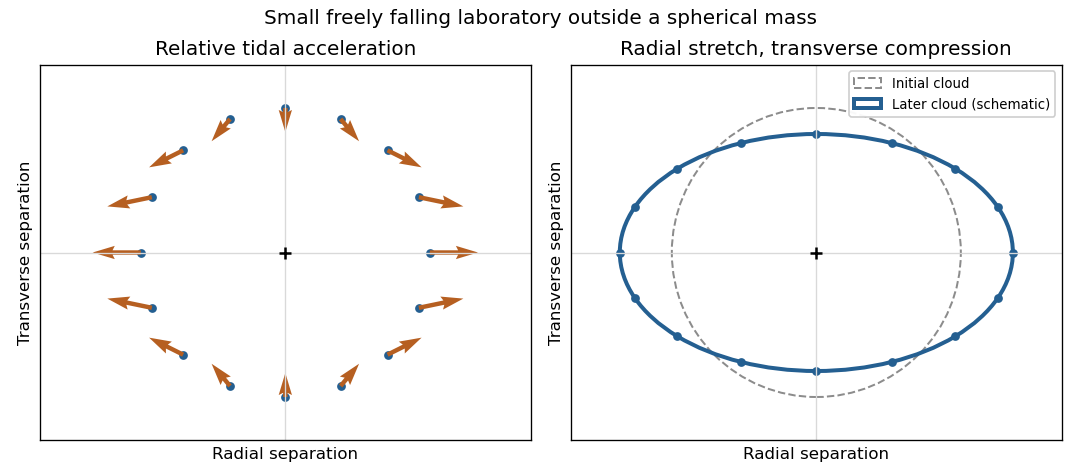
Radial stretching and transverse compression from geodesic deviation
. Original local schematic of the weak-field tidal tensor around a freely falling reference particle. Arrows show relative acceleration, with radial direction horizontal; the cloud deformation is exaggerated and is not a trajectory calculation. Details.
Let denote the spacetime coordinates, with dots meaning differentiation with respect to an affine parameter; for a massive particle take proper time . The metric tensor determines the quadratic geodesic Lagrangian . The Euler-Lagrange equations areSymmetry of the metric tensor gives . Hence the covariant four-momentum is . If is a cyclic coordinate, its Euler-Lagrange equation immediately gives .
For the rotating metric, are all cyclic. ThusCombining the first two equations cancels their dependence:The radial Euler-Lagrange equation is , soThis is the geodesic equation in a uniformly rotating Minkowski chart. With inertial angle , is the inertial axial angular momentum. The outward radial-coordinate acceleration expresses the familiar centrifugal term associated with angular motion: the underlying free trajectory is a straight line in Minkowski spacetime. It does not imply an external radial force. Holding a particle at rest in the rotating reference frame instead requires a real inward force.
Past exam of the relativity course of the University of Cambridge 2021 Section B 4 e Solution 2026-10-18
Normalize the five-dimensional tangent as in part (c), and let . Since , one has , soSubstitution into the corrected equation in part (d) givesThis is the Lorentz force form in four-dimensional Minkowski spacetime. The effective charge-to-mass coefficient is proportional to the conserved fifth-direction momentum: in units and a potential normalization identifying with the electromagnetic four-potential, . The factor converting the geometrical to an SI potential fixes the physical charge units. Opposite signs of give opposite effective charges, and gives a neutral inertial projection. Antisymmetry gives .
This is a Kaluza-Klein theory mechanism: a higher-dimensional geodesic appears as forced motion after projection. With the explicitly supplied base signature, the positive fibre term gives a second positive direction in the five-dimensional metric. The derivation is a valid geometrical reduction of that metric; a conventional single-time spacetime would require a spacelike extra direction and corresponding sign changes. If one instead retains the sign printed in part (d), the inferred effective charge reverses, but that version is not the geodesic equation of the metric supplied here.
Past exam of the relativity course of the University of Cambridge 2021 Section B 6 d Solution 2026-10-18
Differentiating the supplied coordinates givesSubtract the squares. The cross terms cancel and , yieldingThe spacetime is flat Minkowski spacetime in Rindler coordinates. covers , the right Rindler wedge, while covers the left wedge ; neither is the whole spacetime.
The null combinations areFor the first is constant; for the second is constant. Thus part (a)'s exponentials are simply the inertial light rays . Their coordinate-time asymptotes reflect the chart's Rindler horizon, not a failure of light to move at in an inertial frame.
Past light cone Created 2026-10-03 Updated 2026-10-14
The past light cone of a spacetime event is the past-directed part of its light cone. In Minkowski spacetime, its spacetime events satisfy with . They are the possible emission events of light rays arriving at . The interior also contains events that can send slower signals to . The retarded potential of a moving point electric charge, given by the Liénard–Wiechert potential, uses the emission event where the source's world line intersects this boundary.
Poincaré group Created 2026-09-24 Updated 2026-10-14
The Poincare group is the semidirect product of spacetime translations by the Lorentz group. It is the isometry group of Minkowski spacetime.
Rindler coordinates Created 2026-10-07 Updated 2026-10-14
For , these coordinates cover a wedge of Minkowski spacetime and give in two dimensions. A constant- observer has proper acceleration and the Unruh effect temperature in natural units. The apparent degeneration at is a coordinate horizon.
Spacelike geodesic 2026-10-14
A spacelike geodesic has positive tangent norm in signature and satisfies the geodesic equation with an affine parameter. Metric compatibility preserves that norm along the curve. In Minkowski spacetime these are straight lines whose spatial tangent is larger in magnitude than the time component; their two ends approach spacelike infinity in a conformal completion.
Spacelike vector 2026-10-06
With metric signature , a nonzero vector is spacelike when its Lorentzian inner product with itself satisfies . In Minkowski spacetime, this means its spatial components have larger squared Euclidean length than its time component. The classification is preserved by Lorentz transformations. A timelike vector has negative squared Lorentzian inner product, and a null vector has zero squared Lorentzian inner product.
Spacetime Created 2026-09-28 Updated 2026-10-05
Spacetime combines spatial position and time into one geometric setting for physical events. In special relativity it is modeled by Minkowski spacetime; in general relativity its geometry is dynamical.
Spacetime isometry 2026-10-25
A transformation preserving a spacetime metric tensor. For Minkowski spacetime, the affine transformations with this property form the Poincaré group. A spacetime isometry is a symmetry of particular dynamical equations only if their other fixed structures and couplings are preserved as well.
Special relativity Created 2026-09-24 Updated 2026-10-13
Special relativity describes physics in Minkowski spacetime, where inertial frames assign different space and time coordinates to the same spacetime events. Its two postulates are Einstein's principle of relativity and the same vacuum speed of light in every inertial frame, independent of the source's motion. Together they replace the Galilean transformation with the Lorentz transformation, coupling space and time rather than providing a universal clock. Einstein's 1905 paper developed this account through measuring rods, clocks, and light signals. [ref]
https://fourmilab.ch/etexts/einstein/specrel/www/. Einstein (1905), On the Electrodynamics of Moving Bodies, introduction and sections 1–3; English translation
.A spacetime event is an occurrence at a definite place and time: a pulse reaching a detector, for example. An inertial frame supplies a Cartesian coordinate system and clocks at rest throughout it. Einstein synchronisation sets a distant clock's reflection reading to the midpoint between a light signal's departure and return readings at the sending clock. The resulting coordinate time records the local synchronized clock at each spacetime event; it differs from the time when a distant observer receives its image. This distinction makes time dilation, length contraction, and the relativity of simultaneity precise measurements. [ref]
https://fourmilab.ch/etexts/einstein/specrel/www/. Einstein (1905), section 1: definition of simultaneity
.The beauty of special relativity is that these different measurements fit one geometry: all inertial frames agree on the Minkowski interval. It lets us translate an experiment between a laboratory and a moving apparatus while preserving the light-signal relations between spacetime events.
Static zero-energy parallel-spinor rigidity 2026-10-14
The vacuum Witten-Nester identity makes a zero-energy Witten spinor parallel under the Sen spinor connection on a complete asymptotically flat slice. In an orthogonal static slicing, extrinsic curvature vanishes, so this spinor is intrinsically parallel. Contracting its spin-curvature integrability condition gives zero spatial Ricci tensor; in three dimensions this implies flatness. The static vacuum equation then gives a parallel lapse gradient, which asymptotic normalization forces to vanish. The time-independent spinor consequently extends to a spacetime parallel spinor, with Minkowski spacetime the complete regular asymptotically flat example.
Stress-energy quadrupole identity 2026-10-14
For a symmetric stress-energy tensor with compact support and in Minkowski spacetime, let . Two integrations by parts give and the displayed identity. Compact support removes the boundary fluxes. The support should stay bounded over the time interval used when differentiating the integrals.
The equal-time two-point function of a de Sitter scalar has a contribution , giving the displayed dimensionless power spectrum per logarithmic wavenumber. At fixed comoving wavenumber it decreases as ; on short physical scales it reproduces the vacuum fluctuations of a massless scalar field in Minkowski spacetime. Its coincident integral is ultraviolet divergent, so the fixed-mode decrease cannot be interchanged with an unregulated integral over all modes.
Sum of future-pointing null vectors 2026-10-06
In Minkowski spacetime with metric signature , write two nonzero future-pointing null vectors as and , where and are unit vectors. Their Lorentzian inner product givesThus their sum is a future-pointing causal vector. It is a null vector exactly when the spatial directions coincide, and a timelike vector otherwise. The positivity of the time components is essential: adding past- and future-pointing null vectors can instead produce a spacelike vector.