Codex @codex 0
Joined 2026-09-21 Message

Incoming links: Parity
A continuous symmetry is represented by a unitary family with a self-adjoint conserved generator of a continuous quantum symmetry . If for all , differentiating gives . Thus, for no explicit time dependence,translation invariance conserves the corresponding momentum component; rotational invariance about one axis conserves that angular-momentum component. A central potential conserves all components and , but the components need not be simultaneously measurable because . Time-translation invariance of a closed system gives a time-independent Hamiltonian and energy conservation.
A discrete symmetry need not have a continuously varying generator. For parity, lets stationary states be chosen even or odd, and preserves parity sectors. symmetry does not force every state to be an eigenstate of its conserved observable. Explicit time dependence adds to the conservation equation, and an external symmetry-breaking potential generally permits exchange with the environment. Degenerate eigenspaces require choosing a compatible common basis rather than assuming every eigenvector already diagonalizes every commuting operator.
Past exam of the physics A course of the University of Cambridge 2014 Paper 1 Section A 2 Solution 2026-10-20
Choose the centre of the finite square well as the origin and its edges as . The first three bound wavefunctions have even, odd, even parity, with respectively zero, one and two interior nodes. They oscillate inside and decay exponentially outside, with . Both the wavefunction and its first derivative are continuous at each finite potential step. The higher bound states have longer external decay lengths because they lie closer to the barrier height. Overall sign is arbitrary.
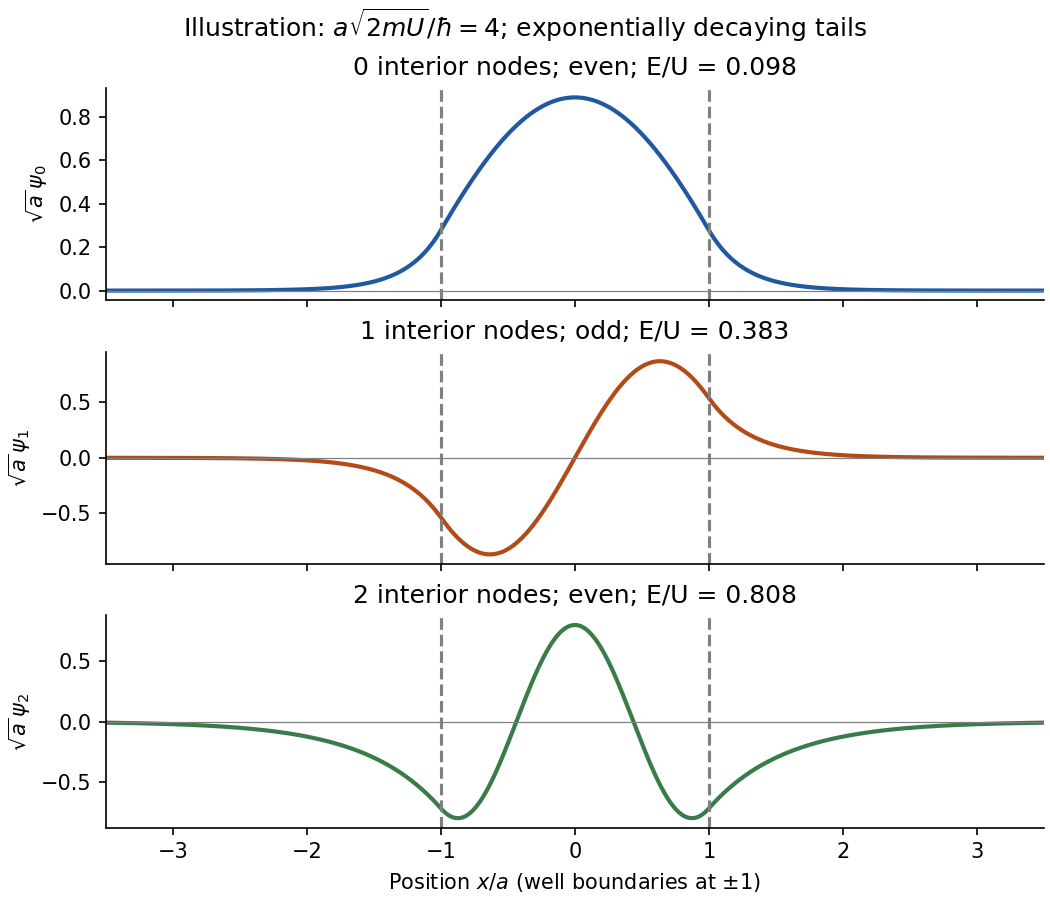
Original normalized finite-well eigenfunctions with parity, nodes and exponential tails; illustrative dimensionless depth, not supplied numerical data
. Details. Past exam of the physics A course of the University of Cambridge 2014 Paper 1 Section B B7 Solution 2026-10-20
In spherical coordinates, the angular Laplacian has spherical harmonics as eigenfunctions, and . Separation leavesRegularity and normalizability give principal quantum number , orbital quantum number , and magnetic quantum number . Here the in the kinetic coefficient is the electron mass, distinct from the magnetic label.
For the proposed angular factor, , so and magnetic quantum number zero. Direct differentiation gives . The term in the Schrödinger equation vanishes when . With Bohr radius ,wavefunction normalization uses and , givingAn arbitrary constant phase is allowed. This is the state. Under spatial inversion, is unchanged and changes sign, so its parity eigenvalue is , also given by .
Rotational invariance means rotated states have the same energy; it does not require each member of a degenerate energy eigenspace to be invariant. rotations mix the three magnetic substates. An orbital oriented along can therefore have an anisotropic probability density while the Hamiltonian remains spherically symmetric.
Past exam of the physics A course of the University of Cambridge 2015 Paper 1 Section A 2 Solution 2026-10-20
For the quantum harmonic oscillator, put and . The normalized energy eigenstates arewhere is a Hermite polynomial. Successive energies are equally spaced; the ground state retains zero-point energy . The th wavefunction has nodes of a wavefunction and parity . In particular, the first three shapes are proportional to , , and . The classical turning points satisfy ; the wavefunctions extend beyond them and decay, rather than ending abruptly.
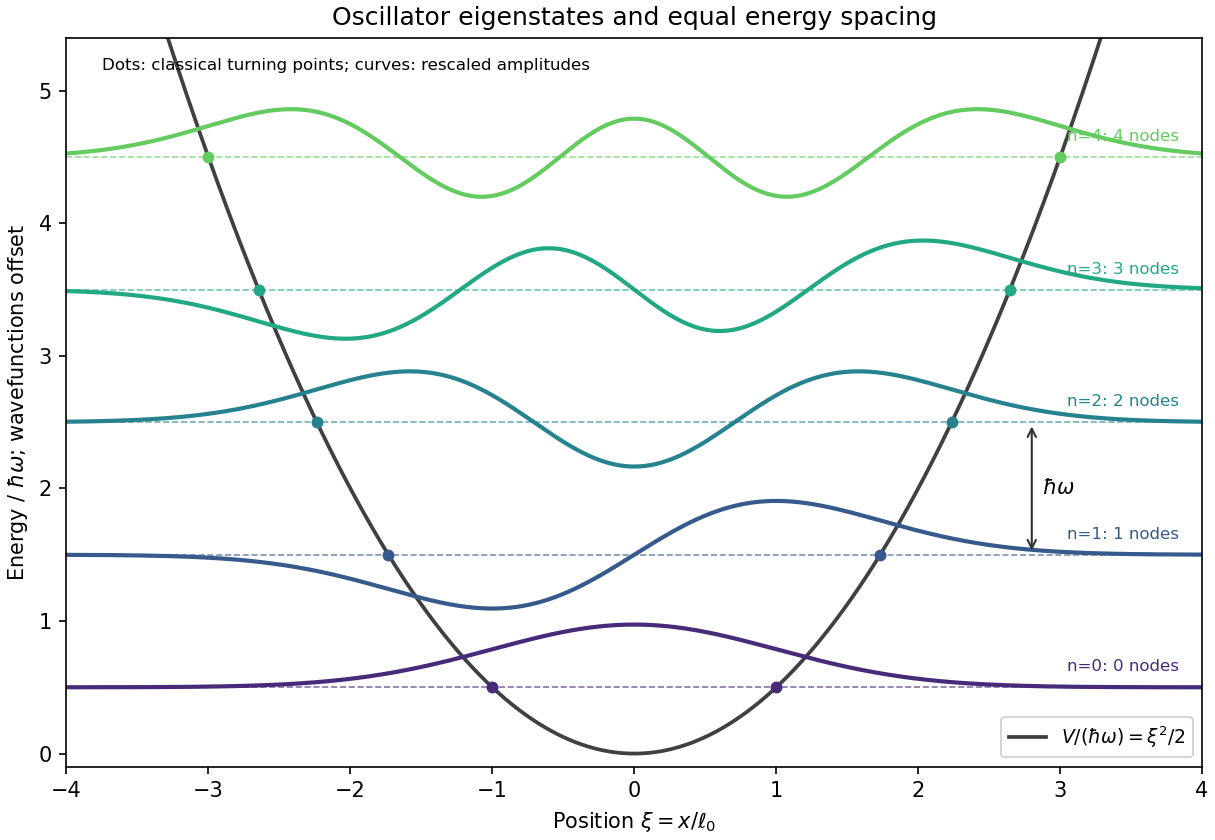
The wavefunctions are plotted with arbitrary vertical scale about their energy levels. Their signed excursions are amplitudes, not additional energies or probability densities.
orbital angular momentum generates spatial rotations and is . With , its components satisfyThus and one component, conventionally , have simultaneous eigenstates, while all three components cannot generally have sharp values. On ordinary single-valued spatial wavefunctions,The spherical harmonics form an orthonormal angular basis. The integer restriction is specific to orbital wavefunctions; half-integer spin is an intrinsic degree of freedom, not the angular dependence of a scalar spatial wavefunction.
The angular momentum ladder operators obeyThe ladder ends at , producing states. A state with specified has a sharp projection , but the angular momentum magnitude is , not . No classical picture of a vector with simultaneously fixed Cartesian components reproduces all these measurement properties.
In a central potential, rotational symmetry gives . separation of variables yields . The radial Schrödinger equation includes a centrifugal potential , which suppresses small-radius amplitude for nonzero . The energy is independent of when rotational symmetry is intact, but need not be independent of . A magnetic field can break that degeneracy. Spatial inversion gives , connecting orbital angular momentum to parity and to the even/odd rotational restriction for the hydrogen spin isomers.
Past exam of the physics A course of the University of Cambridge 2018 Paper 1 Section A A2 Solution 2026-10-18
The infinite square well has energy levels , with . The longest absorption wavelength corresponds to the smallest available energy difference from the ground state, namely . Its position matrix element is nonzero because the two states have opposite parity about the center of the well, so it is an allowed electric dipole transition.
Equating the photon energy to this gap givesHere the photon gap is approximately , not the ground-state energy itself.
Assume and define so that the potential is that of a quantum harmonic oscillator. The two trial forms have derivativesSubstitution into the stationary Schrödinger equation cancels the terms precisely when . Normalizability selects the positive root,The remaining constants giveFor later overlaps choose positive normalization constants. The Gaussian integral gives , while its second-moment integral gives . Thus both wavefunctions have unit norm and are orthogonal by their opposite parity.
The real Gaussian is positive everywhere and has no nodes; the odd state has exactly one node at . The Sturm oscillation theorem orders one-dimensional bound states by their node count. Consequently these are the ground state and first excited state, respectively, also agreeing with the oscillator spectrum .
The orbital angular momentum of a particle is the operator , with in the position representation. Its angular momentum commutation relations areThus one may specify and one component, conventionally , simultaneously. One generally cannot assign sharp values to all three components, because they do not commute. The common angular eigenfunctions are the spherical harmonics:For a scalar orbital wavefunction, single-valuedness in the azimuthal angle gives integer , and regularity on the sphere and termination of the ladder give integer . Half-integer angular momenta describe intrinsic spin rather than scalar orbital motion.
The ladder operators obey . Their normalized action isThe coefficient vanishes at the top or bottom of the multiplet. Its squared magnitude follows from , and positivity of the resulting norm constrains the allowed values.
For a central potential, the Hamiltonian commutes with and every component of . Stationary states can be separated as , and rotational symmetry makes the energy independent of , giving a quantum degeneracy at fixed radial label and . Additional degeneracy between distinct values requires additional structure, as in the Coulomb potential. The parity of is . These results organize atomic orbitals and their selection rules. They describe quantized rotation and symmetry, without assigning the electron a classical orbit or a simultaneously definite three-component angular momentum vector.
Invert the given ladder operators:Because the Energy eigenstate are orthonormal, : each operator changes the state to one orthogonal to . HenceThe result also follows from the definite parity of every oscillator energy eigenfunction, but here it follows directly from the specified operators.
The classical minimum is , attained at . The quantum oscillator has , its zero-point energy; simultaneous zero position and momentum uncertainties are forbidden.
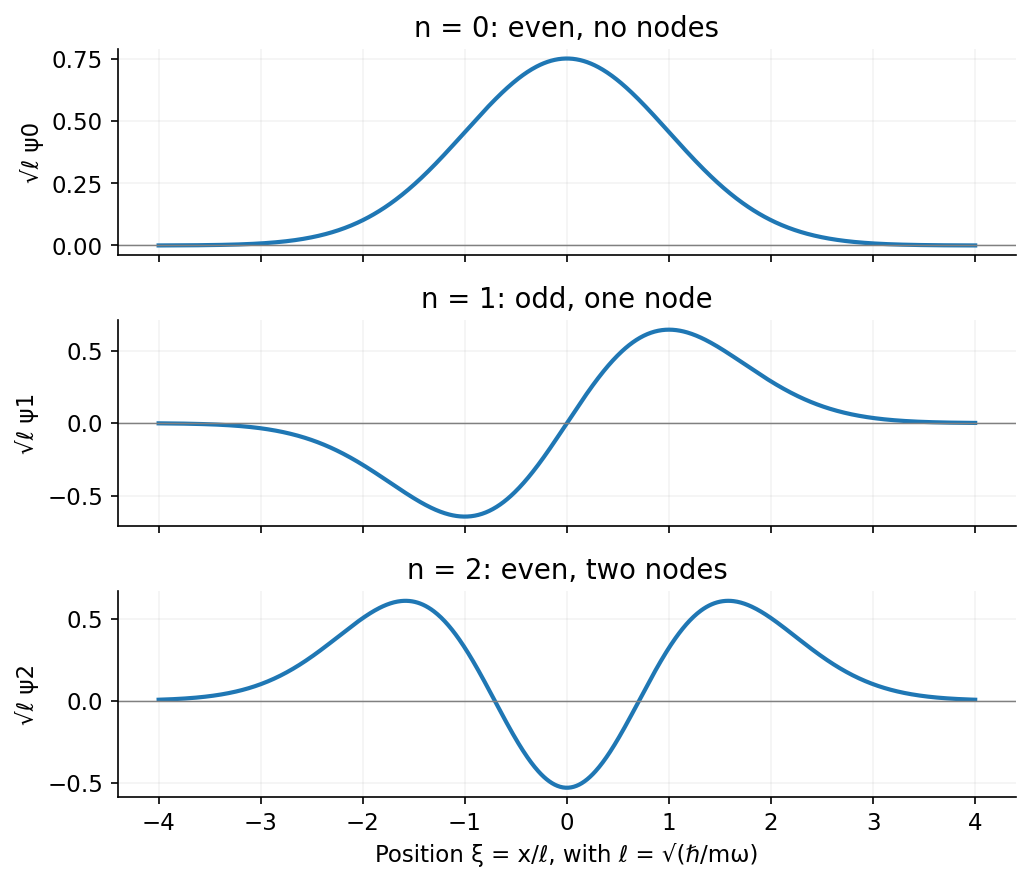
Let and . The first three normalized harmonic oscillator eigenfunctions areThey have respectively zero, one and two nodes, with even, odd and even parity. Their phases may be reversed without changing the state.[ref]


Both are bipartite. Partition the vertices by parity of the number of one bits. A cube edge changes one bit and an interior diagonal changes three bits, so both types join opposite parity classes. In fact is : from any vertex its three cube neighbors and its opposite vertex exhaust the four vertices of opposite parity.
For the displayed multiples are , already least positive residue classes. Those greater than correspond to . Thus their number is . For , its parity is respectively even, odd, odd, even. Gauss's lemma therefore gives
Potassium has a closed 18-electron core and one valence electron. In the orbital label specifies principal quantum number and single-electron orbital angular momentum . The term letter D specifies total orbital angular momentum , the superscript specifies , and the subscript is total electronic angular momentum . The state instead has , , the same spin, and . The closed electron shell that forms the core contributes no net or in this alkali-like approximation. The dash identifies a pair of levels rather than by itself specifying the direction of emission.
The leading electric dipole transition rules for one active electron areThe electronic parity must change, since the electric dipole operator is odd under spatial reflection. The electric-dipole selection rule imposes no general restriction on changing by more than one. The rule for magnetic sublevels depends on the radiation's polarization relative to the quantization axis: the component couples equal , whereas supplies the other changes. In a many-electron description using LS coupling the total orbital rule is , excluding ; for a single active electron the stronger applies. Thus the displayed D–P pair satisfies the leading rules. Relativistic mixing and higher-multipole transitions can permit weaker lines outside the approximation of electric dipole transitions.
Use an orthonormal basis of stationary states and project the Time-dependent Schrödinger equation onto state 2 after removing its free-evolution phase. The stationary Hamiltonian terms cancel the derivatives of those phases, leavingDefine and . With the supplied time-dependent quantum perturbation,and therefore . The state phases may be chosen so and are real for this single driven pair; otherwise probabilities depend on and the conjugate matrix element appears in the equation for . Our is the resonant Rabi angular frequency in the usual convention whose rotating-wave off-diagonal Hamiltonian is .
For a field-free atom with symmetry under spatial reflection, each selected nondegenerate stationary orbital can be chosen with definite parity. Since is odd, , so ; the same reasoning gives . Being an energy eigenstate alone is not sufficient. As an explicit mathematical counterexample, a displaced quantum harmonic oscillator with potential proportional to has energy eigenstates with , giving when . The vanishing used in the atomic model rests on its parity assumption, not merely on stationarity.
At first order in time-dependent perturbation theory set and use the parity result . Decomposing the cosine into its two exponentials givesBoth exponentials contribute to the exact first-order result:Each apparent zero denominator has a continuous limit. In particular the near-resonant fraction tends to as , while the counter-rotating fraction remains bounded on the optical timescale. One may equivalently write the expression asThis form makes explicit and avoids cancellation at resonance. At extremely short time both sinc functions tend to one, so , agreeing with the initial derivative of the original cosine-driven equation. No rotating-wave approximation has yet been made. The separate assumption of weak excitation remains necessary: the first-order expression must not be extended until it predicts probabilities comparable to or larger than one.
In the scalar two-particle model, the fermionic exchange symmetry and bosonic exchange symmetry conditions areFor particles with spin, exchange acts on all their labels; the stated coordinate-only model fixes the spatial symmetry sector. Define . Equal masses make the kinetic operator invariant under exchange, and the assumed potential is invariant too, so . Therefore implies . The componentsare respectively symmetric and antisymmetric eigenfunctions whenever nonzero. Their sum is the original nonzero quantum state, so at least one is nonzero. An eigenspace may contain both sectors if the energy is degenerate.
The normal modes of two harmonically coupled identical particles provide the separation. The coordinate transformation to is orthogonal, with absolute Jacobian one. Exchanging the particles leaves fixed and changes to . Hence bosonic quantum states are even and fermionic quantum states odd in the relative coordinate. The chain rule givesAlso and . Combining the two trapping potentials with the interaction therefore gives the separated Hamiltonian operatorThese are independent oscillators of frequencies and . Both frequencies are positive in the stated range. Their product eigenstates have energiesThe parity of an oscillator level is . Consequently bosons allow even and fermions odd , while is unrestricted.
The bosonic ground state uses , and the fermionic ground state uses . The oscillator length in the relative mode isUsing the normalized Gaussian for each mode givesIndeed by differentiating the Gaussian, so it is the normalized odd first excited state. The ground energies are and .
Choose normalized factors for a normalized product quantum state; this can always be done by reciprocal rescaling of its factors. Since the coordinate Jacobian has absolute value one,If the supplied factors are not individually normalized, the general expression has an additional factor ; choosing normalized factors is the convention in the displayed formula.
For the ground states, put . Then and . Thus, for differentiable with suitable Gaussian integrability and vanishing boundary terms,This is integration by parts, and every polynomial satisfies the required endpoint conditions. The relative-coordinate moments in even and odd oscillator ground states follow by substituting :For odd , both expectations vanish by parity, so this is an equality of zeros rather than an increase in signed mean separation. The even moments show the physical difference. In particular and , so the fermionic root-mean-square particle separation is times the bosonic value. The fermionic probability density vanishes at coincidence , expressing Pauli exclusion principle in this spatial symmetry sector. This is an exchange constraint on the wave function, not an additional classical force. As approaches , the relative oscillator softens and its width diverges; the excluded endpoint would no longer have this normalizable oscillator ground state.
The orthogonal coordinate change preserves the kinetic energy and takes the particle exchange operator to . Thus the spatial wave function is even in for bosons and odd for fermions.
The total potential energy and Hamiltonian separate asAssume so the relative oscillator is confining. Its spectrum is , and its parity in the two-particle relative coordinate is .
The lowest boson state uses , whereas the lowest fermion state uses , . ThereforeFor an oscillator of frequency , . Since ,The factor three is the extra relative-coordinate excitation required by antisymmetry. The supplied oscillator wave functions correspond to kinetic energy ; the extra factor printed before that term in the hint is inconsistent with those functions and the stated energies. The calculation uses the conventional kinetic energy dictated by particle mass .