[ref]
https://www.whatdotheyknow.com/request/natural_science_tripos_physics_e_2/response/2340776/attach/2/FOI%202023%20399%20Zahid%20materials.pdf?cookie_passthrough=1. Original public PDF, physical pages 669–671
virial pressure-radius curve with uniform-sphere binding energy. Put . Isothermality makes , so the virial theorem givesThe curve crosses zero at , rises to its maximum atthen decreases toward zero at large radius. Since , a cloud displaced outward at fixed external pressure has a restoring pressure deficit only on the descending branch. Thus the homologous, isothermal radial mode is stable for , unstable for , and marginal at . The negative-pressure branch is not a physical equilibrium with a positive confining pressure. This conclusion uses the stipulated gravitational-energy approximation, not the exact isothermal density profile.
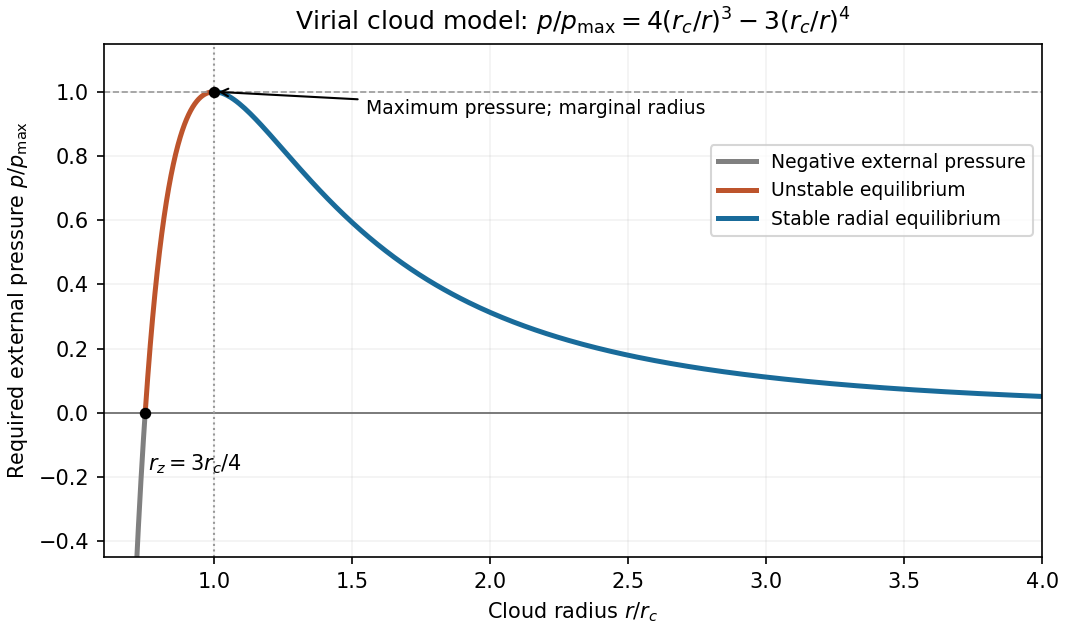
Original pressure-radius curve and stable versus unstable branches of the stipulated virial cloud model
. Details. 
critical mass from a virial pressure turning point. At the turning point, ; henceUsing the cloud's mean density , the condition becomesUsing the boundary density instead changes the numerical coefficient, not this scaling. The coefficient should not be identified with the exact Bonnor-Ebert sphere threshold because the assumed potential energy is different.
mass and luminosity weighting of a stellar initial mass function. Impose finite birth-mass cutoffs . The stellar birth mass and main-sequence luminosity scale asFor a broad mass interval, the low-mass end controls the first integral and the high-mass end the second. Per logarithmic mass interval the weights are respectively and . Finite lifetimes remove massive stars from an aging population, so the luminosity conclusion applies while those stars remain on the main sequence.
exponential closed-box gas consumption. The gross formation rate is , but the permanent locking rate is . The instantaneous recycling approximation and mass conservation give , . ThereforeHere means surviving locked stellar mass in the galactic gas fraction, not the cumulative gross mass that has passed through star formation.
locked-mass and returned-mass yield conventions. Pre-existing metals are locked at rate ; the stipulated newly produced metal source is . ThusFor and initially pristine gas,The effective yield is per unit permanently locked mass; it is not the source parameter . For , and the direct time equation gives . For , the explicitly stipulated metal source vanishes, so this particular enrichment model gives . Constant yield is a trace-enrichment approximation; the formal logarithmic divergence as gas is exhausted must not be interpreted as a physical metal fraction exceeding one.
backward extrapolation of exponential closed-box star formation. Denote the present age of the universe by . With the last paragraph's ,TODO: a present age of the universe or cosmology is needed for a unique numerical estimate. For the explicitly illustrative choice , this is about , requiring of gas at that epoch in the same model. This is an extreme history for a present Milky-Way-like system, although intense high-redshift star formation by itself is not forbidden.
The extrapolation forces a fixed gas reservoir to decline exponentially over many gas-depletion times. Gas accretion, outflows, evolving gas density and star-formation efficiency, delayed recycling, and galaxy assembly break that assumption. The empirical disk-averaged relation is not a universal constant-efficiency law for all gas: the original measurements combined Balmer series H-alpha, atomic gas, carbon monoxide and infrared data, with tracer calibration and dust corrections entering the inference.[ref]
The Global Schmidt Law in Star Forming Galaxies by Robert C. Kennicutt Jr.. Abstract: observed tracers, sample, and fitted index
Cosmological calculations explicitly support continuing cold-gas supply to rapidly forming high-redshift galaxies, providing a physical alternative to this closed-box backward extrapolation.[ref]Cold streams in early massive hot haloes as the main mode of galaxy formation by Avishai Dekel and others. Abstract: stream-fed galaxies and comparison with observed abundance
Radial epicyclic motion. At fixed specific angular momentum, use and . A circular orbit at obeys . Expanding gives , whereFor the radial epicyclic frequency describes simple harmonic motion. The angular correction follows from conservation of angular momentum, , and describes an epicyclic motion around the guiding circular orbit.
Stabilizing terms. In the given local fluid dispersion relation, is rotational support, important at long wavelength; is random-motion or pressure support, important at short wavelength. The term is destabilizing self-gravity. Although the wording refers to stellar dispersion, this algebra uses the supplied fluid approximation; a collisionless stellar treatment has a reduction factor and a different numerical normalization.[ref]
On the Gravitational Stability of a Disk of Stars by Alar Toomre. Abstract and Sections II–V: collisionless stability threshold and random-motion support
Axisymmetric threshold. For , set . Completing the square givesThus gives local axisymmetric oscillatory stability; gives a growing band, withAt , the minimizing mode has zero frequency and is marginal, not a strictly restoring oscillation. Local axisymmetric stability does not establish stability to every global nonaxisymmetric mode.
long-wave and short-wave branches at marginal Toomre stability. For and ,The long-wavelength branch, using the minus sign, requiresThese endpoints are the inner and outer Lindblad resonance conditions. The stated dispersion relation does not restrict every wave solution to that interval. Its plus-sign short-wavelength branch has even outside it: for example, gives and satisfies the equation. Additional branch selection or resonant absorption physics would be needed for an absolute confinement claim. No such condition is supplied.
Toomre stability radius of a flat-rotation disk. With , . Using ,The supplied local model therefore predicts stable radii below about , marginality at that radius, and axisymmetric instability farther out while its assumed constant surface density and thin-disk approximation remain applicable. An infinite constant-density, flat-rotation disk is an idealization, not a global self-consistent galaxy model.
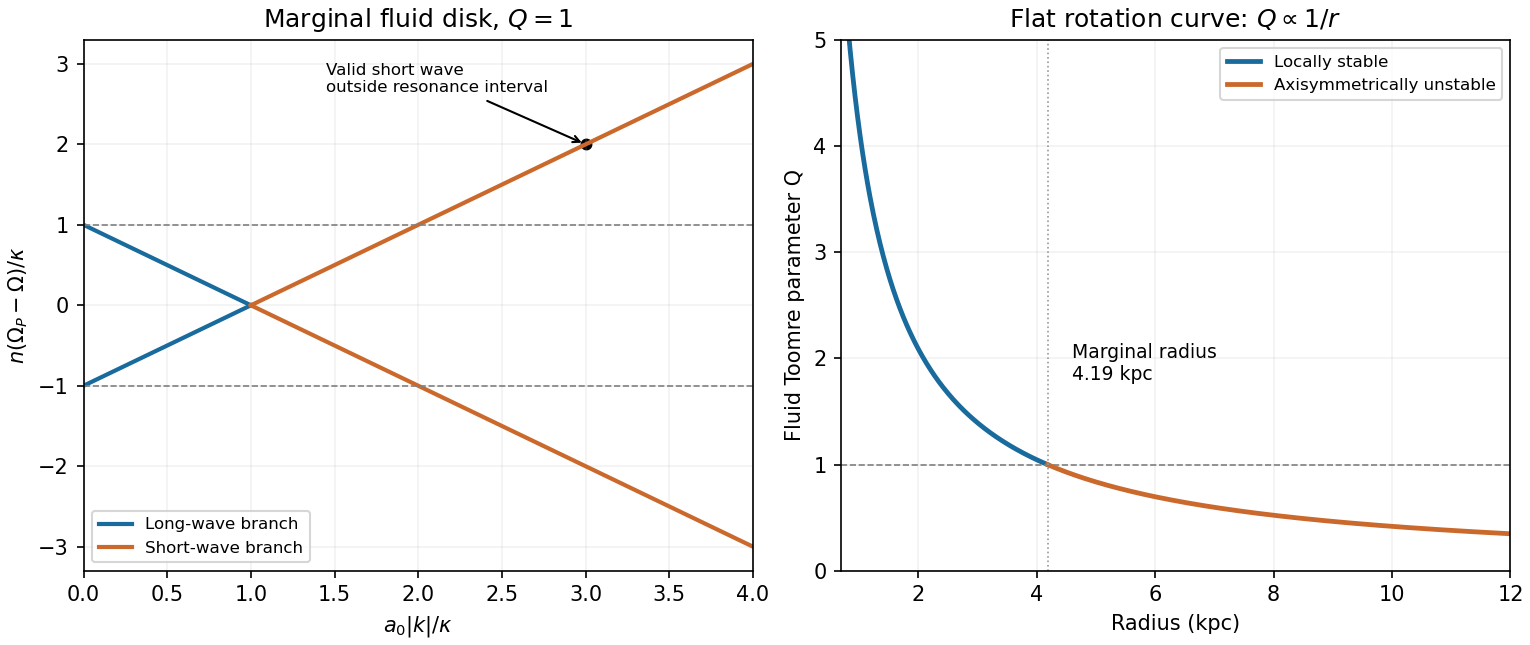
Original marginal-disk dispersion branches and radial Toomre parameter, showing the long-wave restriction and the surviving short-wave branch
. Details. 
For a monatomic ideal gas, write the thermal energy density as . At low optical depth, radiative loss uses an astrophysical cooling function, often written , while contains heating. At fixed density the net radiative gas cooling time is approximately when the denominator is positive; a cooling flow closer to constant pressure must include enthalpy and compressional work. Comparing this time with the free-fall time of a uniform sphere determines whether pressure can be lost during gravitational contraction.
Hot ionized gas cools by bremsstrahlung and recombination; collisional excitation followed by photon escape supplies atomic and metal-line cooling at lower temperatures. molecular line cooling through rotational or vibrational lines and dust thermal emission become important in cold dense gas. Abundances, ionization state, density-dependent collisional de-excitation, and photon trapping all change the cooling function. Optically thick gas requires radiative transfer, not a simple local density-squared loss law.
Heating comes from photoionization, grain photoelectric heating driven by ultraviolet light, cosmic rays, shocks, turbulent dissipation and compression. photoionization heating deposits the photon energy above the ionization threshold as electron kinetic energy. A thermal equilibrium satisfies ; its stability depends on how the net loss changes under the relevant pressure or density constraint, not merely on equality. Different stable balances permit a multiphase interstellar medium. Spectral-line ratios constrain temperature and ionization, but interpreting them requires density diagnostics, interstellar extinction corrections and a radiation-field model.
A cold self-gravitating core initially contracts on a dynamical scale if cooling prevents pressure from halting collapse. Increasing optical depth eventually traps radiation and forms a pressure-supported first hydrostatic core. Dissociation of molecular hydrogen absorbs compressional energy, softens the equation of state and triggers a second protostellar collapse to a compact protostar. Rotation produces a disk; angular-momentum transport permits continuing accretion, while outflows remove some mass and angular momentum.
An accreting object's luminosity includes a contribution of order , with a coefficient set by where accretion energy is radiated or retained. After accretion subsides, gravitational contraction supplies internal luminosity over the Kelvin-Helmholtz cooling time . Hydrostatic contraction heats the interior even while energy is radiated, as follows from the virial theorem and the negative heat capacity of a virialized gravitational system. accretion luminosity must not be substituted for in the contraction time without an energy-budget justification.
Low-mass, nearly fully convective pre-main-sequence stars contract down a Hayashi track at roughly constant effective temperature and decreasing radius and luminosity. A developing radiative core can lead onto a Henyey track toward higher effective temperature; the route depends on mass and opacity. The deuterium-burning energy-generation rate can temporarily moderate contraction, but sustained core hydrogen burning marks arrival on the main sequence. Massive objects may begin hydrogen burning while still accreting, and substellar objects never establish long-lived hydrogen burning. An infrared spectral class reflects envelope and disk emission as well as inclination and interstellar extinction, so it is not a unique stellar age or interior evolutionary track.
Stellar radiation, stellar winds and supernovae return energy, momentum, mass and metals to surrounding gas. Heating, ionization, turbulent support and gas removal can reduce subsequent star formation; swept-up shells can also compress gas locally. Whether thermal energy drives an outflow depends on its radiative gas cooling time relative to expansion: radiative losses can remove energy while leaving substantial momentum transfer. Thus deposited energy alone does not specify the dynamical effect.
The galactic gas regulator has mass budget , where is the returned fraction and is the mass-loading factor. In a quasi-steady state, . This connects feedback to the available gas supply. A wind's kinetic power and momentum flux must fit the source budget and gravitational binding cost. Gas that fails to escape may form a galactic fountain and later return; preferential metal loss changes chemical evolution.
Absorption against a galaxy's stellar continuum provides a concrete outflow test: compare interstellar sodium absorption with the systemic velocity and stellar absorption spectrum. A primary starburst survey found blueshifted interstellar absorption and an inclination dependence consistent with minor-axis outflows. Its saturated lines also illustrate why velocity detection is more direct than a unique column density or mass flux.[ref]
Absorption-Line Probes of Gas and Dust in Galactic Superwinds by Timothy M. Heckman and others. Abstract: NaD spectra, systemic velocities, viewing angle and optical depth
Deprojection, covering fraction, ionization, radius and the unseen hot phase limit total outflow-rate estimates.An accreting supermassive black hole adds radiation, winds and astrophysical jets. Coupling these to the interstellar or circumgalactic medium can suppress cooling or expel gas, especially in deep potentials where stellar driving alone may be inadequate. Jet cavities, line-emitting gas and multiphase outflows test different channels; coexisting activity and low star formation alone do not prove a causal feedback history.
Small primordial fluctuations seed later structure. For adiabatic cosmological perturbations on scales outside the horizon, the uniform-density curvature perturbation is conserved when the non-adiabatic pressure perturbation and the decaying mode can be neglected. A density contrast outside the horizon is gauge-dependent, so its apparent power-law growth should not be confused with directly measured local collapse.
For subhorizon, pressureless matter, the linearized continuity equation, Euler equation and Poisson equation combine intoHubble expansion damps peculiar motion; self-gravity amplifies overdensities. During radiation domination, radiation pressure drives acoustic oscillations and cold dark matter growth after horizon entry is only logarithmic. During matter domination the growing and decaying solutions are and . Dark-energy domination later suppresses growth relative to the matter-era law.
For a pressure-supported fluid the Fourier-mode equation also contains , giving a Jeans length separating acoustic support from gravitational growth. Before recombination, baryons are tightly coupled to photons and oscillate rather than freely following dark matter. Silk damping from photon diffusion damps small-scale photon-baryon fluctuations; after decoupling, baryons can fall into dark-matter potential wells. free streaming smooths species-dependent scales and distinguishes cold from warm or hot dark matter.
Schematically, the linear matter power spectrum can be written under the usual primordial-curvature normalization. The cosmological transfer function records horizon entry, matter-radiation equality, acoustic physics and damping; the linear growth factor records later amplification. density contrasts approaching unity require nonlinear collapse and halo formation beyond this approximation. cosmic microwave background anisotropies and galaxy clustering test the same initial perturbations through different transfer histories; galaxy bias, redshift-space distortions and observational selection enter the galaxy comparison.
Articles by others on the same topic
There are currently no matching articles.