Original public paper: Physical PDF pages 672–675. Both adjoint-vacuum cases, the decay calculation and all three optional notes are covered. Natural units and the metric are used.
In spontaneous symmetry breaking, the action respects a symmetry while a selected vacuum state is invariant only under a proper subgroup. A nonzero vacuum expectation value can identify that choice. For a local gauge theory, gauge transformations are redundancies rather than transformations between physically different states; a gauge-fixed scalar expectation value describes the Higgs mechanism and its massive excitations. It should not be interpreted as breaking an observable local redundancy.
Write the adjoint scalar field as , with Hermitian gauge generators normalized by . Since is constant, the part of the covariant derivative linear in the gauge field is . Both and are Hermitian, so their commutator is anti-Hermitian. The scalar kinetic term therefore contributesMatching coefficients gives the adjoint scalar gauge-boson mass matrixIt is positive semidefinite: for real coefficients , its quadratic form is , where . Its null space consists of generators commuting with the vacuum, the Lie algebra of its centralizer.
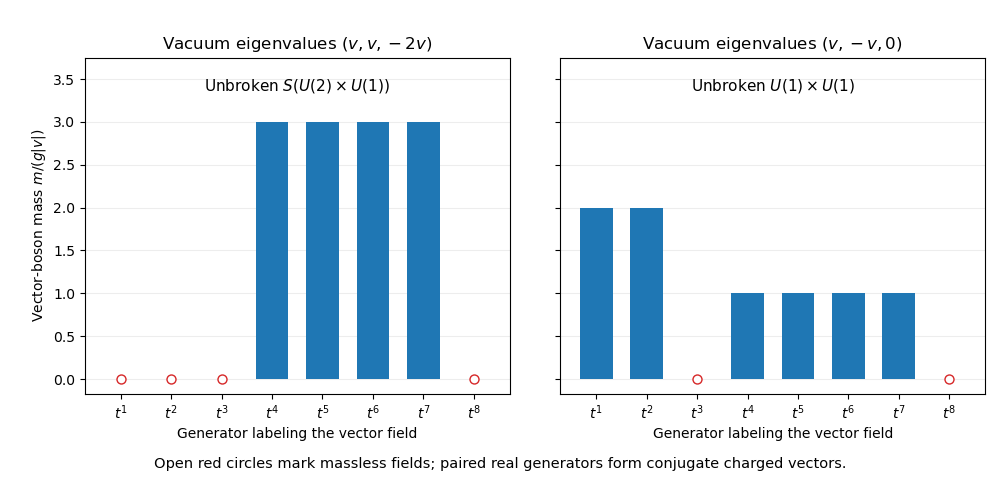
For a diagonal vacuum , the matrix unit obeys . The two normalized Hermitian generators built from each acquireThe diagonal generators commute with every such vacuum and remain massless. Orthogonality of these root generators also shows that the mass matrix is diagonal in the supplied Gell-Mann matrices basis. Take and below; restores the full SU(3) group.
For eigenvalues , the first two entries coincide. Consequently the generators , as well as , commute with the vacuum. The and eigenvalue differences both have magnitude , givingThere are four massless and four massive gauge bosons. The centralizer of a Hermitian matrix in SU(n) preserves the degenerate two-dimensional eigenspace, so the unbroken group isAt the Lie algebra level this is , generated by and . The finite quotient specifies the actual subgroup inside SU(3); simply writing suppresses that global identification. The four real massive fields combine into a complex SU(2) doublet and its conjugate. Unbroken SU(2) rotations relate its two components, explaining the equal masses of the and sectors in this SU(3) gauge theory with an adjoint Higgs field.
For eigenvalues , all entries are distinct. The difference has magnitude , while both the and differences have magnitude . The adjoint scalar gauge-boson mass matrix therefore givesOnly the two diagonal generators commute with the vacuum. Its unbroken group is the maximal torusThe two real fields belonging to each pair combine into oppositely charged conjugate vector states with equal mass. The further equality between the and masses comes from the equally spaced vacuum eigenvalues; the surviving Abelian group alone does not force distinct root-charge sectors to have equal masses. Thus a fourfold massive degeneracy occurs in both examples, but its relation to the unbroken continuous symmetry differs. The scalar potential has not been specified, so no additional symmetry of that potential or physical scalar mass spectrum can be inferred.

The Standard Model is a chiral gauge theory: left-chiral quarks and leptons form SU(2) weak doublets, while the corresponding right-chiral charged fields are weak singlets. The covariant kinetic term contains . With , its off-diagonal generators give the weak charged currentAn overall interaction sign depends on the convention for the covariant derivative and has no effect on this decay rate. The chiral projector explains the vector-minus-axial combination. The Cabibbo-Kobayashi-Maskawa matrix comes from the different left-handed rotations that diagonalize up- and down-type fermion mass matrices. Set and as stipulated.
Let , the massive vector polarization sum. Sum over final spins and average over the two equally populated initial top quark spins. The fermion spin sum and the Dirac adjoint of the vertex giveThe term vanishes because . Anticommuting through the remaining gamma matrices, using , then using cyclicity of the matrix trace and the symmetry of yieldsThe extra factor two from the chiral algebra compensates the initial spin-average factor. The term with is antisymmetric in and vanishes upon contraction with . The remaining gamma-matrix trace isIts contraction givesHere , , and , soThereforeThe two-body Lorentz-invariant phase space has rest-frame momentum . Substitution into gives the two-body top-quark decay widthThe squared threshold factor combines the vanishing final momentum with the corresponding kinematic factor in the squared scattering amplitude. The longitudinal W boson polarization contributes the high-mass enhancement proportional to . The result is at tree level, for an on-shell W boson and ; finite bottom mass and radiative corrections change it. Restoring quark mixing multiplies the width by .
A relativistic quantum field describes both creation and annihilation of excitations; a one-particle wavefunction alone is insufficient when interactions can change particle number. For a free complex scalar field, one conventional mode expansion of a free field isThe apparently negative-frequency term creates a positive-energy antiparticle; it is not a physical particle of unbounded negative energy. The normal-ordered Hamiltonian and conserved global phase charge have the formsParticles and antiparticles have equal mass and opposite additive internal charges. Including both frequency sectors is also essential to the local field commutator: the positive- and negative-frequency terms combine so that spacelike-separated scalar observables commute, respecting microcausality.
A Dirac field similarly contains particle annihilation operators multiplying spinors and antiparticle creation operators multiplying spinors. Its canonical anticommutation relations implement Fermi-Dirac statistics, whereas scalar modes use commutators and Bose-Einstein statistics. These assignments are tied to the Spin-statistics theorem under the usual relativistic locality and positivity assumptions. Conserved charge constrains particle creation and annihilation, but particle and antiparticle numbers need not be separately conserved in an interacting theory.
An antiparticle need not be a distinct species. A neutral real scalar field is self-conjugate; the photon is also its own antiparticle. A Majorana fermion obeys a self-conjugacy condition and cannot carry an unbroken additive charge that distinguishes it from its antiparticle. Electric neutrality alone does not force self-conjugacy when other conserved quantum numbers distinguish the states.
Loop corrections in perturbative quantum field theory integrate over unbounded internal four-momentum. For example, after a Wick rotation, a four-dimensional integral with large-momentum behaviorhas a logarithmic ultraviolet divergence. This is sensitivity to short distances, distinct from a possible low-momentum infrared divergence.
Regularization in quantum field theory first makes the expression mathematically well defined, for example with a cutoff or dimensional regularization in . A regulator is an intermediate prescription rather than a measured physical parameter; a hard momentum cutoff can obscure gauge identities, so their preservation or restoration must be checked. Introduce bare fields and parameters, such as , and split the regulated Lagrangian density into a renormalized part and local counterterms. For instance, wavefunction, mass and coupling counterterms cancel the corresponding divergent parts of Green functions order by order.
Renormalization conditions fix finite parameters through specified observables or a subtraction prescription. Once these physical inputs are held fixed, predictions must not depend on the arbitrary regulator. In a renormalizable quantum field theory, a finite set of operator coefficients suffices to absorb ultraviolet divergences at every perturbative order, with the allowed structures constrained by the theory's symmetries. Gauge theories impose relations among counterterms through identities such as the Ward-Takahashi identity; one cannot choose every diagram's subtraction independently.
The remaining dependence on a chosen renormalization scale describes running couplings and is organized by the renormalization group. An effective field theory can instead include higher-dimension operators suppressed by a high scale. Infinitely many are allowed in principle, but only finitely many contribute at a fixed accuracy in the low-energy expansion. Renormalization is therefore a controlled relation between parameters and predictions at different scales, rather than an instruction to discard every infinity without fixing physical inputs.
The left- and right-chiral components of a charged Standard Model fermion transform in different electroweak group representations. A bare Dirac mass term is therefore not invariant under the full electroweak gauge group. The Higgs doublet supplies the missing transformation properties. With , the gauge-invariant Yukawa interactions arewhere each is a flavor-space Yukawa matrix. For example, hypercharges in the down-quark term add to , while those in the up-quark term add to . Thus the Higgs and conjugate Higgs are required in different terms.
After electroweak symmetry breaking, choose unitary gauge with . The fermion mass matrices becomeA singular value decomposition defines nonnegative physical tree-level masses. The mismatch is the Cabibbo-Kobayashi-Maskawa matrix in the weak charged current. The corresponding physical Higgs boson couples diagonally as in the minimal one-doublet theory. This relates its coupling strength to each mass, but the measured Yukawa couplings remain independent input parameters: the minimal theory does not predict their hierarchy.
The minimal renormalizable Standard Model contains no right-handed neutrino, so it has neither a neutrino Dirac Yukawa term nor a gauge-invariant renormalizable left-handed Majorana mass term. Its neutrinos are massless. Observed neutrino oscillations require going beyond that minimal field content or operator set: adding right-handed singlets permits Dirac masses, while the dimension-five Weinberg operator gives a Majorana neutrino mass of order after symmetry breaking. These alternatives should be distinguished from the charged-fermion Yukawa mechanism.
Articles by others on the same topic
There are currently no matching articles.