The classification of compact surfaces says that every compact connected surface without boundary is homeomorphic either to the sphere with handles, with Euler characteristic , or to a connected sum of real projective planes, with Euler characteristic . The first family is orientable and the second is nonorientable; the displayed invariants uniquely determine the type. With boundary one additionally removes a uniquely determined number of open disks.
Number the vertices of the fourteen-gon in boundary order. The printed edge identifications implyThus there is one vertex, seven edges and one face in the quotient. ConsequentlyThe two occurrences of have the same sign, as do those of , so the orientation on the polygon cannot extend consistently across those paired edges. Thus the surface is nonorientable, and classification identifies it as a connected sum of seven projective planes. The inverse on the first occurrence of and the positive second occurrence have been retained in the vertex calculation.
A Riemann surface is a connected Hausdorff second-countable space equipped with complex coordinate charts whose changes of coordinate are holomorphic with holomorphic inverses. Such charts give it the structure of a one-dimensional complex manifold.
A holomorphic change of coordinate has nonzero derivative. In real coordinates its derivative matrix has determinant by the Cauchy-Riemann equations. Thus every overlap preserves the standard orientation of the complex plane. These chart orientations fit together, proving every Riemann surface is orientable.
For a regular parametrization choose the unit normal . The first fundamental form is the squared length induced on tangent vectors:The second fundamental form records their normal bending:The Gaussian curvature isRegularity ensures .
Expanding the characteristic determinant givesThe product and sum of its two roots therefore giveReversing the normal changes both principal curvatures and the mean curvature in sign, while leaving their product unchanged.
For the ruled surface, , so . AlsoThusThe denominator is positive at every regular point, proving that zero Gaussian curvature is equivalent to the vanishing of the stated scalar triple product. In particular the Gaussian curvature of a regular ruled surface is always nonpositive.
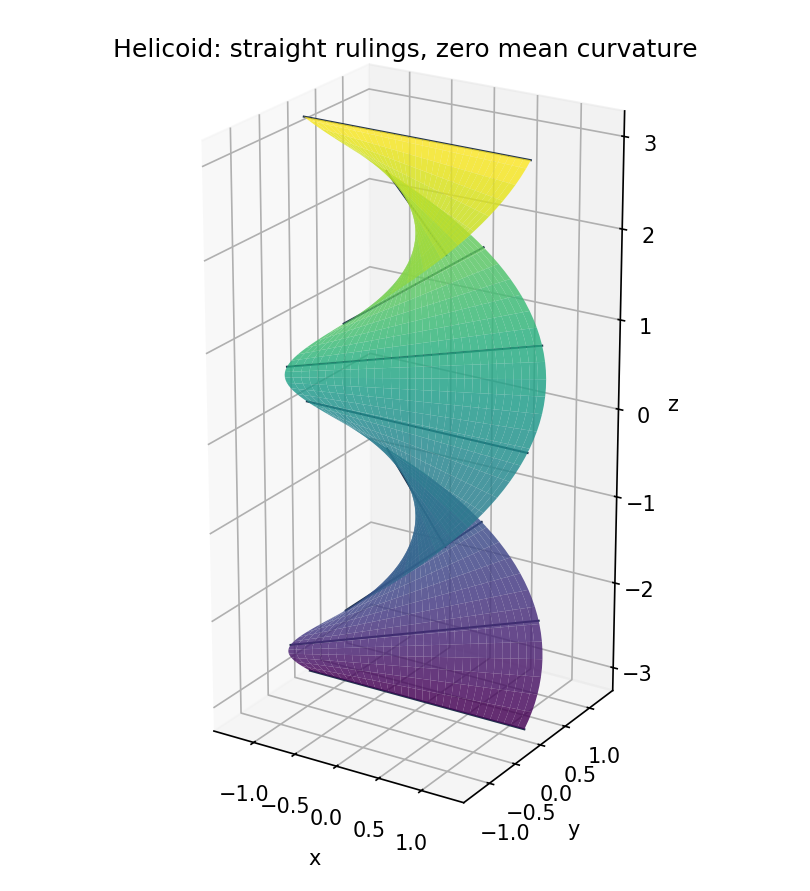
For the helicoid,Hence , , . Since and , both and vanish. The mean-curvature formula therefore givesFor comparison, , so ; zero mean curvature does not mean zero Gaussian curvature.

For the unit-speed curve, the normal curvature is , and the geodesic curvature is . Differentiating twice and taking the normal component kills the terms in , givingAn affinely parametrized geodesic has zero tangential acceleration, or equivalently its covariant derivative of velocity is zero. For unit speed, , and form an orthonormal frame. Therefore , so zero tangential acceleration is exactly .
Since , differentiation givesThe corresponding calculation with givesThus the two requested equations hold exactly when is perpendicular to both tangent basis vectors, which is precisely the geodesic condition.
On expanding the left sides, the coefficient matrix of is the positive-definite metric matrix. It is invertible, so the equations form a smooth second-order ordinary differential equation in local coordinates. The local existence and uniqueness theorem gives a unique solution for each initial point and coordinate velocity. For an arbitrary initial tangent vector this is an affine parameter of constant speed ; it is arclength when . For the solution is the constant curve. This specifies how the arbitrary-velocity statement relates to the preceding unit-speed convention.
Let be reflection in the plane. Choose a point of the regular intersection curve and a unit tangent vector to it. Both the point and are fixed by . The unique local geodesic with these initial data is carried by the surface isometry to another geodesic with the same initial data. Uniqueness therefore gives . Its image lies in the fixed-point set of the reflection, namely the plane, hence locally in the intersection curve. Thus the intersection curve is a geodesic, when parametrized by arclength.
For a positively oriented curvilinear polygon bounding a disk in one coordinate patch, with exterior turning angles , the Gauss-Bonnet theorem statesFor a closed compact surface the global formula isTriangulate the surface with each triangle contained in a coordinate patch. For each face, writing its exterior angles as minus its interior angles gives . On summing, the two contributions on each internal edge cancel, and all angles at each vertex sum to . Thus . Since , this equals , as required. For a nonorientable surface apply the orientable version to its orientation double cover: both the curvature integral and Euler characteristic double. With boundary, the same summation retains the boundary geodesic-curvature integral and the exterior angles at boundary corners, giving the corresponding global boundary formula with right side .
For the sphere, choose the inward normal so that the second fundamental form is . Both principal curvatures are , giving ; the outward choice reverses both signs and gives the same product.
The octant has area , so its curvature integral is . Its sides are great-circle geodesics, hence have zero geodesic curvature. Each interior angle is , so each exterior angle is also . Thereforeverifying the polygon formula directly.
If two distinct geodesic arcs enclosed a disk, regard its boundary as a curvilinear two-sided polygon, with interior angles . These are positive; zero angle would make the arcs tangent and local geodesic uniqueness would make them coincide. The geodesic-curvature terms vanish, so Gauss-Bonnet givesThis contradicts . Thus no such disk-bounding geodesic bigon exists. The disk hypothesis matters because it fixes the Euler characteristic on the right side.
For a projective frame, choose representative vectors forming a basis. Express the final point by . Every is nonzero, since otherwise some of the given representatives would be dependent. Rescale the first representatives to , so the last point is represented by their sum. Do the same for the target frame, with basis . The linear map taking each rescaled source basis vector to the corresponding target vector induces the required projective transformation. For uniqueness, a transformation fixing the first coordinate points is represented by a diagonal matrix. Fixing their sum forces every diagonal entry to agree. It is therefore scalar, giving a unique projective transformation.
If three intersection points of the conics lay on a line, Bézout's theorem would force that line to be a component of either nonsingular conic, impossible. Thus the four points form a projective frame and can be moved to the three coordinate points and . Vanishing at the coordinate points removes the square terms from each conic equation; vanishing at the last point gives .
Substitution gives, by direct expansion,The substitution matrixhas determinant two, hence is invertible over . If the initial frame transformation is represented in the direction old coordinates equal times new coordinates, take . Both quadratic forms then have no mixed terms, proving and are simultaneously diagonal. The same argument applies when an individual conic is reducible but the intersection consists of exactly four distinct points: a line containing three would be a common component, contradicting finiteness of the intersection.
An inflection point is a smooth point where the tangent line has intersection multiplicity at least three with the curve. For a nonsingular plane curve of degree , these are the intersections with its Hessian curve, whose degree is . The original curve is not a component of its Hessian: otherwise in each graph chart the tangent direction would have zero derivative identically, making the curve locally a line and hence a line globally. Bézout therefore gives the upper bound , counting multiplicity. A nonsingular conic has no inflection points; lines are excluded from this finite-contact definition.
Take . Its Hessian determinant isAt infinity the curve has only , which is an inflection point: its tangent is and the restricted equation is . In the chart , substitute into the Hessian equation to obtainThus the full answer isThe four complex values of are distinct and none is , so each gives two distinct nonzero values of . Together with these are all nine inflection points, exhausting the Bézout bound.
For a degree- nonconstant holomorphic map from a compact connected Riemann surface of genus to the projective line, the Riemann-Hurwitz formula iswhere is the local degree. A meromorphic function defines a map to the sphere by giving its ordinary finite values away from poles and value infinity at each pole. The reciprocal function is holomorphic in a neighborhood of a pole, proving holomorphicity there. For use in Riemann-Hurwitz the function must be nonconstant; a nonzero constant still defines a holomorphic map, but of degree zero.
Let . The double pole of gives a degree-two map to the sphere. The torus has genus one, so total ramification is four. One simple ramification point is zero, above infinity. At the three nonzero half-period classes , evenness and periodicity give . Each is a ramification point of local degree two, and these account for all remaining ramification. Put . They are distinct, since a degree-two fiber cannot contain two points each of local degree two.
At each , has a double zero and has a simple zero. Consequently the elliptic quotienthas removable singularities there and no zeros or poles elsewhere except possibly zero. Near zero, and , so . Thus is holomorphic on the compact torus and constant, provingThe printed additional requirement that all three be nonzero is false. For the square lattice , invariance of the defining series under multiplication by gives . At , one has , so periodicity gives and hence . This is one of the three branch values. Distinctness, which is all the cubic construction needs, remains valid.
DefineThe image lies on . Distinct roots make its affine part smooth, and the point at infinity is smooth because the derivative of its equation with respect to is nonzero there. Near zero the projective coordinates and extend holomorphically. Every finite value has two preimages under except at a branch value. Evenness pairs those preimages as , and oddness of distinguishes them unless they are the same half-period class. Therefore the two coordinates together give injectivity and reach both signs of , proving surjectivity onto the cubic. Thus is a bijective holomorphic map to a nonsingular cubic, including when one branch value is zero.
A divisor on an algebraic curve is a finite formal sum with integer coefficients. Its degree is . The principal divisor of a nonzero meromorphic function is . For a nonconstant , zeros and poles are fibers over zero and infinity of the same map to the sphere, each of total multiplicity equal to its degree; hence . A nonzero constant has zero divisor.
Write and . The Riemann-Roch theorem stateswhere is a canonical divisor. Taking gives . Constants span only one dimension, so there is a nonconstant . It has no poles outside these points and at most a simple pole at each. Thus the required nonconstant function exists, with actual poles at some nonempty subset because a holomorphic function on a compact connected curve is constant.
Since every is fixed, has poles only among the first points, with order at most one: a biholomorphic change of coordinate preserves pole order. Thus also has at most poles, counted with multiplicity. At every with , both terms are finite and equal, so .
If were not zero, its principal divisor would have degree zero. It would therefore have at most zeros counted with multiplicity. But it has at least distinct zeros. When this number exceeds , a contradiction. Consequently
Choose an actual pole of ; one exists by nonconstancy and compactness. In a local coordinate centered there, its simple pole has expansion with . HenceThe holomorphic inverse function theorem makes a local coordinate. Here the source notation denotes the reciprocal, rather than an inverse map of the meromorphic function.
The chosen pole is among the fixed points, so maps a sufficiently small neighborhood of it into the coordinate neighborhood. If , then there. Injectivity of this coordinate forces throughout a nonempty open set. The stated identity principle then gives equal to the identity everywhere.
If a nonidentity holomorphic automorphism had more than fixed points, choose that many distinct ones and apply the function constructed above. The zero-and-pole count would give , and the local reciprocal coordinate would force to be the identity, a contradiction. Therefore
Articles by others on the same topic
There are currently no matching articles.