The classification of compact surfaces states that every compact connected topological surface without boundary is homeomorphic to exactly one of the sphere, a connected sum of surfaces consisting of tori, or a connected sum of real projective planes. The torus family is orientable and the projective-plane family is nonorientable; their respective genera are unique. Including makes the sphere the genus-zero orientable case. If boundaries are allowed, the number of removed open discs is an additional invariant.
A finite subdivision into vertices, edges and polygonal faces defines the Euler characteristicCount cells after all identifications. Subdividing an edge adds one vertex and one edge; splitting a face adds one edge and one face. Each operation leaves unchanged. Comparing subdivisions through a common refinement proves independence of the subdivision.
For the connected sum of surfaces, remove an embedded open disc from each surface and identify the resulting boundary circles by a homeomorphism. The resulting closed connected surface is denoted .
Removing a disc decreases the Euler characteristic by one. Gluing the remaining surfaces along their common boundary subtracts the characteristic of a circle, which is zero. ThusThis can be verified by choosing matching subdivisions of the boundary circles and counting the vertices and edges identified in the gluing.
A square model of the torus has one vertex, two edges and one face, so its Euler characteristic is zero. The connected-sum formula givesThe real projective plane has a bigon model with one vertex, one edge and one face, hence characteristic one. Therefore
Take , and . The first is orientable, while , the Klein bottle, is not, so and are not homeomorphic.
Both and are nonorientable and have Euler characteristic . By the classification of compact surfaces, both are homeomorphic to the connected sum of three projective planes. HenceThis is failure of cancellation for connected sums of surfaces.
For a nonconstant holomorphic map of degree between compact connected Riemann surfaces, the Riemann-Hurwitz formula isHere is the local degree, characterized by local coordinates in which the map is . The sum is finite and its terms are nonnegative; a ramification point has .
If , the Riemann-Hurwitz formula gives , where . If , the right side is nonpositive, a contradiction. Therefore
The given Weierstrass elliptic function is even, by replacing the lattice index with . Differentiation givesFor any , reindexing the sum shows . Thus is constant off the lattice. Replacing by and using evenness changes this difference to its negative, so and . Hence is doubly periodic.
It therefore descends to a meromorphic function on , with a double pole at zero modulo the lattice and no others. A meromorphic function is a holomorphic map to the Riemann sphere, sending poles to infinity. Locally at zero, is holomorphic and vanishes there, so the sphere chart at infinity supplies the required extension. The map is nonconstant because it has a pole.
The total pole order in one period cell is two, so the map has degree two. The Riemann-Hurwitz formula for genus one to genus zero gives , hence . Each local degree is at most two, so every ramification contribution is exactly one. ThereforeThey are zero and the three nonzero half-period classes. Zero is ramified because its reciprocal has a double zero. At a nonzero half-period, oddness and periodicity of force ; the count shows these exhaust the remaining points.
For a degree-two map to the Riemann sphere, the Riemann-Hurwitz formula gives . Again each ramification index is two, so the number of ramification points equals . Thus
For a regular parametrization , the first fundamental form is the induced metricIt measures the lengths and angles of tangent vectors. A geodesic is a curve whose unit tangent has zero covariant derivative along itself. For an arc-length parametrized surface curve in Euclidean three-space, this means its acceleration is normal to the surface, or .
Since , we have . The normal-acceleration characterization of a geodesic givesExpanding and differentiating the metric coefficients yields , , and . ThereforeApplying the same calculation to givesThese are also the Euler-Lagrange equations of the quadratic metric energy.
For the surface of revolution, the arc-length condition on its profile gives , , . Thus the geodesic equations reduce toConsequentlythe Clairaut first integral for a surface of revolution.
On a meridian, take and . Both equations hold, so every meridian is a geodesic. On a cross-section , arc length requires . The first equation then holds exactly when , while the second holds automatically. Hence
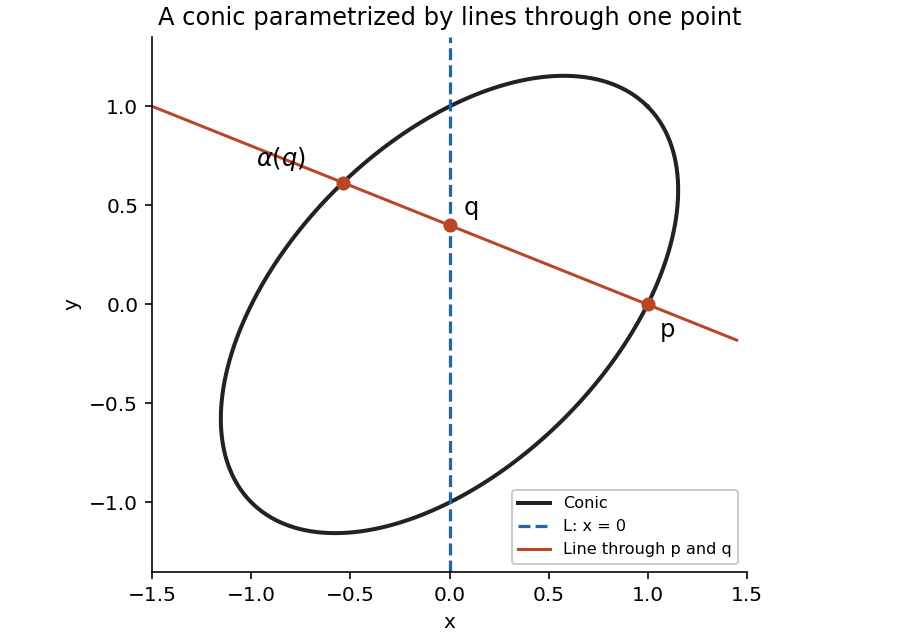
For every , the line meets the nonsingular conic in two points counted with multiplicity by the Bézout theorem. One is ; define as the second, using for the unique tangent line at . Conversely, for , intersect the line with , and send itself to the intersection of its tangent with . Since , each intersection with is unique. These constructions are inverse, so is a bijection preserving the stated collinearity. This is parametrization of a conic by projection.
For the particular conic take and . If , points on have coordinates . Substitution into the conic givesTaking the second intersection gives the explicit mapThe three coordinates do not vanish simultaneously. If , the formula gives , as required for the tangent direction.
For rational points, put when . The full affine list istogether with the parameter , which gives . The denominator is for rational . Conversely, every rational point other than determines a rational joining line and hence a rational point of ; the point is obtained at . Thus this lists all rational solutions.

An inflection point of an algebraic plane curve is a smooth point where the tangent has intersection multiplicity at least three. For a homogeneous defining polynomial of degree , its Hessian curve is defined by the determinant of the matrix of second partial derivatives, of degree . In characteristic zero, the smooth inflection points are exactly the smooth points of .
For a local verification, move a smooth point to and its tangent to , and scale so . The tangent contact is at least three exactly when . The homogeneous Euler identities give the Hessian matrix at that point as , whose determinant is . This proves the criterion for .
For the given cubic, the singularity equations are . No coordinate can vanish at a projective solution, since that would force all three to vanish. Multiplying the equations therefore gives , so singularity requires . Conversely, under that condition the point satisfies all three equations, and the Euler identity places it on the cubic. Thus
The second-derivative matrix isIts determinant is . Hence the Hessian curve has equationIf , this is the union of three lines and is singular. If , divide by and write it as a Hesse cubic with parameter . The preceding singularity criterion gives , equivalentlyThus the complete condition isThe other values beyond the source's first family are zero and the three cube roots of eight.
On the nonsingular cubic, . Substituting this into the Hessian equation leaves . Since , a flex has a zero coordinate. The remaining cubic equation then gives the nine pointswhere . All are distinct, smooth, and lie on both the cubic and its Hessian curve, so they are exactly the inflection points. In particular the nine flexes are independent of within the nonsingular family. This is the flex configuration of the Hesse pencil.
A divisor on an algebraic curve is a finite formal integer sum . Its degree is . The Riemann-Roch space consists of zero and the meromorphic functions with , and . The Riemann-Roch theorem stateswhere is a canonical divisor, of degree . In genus one, for . A negative-degree divisor on an algebraic curve has no nonzero section, since a principal divisor has degree zero and an effective divisor has nonnegative degree. HenceA nonsingular plane cubic has genus one by the genus-degree formula. Therefore , and there is a nonconstant . It has at most simple poles at and no other poles. It cannot have no poles, since a holomorphic function on a compact Riemann surface is constant. It cannot have just one simple pole either, by the allowed fact, or by . Thus has simple poles at both and , and no others.
Apply the preceding argument to to obtain a nonconstant meromorphic function with simple poles exactly at . Both , and the constant function one, belong to .
If , examination at , where only has a pole, forces . Examination at , where only has a pole, forces , and then . Thus the three functions are linearly independent. Since the Riemann-Roch theorem gives ,
Away from , all three coordinate functions are holomorphic and the first is one, so they define a projective point. Near , take a local coordinate vanishing there. Write with , while is holomorphic. ThenThe scaled coordinates are holomorphic and do not all vanish, proving a holomorphic extension. Similarly . At , write and with . The same scaling gives , again well-defined. Hence
Every degree-three monomial evaluated at is with . Its possible pole orders at are at most , , , respectively, and hence at most three each. Therefore .
The vector space of homogeneous degree-three polynomials in three variables has dimension . The target Riemann-Roch space has dimension nine, because its divisor on an algebraic curve has degree nine and genus is one. Thus the evaluation linear maphas nontrivial kernel. Consequently
Away from the three poles, the identity from the preceding part puts on the cubic . The local extensions and continuity put the three pole images there too. Thus , a cubic curve.
The local calculations gaveThey are three distinct points on the line with first coordinate zero. Hence are collinear. This is three-point Riemann-Roch construction of a plane cubic.
Articles by others on the same topic
There are currently no matching articles.