Let , the th triangular number. Pairing the terms of the arithmetic progression proves . We prove the cube identity by mathematical induction. For both sides equal one. If , thenAdding establishes the next case. ThusEquivalently, the same displayed difference telescopes from , providing a direct proof without induction.
An integer square is divisible by four exactly when its base is even: an even base has square , while an odd base has square . Apply this observation to the triangular number obtained above. Since is even,Checking the four residue classes of modulo four, the products have residues , respectively. ThereforeThe original PDF has two alternatives modulo four; the TeX transcription incorrectly turns the second alternative into a modulus-three expression.
An equivalence relation on a set is a binary relation that is reflexive, symmetric and transitive: every satisfies ; implies ; and , imply . Each of these quantifiers ranges over the entire specified set. The separate entries below test these three properties.
This is an equivalence relation. The difference is an even integer, proving reflexivity. If then , proving that the relation is symmetric. If and then , proving transitivity. Its equivalence classes are the translates ; two real numbers need not be integers themselves to belong to the same class.
For nonzero complex numbers, . Since is positive real, the condition is equivalent to . This is an equivalence relation. The ratio gives reflexivity; the reciprocal of a nonzero real ratio shows that the relation is symmetric; and gives transitivity. An equivalence class is a real line through zero with zero removed, or equivalently all nonzero complex numbers with the same argument modulo .
This is not an equivalence relation. For , , so reflexivity fails. It is symmetric, because is the conjugate of , and an integer is real. It also fails transitivity: take and . Then are integers but is not. A single failure would suffice, but these examples identify exactly which properties break.
This is not an equivalence relation. With the usual convention that zero is a perfect square, gives reflexivity, and changing the sign of shows that the relation is symmetric. However because , and because , whereas is neither a positive nor a negative perfect square: . Thus transitivity fails. If “perfect square” were restricted to positive squares, reflexivity would fail as well, leaving the same negative classification.
Let be the constant fuel mass rate, and let be the remaining rocket mass. Take positive motion opposite to the exhaust direction. Over a short interval , momentum conservation including the mass expelled at velocity givesConsequently, while the rocket slides forward,This is the constant-burn rocket with ground friction. Assuming forward sliding begins immediately and persists, integration from rest givesand henceA necessary physical assumption is missing from the printed request. With a common static friction and kinetic friction coefficient , immediate motion requires ; equality allows motion as soon as fuel loss lowers the normal force. Then the acceleration is nonnegative initially and increases thereafter, so forward sliding is consistent. Without this assumption the displayed expression need not be the final speed and can even be negative.
For completeness, the physical rest/sliding solution with these equal coefficients is as follows. If , the rocket never starts before burnout and its final speed is zero. If , static friction initially balances the thrust and release occurs atIntegrating only the sliding interval yieldsThis speed is positive because, with , it equals , whose derivative with respect to is . The case recovers the frictionless rocket equation. If static and kinetic coefficients differ, the release condition uses the static coefficient and the subsequent integral uses the kinetic coefficient; the prompt supplies no second coefficient.
About a fixed origin, the total momentum and angular momentum areA time-independent translation leaves every velocity unchanged. ThereforeThe cross product is perpendicular to , giving the invariantThe other requested transformation follows from the vector triple-product identity:The actual PDF asks about ; the TeX's occurrence of is a transcription error.
If , the translation term vanishes and angular momentum is independent of origin. If , chooseThen , and soThus the new angular momentum is parallel to the total momentum. The freedom along gives the central axis of a momentum system. If the invariant dot product is zero, the new angular momentum is the zero vector. All expressions assume a translated fixed origin, not a moving reference frame.
Use the inclusive convention: a set is countable if it admits an injective function into . This includes every finite set and the empty set. If is injective and , its restriction to is still injective, proving directly that every subset of a countable set is countable.
Enumerate pairs by diagonals. The positive-integer Cantor pairing functionis a bijection : on the diagonal , its values are through , each once, and these consecutive blocks partition . This proves countability without assuming any product theorem.
For a sequence of countable sets , choose injections . For in their union, let be the least index containing . The mapis injective: its encoded index and the injective within-set code recover . Thus a countable union of countable sets is countable. Selecting the injections for an arbitrary given family uses the usual axiom of countable choice; when the encodings are supplied, the displayed construction is entirely explicit.
For finite Cartesian powers, start with the identity injection on and recursively encode as . This proves that is countable for every positive integer and is the constructive proof of the finite Cartesian power of a countable set property.
For each positive integer , let consist of the functions for which is a period. Restriction to the residues is a bijection : any tuple extends uniquely to all of by taking residues modulo , including negative arguments. Hence is countable. Every periodic function belongs to some , soThere is no need to assume the chosen period is minimal; multiple descriptions only create overlap, which does not invalidate the union argument. This is an instance of the cardinality of integer-periodic function spaces principle.
For a prime number , every nonzero residue class has a unique multiplicative inverse modulo : Bezout identity supplies one because its representative is coprime to , and cancellation modulo a prime gives uniqueness. Pair each residue with its inverse. The only unpaired residues satisfy , so ; the Euclid lemma gives or . For odd , these are distinct. Every other pair contributes one to the product of all nonzero residues, leavingFor , as well. This proves Wilson theorem in all cases.
For an odd prime, set . Pair the upper half of the factorial with the negatives of the lower half:If , then is even. ThereforeThis constructs a square root of minus one modulo a prime explicitly.
The modular congruence first implies . Multiplication by such an permutes the nonzero residue classes modulo the prime : if , cancellation gives . Multiply all these residues and cancel their nonzero product to obtain , the usual short proof of Fermat little theorem.
Now . By the Euclid lemma, either or . In the latter case, because ,contradicting the preceding product argument, since is odd. ThusNo unproved assertion about the number of fourth roots is needed.
For , part (i) constructs a solution to . It is nonzero modulo , so and are distinct for odd . Any other solution obeysThe Euclid lemma forces or . Hence there are exactly two solutions. For , a solution to would have , but part (ii) would imply , impossible because cannot divide two. ThereforeThese two cases exhaust all odd primes.
For integers not both zero, their greatest common divisor is the greatest positive integer dividing both. For the degenerate pair use the conventional value zero. A number divides both exactly when it divides both : one direction uses closure of divisibility under sums; the reverse subtracts . The positive common-divisor sets are therefore identical, provingThis also holds for under the stated convention and does not depend on the signs of the integers.
Bezout identity states that there exist integers such that . If a prime divides but does not divide , then , so choose with . Multiplying by gives . Both terms on the left are divisible by , so . Thuswhich proves the Euclid lemma from the requested identity. The separately numbered entries use these arithmetic facts for the Fibonacci numbers.
Write . For , the recurrence and the previously proved greatest common divisor invariance giveRepeating reaches . This also gives the case directly. Applying the same invariance once more,Thus both requested greatest common divisors equal one for every . This is the adjacent-index instance of Fibonacci gcd reduction, derived directly rather than assuming the stronger general formula.
Put . The Fibonacci recurrence matrix modulo an integer is , so . Direct matrix multiplication givesTaking the second coordinate provesFor explicit arithmetic behind the second power, squaring gives , whose square is the displayed . Thus the modular period assertions follow from calculations and the recurrence, not from quoting a period theorem.
The same recurrence matrix hasTherefore , and in particular . Starting from and iterating,Consequently every nonnegative index divisible by five has a Fibonacci number divisible by five, including index zero. This directly proves the requested divisibility without assuming a general Fibonacci divisibility theorem.
For each of the arguments of a function , there are choices of image, independently. Thus there are functions. A binary relation is a subset of the ordered pairs in , giving relations.
Represent a binary relation by its incidence matrix, with row and column . Requiring some with means that column must be a nonempty subset of the possible rows. Each column therefore has choices, independently, givingrelations with no empty column.
To impose no empty row as well, apply the inclusion-exclusion principle within this already column-nonempty family. Let be the family whose row is empty. If a specified set of rows is empty, every column must be a nonempty subset of the remaining rows, giving possibilities. There are ways to choose those empty rows. Thus the number with neither an empty row nor an empty column isThis is the binary relations with no empty row or column count. It does not require symmetry or transitivity of the relation. If , there is one empty function and one empty relation, and all quantified nonempty-row/column requirements are vacuous; the formulas still hold with the combinatorial convention for an empty product.
With no electric force, the Lorentz force equation isIts scalar product with velocity proves conservation of energy for the particle's kinetic energy:If with a fixed unit direction , then , so the parallel component of velocity is constant even when the field magnitude varies.
The angular momentum about the origin does not generally remain constant, becauseFor example, at an instant with , and , its derivative is , nonzero when those factors are nonzero. A force perpendicular to velocity can preserve kinetic energy while exerting a nonzero torque.
For the constant axial field, Cartesian equations are , , and . Use the signed projected areal rate . ThenThusThe second equation is the magnetic axial angular-momentum invariant, replacing ordinary conservation of . In the symmetric gauge, the added term is the magnetic contribution to canonical angular momentum; it is the axial component that is conserved, not the full mechanical angular-momentum vector.
Let be the constant squared transverse speed. If the motion has a nonzero parallel speed, , where is total kinetic energy. Solving the invariant and using givesThe TeX transcription omits the angular equation, which is present in the PDF and restored here. The PDF's positive radial root describes the outward branch only. An inward branch needs the minus sign, with sign changes at radial turning points; polar coordinates themselves are singular at . These qualifications are needed for a global description of a cyclotron trajectory whose radius about an arbitrary origin can both increase and decrease.
The initial time-dependent-field discussion treats the stipulated magnetic force as a prescribed particle model. If one additionally imposes full Maxwell equations with electric field zero throughout a region, Faraday law requires the magnetic field there to be time independent. The energy calculation is nevertheless valid for the stated force model; it does not assert existence of a Maxwell-consistent time-dependent field with zero electric field everywhere.
For positive masses and distinct positions, Newtonian gravitational field givesInsert with . The separation numerator contributes a factor and the denominator , soHence the time-dependent equations are satisfied wheneverThe fixed-shape condition is a Newtonian central configuration, and the resulting motion is a homothetic gravitational motion. It applies away from the collision scale ; a negative scale would require absolute values in the force scaling rather than the same positive-scale formula.
In the pair potentialdifferentiating a pair with respect to produces . Every pair incident on contributes exactly once, so . Moreover for . Differentiating with respect to at one proves the relevant Euler homogeneous function theorem identity directly:Dot each fixed-shape equation with and sum to obtainFor a nontrivial collision-free configuration with at least two positive masses, and , and therefore . Positivity requires an interacting pair; an isolated one-particle system is the degenerate zero-force exception rather than a positive- gravitational configuration. Pairwise cancellation also gives , so the nondegenerate configuration has : its scaling origin is the centre of mass.
Finally, the system's kinetic energy is and its potential energy is . ConsequentlyThis establishes the energy relation for every fixed configuration satisfying the algebraic condition, without assuming any particular particle arrangement.
The parallel axis theorem states for two parallel axes, one through the centre of mass and the other a perpendicular distance away. To see this, expand the squared distance to the translated axis in the mass integral; its mixed term vanishes because the centroidal first moment is zero.
For a uniform solid hemisphere, the moment about a diameter in its flat face is half the corresponding full-sphere moment. With full-sphere mass , it is . The original PDF gives the centroidal displacement ; the TeX's is incorrect. Moving the diameter axis to its parallel centroidal axis therefore yieldsThis is the moment of inertia of a uniform solid hemisphere, not that of a thin hemispherical shell.
Take a cross-section perpendicular to the rotation axis. Let be the underlying sphere centre, the centre of mass and the contact point. During rounded-surface contact, vertically and points toward the curved face, with downward component . ThereforeFor rolling without slipping, is instantaneously at rest and the body rotates about it with angular speed . Thus the centroid speed is . Translation and rotation contributeThe initial vertical base has and , so conserved energy is . Equating the later to this value givesOn the initial roll toward the lowest centroid position, . Static contact friction does no work because the contacting material point is at rest; its coefficient must be large enough for the assumed no-slip motion. The formula describes the rounded-contact phase of the rolling uniform solid hemisphere and should not be continued through a change of contact geometry without another model.
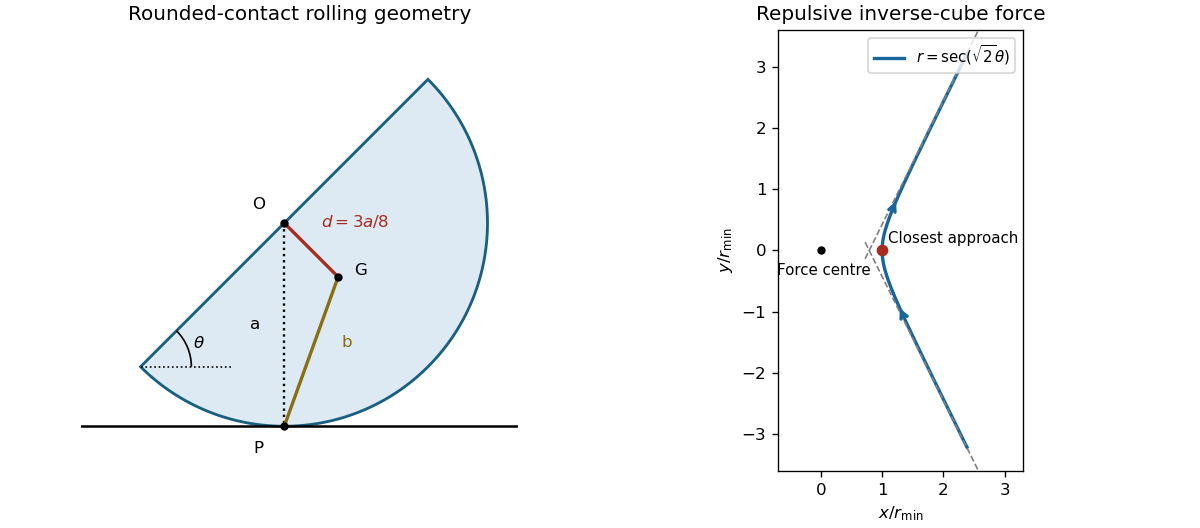
Rolling hemisphere centroid and contact geometry, and scattering under a repulsive inverse-cube force
. Details. 
The unit vectors of plane polar coordinates obey and , as follows by differentiating their Cartesian sine/cosine components. Since ,At a regular point of nonzero speed, rotating this velocity vector through a right angle produces a normal vector. Thus, up to its orientation,Its scalar product with gives the distance from the origin to the tangent line:Where is a differentiable function of and , substitute to obtainA choice of principal normal is undefined on a locally straight segment, but the perpendicular normal line and the tangent-distance formula remain meaningful.
For a central force, the torque vanishes. Use physical signed angular momentum , with . The preceding geometric formula implies , where . Conservation of energy gives . Eliminate to obtain the pedal equation for a central-force orbit:Equivalently the radial energy equation isOn an outward radial branch, divide by and integrate:On an inward radial branch the integrand acquires a minus sign. At a turning point the two branches must be joined; the quoted positive-root integral is a local branch representation, not a single global time-parametrized orbit.
For with , defineA finite moving orbit has . In the radial integral, set . Because , the outward integral, measured from the radial minimum, isJoining the inward and outward branches givesThe orientation in time is determined by the sign of . The repulsive inverse-square potential generates force , an outward inverse-cube central force, not an inverse-square force. The orbit approaches infinity along two asymptotic directions, turns once at and escapes again. The total polar-angle sweep is , and the repulsive scattering deflection isThe effective potential decreases strictly to zero, so it admits no finite circular or bounded orbit. The sketch shows this scattering in a repulsive inverse-square potential. In the radial case , the formulas dividing by are inapplicable; the direction is fixed, the turning radius is and the particle reverses on the same ray.
Articles by others on the same topic
There are currently no matching articles.