Split the vector into its normal and tangential orthogonal projections:A reflection in the plane negates the first component and preserves the second. Thus , giving the Householder reflectionSince and ,The columns of a matrix representation of a linear map are the coordinates of the images of the ordered basis vectors. Consequently, in the orthonormal basis ,Equivalently, with the orthogonal matrix , the change of basis formula is .
Write , , . If , every and the claimed inequality is immediate. Otherwise the sum of squaresholds for every real . Choosing gives , and hence the Cauchy-Schwarz inequality in its stronger absolute-value form:In particular , as requested. For unit vectors, , so this same argument givesThe absolute value is essential for opposite-pointing vectors; it follows from the squared inequality without a sign assumption on their dot product.
For a nonempty set , a real number is its supremum if every satisfies and every upper bound of satisfies . Equivalently, is an upper bound and, for every , some has . The least upper bound axiom states that every nonempty set of real numbers bounded above has a real supremum.
Suppose is nondecreasing and bounded above. Apply the least upper bound axiom to , obtaining . For any , cannot be an upper bound, so there is with . For every , monotonicity givesso . This is precisely the definition of a convergent sequence. If is nonincreasing and bounded below, apply the proved case to ; its limit is the negative of the infimum of the original terms. Thus the bounded monotone sequence theorem follows directly from the axiom:
For the first derivative, , which is the stated formula at . If the formula holds at , differentiating multiplies its coefficient by . The factorial coefficients satisfyThe sign changes, proving by mathematical induction that
Apply the given Taylor formula with integral remainder at . Its polynomial part is , where is the first terms of the requested series, sinceTo justify passage to the infinite series, for ,Therefore the integral remainder obeysThe last inequality follows from , a direct binomial theorem bound. Hence , and
Let be the augmented matrix of the linear system. Consistency means that is in the column space of , equivalently . For a consistent system, choosing one solution gives every solution as . The rank-nullity theorem therefore gives the complete classification:
- Unique: , equivalently .
- Infinitely many: .
- None: .
For the given equations, subtracting the first from the second and the second from the third givesIf , then and the first equation gives . If , the first reduced equation is , so the system is inconsistent. ThusThese conclusions can also be checked from , but the row differences exhibit the inconsistency directly.
Using the Levi-Civita symbol and Einstein summation convention, the scalar triple product isInterchange the dummy indices . Antisymmetry gives , since . Over the real numbers this proves
The normal vector to the first plane and the specified positive direction give . Then and , soNext . A vector perpendicular to both and is a scalar multiple of their cross product; the required length gives the two possibilities and . The original PDF specifies approach to the x-axis. From the original squared distance to that axis is . The two candidate endpoint squared distances are and . Hence .
Adding the given yields . By the proved scalar triple product identity, , so the only vector of the specified length for is the zero vector. Finally set . The last point is , and its plane condition becomes . Thus and .
All waypoints, in the given distance units, areTherefore the final location is . The converted TeX omits two vector instructions and changes the axis; the computation above follows the original PDF.
Put and retain the domain restriction . Then , so the continued fraction simplifies toThe other denominators are nonzero automatically because . Writing , the real-part condition becomesMultiplying by and rearranging gives . Thus the first geometric locus in the complex plane is the circleIts center is and radius is ; it does not contain the excluded point on its circumference.
The principal complex logarithm has imaginary part equal to the complex argument, so its equation gives the open rayIf one interprets the logarithm as multivalued, requiring a value with imaginary part gives the same ray. Expanding in the other equation gives , hence . Its solution is the union of the entire imaginary axis and the horizontal line .
These latter loci bound a right triangle with verticesThe bounded open region is , . Its closure is the closed triangle. Although the logarithm is undefined at , the imaginary-axis locus includes that vertex. The earlier circle is a separate locus and is not a side of this triangle.
The right angle is at , so the circumcenter is the midpoint of hypotenuse :Thus its circumcircle has the complex equationTo find the incircle, let its radius be . Tangency to and puts its center at . The distance from that point to is . Requiring this distance to be givesThereforeThis tangent circle is indeed the largest contained circle. For any contained disk of radius , its center has distances from the three side lines. Splitting the triangle into triangles with that center as vertex gives area , where is its semiperimeter. Here and , so . Our circle attains this upper bound, proving maximality rather than just tangency.
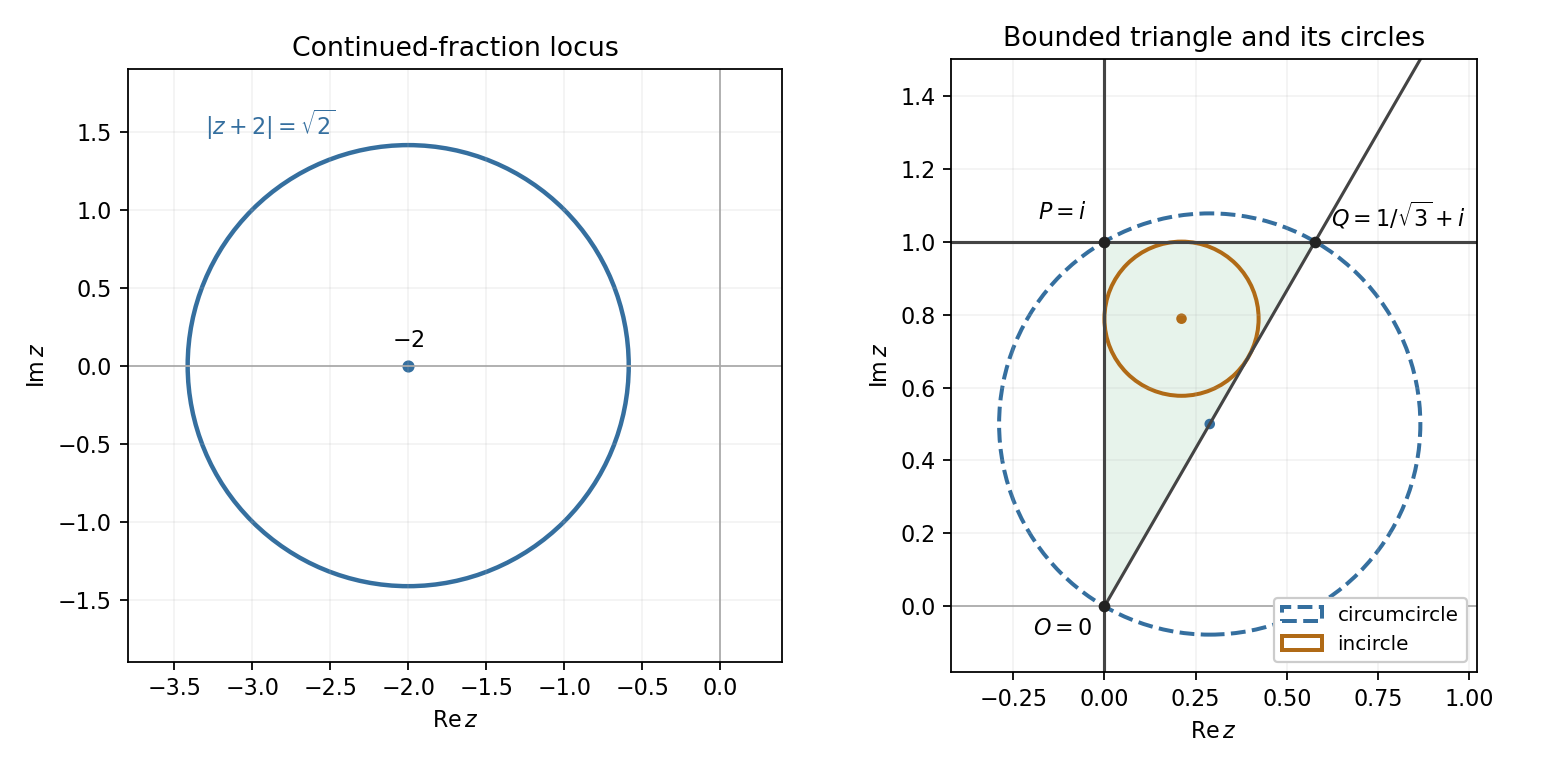
Complex loci and the bounded triangle with its circumcircle and incircle
. Details. 
Yes. Suppose . Taking its dot product with eliminates the last two terms and givesThe nonzero scalar triple product forces . Cyclically using and forces as well. This is the definition of linear independence. Equivalently the three-column matrix has nonzero determinant.
No. For every , takein . These form a minimally dependent vector family: the full family is dependent because .
If the omitted vector is , the remaining coordinate vectors are independent. If the omitted vector is , a relation among the retained vectors has an coordinate coming only from , so its coefficient must be zero; the coefficients of all retained coordinate vectors must then be zero. Thus every -element subfamily is linearly independent, as required for a counterexample. When , the empty subfamily is independent while the one-vector family consisting of the zero vector is not, so the answer remains negative.
A direct construction, valid for every , isThe first coordinates give , andThe first two norms are one. For the third,Thus the required Gram matrix is . The column matrix is upper triangular and has determinantso these vectors are linearly independent. This is an explicit instance of unit vectors with a common inner product; at it reduces to the standard orthonormal basis.
Rolle's theorem states that if a real function is continuous on , differentiable on , with and , then some satisfies .
For the two-function assertion, defineThis function has the required continuity and differentiability and satisfies . Rolle's theorem therefore gives withThis proves the Cauchy mean value theorem even when either endpoint increment vanishes; no division was used.
Now impose the stated zero endpoint values and nonvanishing assumptions near . For each , applying the proved identity on gives some such thatAs , every possible also tends to . Explicitly, for any , choose a right neighborhood of where . If lies in it, so does , and therefore . This proves the endpoint zero-over-zero form of L'Hôpital's rule:No continuity of either derivative is required, only their ratio limit and the given nonvanishing conditions.
For the final limit, near zero , so the real logarithm is well defined. First apply the proved rule to on the right: its derivative ratio is . Next apply it to ; the derivative ratio isThe original quotient is even, so the left limit equals the right limit. Consequently
Use integration by parts on , for :Both boundary terms are zero. Therefore the Wallis integrals satisfyStarting with and , repeated application givesThese formulas also hold at by empty products.
For , , so when . Integrating the strict inequalities proves . In particular . For , the recurrence and giveThusAt the same displayed bounds are , also true directly from .
The squeeze theorem now gives . Substituting the evaluated integrals showsand henceThis is twice the finite-product form of the Wallis product; the proof used only the integral recurrence and strict comparison of its integrands.
For the additive function, setting both arguments to zero gives , and then . Continuity at the given point impliesFor any real , , so is continuous at every point. This proves the continuity part of additive function continuous at one point is linear.
Let . Repeated addition and negation give for every integer . For integers and positive ,so for every rational number . Given any real , choose rational . Continuity and density of the rational numbers giveConversely each real multiple of satisfies the Cauchy functional equation.
For the multiplicative equation, assume first that is not identically zero and choose with . Then forces . Nextmakes every value nonzero, andmakes every value positive. Thus is a continuous real additive function, since . The proved classification gives for a real constant . This solves the continuous exponential functional equation:Both types satisfy the equation and continuity, and every nonzero solution is everywhere strictly positive.
Rearranging the assumed positive-term ratio inequality givesInduction therefore yields for every . In particularThe positive partial sums of the first series are nondecreasing and bounded above, so the bounded monotone sequence theorem proves that they converge. This is the ratio comparison test, and establishes convergence of .
Extend the sequence by . Cancelling factorials in consecutive normalized central binomial coefficients givesThe given logarithmic inequality therefore impliesOn , , so summing its integrals gives . Exponentiating yields the explicit boundAlso every consecutive ratio is less than one, so is strictly decreasing, a fact needed for the alternating endpoint.
At the terms are . Their decay to zero alone is insufficient for convergence. In factbecause the difference has numerator . Since , induction gives . The comparison harmonic series diverges, so
At the terms are . Part (ii) gives positive decreasing magnitudes tending to zero, so the alternating series test applies. To see the convergence directly, let . Thenwhile , obtained by grouping . Thus the even partial sums have a finite limit. The odd partial sums differ from them by , so the whole sequence of partial sums has the same limit. Absolute convergence would require convergence of , already disproved. Hence
Articles by others on the same topic
There are currently no matching articles.