For the polar decomposition of an invertible real matrix, start with . For nonzero , , since makes invertible. The spectral theorem for real symmetric matrices gives an orthonormal basis with and . DefineThen is a positive-definite symmetric matrix, , andbecause . Thus is an orthogonal matrix with positive determinant. Set ; it too is a positive-definite symmetric matrix, and . Moreover . This provesThe positive square root is unique: any positive symmetric square root of commutes with , preserves its eigenspaces and has the positive scalar square root on each of them. Hence , then and , are unique. These are the right stretch tensor, rotation and left stretch tensor of the polar decomposition in continuum mechanics.
A standard spectral strain measure isTake , and , with strictly increasing; the customary stronger condition gives a regular one-to-one parameterization of all positive principal stretches. The zero condition makes a rigid rotation strain free, monotonicity distinguishes extension from contraction and prevents nonunit stretch from being strain free, and the derivative normalization gives the ordinary infinitesimal strain. Indeed, for ,Under a superposed spatial rotation , and hence remain unchanged, giving material frame indifference. Choosing satisfies all these conditions and gives the Biot strain tensor
The meaning of work-conjugate stress and strain here is that a symmetric material tensor satisfiesfor every admissible rate, with both powers measured per reference volume. To keep the nominal-stress index convention explicit, write , so and the power is . Differentiating gives , where is skew. Conservation of angular momentum gives symmetry of , or equivalently of . ThereforeThe first term vanishes because a symmetric tensor has zero contraction with a skew tensor. Since , the symmetric Biot stress isIf the nominal stress is instead stored spatial-index first as , the same answer is . The symmetrization is essential: need not itself be symmetric.
Use . In cylindrical orthonormal bases the principal stretches are , and . Incompressibility givesIntegrate from the inner surface to obtain the inflation and extension of an incompressible tube kinematicsIn particular . The radial principal stretch is , so the reference-volume strain energy density is with the three arguments .
For reference length , the stored energy is , whereLet denote the total axial resultant acting on the material annulus. The work of the inner pressure on the cylindrical wall is , and axial work is . Reversible virtual work therefore saysThe independent derivatives of the circumferential stretch areEquating the coefficients of and provesand the corresponding axial resultant isHere holds fixed. If means the independently applied load on pressurized closed ends, the pressure also does axial end-cap work . Equivalently its complete work is . In that convention,If includes the end-pressure resultant, it is itself. Stating this distinction is necessary because the ends are not specified; the pressure formula is the same in both conventions.
For the specified Mooney-Rivlin solid convention, differentiating the constrained strain energy density givesThusPut . If , yields . The factor cancels becauseThe limits are and , so direct integration givesFor , all circumferential stretches equal and the original integrand vanishes, so this formula still holds, with . This also verifies its continuous limiting value without dividing by zero.
Let and use a fixed arbitrary material subvolume in the reference configuration, with outward unit normal . The reference mass density is time independent. The global momentum conservation law isThe divergence theorem, differentiation under the integral, and arbitrariness of give
The global conservation of energy law includes both internal energy and kinetic energy:Here is outgoing heat flux per reference area. Localizing givesSubtract the scalar product of the local momentum conservation law with . Since , this proves the Lagrangian internal energy balance
For positive temperature , the global entropy inequality isIts local excess is a nonnegative production density . Expanding the divergence of proves the Lagrangian entropy inequality in the requested equality form:No constitutive assumption on the heat flux was needed for these balance identities.
For the reference-configuration jump balances, make the orientation convention explicit. Write and let point from the minus side to the plus side. Let be the actual interface speed in direction . A signed level function with the plus side obeys on the interface. For , the singular time derivative is ; the singular reference divergence of is . Thus a local conservation law bounded sources has the Rankine-Hugoniot conditionThis is also the shrinking moving-pillbox calculation of the global law: finite volume supplies have no surviving surface term.
To match the displayed positive-sign momentum jump in the paper, use its speed parameter as , so the interface travels in direction . Assuming continuous and no surface force or energy supply, the jump laws are thenand, from ,The last inequality is nonnegative entropy production concentrated on the interface. Temperature and flux in the entropy term are the traces on their respective sides; one cannot take a common temperature outside the jump unless it is continuous.
If is instead defined as the interface speed in direction , all three terms above acquire a minus sign. In particular the printed positive-sign momentum formula requires the opposite speed convention; changing just the order of the jump does not remove this convention issue. If reference density is discontinuous, replace by the jump of the complete conserved density.
An equivalent internal-energy jump follows by subtracting the kinetic-energy jump using , where :The averaged traction appears because ; using a one-sided traction would generally be incorrect.
The spin tensor is skew, and means and . Differentiate all factors to obtain the corotating-frame representation of a Jaumann derivative:Thus the Jaumann derivative is the ordinary derivative of the tensor components in this rotating frame.
Put , , and , . The corotational Jeffreys fluid equation reduces toFor , an integrating factor gives the complete finite-initial-time solutionThe infinite-past constitutive history selects , as holds for bounded past stress histories, and assumes convergence of the integral. Taking that limit and rotating back provesA general initial stress would retain the displayed homogeneous term. Incompressibility means ; the pressure reaction is added as and does not affect this deviatoric stress equation.
For simple shear deformation, direct multiplication gives the velocity gradient and its symmetric and skew parts:Use the signed counterclockwise angle withThus the material frame rotates clockwise for positive shear rate. This angle convention is necessary for the signs of the sine terms. Set . With and , multiplication yieldsSubstitution in the history formula provesThe suppressed third row and column are zero for the selected infinite-past history.
For constant shear rate , . Put . The real and imaginary parts of the elementary exponential integral giveThe constant-rate deviatoric stress therefore has componentsThe normal-stress difference is . As checks, the small-rate shear viscosity is , and removes all memory and normal stresses, leaving the Newtonian relation .
Let and . The supporting-hyperplane inequality for the convex viscous dissipation potential givesThe stress is symmetric because its argument is a symmetric rate-of-strain tensor, so . Subtracting the two functional values yieldsIntegration by parts turns the first integral intoInertialess force balance is . The variation vanishes on , and the traction is on . Thus both the volume and boundary contributions cancel exactly, proving the convex viscous potential minimum principleOnly convexity, not strict convexity, is required, so no uniqueness follows just from this argument. For incompressible flow, admissible trial velocities must also be divergence free. The pressure term then does no work, because ; the same proof applies to the deviatoric constitutive law.
For , differentiation in the symmetric tensor space gives . Therefore the Bingham fluid viscous dissipation potential givesThe deviatoric stress is trace free since is trace free; an arbitrary pressure reaction completes the Cauchy stress tensor.
At the yield term is not differentiable, and the correct relation is the subdifferential condition. A symmetric trace-free stress is admissible there ifThe Cauchy-Schwarz inequality shows that this is equivalent to ; necessity follows by choosing proportional to . Hence the no-strain-rate restriction isThe quadratic term has zero derivative at zero and does not change this restriction. This is the unyielded part of the Bingham plastic law.
For flow along the plates, write , and take as the pressure-drop magnitude. The only nonzero rate-of-strain tensor entries are , so and the yielded shear stress law isForce balance gives . The prescribed odd, continuous shear stress fixes its integration constant to zero, provingFor the inverse shear law is
The original PDF also calls odd. That assumption is inconsistent with a nonzero flow between identical fixed plates: the inverse shear law makes odd, whereas the derivative of an odd is even. Both can hold only if , and the no-slip wall values then give . Thus with the literal odd-velocity requirement, there is no admissible flowing solution when . The standard pressure-driven velocity is even; replacing that erroneous parity yields the intended profile below.
If , the whole gap is unyielded and the fixed no-slip walls force . Otherwise let . The plug flow of a yield-stress fluid occupies . In the upper yielded layer , and integration from givesIn the plug the velocity is the constant , and reflection gives the lower layer. The complete plane Poiseuille flow of a Bingham fluid answer isThe profile is continuous with continuous first derivative at the plug boundaries, vanishes at both walls and tends to the ordinary parabolic profile when . If signed pressure gradients of either direction are allowed, the threshold is , and reversing the gradient reverses the velocity.
Put , , , and write , . In antiplane perfect plasticity, force balance and the fixed yield surface giveDifferentiate the second relation in . Along the proposed characteristic curve,Similarly, differentiating the yield relation in givesThe associated flow rule and give , . ConsequentlyThus both shear stresses and the antiplane velocity are constant on each characteristic. Assume a regular yield gradient . Since the stress is constant on a characteristic, its tangent has fixed direction, so the curves are straight lines, apart from arbitrary reparameterization by .
In a centred antiplane plastic fan those lines emanate from the crack tip. Henceand a radial line at angle from the axis must haveThe crack faces have normal in the direction, so traction freedom requires there. The fan joins the adjacent constant crack-face stress region along the characteristic carrying that stress. Its boundary line therefore satisfieswith the direction interpreted directly when the denominator vanishes. The original PDF reverses this ratio. Its displayed ratio is , whereas the tangent of an angle from the axis is . The distinction cannot be removed while retaining both its stated characteristic direction and its angle convention.
For the elliptic yield surface, with ,On the forward fan , choose the loading branch . The radial tangent condition gives . Substituting in the yield equation and choosing the positive square root gives exactlyFor the endpoints, use the equivalent nonsingular expressionsThey give on the upper boundary ray and on the lower one. The correct boundaries are , the vertical line through the tip. At either of these stress states and , so the characteristic tangent is vertical. The printed boundary ratio would instead give a horizontal line, providing a concrete counterexample to that intermediate assertion.
Extend the upper and lower rear sectors by the constant stresses and respectively; these satisfy the traction-free crack faces and match the fan stresses continuously. The reversed loading has all stresses negated. To check equilibrium within the forward fan, differentiation givesand hence . The yield equation is satisfied identically as well.
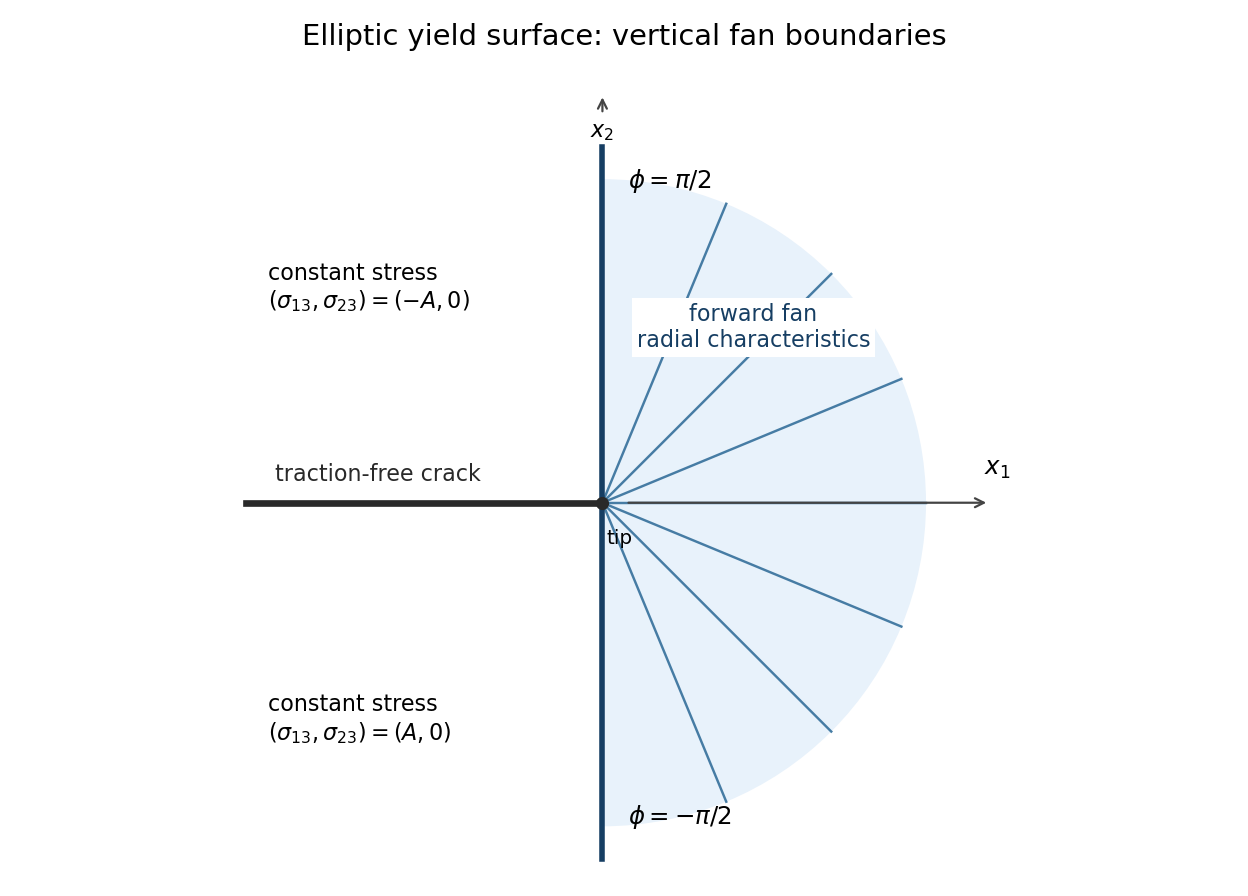

Finally , while . The associated flow rule reduces tofor this stress branch. Any such angular velocity field is constant along the rays and has constant values in the adjacent rear sectors. Its magnitude and angular variation require velocity or loading data beyond the specified traction-free faces; the local stress fan alone does not determine them.
Articles by others on the same topic
There are currently no matching articles.