Lagrange's theorem states that for a subgroup of a finite group , . In particular divides ; the equal-sized cosets partition .
Apply the theorem to inside both subgroups. Its order divides both coprime orders, so . For and , the group commutator lies in by being a normal subgroup, and in because . It is therefore the identity. Thus every element of commutes with every element of .
Define by . The cross-commutation just proved gives , so this is a group homomorphism from the direct product of groups. The product assumption makes it surjective. If , then , so both entries are the identity and the kernel of a group homomorphism is trivial. HenceThis proves the internal direct product theorem in the present coprime-order setting, rather than merely matching the numbers of elements.
Both factors being normal subgroups places cross-commutators in their intersection, forcing cross-commutation.
A cyclic group has one generator of a group: . An abelian group has for every pair of elements. Powers of one element commute because , so every cyclic group is Abelian. The Klein four-group is Abelian but is not a cyclic group: every nonidentity element has order two, whereas a generator of a group for a four-element cyclic group would have order four.
Fix a generator of a group of . A group homomorphism is determined by because , and the relation forces . Conversely, such a defines : exponents differing by a multiple of give the same value, and addition of exponents verifies the group homomorphism law. Thus the homomorphism from a finite cyclic group correspondence isFor , the order of a permutation is the least common multiple of its disjoint cycle lengths. The condition allows identity, transpositions, two disjoint transpositions, and four-cycles. The sixteen homomorphisms are , with the full list of possible generator imagesThe remaining eight elements of the symmetric group are three-cycles and do not qualify.
Differentiation gives . The squared speed is , so the arc length isThe speed never vanishes, so this is a regular curve throughout its parameter range.
Use the arc length coordinate oriented in the direction of increasing : , with . Also , giving and . The Lagrange identity for the cross product yieldsThe curvature of a space curve is thereforeFor the forward portion , this has ordinary nonnegative arc length . If instead nonnegative distance is measured backwards from , put for ; that branch has , . Choosing orientation avoids confusing the two points at the same unoriented distance.
For a continuously differentiable vector field on all of , the necessary and sufficient condition for a conservative vector field is . Necessity follows from equality of mixed partial derivatives of a potential; sufficiency uses the being a simply connected space. On a general domain the topology cannot be omitted.
Here the relevant mixed partial derivatives areThus the curl vanishes. Integrating the first component in gives . Matching the second component gives , hence . Matching the last component forces . A potential of a conservative vector field with the convention is consequentlyIf a physical potential is defined instead through , it is .
Take and let act by left multiplication . Each is a permutation, with inverse . Associativity gives , so is a group homomorphism into . If is the identity permutation, evaluating it at the identity element gives . ThusThis is the Cayley theorem, realized by the left regular action, which is a faithful group action.
Place the cube's vertices at . Its full symmetry group of a cube consists of signed permutation matrices. To see completeness, a cube symmetry fixes its center of a group and permutes the six face normals, so it sends coordinate axes to signed coordinate axes; conversely every such matrix preserves the cube. Coordinate permutations and sign changes take any edge to any other edge, so this is a transitive group action on edges.
Choose the edge . A symmetry stabilizing it must preserve its axis direction and its midpoint . It can swap the first two coordinates and independently reverse the third coordinate, but cannot change the signs of the two fixed coordinates. HenceThere are twelve edges and four elements of the stabilizer subgroup. The orbit-stabiliser theorem therefore gives , including orientation-reversing symmetries, not just the twenty-four rotations.
The action defines a group homomorphism . If an element fixes every edge as a set, it fixes every vertex, since each vertex is the unique common point of its three incident edges. A cube isometry fixing all vertices is the identity. Thus this is a faithful group action, and the cube symmetry action on edges embeds as a subgroup withIt is not a normal subgroup. Central inversion belongs to and swaps the twelve edges in six opposite pairs. In , all permutations of cycle type are conjugate, and their number isIf were a normal subgroup, it would contain this entire conjugacy class, impossible for a group of order forty-eight. This avoids relying on a classification of normal subgroups of the symmetric group.
For in the special linear group over a finite field, define the Möbius transformation when the denominator is nonzero, and set when it is zero. At the extra point, for , and for . Determinant one prevents simultaneous zero numerator and denominator.
The orbit-stabiliser theorem states , and for a finite group . The matrix sends infinity to any chosen , so the orbit of infinity is the whole projective line, of size . Its stabilizer subgroup iswhich has elements. ConsequentlyThe SL2 action on a finite projective line need not be faithful: scalar matrices can fix every projective point. Faithfulness is not needed for this orbit calculation.
For and , direct multiplication gives . In , and , soTo rule out all conjugators when , suppose and write . Comparing gives and . Its determinant condition is , so . The nonzero squares modulo five are and , and therefore no such exists. The two matrices are not conjugate in . This is the square-class obstruction in unipotent conjugacy in SL2 over a finite field; checking only diagonal conjugators would not by itself exclude every possible conjugator.
Write the matrix as . Direct multiplication and inversion giveThe identity is and all determinants are one, so these formulas verify the subgroup criterion inside . This is the real Heisenberg group.
The map is a surjective group homomorphism to the additive group of real numbers; its kernel is exactly . Hence is normal and the first isomorphism theorem givesTwo matrices commute exactly when . Requiring that relation for every forces , while is unrestricted. ThereforeFinally is a surjective group homomorphism to the additive group with precisely this kernel of a group homomorphism, giving . The central coordinate records noncommutativity: the group commutator is .
Use the dihedral group presentation . Every element is or . A nonidentity rotation has order two only when its exponent is , while for every . Thus the complete list isThe half-turn is central, so its conjugacy class is the singleton and its normal closure is .
For reflections, and . Hence the conjugacy class is exactly the reflections whose exponents have the same parity as :The subgroup generated by this class contains , as the product of two consecutive listed reflections, and contains . Conversely those two generators contain every listed reflection. Their subgroup is invariant under conjugation by both and , so the smallest normal subgroup containing isof order and index two. This involutions in an even dihedral group classification distinguishes the two reflection classes from the central half-turn.
If one subgroup contains the other, their union is the larger subgroup. Conversely, if neither contains the other, choose and . If the union were a subgroup it would contain . If , then , a contradiction; if , then , again a contradiction. ThusThe union of two subgroups cannot generally be treated like their generated subgroup.
Choose , possible because is proper. For any , the element is also outside , since otherwise multiplying by would put inside . Thus both and belong to , and . So contains as well as its entire complement, provingThe complement of a proper subgroup generates the group argument does not actually require finiteness.
For a nontrivial finite p-group of order with , partition into conjugacy classes. A noncentral class has size , a positive power of larger than one by Lagrange's theorem. The class equation therefore saysThe center of a group contains the identity, so , proving its nontriviality. The positive-exponent qualification matters: the one-element group has no nonidentity central element.
If , its center of a group has order or . In the first case, the quotient group has prime order and is cyclic. Whenever a central quotient group is cyclic, writing all elements as with central shows that they commute: . Thus that case would already make Abelian and its center of a group all of , a contradiction. Hence every group of order is Abelian.
If there is an element of order , it is a generator of a group for , giving . Otherwise every nonidentity element has order . Pick and . Their cyclic subgroups have trivial intersection, and they commute; the distinct products exhaust . Hence the classification of groups of order p squared isBoth groups exist and are nonisomorphic, since only the first has an element of order .
For a smooth one-to-one coordinate transformation with nonsingular derivative, the Jacobian determinant isLocally a small coordinate box maps, to first order, to a parallelepiped whose volume is the absolute determinant of the derivative times the original volume. Summing these local volume approximations gives the change of variables formula, with accounting for either orientation. The usual regularity and nonsingularity hypotheses are part of this substitution theorem.
The region is the upper half of the spherical shell between radii two and three, including its annular flat boundary in the equatorial plane. Use spherical coordinates , , with , , . Their Jacobian determinant is ; the polar axis and azimuth seam have measure zero, so do not obstruct this integration.
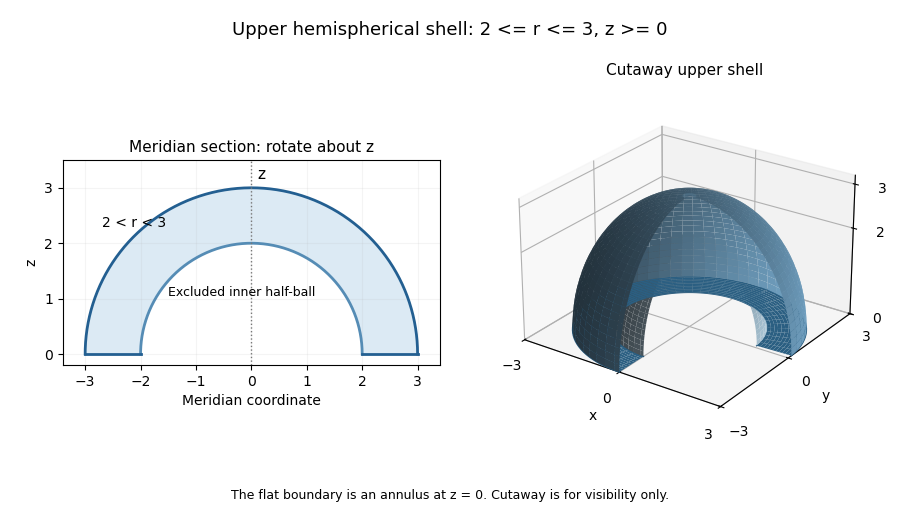
The integrand is . Consequently
Take the normal vector outward from the cylinder-and-cone solid. The surface consists of the cylindrical side and conical roof, with no bottom disk; this convention fixes the otherwise unspecified orientation of a surface. The boundary is the radius-two circle at . Reversing every normal vector reverses the final sign.
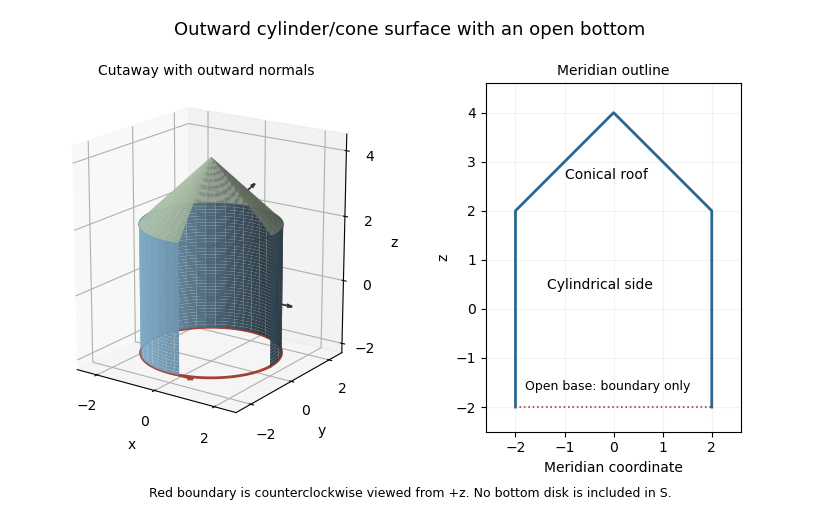
For , its curl is . For the cylindrical parametrized surface, use , with , and use as the outward area vector. Its flux isFor the cone, let , and . Its outward area vector is . ThusThe total surface integral is therefore with the outward convention, or for the opposite convention.
For Stokes theorem, the induced bottom-circle orientation is counterclockwise as viewed from above, opposite to the orientation of an outward bottom cap. Use with increasing . Thenagreeing with the two parametrized fluxes. The seam at is internal and cancels between the two pieces; the cone tip does not supply another boundary curve.
For a Cartesian change of basis represented by an orthogonal matrix , vectors transform as and . Their squared norms are invariant and . Substitution into the given expression therefore givesthe transformation law of a Cartesian second-rank tensor. The magnetic field's extra axial sign under an improper physical reflection, if included, appears twice and cancels in its quadratic contribution.
Write the Maxwell stress tensor as . Its divergence isThe identity follows by contracting two Levi-Civita symbols, or directly by differentiating components. Using Maxwell's equations consequently yieldsHence the local conservation of electromagnetic momentum isThe two subtracted terms are the Lorentz force density, while is the electromagnetic momentum density in the units used here.
Use the Levi-Civita symbol and summation over repeated indices. Contracting the two symbols givesThus the curl of a cross product is
Under the usual bounded-domain hypotheses, with piecewise smooth boundary and a sufficiently smooth vector field, the divergence theorem stateswhere is outward. Apply it to and use the product rule to obtainFor uniqueness, let for two classical solutions with the same Dirichlet boundary data. Then and on the boundary. Taking , gives Green's first identity in the formThe continuous nonnegative integrand must vanish, so is constant on each connected component. The zero boundary data make every such constant zero. Thus the solution of the Dirichlet problem for the Laplace equation is unique, if it exists. This establishes Uniqueness of the Dirichlet problem; existence is assumed. Boundedness, or suitable conditions at infinity, is needed: on an unbounded half-space the harmonic function has zero boundary values but is not identically zero.
Articles by others on the same topic
There are currently no matching articles.