For a Lie bracket over or , antisymmetry of a Lie bracket means . In particular in these characteristic-zero fields. The Jacobi identity isIt expresses compatibility of the bracket with its own adjoint action. Bilinearity must hold over the chosen base field, and the bracket must take its values in the same vector space.
For the matrix commutator, bilinearity and antisymmetry follow directly from distributivity. Associativity of matrix multiplication givesadding the two cyclic permutations cancels every monomial. Thus the Jacobi identity holds in the entire matrix algebra. For a specified linear subspace, the only additional bracket condition is closure: must belong to the subspace whenever do. It is unnecessary to require closure under the separate products and .
To determine the special unitary Lie algebra, let be a differentiable curve in the special unitary group with and . Differentiating gives . Differentiating at the identity gives . Conversely a traceless skew-Hermitian matrix has unitary and , so it really is a tangent vector. ThereforeThis is a real Lie algebra of complex matrices: multiplication by generally leaves this real subspace. Its complexification is , not the compact algebra itself. For ,Thus closure holds, and the already verified commutator identities establish all the Lie algebra axioms.
The cross-product Lie algebra on is bilinear, antisymmetric and closed because the cross product has those properties. Its Jacobi identity follows from the vector triple-product identity:In the cyclic sum, the coefficients cancel by symmetry of the scalar product.
For the explicit relation to the SU(2) Lie algebra, take the three Pauli matrices and defineThese matrices are traceless and Skew-Hermitian, and the three images of the standard basis form a real basis of . Using the Pauli matrix commutator identity,Hence is a real Lie algebra isomorphism. The factor and sign are essential for preserving the unscaled cross-product bracket. At the group level there is an Adjoint double cover from SU(2) to SO(3); the isomorphism of their tangent algebras does not identify the two global groups.
Take the Minkowski metric with signature and a coupling . For a charged scalar field use the gauge covariant derivativeA scalar electrodynamics Lagrangian isAny real potential bounded below and depending only on the modulus gives gauge invariance. Indeed,The derivative of the phase cancels the shifted gauge field in the first identity; commuting partial derivatives proves the second. These identities verify invariance of every term, including the interaction hidden in the kinetic term.
For an unbroken example choose with and . The minimum is at zero. There is no vector mass term in the quadratic expansion and no Higgs mechanism. Pure electromagnetic theory has a neutral massless spin-one photon with two physical transverse polarizations, equivalently helicities and ; longitudinal and time-component polarizations are gauge redundancies. In the unbroken scalar theory, the same massless photon is accompanied by a spin-zero charged particle and its oppositely charged antiparticle, both of mass . A complex scalar has two real physical degrees of freedom, rather than two unrelated charged species.
For a Higgs example chooseThe vacuum modulus is nonzero. Around one vacuum representative, unitary gauge removes the phase and writes . ThenThus the quadratic spectrum isThe gauge boson is a massive spin-one particle with three polarizations, and is a neutral massive spin-zero Higgs boson. The scalar phase supplies the longitudinal vector polarization; it is not an extra physical massless Goldstone boson. The degree count is unchanged: two massless-vector polarizations plus two scalar degrees become three massive-vector polarizations plus one radial scalar degree. The underlying gauge invariance remains a redundancy of the description.
For the two-charge theory, useand retain the same gauge transformation of . Both derivatives transform with the phase of their own field. A manifestly stable two-charge scalar gauge potential is, for positive , and a nonzero complex constant ,Since has charge , its modulus is gauge-invariant. Expanding its square exhibits the direct couplingIn particular the charge in is , which uses the stated charge ratio. The potential is real, bounded below and has the zero-field minimum, while the kinetic terms have the standard positive signs. A complete example is thereforeThere is genuine direct interaction even with because . In four spacetime dimensions has mass dimension , but the expanded potential contains only quadratic, cubic and quartic field monomials; the cubic coefficient has dimension one. Thus the example is also power-counting renormalizable.
Treat the quarks as the fundamental triplet of approximate flavour symmetry. The flavour product follows by splitting the first two quarks into symmetric and antisymmetric pieces:ThereforeThe dimension check is . The baryon decuplet is the completely symmetric flavour sector, the three-quark flavour singlet is completely antisymmetric, and the two copies of the baryon octet carry mixed permutation symmetry. The two octet copies are a multiplicity space for permutations of the three quark slots, not automatically two distinct ground-state baryon octets.
For the weight diagrams use isospin projection and flavour hypercharge . The quark weights areWeights add in a tensor product. In a three-quark composition, and . The baryon decuplet has rows . Its upper-right weight is , the , while its bottom weight is , the . In the baryon octet, the upper weights are and , giving the proton and neutron. The origin has two independent states with content : the and the . Their equal weights do not make them the same state. The three-quark flavour singlet has only and content , with normalized flavour wavefunctionThis singlet is a different representation from the octet , despite the same quark content and weight.
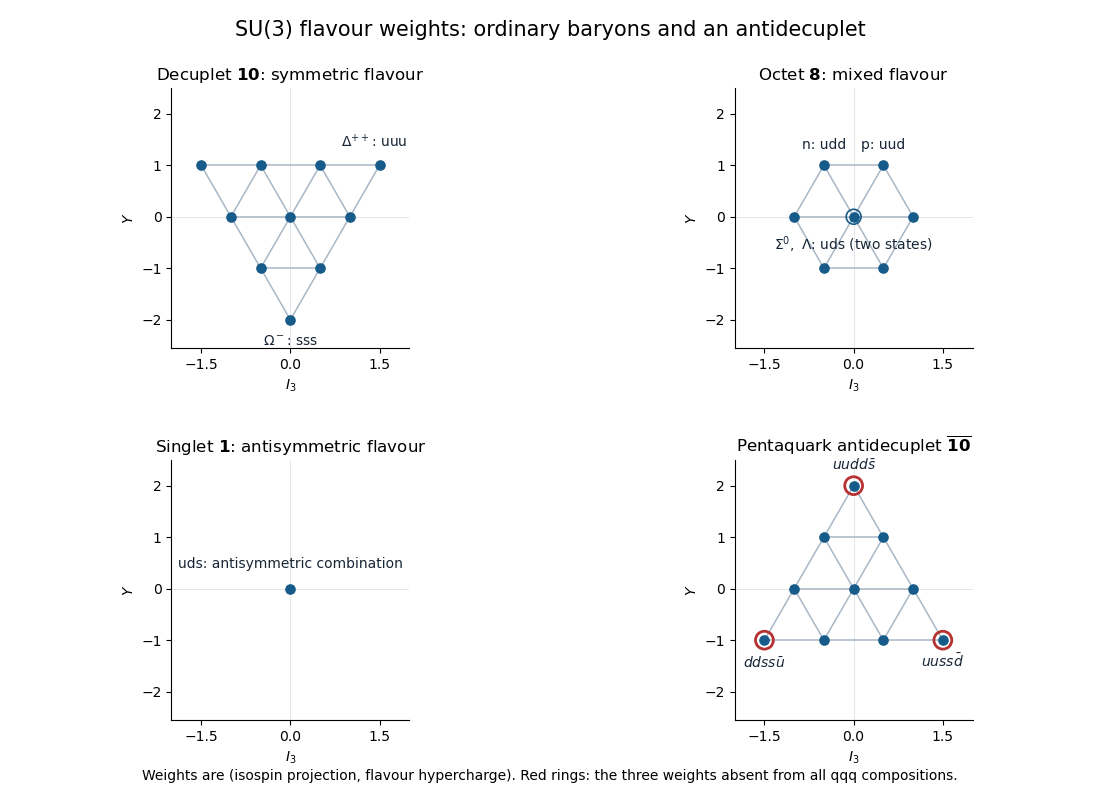
Flavour weight diagrams for the baryon decuplet, octet, singlet and pentaquark antidecuplet; red rings mark the three exotic weights
. Details. 
The Pauli exclusion principle requires the full three-quark wavefunction to change sign under exchange of any two quarks, including their spatial, spin, flavour and colour labels. A three-quark colour singlet has the antisymmetric colour factor . Consequently the remaining spatial-spin-flavour factor must be symmetric. The flavour representation alone is not the full exchange wavefunction.
For the lowest orbital state, the spatial wavefunction is symmetric. Completely symmetric decuplet flavour then requires the symmetric spin- wavefunction; this includes states such as with aligned spins and does not violate Pauli because their colours are antisymmetrized. Mixed octet flavour combines with mixed spin- wavefunctions to give a symmetric spin-flavour factor. More explicitly, the two-dimensional permutation representation of mixed symmetry tensored with itself contains the trivial representation, which selects the physical symmetric combination. These are the familiar ground-state spin assignments.
Antisymmetric singlet flavour in a symmetric orbital state would instead require a completely antisymmetric three-quark spin state. But , so three spin- quarks have no such state. There is no flavour-singlet three-quark ground-state S-wave baryon. A singlet is allowed with orbital excitation: mixed spatial and mixed spin symmetry can combine antisymmetrically, and their product with the antisymmetric flavour sector is symmetric. For example an , spin- configuration can give negative-parity total spins or . This Pauli constraint on three-quark flavour multiplets distinguishes a permitted representation in the flavour tensor product from its possible orbital-spin realization.
For a pentaquark, choose each of two quark pairs in . Their symmetric flavour combination lies in , and combining with the antiquark givesThus contains a pentaquark antidecuplet. This identifies a flavour sector; it does not by itself prove binding or fix the spin and orbital structure needed for overall fermion antisymmetry.
The antidecuplet is the conjugate of the symmetric decuplet, so its rows are . A three-quark state only has , and at it contains two strange quarks and one light quark, allowing only . Hence the exotic weights are preciselyPossible minimal contents are , , and . By the Gell-Mann--Nishijima formula, their charges are respectively . Every other antidecuplet weight is also a weight of some three-quark composition, although its total isospin representation can differ.
Exotic weights do not imply a weak-decay lifetime. The strong interaction can conserve all the quantum numbers in baryon-plus-meson channels, for exampleThese are quark rearrangements into a three-quark baryon and a quark-antiquark meson, not decay into a single three-quark state. Accordingly they are generically short-lived strong resonances if these channels are kinematically open. Flavour representation theory alone gives no masses or widths; a state below all strong thresholds, or one with dynamically suppressed couplings, can be longer-lived. The quantum numbers provide no general protection against the displayed strong decays.
Use the metric in the question and fix the Levi-Civita symbol convention . A consistent choice of rotation Lie algebra generators isSubstituting the indices into the printed Poincare algebra givesThe other cyclic brackets follow the same way. The negative spatial metric and antisymmetry of both enter this sign.
The printed brackets are real Lie algebra brackets, without the factor used for ordinary commutators of Hermitian quantum observables. We use those brackets for the algebraic verifications. For physical eigenvalues below, angular momentum is Hermitian, its spin projection is the real number , and . In that quantum convention the ordinary operator commutators are times the displayed brackets. This distinction prevents identifying a real spin projection with an anti-Hermitian matrix eigenvalue.
In the universal enveloping algebra, translations commute. The Pauli-Lubanski pseudovector therefore satisfiesFor fixed , the product of momenta is symmetric in while the epsilon coefficient is antisymmetric in them. There is no need to commute the Lorentz generator through the momenta.
Using the commutator derivation identity and the mixed bracket,The two terms become equal after swapping , and the last expression vanishes by antisymmetry in . In the Hermitian observable convention, the calculation has one overall extra and still vanishes. Thus preserves each momentum eigenspace.
For the specified epsilon orientation, two useful component identities areThe order displayed matters: the momentum operator is on the right, so it can act first on the momentum eigenstate. At rest, , and on a spin state with these giveThese are massive rest-frame Pauli-Lubanski eigenvalues. The raised component would be ; confusing with reverses the answer.
Helicity is the projection of spin angular momentum, or equivalently the rotation generator acting internally, along the momentum direction:For the momentum with , the helicity operator is . Hence a helicity- state hasThe result uses only the two longitudinal components and does not need a separate assumption about the transverse little-group generators. These massless longitudinal Pauli-Lubanski eigenvalues agree with for ordinary finite-helicity representations.
Finally, at rest the contraction is . For the chosen null momentum it is , whose two eigenvalues cancel. Thus both results obey . Reversing the epsilon orientation reverses all eigenvalues together; it leaves both identities and both consistency checks intact. For a literal anti-Hermitian derived representation of the printed real algebra, write for the Hermitian observable. Since is bilinear in generators, its abstract enveloping-algebra image is . Thus the corresponding formal-image eigenvalues, if that convention is intended, areHere has eigenvalue , while and themselves remain real physical labels. This is the same result after the Hermitian quantum generator convention is applied to both factors, not an inconsistent choice of spin sign. Both the Hermitian-observable and literal anti-Hermitian interpretations are consequently specified.
Articles by others on the same topic
There are currently no matching articles.