Introduce a parameter to keep track of total degree. The power series for the matrix exponential givesSet and , where the commutator is . Expanding a second matrix exponential givesSincethe two expressions agree through total degree two. More explicitly, applying the local matrix logarithm to the first expansion gives . This proves the displayed order of the Baker--Campbell--Hausdorff formula. The Lie algebra is closed under the commutator, so its displayed exponent lies in the same Lie algebra. The expansion is a formal power series identity, or a convergent identity sufficiently near the identity matrix; this argument does not assert unrestricted global convergence.
The next two terms of the Baker--Campbell--Hausdorff formula are the two cubic commutators:Here means total degree at least four in . If one continues by one more degree, the quartic contribution is .
For the Pauli matrices, use the Pauli matrix multiplication lawPut . The antisymmetric term disappears when contracted with , so . Consequently every even power of equals , and every odd power equals . Splitting the matrix exponential into even and odd terms of its power series yieldsThe Pauli matrices are Hermitian matrices, and the components of are real, so . For real , the resulting matrix satisfiesAlso and , so its two eigenvalues are . The eigenvalues of are therefore , whose product is one. Thus is a unitary matrix with determinant one: it belongs to the SU(2) group.
Multiplying the two exact Pauli matrix exponentials, and using , givesIn particular, the term has a minus sign. Its quadratic Taylor expansion isTaking , , the Pauli matrix commutator identity gives . The quadratic exponent in the Baker--Campbell--Hausdorff formula is therefore . In , only the linear part of contributes to through degree two. The anticommutator gives , reproducing the exact product's quadratic expansion.
For a differentiable curve in the SO(3) group with , differentiating gives , where . Conversely, if is a real skew-symmetric matrix, is an orthogonal matrix and has determinant . HenceThe displayed generators of the SO(3) Lie algebra areThey are linearly independent and span the three independent entries of a real skew-symmetric matrix. Equivalently, . The vector triple-product identity then givesThus the structure constants of a Lie algebra in this basis are
Use a real, antisymmetric convention throughout the SO(3) vector Higgs model. With gauge coupling , the gauge covariant derivative and gauge field strength areThere is no factor of in these formulas because are real antisymmetric generators. For a local non-Abelian gauge transformation , with in the SO(3) group, the compatible transformation of the gauge potential isIt gives and . These covariance laws fix the relative signs in the gauge covariant derivative and gauge field strength.
An SO(3) invariant quartic scalar potential isSince , this scalar potential is gauge-invariant. Its minimum is the sphere , rather than a preferred direction in the internal vector space.
Writing , the cross product form of the gauge covariant derivative is . In components this isCorrespondingly, the gauge field strength has components
A covariantly constant vector Higgs field has constant norm, becauseThe last equality uses antisymmetry of the gauge potential. On a connected region write this norm as . If , the vector Higgs field is identically zero. If , the SO(3) group acts transitively on unit vectors, so choose a smooth local non-Abelian gauge transformation rotating to . In this unitary gauge, with constant. This is a local construction, and is global on a trivial contractible region; a nontrivial bundle can require more than one gauge patch.
For nonzero , substituting the constant aligned vector Higgs field into gives . For nonzero gauge coupling, the most general compatible gauge potential and gauge field strength arewhere is an arbitrary real one-form. Thus the surviving gauge group is the stabilizer subgroup of . A covariantly constant vector Higgs field does not force the gauge field strength to vanish: it only requires the curvature to annihilate that field.
For the Higgs mechanism, choose a vacuum of the SO(3) invariant quartic scalar potential, so the constant norm is . The canonically normalized kinetic term then containsThe two broken-direction gauge bosons have mass (or if the sign of is unrestricted), while the gauge boson remains massless. The two angular Goldstone bosons supply the massive vectors' longitudinal gauge-boson polarizations. The radial fluctuation remains a physical scalar field, with for this normalization. The condition selects backgrounds without broken-direction gauge potentials; fluctuations about such a vacuum exhibit the two massive modes. Constancy of the norm alone does not require it to minimize the scalar potential.
The special orthogonal group in five dimensions isIts Lie algebra consists of real skew-symmetric matrices. There are independent entries above the diagonal, so . Equivalently, the orthogonality equations impose fifteen independent constraints on twenty-five matrix entries; the determinant condition chooses a component without changing the dimension.
Fix the fifth coordinate. The matrices , , form an explicit subgroup. Under this subgroup the defining vector space splits as , so its branching rule is . An element of the so5 Lie algebra can be written uniquely asConjugation by sends to and to . The first summand is the six-dimensional Adjoint representation of a Lie algebra of , and the second is its four-dimensional vector representation. Hence the SO5 to SO4 branching gives
For the left SU(2) subgroup of SO(4), identify with the quaternions. Left multiplication by a unit quaternion is a real orthogonal transformation and gives an embedded SU(2) group. More generally, gives the double cover with kernel . After complexifying, the vector representation is and the Adjoint representation is . Restricting to the left factor turns the right factor into a multiplicity space. ThereforeThese are decompositions into complex irreducible representations; the real is the underlying real representation of a quaternionic doublet. Combining the branching rules gives
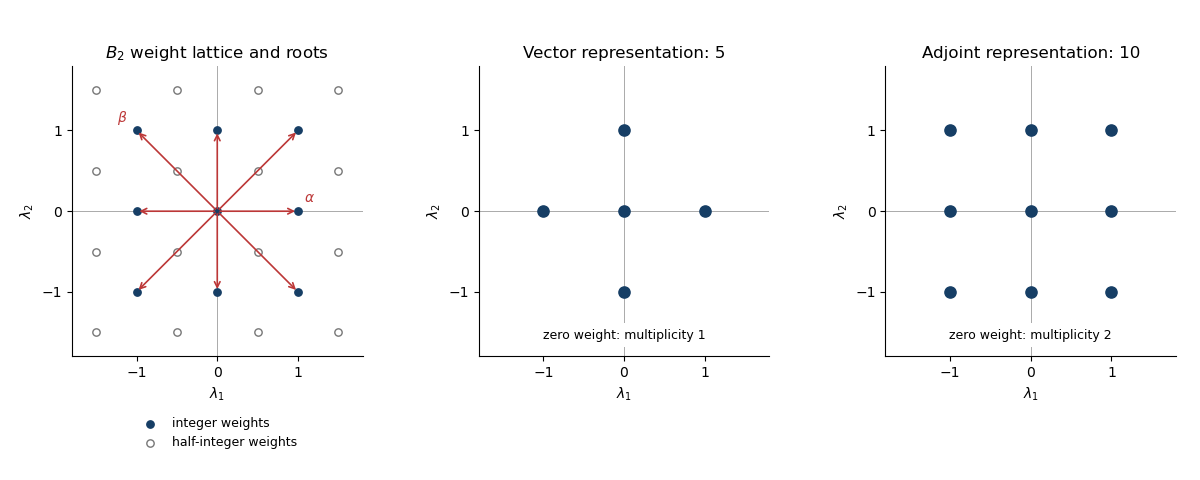
Write a weight as . The integrality conditions for the B2 root system give and . Hence , , with . ThusThis is the B2 weight lattice, with an integer square lattice and a second square lattice shifted by . The eight roots of a root system areThe short roots lie on the coordinate axes and the long roots on the diagonals. The positive roots for the given simple-root choice are , , , .
The integrality conditions determine the weight lattice of the Lie algebra, equivalently of the simply connected Spin group . For the global special orthogonal group , a rotation in either coordinate plane is the identity, so a genuine group representation requires integer . Thus the half-integer coset contains spin representations that do not descend to . Both representations requested here have integer weights, so their diagrams are unaffected by this distinction.
The root system of the displayed subgroup is . The two orthogonal pairs give its two commuting factors. Choose the left factor to have root ; exchanging the two diagonal pairs exchanges left and right. Its coroot pairs with a weight asThis demonstrates the diagonal-root SU(2) embedding in SO(5) directly. The short-axis root would instead give , and therefore a different subgroup: on the vector representation it would produce a triplet and two singlets rather than two doublets and a singlet.
For the vector representation, simultaneously rotate the first and second coordinate planes. Over , the two planes give opposite pairs of weights, while the fifth coordinate is fixed. Hence its weight diagram iswith every weight multiplicity equal to one. Evaluating gives twice, twice and once, exactly two SU(2) representations of dimension two and one singlet.
For the Adjoint representation, the root-space decomposition has one one-dimensional space for each of the eight roots and a two-dimensional zero-weight Cartan subalgebra. ThusThe coroot values have multiplicities at . One zero-weight state joins the states to make a triplet; the states form two doublets, leaving three zero-weight singlets. This verifies the earlier branching rule and accounts for all ten dimensions.
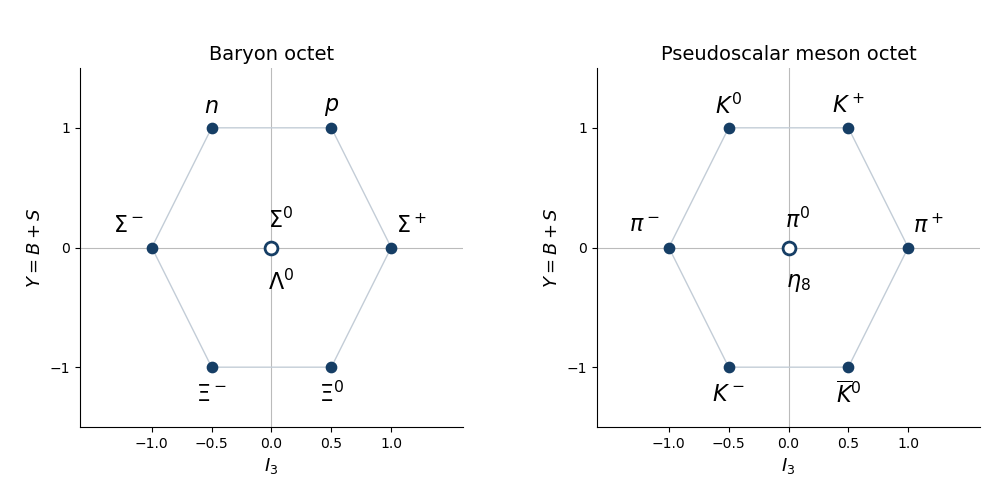
Use flavor hypercharge , where is baryon number and is strangeness. The isospin coordinate is . The baryon octet has coordinatesHere the nucleons have , the Sigma baryons and Lambda baryon have , and the Xi baryons have . The central Sigma baryon belongs to an isospin triplet while the central Lambda baryon is an isospin singlet; equal coordinates do not identify the states.
The pseudoscalar meson octet isThe pions have , the upper kaons have , and their lower antiparticles have . The two central states are the neutral pion and the Eta octet state. This is the octet basis of flavor symmetry; the physical eta can also mix with the flavor-singlet state.


For the flavor SU(3) Cartan generators, choose the Hermitian physics convention and the inner product . Then an orthonormal diagonal basis isStrictly, are elements of the anti-Hermitian SU(3) Lie algebra; are the corresponding Hermitian observables. In the quark basis , the up and down quarks form an isospin doublet and the strange quark is a singlet. Their values are . Each quark has baryon number , and their strangeness values are . It follows thatThese flavor hypercharge conventions differ from the electroweak hypercharge convention. If instead the inner product is , the orthonormal basis is , , and the same operators are , .
In the ordinary quark model, the proton has valence content and charge , while the neutron has content and charge zero. Additivity of electric charge gives and , hence , . The Sigma baryon has content and charge , giving . Thus the quark triplet's electric charges, in units of the positive elementary charge, areThe Gell-Mann--Nishijima formula is consequentlyIt also reproduces every baryon octet charge from the first diagram. On antiquarks the additive quantum numbers reverse sign, and combining a quark with an antiquark reproduces the meson octet charges.
Because the down and strange quarks have identical electric charge, commutes with the U-spin generatorsThey satisfy ; equivalently the anti-Hermitian matrices span an subalgebra. The entries on the block of are equal, so for all three U-spin generators. The electric charge is therefore constant within each irreducible U-spin multiplet. For example, U-spin relates and , and relates and , without changing their charge. It does not imply exact mass degeneracy: unequal down- and strange-quark masses break U-spin.
For pion-nucleon octet channels, assume the collision is governed by the strong interaction. The initial baryon number is one and strangeness is zero, so an outgoing meson-baryon pair must preserve , , and electric charge. Thus its total flavor hypercharge is . The allowed types areA kaon of can accompany a Lambda baryon or Sigma baryon of . An antikaon cannot balance the nonpositive strangeness of an octet baryon. A Xi baryon would require a meson of , which the meson octet does not contain.
Resolving these types by electric charge gives all possible pairs:In the isospin-symmetric approximation, total isospin is conserved as well: the incoming contains . The and channels contain both values, while and contain only . The extreme-charge initial states are pure , consistently excluding and . Clebsch-Gordan coefficients relate amplitudes in different charge channels; the table establishes permission, not equal probabilities. Electromagnetism and unequal up- and down-quark masses introduce small violations of isospin symmetry.
Finally, energy and momentum conservation require for a particular pair, where is the squared total four-momentum. Only channels above their own threshold can occur. Total angular momentum and parity symmetry in quantum field theory constrain the partial waves of the meson-baryon scattering: a pseudoscalar meson and a positive-parity spin-one-half baryon have pair parity and total angular momentum (only for ). Initial and final partial waves must have matching and parity. Sufficient energy can open a channel, but cannot remove the electric charge conservation, baryon number, or strangeness constraints.
Articles by others on the same topic
There are currently no matching articles.