A real square matrix is orthogonal when , equivalently . For and ,Thus is orthogonal for every allowed angle, and indeed for every real angle.
Using orthogonality,Both norms are nonnegative, so taking square roots provesThus an orthogonal matrix is a Euclidean isometry fixing the origin.
The columns outside indices are unchanged coordinate vectors. The remaining two columns have nonzero entries only in rows , with the block . They have squared norm and mutual inner product zero; they are also orthogonal to all the unchanged columns. Hence .
Let . If , choose with and . ThenEvery other coordinate is unchanged. If , choose ; the same conclusions hold. Therefore the procedure can be fixed with the nonnegative pivot conventionThis is a Givens rotation.
Write for the actual successive rotations , , and , each selected using the currently transformed matrix. The first eliminates position ; the second eliminates while leaving row two unchanged. After these, the first column is . The final rotation of rows two and three preserves both zeros in that column and eliminates . HenceA lower-triangular starting matrix does not force any further zeros above the diagonal. For example, the lower-triangular matrix with all entries on and below its diagonal equal to one gives, with the nonnegative pivot convention,which has all upper-triangular entries nonzero.
Inverting the product of rotations yields the QR factorizationThe order reverses when taking the transpose. If is orthogonal, then is both orthogonal and upper triangular. Its first column forces and orthogonality with the other columns forces . Applying the same argument to the remaining block makes diagonal with entries of modulus one.
Our elimination rule makes and positive when nonzero, so they are both one. Every rotation has determinant one; thus andWithout a fixed pivot-sign convention one could only specify a diagonal sign matrix. The convention chosen in part (c) determines the precise signs above.
Subtract the two finite sums. In the shifted sum replace the summation index by . For every interior index the new coefficient isby Pascal's identity; the two endpoint coefficients agree as well. ThereforeFor a degree- polynomial with leading coefficient , the backward difference has leading termSince , this coefficient is nonzero for . Starting with , iteration gives degree and leading coefficient for . The next difference of the resulting constant is zero:
A natural cubic spline with the given knots is a function that is polynomial of degree at most three on each interval between consecutive knots and has . With the usual whole-line convention, it extends affinely outside the extreme knots. The word natural refers to these endpoint second-derivative conditions; the interpolation values must be specified separately.
For , direct differentiation on either side of the knot givesBoth one-sided limits of the function and its first two derivatives at are zero, so these formulas are continuous there andIts third derivative jumps from zero to six, which is permitted for a cubic spline.
The finite sum of truncated cubes is by part (b) and is cubic on each knot interval. For , every term vanishes. For , every truncated power equals its ordinary polynomial, so part (a) applied to givesIt is therefore zero on both exterior intervals. Its regularity makes the endpoint second derivatives zero too, proving naturality.
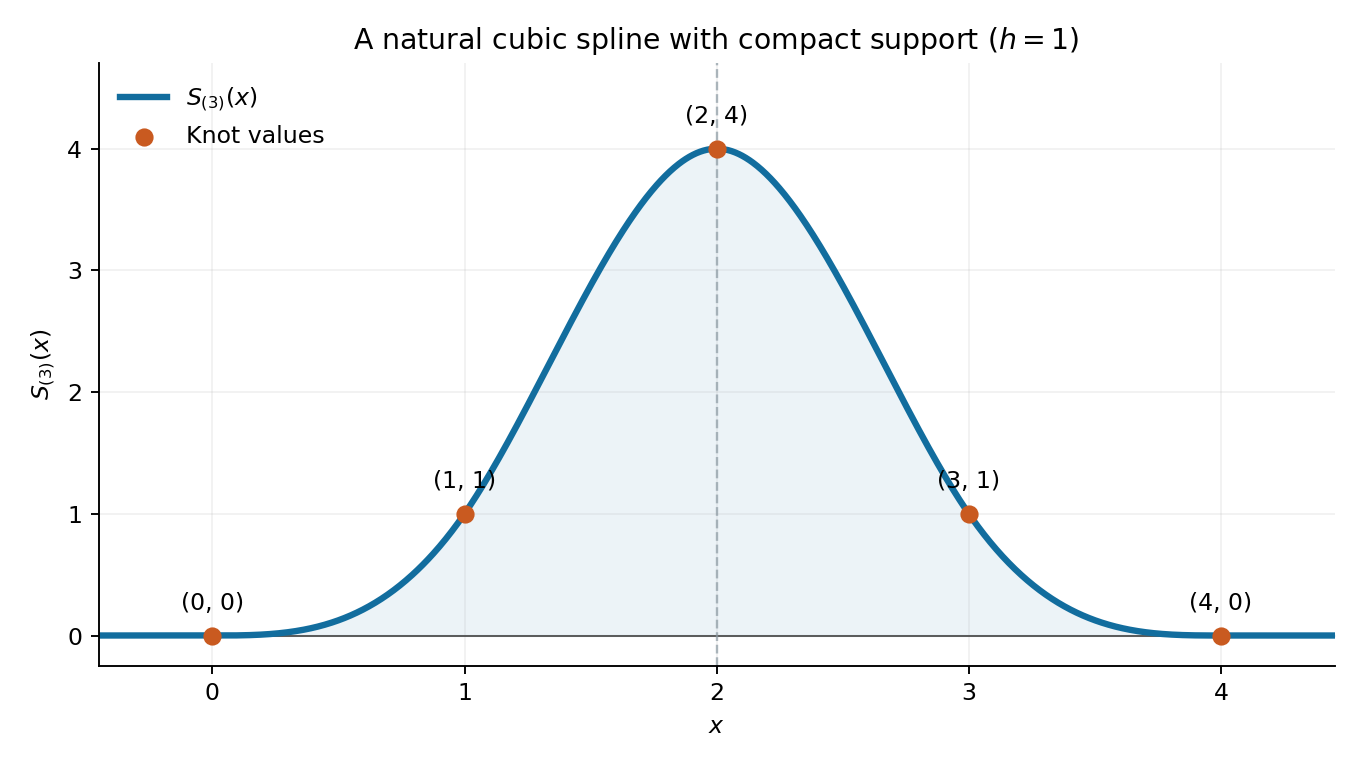
Evaluation at the five knots givesFor example the three interior values in units of are , , and . At the cancellation is .
For an explicit graph description isIt is symmetric about , increases from zero to its maximum four at the centre, and decreases symmetrically back to zero. It joins the zero tails with zero first and second derivatives.

Articles by others on the same topic
There are currently no matching articles.