Doping changes the mobile carrier population by introducing controlled impurity levels. In an intrinsic semiconductor, the filled valence band is separated from the nearly empty conduction band by a band gap . Thermal excitation produces an electron-hole pair, so the Electron and hole number densities obey . A electron hole represents a missing valence-band Electron and behaves as a mobile positive charge carrier. For nondegenerate bands in thermal equilibrium,Here are the effective density of states, the band edges, and denotes the chemical potential, conventionally called the Fermi level. The semiconductor mass-action law holds in this nondegenerate equilibrium regime.
In a tetrahedrally bonded elemental semiconductor such as silicon, a substitutional group-V atom has an extra outer Electron relative to the host. It is a donor impurity: a shallow level just below can ionise, releasing an Electron to the conduction band and leaving a fixed positively charged donor. The resulting n-type semiconductor has Electrons as majority carriers and holes as minority carriers. Conversely a group-III substitution supplies one fewer bonding Electron. An acceptor impurity can take an Electron from the valence band, leaving a mobile electron hole and a fixed negative acceptor; the resulting p-type semiconductor has holes as majority carriers.
The impurity state is shallow because the Electron or hole responds to a screened Coulomb potential and an effective mass, rather than the bare atomic potential. A simple hydrogenic donor estimate iswhere is the relative permittivity. This is a useful scaling model, with real band anisotropy and central-cell effects omitted. Dopants are fixed in the lattice; their ionisation changes mobile carrier numbers without making a uniformly doped bulk sample carry a large net electric charge.
The charge neutrality condition isWhen shallow dopants are almost fully ionised and , an n-type region has and . A p-type region similarly has and . Thus compensation by the opposite impurity type reduces the majority-carrier density; the total dopant concentration is not generally the mobile carrier density. At sufficiently high impurity density the degenerate semiconductor regime requires the full Fermi-Dirac distribution and these exponential approximations fail.
There are three useful temperature regimes. At low temperature, dopant freeze-out leaves many shallow levels un-ionised. In the extrinsic regime, the dopants are largely ionised and set the majority-carrier density. At high enough temperature, intrinsic pair creation dominates and approach . The Fermi level moves towards the conduction band with donor doping and towards the valence band with acceptor doping. The electrical conductivity isDoping therefore controls conductivity and its carrier type, but ionised impurities also scatter carriers and can reduce charge carrier mobility. Carrier density and mobility must both be considered.
A p-n junction forms when p-type and n-type regions are joined within a semiconductor. Initially the concentration gradients drive diffusion current: Electrons diffuse from the n region to the p region and holes in the opposite direction. Recombination removes mobile majority carriers near the join, exposing fixed positive donors on the n side and fixed negative acceptors on the p side. This forms a depletion region and an electric field directed from n to p. Its drift current opposes diffusion. At equilibrium the net current vanishes and the Fermi level is uniform, although the band edges vary spatially through band bending.
For an abrupt nondegenerate junction with fully ionised dopants, its built-in potential isUnder the depletion approximation, the space-charge densities are on a p-side width and on an n-side width . Integrating Poisson equation and imposing zero field outside gives andMost of the depletion width therefore extends into the more lightly doped side. The schematic shows the impurity levels before contact and the resulting space charge and potential after contact; there is no externally extractable equilibrium battery voltage from the built-in field alone.
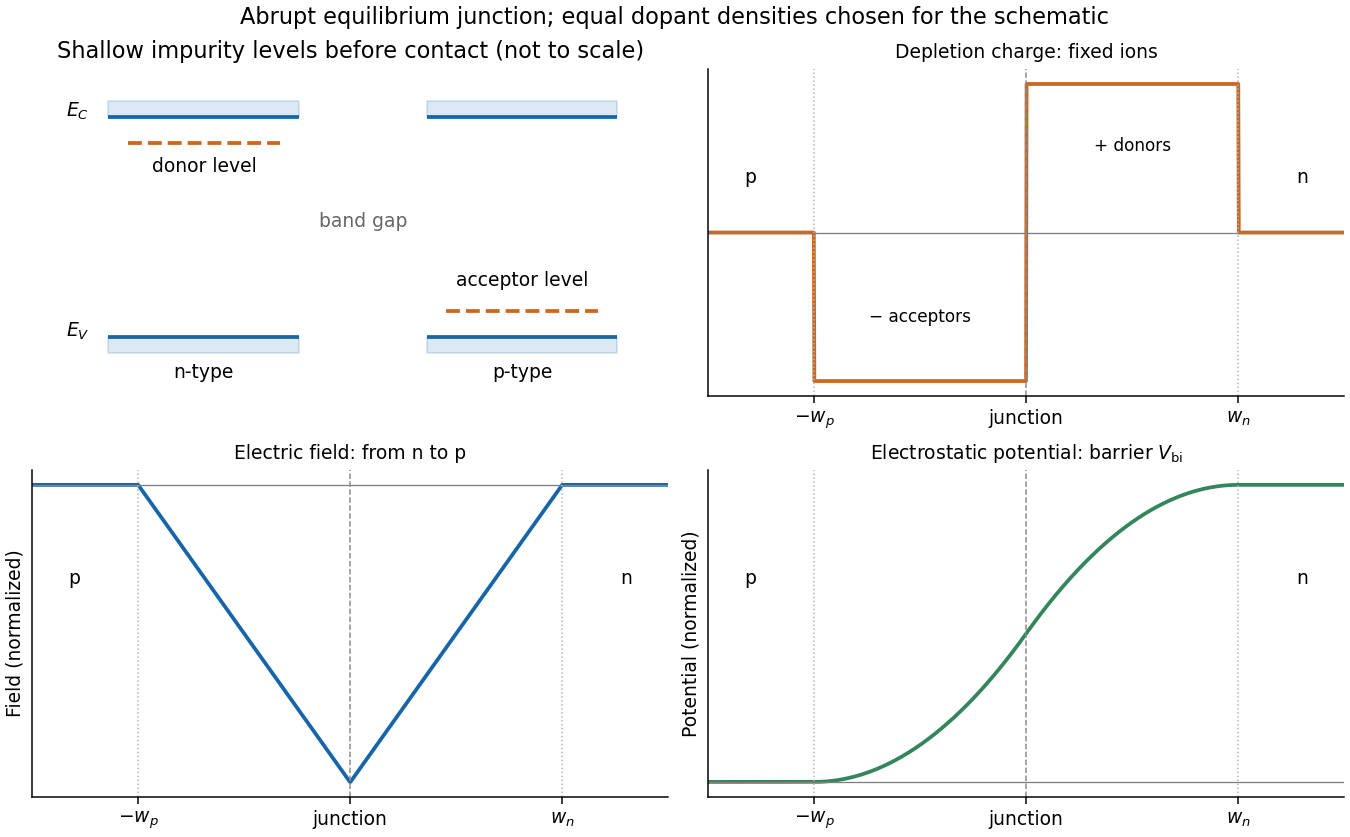
Shallow donor and acceptor levels, and charge, field and potential in an equilibrium abrupt p-n junction
. Details. 
A forward bias, with p positive relative to n, reduces the barrier from towards and injects minority carriers across the junction. In the ideal low-injection, diffusion-controlled regime this produces the Shockley diode equation, . Reverse bias increases the barrier and the depletion region; only a small thermally generated minority-carrier current flows before breakdown. Reverse-biased depletion regions also give a voltage-dependent junction capacitance. Real devices have recombination, leakage, series resistance and breakdown mechanisms beyond the ideal law. Controlled doping creates majority and minority carriers, and their junction produces a depletion barrier that makes rectification possible.
The convolution of two aperture functions in one dimension isWith Fourier transform convention , the convolution theorem statesThe first identity follows by substituting the convolution integral, putting , and separating the resulting double integral into times . For an absolutely integrable pair the interchange is justified by absolute convergence; finite optical apertures satisfy suitable integrability assumptions.
In Fraunhofer diffraction, the observed field is the Fourier transform of the transmitted complex aperture field. For two identical slits, let be one slit and use a pair of Dirac delta distributions to locate the centres:Consequently . For a rectangular slit, , giving a single-slit diffraction envelope times the double-slit interference factor in intensity. A phase reversal replaces the plus between the deltas by a minus, giving instead, as in B7.
More generally, an -slit array is a single-aperture function convolved with a finite comb. Its field contains the factorThis separates the narrow diffraction grating maxima from the individual-aperture envelope. The same reasoning holds in two transverse dimensions. Multiplying an existing aperture by an additional finite mask instead convolves their field transforms and can broaden features. These are operations on complex fields: intensity is the squared modulus of the final field and cannot generally be substituted into the field-level convolution theorem.
In thin-film interference, coherent beams reflected at the two faces of a transparent film overlap. Let the film have refractive index , thickness , and internal ray angle , determined by Snell's law. For vacuum wavelength , the propagation part of the relative phase isAlthough the internal round-trip ray length is , the two emergent rays must be compared on the same outgoing wavefront. Subtracting their external lateral path contribution gives the effective optical path difference , explaining the cosine rather than its reciprocal.
Reflection also changes phase. At normal incidence in lossless positive-index media, the electric-field Fresnel equations give : reflection towards higher index reverses sign, whereas reflection towards lower index does not. If the two interfering reflections differ by one such phase reversal, their total relative phase is modulo . Then reflected maxima and minima obeyIf there are zero or two reversals, the conditions interchange. These bright/dark conditions assume overlapping beams with adequate temporal optical coherence; complete cancellation further requires equal amplitudes. In transmitted light, a lossless complete film has complementary intensity variations because reflected plus transmitted power is conserved.
For multiple internal reflections at normal incidence, summing the geometric series gives the exact film reflection amplitudeThis includes both the amplitude mismatch and repeated-beam interference. A normal-incidence antireflection coating on substrate index can cancel reflection at one wavelength when and : both interface reflections reverse sign and the film's round-trip propagation adds , with equal interface amplitudes. A varying thickness or angle selects different maxima for different wavelengths, producing the colours of transparent films in white light. Broad bandwidth and large incidence angles generally prevent perfect cancellation across all wavelengths.
A dispersion relation specifies the allowed angular frequency of a wavevector . A single harmonic wave has constant-phase surfaces moving at the phase velocity,For two nearby components, use the identityThe slowly varying envelope moves at . Taking a narrowband limit gives the group velocity,More generally, expand around the central wavevector of a wavepacket. The linear term translates its envelope at ; the quadratic and higher terms produce group velocity dispersion and packet distortion. This interpretation needs a sufficiently narrow spectrum and weak enough absorption and distortion for an identifiable envelope to persist.
For light in a transparent material, , soThe derivative is evaluated at the wavepacket's central frequency and is the vacuum wavelength. In a nondispersive medium with constant , the two velocities coincide and a packet can propagate without dispersion. In normal optical dispersion , the displayed model gives .
The two velocities can differ even without material dispersion: a waveguide mode with has and , with . The phase velocity is not a signal speed. Near strongly absorbing resonances an anomalous derivative can also make the group velocity exceed or become negative; reshaping then prevents its simple identification with information transport. Relativistic causality constrains the signal front, not the speed of an arbitrary moving phase or distorted intensity maximum.
Articles by others on the same topic
There are currently no matching articles.