Relative to an origin, the inertia tensor is , with . Its orthogonal eigenvectors are principal axes, with eigenvalues the principal moments of inertia. Different components of are multiplied by different eigenvalues, so angular momentum need not point along angular velocity.
For a uniform thin disc, radial integration gives . The perpendicular axis theorem and symmetry then give , henceFor the elastic eccentric impact of a thin disc, neglect gravity's impulse and take the pole's impulse as vertical. Let point up and let the contact position relative to the centre be . An upward impulse givesFor an elastic impact with a fixed pole, the contact point reverses its normal velocity, so . ThereforeHere denotes upward motion; the centre can still move down if . Substitution givesThis also follows by combining conserved angular momentum about the fixed contact with conserved kinetic energy and selecting the separating, nonzero-impulse solution. At the disc simply rebounds without rotation; at its centre is instantaneously stationary. The rebound result concerns the contacting material point immediately after this ideal impact, not its subsequent contact history.
Let denote distance from the neutral axis within a cross section. Bending to radius gives longitudinal strain , so Hooke's law gives stress . Its moment isHere is Young's modulus and is the second moment of area, not a mass moment of inertia. For the stated square orientation, .
For self-weight deflection of a square cantilever, the downward load per unit length is . A free-end segment from to has shear-force magnitude and bending-moment magnitude . Thus, with the given sign conventions,Using the small-slope curvature for downward deflection,The clamp fixes position and slope, and the unloaded free end has zero moment and shear:Four integrations yieldThe linear beam model requires small slopes and strains; the strong dependence eventually invalidates that approximation if other dimensions and material properties are fixed.
Write and . For a circular orbit of radius , centripetal balance gives . Thus and . Since , , these agree with the general expressions.
For an outward coplanar Hohmann transfer, burn prograde at the inner circle to put its radius at the ellipse's pericentre, then burn prograde at apocentre to circularize at the station's radius. The station must be phased to meet the spacecraft there. With , ,Energy at the first burn, with , givesAngular momentum is conserved along the transfer ellipse, so , while the outer circular speed is . For ,The correct second impulse adds . The reversed circularization burn in a Hohmann transfer, using the same impulse magnitude, instead leavesIts magnitude is below the circular speed at , so that point is the new apocentre. Define . For an ellipse at apocentre, , givingThe lunar radius is . Since , the osculating orbit intersects the Moon: the spacecraft crashes before reaching its formal pericentre. The calculation uses impulsive tangential burns and a spherical central gravitational field; it does not assume that a trajectory continues through the solid body.
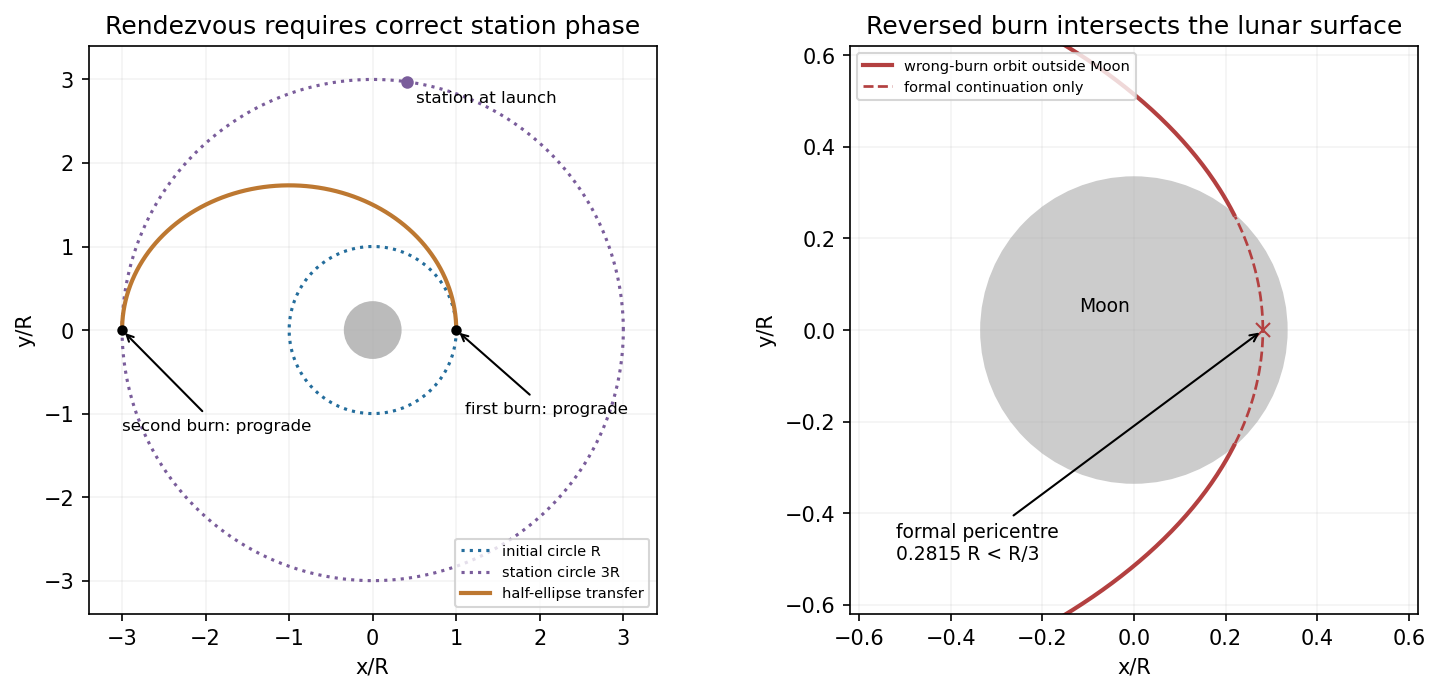
The original plot uses as the length unit and as the lunar radius. The initial station position shown is phased for rendezvous: its initial angular lead is , modulo .
A normal mode is a small-oscillation motion with every coordinate proportional to one common sinusoid, at a fixed amplitude ratio and relative phase. Expanding an arbitrary small motion in normal mode coordinates decouples its linear equations into independent oscillators. With mechanical mass matrix and mechanical stiffness matrix , the generalized eigenvalue equation is .
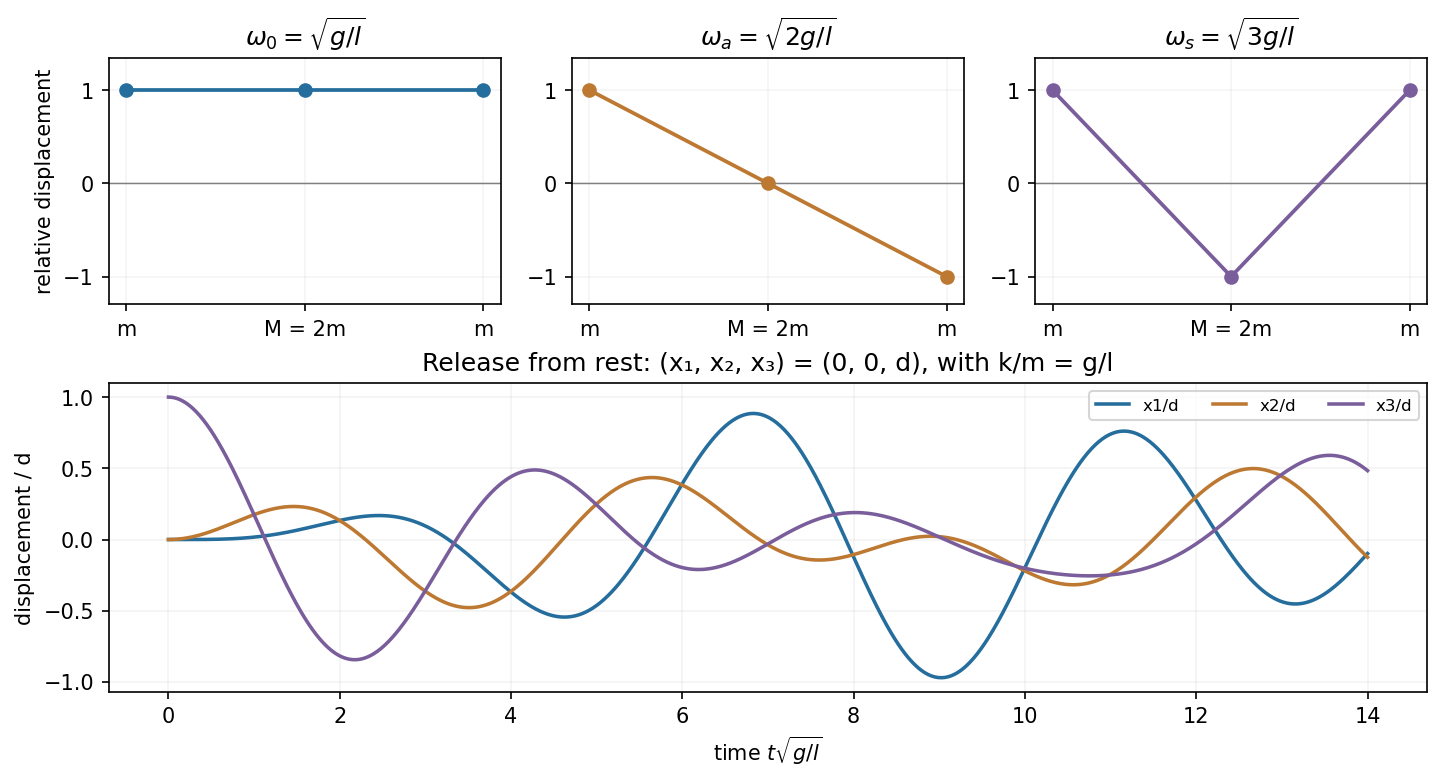
Horizontal gravitational restoring force on each bob is . The two springs add on the first bob, on the middle bob, and on the last. Dividing by the bob masses gives the stated equations withReflection symmetry separates an antisymmetric end motion from two symmetric motions. The three coupled pendulums with equal end masses have independent modesCall their positive frequencies respectively. The middle amplitude in the last mode ensures . The modes are orthogonal in the mass-weighted inner product, rather than generally in the unweighted coordinate dot product.
The initially stationary displacement decomposes asThere are no sine terms because every initial velocity is zero. ThereforeThese give at and solve all three coupled equations. The spring constant is assumed positive; for the frequencies become degenerate and the same superposition reduces to uncoupled pendulum motion.


Articles by others on the same topic
There are currently no matching articles.