The ground-state energies are and , respectively. For a particle in a box of width , the wave function must vanish at both infinite walls. The lowest nonzero standing wave therefore has wavelength , giving the kinetic energy eigenvalueUsing the electron mass and converting joules to electronvolts givesDoubling the confinement length divides this kinetic energy by four. A zero potential energy inside the box does not imply zero total energy: a constant, zero-momentum wave function cannot satisfy both wall conditions unless it vanishes everywhere. This is a concrete manifestation of quantum confinement and the Heisenberg uncertainty principle.
Write the proposed Jeans mass as , with dimensionless . The dimensions of speed, the gravitational constant and pressure areEquating the exponents of mass, length and time givesThus , and , so the pressure-confined Jeans mass scales asA larger speed of sound gives stronger support against gravitational collapse; stronger confinement at fixed speed of sound lowers the characteristic unstable mass. Dimensional analysis determines the scaling, not , which requires a particular cloud model and instability criterion.
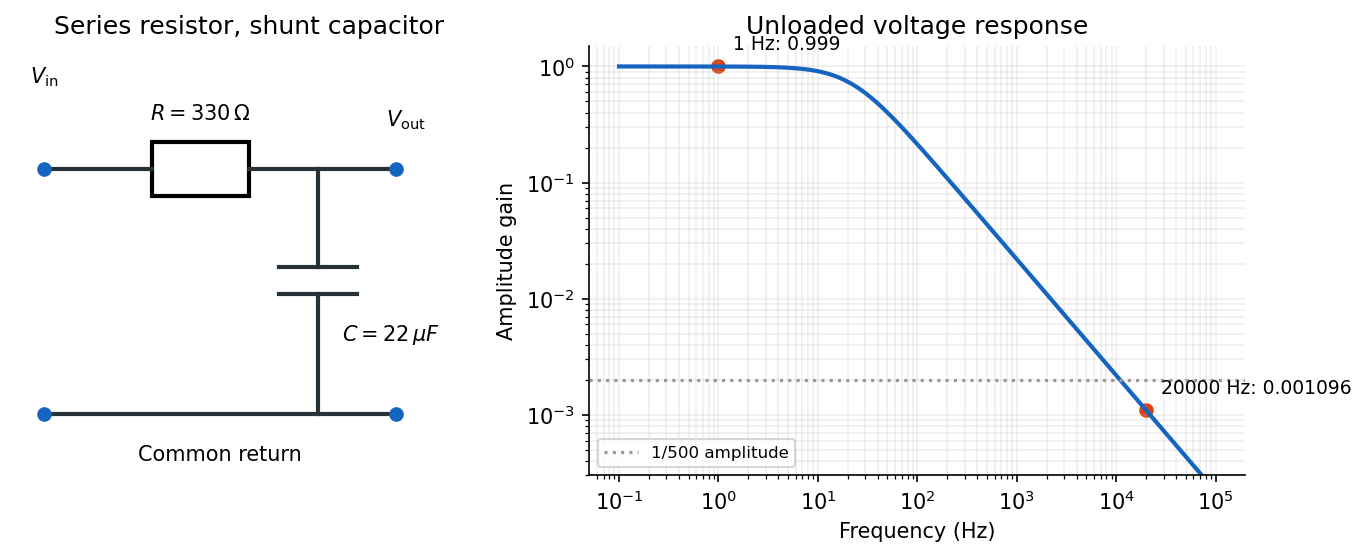
Use an RC low-pass filter: put the resistor in series with the input and the capacitor between the output node and the return conductor. Measure the output voltage across the capacitor, with negligible output loading. The voltage divider then has transfer functionAt the high frequency, the attenuation requirement isAt the low frequency, approximately unchanged amplitude means , soThe upper relation is an asymptotic design condition, because “approximately” specifies no numerical tolerance. For example, retaining at least of the low-frequency amplitude would sharpen the upper bound to approximately .
A practical illustrative choice is . Its voltage gain is approximately at and at : the latter amplitude is reduced by a factor of about . Its cutoff frequency is .

For an ideal air-gap parallel-plate capacitor, neglecting fringing, the electric field between oppositely charged plates is . Dielectric breakdown therefore limits the magnitude of the electric charge on either plate toThe two plates carry and ; the quoted stored electric charge is the magnitude on one plate, rather than the net electric charge of the whole capacitor. The gap does not enter this ideal bound: and make independent of . Edge enhancement of the electric field can lower the practical limit.
Far from its ends, approximate the body by an infinite uniform cylinder. By cylindrical symmetry, the Newtonian gravitational field is radial. Applying Gauss's law for gravity to a coaxial cylindrical surface of radius and length outside the material givesAt the surface, , soThe gravitational acceleration points inward toward the axis. Its small magnitude reflects both the small size and the modest density. The infinite-cylinder approximation uses the specified distance from both ends; a spherical approximation would discard the relevant geometry. No rotational contribution is included, since no rotation rate is supplied.
The threshold must conserve both energy and momentum. For head-on photons, the total energy is , while the total momentum has magnitude . Their combined invariant mass satisfiesAt the threshold for photon-photon pair production, the electron and Positron have no relative momentum in their centre-of-momentum frame, so . ThereforeSimply equating the laboratory energy to would miss the very large laboratory momentum: the newly produced pair must carry it away.
Articles by others on the same topic
There are currently no matching articles.