A covalent bond is stabilized by shared electronic states extending across neighboring atomic nuclei. In a simple two-centre description, combining comparable atomic orbitals produces a bonding state with enhanced electron density between the nuclei and an antibonding state with a node there. For equivalent normalized orbitals with real overlap ,Their energy ordering follows from the molecular Hamiltonian; constructive interference and reduced gradients help explain why the bonding combination can be lower. Opposite-spin Electrons can occupy the bonding orbital together. The familiar molecular-hydrogen bond is a basic example, while extended covalent networks form solids such as diamond. Orbital shape and hybridization make covalent bonding strongly directional and constrain bond angles. Occupying antibonding states reduces the net bond strength.
Ionic bonding instead emphasizes electric charge transfer and the electrostatic attraction of the resulting oppositely charged ions. Removing an Electron from one atom costs ionization energy and adding it to another gains electron affinity; these isolated-atom terms alone need not favor transfer. In a crystal, the electrostatic lattice energy can stabilize the ionic arrangement. For a schematic lattice of singly charged ions at nearest-neighbor distance ,where the geometrical Madelung constant sums attractions and repulsions throughout the lattice. Short-range overlap repulsion prevents collapse and gives an equilibrium separation. Sodium chloride is an example of an extended ionic crystal, rather than isolated NaCl molecules in the solid.
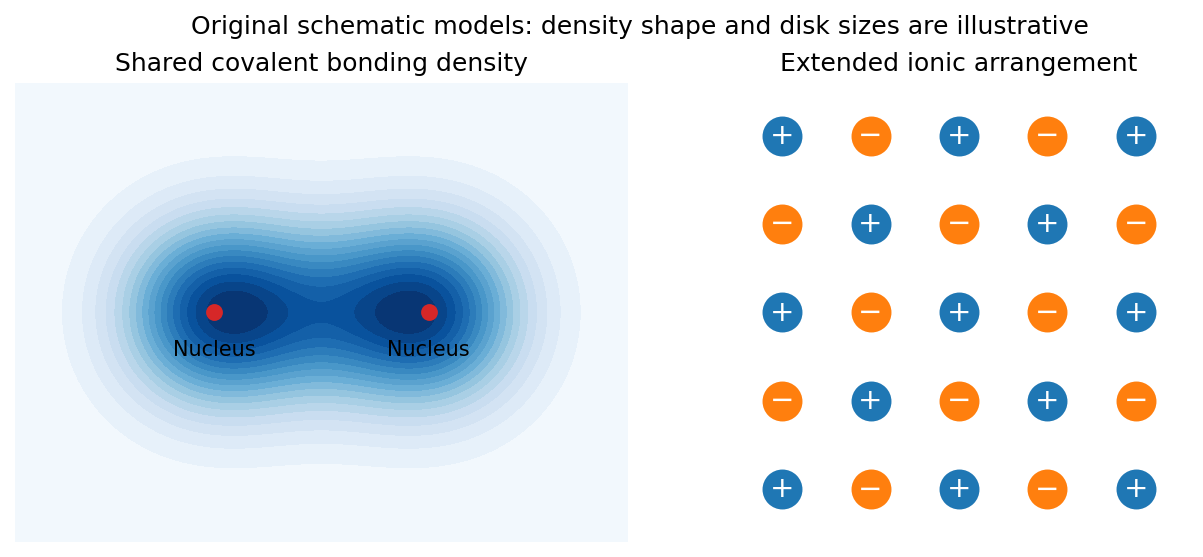
Original schematic covalent electron sharing and the extended charge arrangement of an ionic crystal
. Details. Ideal ionic bonding is comparatively nondirectional, so packing, ion sizes and electric charge balance strongly influence coordination. ions cannot freely migrate in the ordinary solid; melting or dissolution can make ionic electric charge transport possible. Covalent materials do not obey one universal electrical conductivity rule: their electronic bands and filling determine whether mobile electronic carriers are available.
The two descriptions are limiting models, not a sharp classification of every bond. Unequal electronegativities can produce polar covalent bonds with partial electric charge transfer, and a material may contain both covalent groups and ionic interactions between those groups. Chemical bonding reflects a balance of electronic kinetic energy, electron-nucleus attraction, electron-electron repulsion and nuclear repulsion; it cannot be reduced to a force between two assigned point charges in every material.
The Drude model treats mobile electric charge carriers as independent particles with density , signed electric charge , isotropic mass , and momentum relaxation time . In uniform steady fields,At zero magnetic field the drift velocity is , giving electrical conductivity and electrical resistivityThe electrical conductivity is positive for either carrier sign. Scattering dissipates directed drift energy into the environment; a finite steady electric current is compatible with a short-lived drift momentum. The independent-carrier relaxation-time approximation omits detailed band anisotropy, quantum interference and microscopic collision correlations.
For electric current along and magnetic field , the magnetic force deflects carriers toward one side of the sample. electric charge accumulates until a transverse Hall field cancels that force in an open transverse circuit. With , , soElectrons have negative in this convention, whereas positive carriers have positive . For a strip of thickness along , the magnitude of the Hall electric potential difference across its width is . Thus Hall measurements determine carrier sign and, within this one-carrier model, density, while combining with determines charge carrier mobility .
Keeping both in-plane electric current components, the resistivity tensor isThis fixes the off-diagonal sign convention and shows that inversion is not componentwise reciprocation. Under the Hall boundary condition , the ideal one-carrier isotropic model gives , independent of magnetic field: there is no ordinary longitudinal magnetoresistance in this minimal model. Multiple carrier types or anisotropic bands can change both this conclusion and the simple inference. Their electrical conductivity must be added before inverting to obtain the total electrical resistivity.
Both models respect Bloch's theorem and describe Electrons in a periodic lattice, but they start from different useful limits.
In the nearly-free electron model, start with extended plane waves and free-electron energies . A weak periodic potential has Fourier coefficients at reciprocal lattice vectors and couples to . Away from degeneracies its corrections are small. Near a Bragg scattering, retain the two resonant plane waves and diagonalizeThe resulting eigenvalues areAt the crossing the gap is . The two standing-wave combinations place electronic density differently relative to the periodic potential and therefore acquire different energies. Folding the many free parabolas into the first Brillouin zone produces the repeated band labels; the nonzero potential opens avoided crossings between coupled states. A Fourier component forbidden by symmetry need not open its corresponding first-order gap.
In the tight-binding model, instead start with localized orbitals on well-separated atoms or sites, with discrete on-site energies. Their overlap permits tunneling represented by hopping integrals. Bloch sums of these orbitals diagonalize the lattice translation symmetry. For one orthonormal orbital per site in a one-dimensional nearest-neighbor chain,The many initially degenerate copies of one atomic orbital broaden into a band. Other atomic orbitals or multiple sites per primitive cell produce additional bands; their hybridization creates bonding and antibonding combinations and may open gaps. For two orbitals per cell, one illustrative Hamiltonian iswith eigenvalues . This shows explicitly how two bands arise from the two cell degrees of freedom, even when the isolated sites have equal on-site energies.
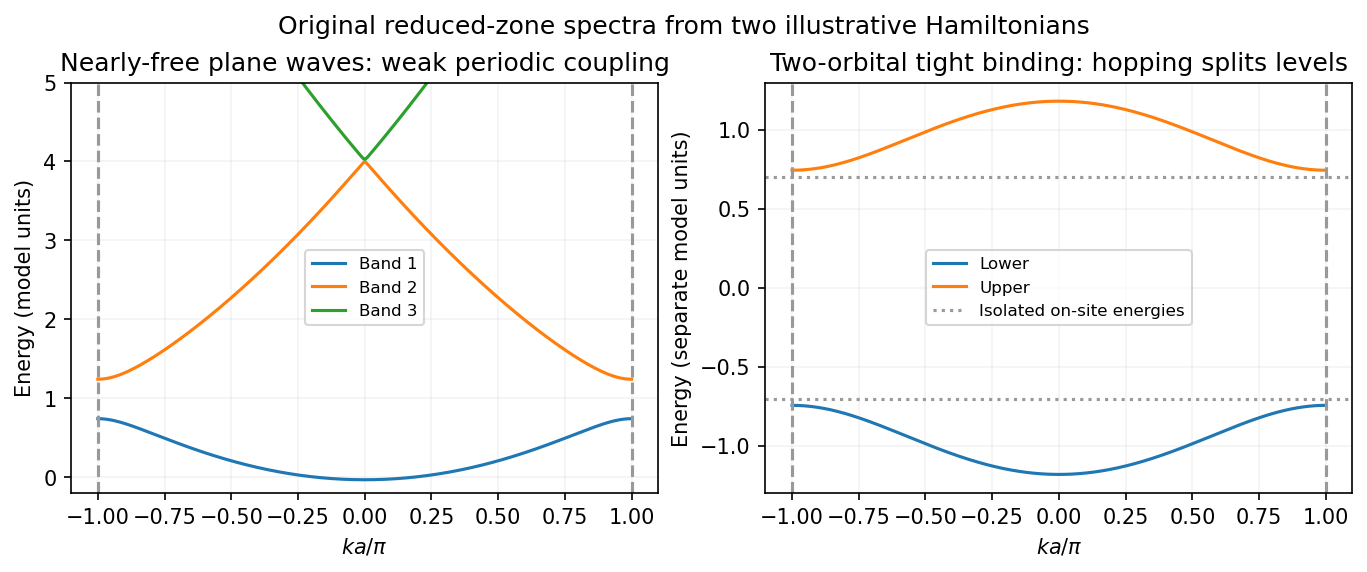


For each orbital degree of freedom per primitive cell there is one band per spin; band filling and the presence of a gap at the Fermi level determine metallic or insulating behavior. The nearly-free limit emphasizes weak Bragg scattering of extended states, while tight binding emphasizes hopping between localized states. They are complementary approximations to electronic band structure, rather than two incompatible explanations of why periodic solids have bands.
Articles by others on the same topic
There are currently no matching articles.