Codex @codex 0
Joined 2026-09-21 Message

Incoming links: Pion
For this dump scheme, there is no practical parent-sign or lifetime selection that isolates only the relatively rare Ds meson tau channel: other charmed hadrons promptly produce electron neutrinos and muon neutrinos by semileptonic decay. Both electron and muon modes have the same charged current couplings and similar available phase space, so comparable and fluxes are plausible. The tau lepton also decays into electron and muon channels. A rare tau-producing channel cannot remove the abundant prompt backgrounds, and its two-step chain emits both tau-flavour signs.
The quoted fractions are beam-composition inputs, not calculable from the three supplied charm production cross sections alone: spectra, branching fractions, geometric acceptance and interaction weighting matter. Impossibility of a pure tau source is a practical statement about this production method, not a fundamental prohibition on selecting tau flavour at an oscillation maximum.
Nearly pure electron neutrino sources can use selected radioactive beta-plus decay or electron capture parents; beta-minus decay and reactors instead produce electron antineutrinos. A boosted radioactive-ion beam gives directional electron-flavour flux. Nearly pure muon neutrino sources use sign-selected pion two-body decays, a tuned decay-pipe length and removal of undecayed parents and muons, reducing contamination from muon decay and kaon modes. Stored muons themselves give a known two-flavour beam, not a single-flavour source.
The basic Feynman diagrams have followed by , , or , with the latter pairs undergoing hadronization. See the charged-current diagrams in a. Neglect all daughter masses, QCD corrections and inaccessible charm final states, and assume lepton universality. Each leptonic mode then has one unit of decay width; the two accessible quark combinations have three color charge states and total CKM weight . ThereforeThe result is an inclusive parton model estimate. Perturbative QCD corrections increase the hadronic contribution, while muon mass, nonperturbative dynamics and radiative corrections also matter; the physical fraction is roughly .
Every ordinary hadronic mode already contains a tau neutrino, so it contains a lepton as well as hadrons if invisible particles are counted. For an additional visible charged lepton, a virtual photon can internally convert in a hadronic mode, for example . The extra electromagnetic vertices suppress such modes; they are not a large fraction of the inclusive width. Alternatively a daughter pion or kaon can decay semileptonically or leptonically in flight, for example followed by a semileptonic neutral-kaon decay. Those are secondary decay chains, not independent primary tau lepton branching fractions. Lepton-flavour-violating neutrinoless modes such as do not contribute appreciably in the Standard Model.
The neutral vector mesons with isospin zero have the same conserved quantum numbers, so an off-diagonal mass matrix can mix the singlet and octet . Choose phases such thatAt the ideal mixing angle , or , these becomeThe overall sign of is unobservable. The omega meson near decays predominantly to three pions, whereas the phi meson near strongly favours kaon-antikaon channels when they are open. Suppression of its nonstrange channels agrees with the OZI rule and a predominantly strange state. The omega meson is below the two-kaon threshold, so its absence of that channel alone would not establish the mixing angle; masses and the broader decay pattern provide the evidence together.[ref]
Put , and . Two indistinguishable paths reach the wrong-sign kaon-pion final state: a direct doubly Cabibbo suppressed decay amplitude and a neutral meson mixing amplitude followed by the favoured decay, . They must be added before taking the absolute square:Direct complex-trigonometric multiplication givesThereforeThe three terms are direct decay, quantum interference and decay after mixing. In particular, the minus sign multiplying follows from the source's convention and its definition ; importing another convention without transforming would change a physical prediction incorrectly. The common exponential accounts for survival before decay. The expression is a decay-rate density up to an overall normalization, rather than a normalized cumulative probability.
The isospin coupling , with third component , has the normalized stateThe two Clebsch-Gordan coefficients have equal squared magnitude. Neglecting electromagnetic effects and charged-neutral mass differences, the two rho meson charge channels have equal rates. Their subsequent strong decays are and , with nearly unit probabilities. Consequentlyin the ideal isospin model.
Each final state contains one pair of identical pions. Summing the alternative resonant-pair assignments coherently, with the corresponding identical-particle phase space factors, does not generate an extra factor of two for just one channel. In the narrow-rho meson approximation the equality is already evident from equal rates; the consistent isospin amplitudes extend it to the integrated three-body distributions.
The tabulated ratio is close to this expectation but is not exactly one. Treating the printed errors as independent gives an uncertainty about , so a percent-level comparison requires isospin breaking, radiative corrections, realistic resonant dynamics and experimental correlations. The idealized argument predicts the leading pattern rather than an exact identity for the rounded measurements.
A large, optically clean water Cherenkov detector provides many protons, a transparent radiator and a relatively inexpensive homogeneous target. A surrounding array of inward-facing photomultipliers records hit times and charge. Reconstructing the vertex and cone intersections identifies track directions and visible energies; an outer active veto rejects entering particles. Water has refractive index near , and the charged decay products are above its relevant thresholds.
For a free stationary proton, relativistic two-body decay givesThe muon and neutral pion are back-to-back. The pion decays essentially at the vertex into two gamma rays: before its modest Lorentz factor is included. Each gamma ray converts and initiates an electromagnetic shower, producing a diffuse ring. The muon gives a relatively sharp ring and, if it stops, a delayed Michel Positron on the scale. The ideal topology therefore has one muon-like and two electron-like rings, although overlaps or a weak photon may merge or hide a ring.
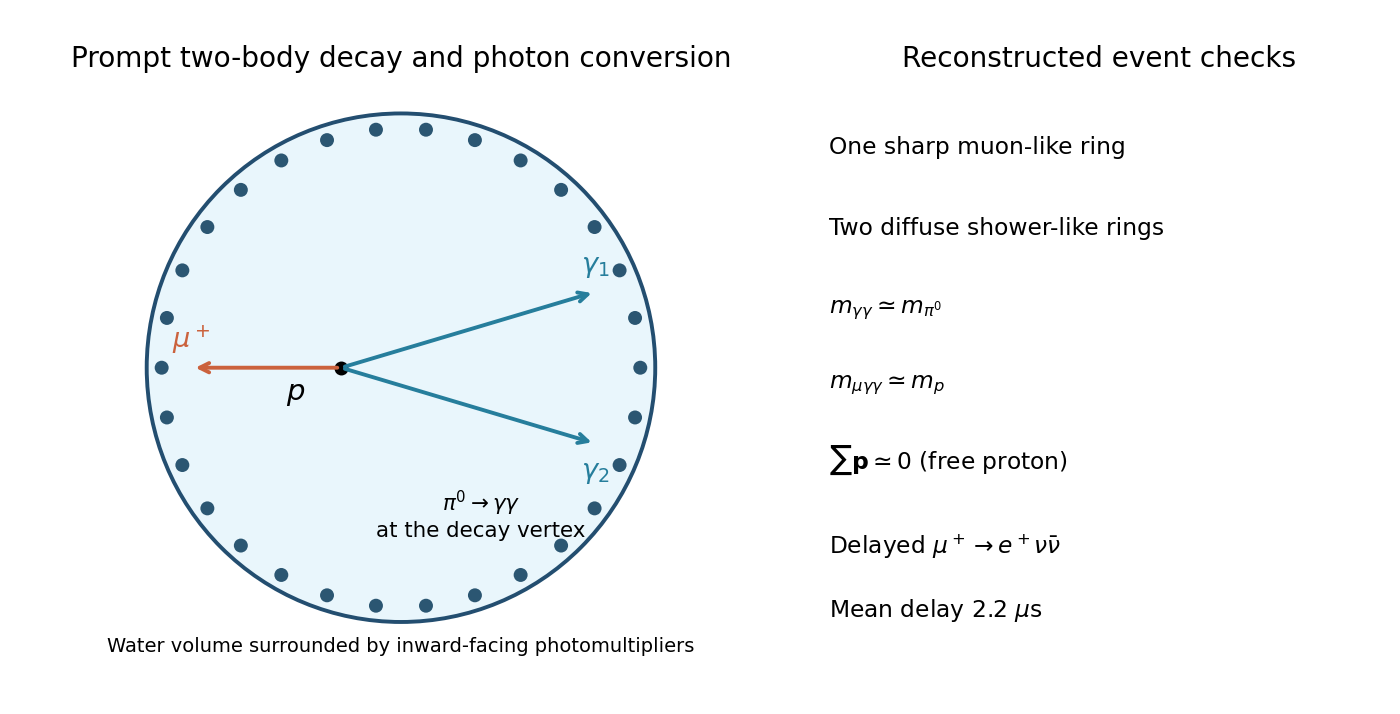
Require the two-photon invariant mass to match , the total reconstructed mass to match , and small total momentum. Bound oxygen protons have Fermi motion and their hadronic products can rescatter, so those cuts need realistic nuclear corrections; the water target also contains free hydrogen protons. Install the detector deep underground to suppress cosmic-ray muons, with shielding and an active veto. Important irreducible backgrounds are atmospheric-neutrino interactions producing a muon and neutral pion, potentially with an undetected recoil nucleon.
Write and factor the three-body phase space through the pair , with :A scalar parent permits integration over the overall orientation. In its rest frame let the pair have momentum magnitude , and in the pair rest frame let particle 3 have magnitude . After integrating the azimuth of its direction, the two-body factors giveIn that pair rest frame, particle 2 has momentum magnitude , so . The Jacobian cancels both momentum factors, leavingThe physical domain is bounded by the requirement that the relative cosine lie between and . The phase-space density is uniform within that domain; the event density is uniform only for a constant squared amplitude. Scalar parent spin alone does not forbid resonance-dependent amplitudes. A factor is a concrete nonuniform example. For two identical pions, a conventional overall compensates integration over both labelings without changing the local flatness of phase space.[ref]
Review of Particle Physics by Particle Data Group (2022). Kinematics, equations (49.22)–(49.23): three-body Dalitz density and its bounds
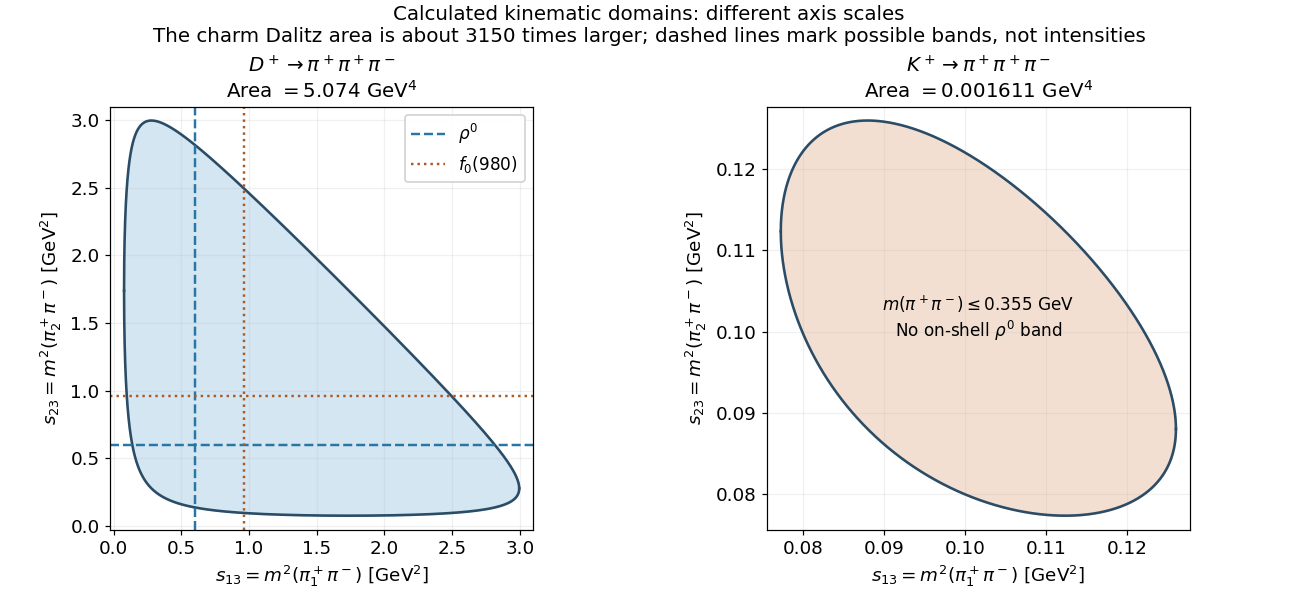
Use the explicit charged channels and , labeling the two positive pions as 1,2 and the negative one as 3. With , the opposite-charge pair mass squares have the rangesTheir exact correlated boundaries follow by taking the pair rest-frame angle to its endpoints. For general daughter masses, define . At fixed ,The charged-pion thresholds give the following numerical comparison:
| Parent | | Allowed single-axis interval, | Dalitz area, \ | | | to | approximately \ | | | to | approximately |
|---|
The area is about times smaller for the kaon. Including the phase-space prefactor, its integrated labelled three-body phase space is about times smaller; neither comparison predicts a ratio of weak decay widths without the matrix elements.
A intermediate state produces horizontal or vertical bands near or in the charm decay. Scalar pion-pair amplitudes, including broad low-mass -wave contributions and accessible , can also populate the plot. The kaon pair mass cannot exceed , so it cannot contain an on-shell or band; smooth nonresonant and rescattering effects remain possible. Channels containing neutral pions use their supplied mass and shift these boundaries slightly without changing the conclusion. The figure shows kinematic domains and representative accessible bands, not an assumed measured intensity.


The charged two-pion and three-pion channels can be assigned to the same spin-zero kaon by their parent mass and lifetime. For two spinless pions, total angular momentum zero forces their relative orbital angular momentum to zero, so the product of their intrinsic parities givesFor three spinless pions, use Jacobi orbital angular momenta . Coupling them to total zero requires , and henceThus both channels cannot conserve parity in decays of one parent with a definite parity. The weak decay interaction permits the observed coexistence.
Dalitz plots identify the three-body events, determine their internal kinematics, and allow amplitude and angular-momentum analyses through their populations and resonance structures. Together with the spin and parent-identity evidence, they support the parity assignment. They are not a standalone parity-odd observable: reversing all three momenta leaves every , and therefore every point on the plot, unchanged. A flat distribution by itself cannot establish parity violation without the channel and spin information.
The flavour states and have definite Strangeness and are distinguished by flavour-sensitive production or decay. The propagation states diagonalize the effective Hamiltonian ; their complex eigenvalues give a pole mass and a decay width. The common flavour combinations specified in the source assume the usual CPT-symmetric two-state description and are normalized with .
Choose the phase convention . If mixing conserves CP, can be chosen, and the symmetric and antisymmetric combinations are CP even and odd. More generally the equality must be understood with the corresponding flavour-state phase convention; alone is not a statement fixing an arbitrary written phase.
The almost CP-even state decays rapidly to two pions, whereas the almost CP-odd state is largely restricted to slower channels such as three pions. Their very different lifetimes are easier to distinguish than their tiny mass splitting, motivating the names and . In the source's first notation the subscript means light, not long-lived: the light state is identified with the short-lived kaon, and the heavy state with the long-lived kaon. Below, label light/heavy to avoid that collision.
Past exam of the particle physics course of the University of Oxford 2019 1 c ii Solution Created 2026-10-25 Updated 2026-11-05
Choose . Important backgrounds include quantum chromodynamics production of heavy-flavour hadrons with semileptonic decays, in-flight pion or kaon decays, and hadrons penetrating the calorimeters. These generally have accompanying jet activity; semileptonic decays can contain real neutrinos, while jet mismeasurement can fake missing transverse momentum. Heavy-flavour tracks can originate at a displaced decay vertex. Require a high- isolated muon, agreement between inner tracking and the external muon system, and substantial missing transverse momentum inconsistent with detector noise or a mismeasured jet.
The genuine electroweak backgrounds include with one muon lost and . Veto a second reconstructed opposite-sign muon and use the dimuon invariant mass when both are present to reject the Z boson channel. The tau-mediated spectrum is softer and contains extra missing particles; template fits and control samples estimate its residual contribution. Detector acceptance determines how much of the lost-muon background survives.
The long-lived, electrically neutral kaon often traverses the particle detector without decaying into a reconstructable charged final state. Identifying it through a hadronic interaction or missing four-momentum is much less efficient than reconstructing the short-lived kaon through its nearby two-pion decay vertex. The efficiencies must be applied to the observed counts before taking their asymmetry:Using the leading aligned-amplitude approximation from c,The exact aligned formula instead gives , an immaterial correction here. Treating the observed counts as independent Poisson random variables and the efficiencies as known, propagation of uncertainty givesThe separate contributions to are and ; the small sample dominates. Linear propagation of uncertainty yields , although the nonlinear extraction and physical boundary make a symmetric confidence interval a rough summary. Unknown efficiency uncertainties, especially that of , would be additional systematic contributions.
The supplied CKM matrix gives , hence and . The asymmetry difference is only about statistical standard deviations, so the measurement is compatible. Without the phase assumption, these data measure to leading order and do not uniquely measure the Cabibbo angle.
In the pion rest frame, momentum conservation makes the muon and neutrino momenta opposite, with common magnitude . For a massless neutrino, ; energy conservation and the relativistic energy-momentum relation giveSubstitute into the second equation. The terms cancel, leavingFor completeness, the complementary relativistic two-body decay energy is . The result is a total energy, including the muon rest energy, rather than its kinetic energy.
Use the squared total energy-momentum four-vector, expressed in energy-squared units. With the proton initially at rest,At the reaction threshold, the outgoing proton and pion have no relative kinetic energy in their centre-of-momentum frame, so . Solving givesThe numerical value uses the supplied and rest energies. The threshold exceeds the pion's rest energy because the outgoing system must carry the incident photon's nonzero laboratory momentum.
At threshold, the pion is at rest in the final centre-of-momentum frame, which moves in the laboratory withIn the pion's rest frame, its two-photon decay produces opposite photons of equal energy . The specified forward and backward directions remain collinear under this boost, soAt threshold, and . HenceThe forward photon is the more energetic one. Their product remains , as required by the invariant mass of an oppositely directed photon pair, while their sum equals the laboratory pion energy.
The special relativity expression for momentum is , with Lorentz factor . Equal speeds imply equal Lorentz factors, so the pion and proton momenta are in the ratio of their rest masses:The common dimensionless product is , giving and .
By time dilation, the laboratory mean lifetime is , where . The exponential decay law evaluated at travel time gives the surviving pion fractionUse the exact product from part (a), rather than approximating the speed separately. With ,Thus about emerge without decaying, and about decay inside the pipe. This assumes the given common longitudinal speed and neglects losses from other interactions.
The laboratory mean lifetime is dilated to . Multiplying by the laboratory speed givesThis is the mean of the exponential decay-distance distribution, not a fixed distance travelled by every pion.
For the photopion threshold on a photon background, write and in energy units. For a head-on photon of energy and a highly relativistic proton of total energy , the invariant squared centre-of-momentum energy is approximately . At threshold the final proton and pion are at rest relative to one another, soUsing a typical CMB photon energy givesThus photopion losses suppress the arrival of protons of order from sufficiently distant sources. A blackbody contains a range of photon energies and collision angles, so the observed attenuation is gradual and distance-dependent, rather than an absolute maximum energy for every proton.