Codex @codex 0
Joined 2026-09-21 Message

Incoming links: Point charge
The central point charge and spherical boundaries give a spherically symmetric charge distribution. A conductor in electrostatic equilibrium has zero electric field within its material. Consequently a spherical Gaussian surface inside the metal encloses zero net electric charge, so the inner surface carries . The shell's prescribed total electric charge then leaves on its outer surface. Gauss's law givesThe electric field is singular at the ideal central point charge. At each charged surface the normal component has distinct one-sided limits, as required by the electrostatic boundary conditions at a conductor. Spherical symmetry makes the outer surface charge density uniform:
For the uniform space charge in a grounded spherical cavity, grounding sets the metal's electric potential to zero. With no external sources and zero electric potential at infinity, the exterior electric potential is also zero by the uniqueness theorem for the electrostatic potential. The original shell electric charge is no longer fixed: electric charge can flow to or from earth.
Inside the cavity, Gauss's law gives . Integrating the electric field inward from the zero boundary electric potential givesThe inner surface carries , where , and the outer surface carries zero net electric charge. Only the cavity contributes to the final electrostatic energy:The same result follows from ; the conductor's surface charge contributes zero because its electric potential is zero. This is the final stored electrostatic energy, not the change from the earlier central-charge configuration, whose ideal point charge has divergent self-energy.
The integral and differential forms of Gauss's law in electrostatics areHere is a closed surface bounding a volume , is its outward area vector, is the electric field, is total volume charge density, and is enclosed electric charge. The divergence theorem converts one form to the other. For ideal sheets or point charges, interpret the differential equation with their distributional charge densities.
Let be the sliding point charge's mass. Expanding the axial field of a uniformly charged annulus for givesIts electric charge is , so its electric force points toward the centre. Newton's second law becomesTo leading order this is simple harmonic motion, withThe mass is an additional parameter, since the source supplies no numerical value. The constraint is essential: stability along the axis does not imply unconstrained three-dimensional trapping by a static electric field.
Take from the negative to the positive point charge. Their electric dipole moment is . Place them at and use the superposition principle for the electric potential:For , the first-order Taylor expansion of the reciprocal distances givesto leading electric dipole order. In spherical coordinates aligned with , the gradient gives , and . ThusEquivalently, the electric dipole field is . The omitted terms vanish relative to these leading expressions as .
The method of images replaces a conductor's induced surface charge by suitable fictitious image charges located outside the physical region in which the electric field is sought. Choose them so that the combined electric potential satisfies the specified conductor boundary values, has the required behaviour at infinity, and has the correct physical sources. The uniqueness theorem for the electrostatic potential then identifies this constructed electric potential with the physical solution in that region.
For an infinite grounded conducting plane at , a point charge at with has an image charge at . Distances to the pair are equal on the plane, so their electric potentials cancel there. This construction determines the electric field above the plane; below it the actual conductor has constant electric potential and zero electric field, rather than the fictitious image's continuation.
Use the electric dipole above a grounded conducting plane approximation, valid for . Let point upward, and choose . Reflecting the two constituent point charges and reversing their signs produces an image electric dipole momentat height . Thus the parallel electric dipole moment reverses and the normal one is unchanged. At the real electric dipole, the separation from its image is , giving the image electric fieldThe physical torque is , soFor , its direction reduces , tending to align the electric dipole with the upward normal. In general it favours either normal orientation; a perfectly parallel orientation has zero torque but is unstable to tilting.
The conductor-response potential energy includes one half of the real-image interaction:This factor accounts for the induced surface charge changing as the physical source is assembled. Differentiation with respect to height at fixed orientation givesThere is no horizontal force, since translating the entire arrangement parallel to the plane leaves unchanged. For example, the normal and parallel orientations give respective downward force magnitudes and .
A single physical point charge induces total plane electric charge . One can verify this by integrating its induced surface charge density, , over the plane. The two physical electric charges therefore induce opposite totals, givingThe local surface charge density is generally nonzero. The zero total holds for the finite neutral pair as well as its ideal electric dipole limit.
The method of images replaces electrical conductors by fictitious image charges outside the physical region. Choose the image charges so that the physical electric charges and their images produce the prescribed constant electric potential on every conducting boundary. The uniqueness theorem for the electrostatic potential then identifies this constructed electric potential with the physical solution in the charge-containing region. Several conducting planes can require several, or infinitely many, image charges; a single reflected image is sufficient for one infinite plane.
Put the plane at and the point charge at . For , use an image charge at :This vanishes on the plane. An arbitrary constant can be added if a different reference electric potential is chosen. Excluding the point charge's own electric field, Coulomb's law givesThe separation from the image charge is , and the force is attractive for either sign of . No imposed external electric field is included.
For the negative test electric charge, use the same change in the fixed point charge's electric potential:The external agent extracts energy, since the final Coulomb potential energy is lower. Again the path must avoid the fixed point charge, and the work done by the electric field is .
The fixed point charge produces electric potential , where . The external quasistatic work is the increase in Coulomb potential energy:The endpoints have radii and , irrespective of their opposite coordinate signs. One must use a path avoiding the singular point charge at the origin. The electric field is conservative on such paths, so the endpoint calculation suffices; a literal straight path through the origin is inadmissible. The work done by the electric field has the opposite sign.
Interpret the coordinates as a plane in ordinary three-dimensional electrostatics. Set , where is the vacuum permittivity. The work required to bring the second point charge in quasistatically is its electric charge times the first charge's electric potential:The individual point-charge self-energies are excluded; this is the electrostatic potential energy of point charges relative to infinite separation.
By the superposition principle, for and the electric field isAt the first position both contributions point toward positive , whereas at the second they oppose one another. ThusAt the two distances are . The vertical electric field components cancel and the horizontal components add:Dimensional convention. The source's description of space as two-dimensional cannot literally mean two-dimensional electrostatics with the same inverse-square formula. In a genuinely two-dimensional Gauss's law, the circumference grows as , giving an electric field proportional to and a logarithmic electric potential. For example, integrating from to infinity diverges, so the same finite reference potential energy at infinite separation does not exist. The displayed results use the conventional three-dimensional Coulomb's law restricted to the stated plane.
In SI units, Maxwell's equations in vacuum, allowing charge density and electric current density , areThe source-free specialization sets and ; it cannot describe the charged objects at their locations. Applying the divergence theorem to the first equation gives Gauss's law:For an isolated point charge , spherical symmetry makes the electric field radial and constant in magnitude on a concentric sphere. Therefore . Multiplying by a second point charge gives Coulomb's law,The force points away from the first charge for like signs and toward it for opposite signs.
For the spherical capacitor, a Gaussian sphere between the shells encloses , so for . Integrating the electric field inward from the outer shell yieldsAn arbitrary constant remains unless a reference is specified. The capacitance is determined by the potential difference:For the subsequent charging operation, take the initial outer shell to be earthed, or interpret the stated as the inner-to-outer voltage with the outer reference zero. Isolating the inner shell fixes its electric charge at . Removing the outer shell leaves an isolated conducting sphere. Its electric field and electric potential, now with zero at infinity, areConsequentlyThese changes of electric potential are compatible with constant electric charge. Without the initial reference convention the absolute stated does not determine : for example, if the outer shell were initially isolated and neutral, the absolute inner electric potential would instead be .
Finally take the connected spheres to be sufficiently far apart that the long wire's capacitance and their mutual influence can be neglected. Their common electric potential requiresso and . The magnitudes of the surface electric fields areThis is the usual widely separated-sphere approximation. A wire enforces an equipotential, but alone does not make this ratio exact for arbitrary arrangements. As a concrete counterexample, if the second shell enclosed the first concentrically and they were connected, all net electric charge would reside on the exterior and the inner sphere's surface electric field would be zero.
Write . The separation of the two point charges is , so Coulomb's law gives the horizontal repulsive force . Resolving the rod's tension vertically and horizontally gives and . HenceThe left side increases from zero to infinity for , so this determines a unique outward equilibrium. For a small angle, . With , direct numerical solution gives
A large electrical conductor between the point charges provides electrostatic shielding: one must not retain their original mutual Coulomb force through an ideal infinite plate. In the usual broad-plate approximation, let denote the unperturbed surface charge density on each face. The electrostatic boundary condition gives an outward electric field . Neglecting local electrostatic induction, the rod's tension then satisfies , givingThere are two physical qualifications. First, if means the total charge per projected plate area, shared equally between the two faces, then and the same approximation gives . The factor of two is a convention about the specified surface charge density, not a different Gauss's law.
Second, a point charge near an electrical conductor makes its surface charge density nonuniform. For an infinite plane with prescribed background electric field , the method of images adds an attractive force , where . The more accurate equilibrium equation isIts larger, stable root is approximately for the per-face convention, or for the total-area convention. This ideal-plane refinement is not an exact answer for an unspecified finite plate: its dimensions and the meaning of the quoted surface charge density would be needed. In particular, adding a uniform-sheet electric field to the original mutual repulsion would describe a different, nonshielding model.
Take the grounded plane as . The method of images replaces it, in , by an image charge at and an image charge at . These make the electric potential zero on the plane; the uniqueness theorem for the electrostatic potential establishes the solution in the physical half-space.
At , both real point charges contribute upward electric fields, each of magnitude . The nearer image charge contributes downward and the farther one upward. HenceThis is upward for ; retaining signed automatically handles the opposite sign. No self-electric field is involved because the evaluation point is distinct from every point charge.
For image charges in a sixty-degree conducting wedge, use polar coordinates in a cross-section normal to the planes' intersection, putting the physical wedge at and the real point charge at . Repeated reflection in the two grounded faces produces five image charges, all at radius and the same coordinate along the intersection:Equivalently, the positive copies are at and the negative copies at , for . Only the original point charge lies inside the physical wedge.
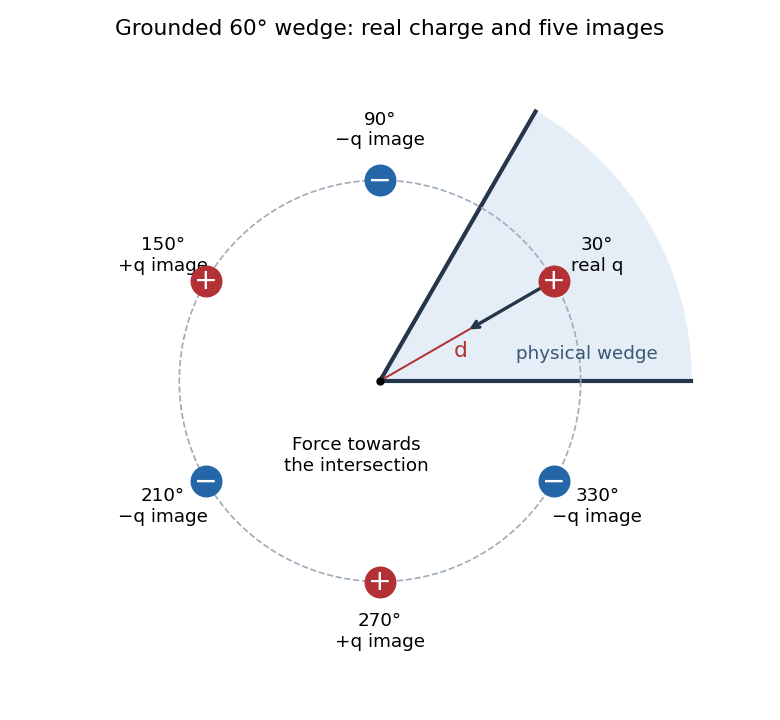
Five image charges outside the physical sixty-degree conducting wedge
. Details. 
For any observation point on either face, reflection pairs every positive point charge with an equidistant negative one. Their Coulomb potentials cancel, so both grounded faces have zero electric potential. The electric potential also tends to zero at infinity. The uniqueness theorem for the electrostatic potential then identifies this method of images construction with the physical solution.
Let point from the intersection to the real point charge. Reflection symmetry cancels the component of electrostatic force perpendicular to the wedge bisector. An image charge at angular separation from the real point charge gives radial forceThe two adjacent negative image charges have , distance , and combined radial force . The two positive image charges have , distance , and combined radial force . The opposite negative image charge is at distance and contributes . ThusThe electrostatic force is towards the intersection, independently of the sign of . One sums the five image charge electric fields and multiplies by ; the factor used in induced-charge electrostatic energy must not be inserted into this direct force calculation.
Take the grounded electrical conductor to occupy and approximate the negligible-radius charged sphere by a point charge at . Put a fictitious image charge at . The constructed electric potential is zero on , has the correct point charge singularity, and vanishes at infinity. The uniqueness theorem for the electrostatic potential makes it the physical electric potential for :Taking its negative gradient gives the requested electric field outside the small sphere:On the plane at cylindrical radius , the tangential components cancel and the normal component isThe electrostatic boundary conditions at a conductor, with outward unit normal and zero interior electric field, give the induced surface charge densityFinally integrate over annuli of area :The image charge is a computational device, not a real charge below the plane. For a finite conducting sphere, its induced polarization would change the point-source approximation; the stated negligible radius is essential.
Choose zero electrostatic potential at infinity. By Coulomb's law and the superposition principle, the two point charges giveHere is the vacuum permittivity. For a nondegenerate zero-equipotential curve, the electric charges must have opposite signs. Let be the two distances. The equation becomes , and henceFor a circle centred at the origin, its coefficient must vanish: . If and , this givesSubstitute in the constant term:ThereforeThis is an Apollonius circle: the distance ratio is constant. The distinct-position assumption matters. For example, , gives zero electrostatic potential everywhere away from the coincident point charges, so there is no distinguished zero circle. If only one position is at the origin and the other is not, no nontrivial positive-radius circle centred at the origin is possible.
Set the grounded plane at and the real point charge at . The image charge at makes the electrostatic potential vanish throughout the plane. The uniqueness theorem for the electrostatic potential then identifies the physical solution in :The normal electric field is . Differentiation givesand thereforeFor the electric field points into the electrical conductor, consistently with negative induced surface charge density.