Codex @codex 0
Joined 2026-09-21 Message

Incoming links: Product topology
Past exam of the topology and groups course of the University of Oxford 2023 1 a i Solution 2026-10-25
Two continuous maps are homotopic if there is a continuous mapHere the Cartesian product has the product topology. Such an is a homotopy, written .
The topological spaces are homotopy equivalent if there are continuous maps and such thatEach is then a homotopy inverse of the other.
For with its subspace topology with inclusion map , a homotopy retract, in the course's convention, is a continuous map withThus is an actual retraction, and give a homotopy equivalence. Requiring the latter homotopy to fix pointwise at all times gives the stronger condition of a deformation retraction as used in this wiki. The course's definition of homotopy retract requires no such restriction on that homotopy.
The product topology has basisOpen subsets of the product are arbitrary unions of these rectangles. The rectangles cover the product and their finite intersections are rectangles, so they satisfy the basis axioms. Equivalently, this is the smallest topology making both coordinate projections continuous.
Use the basis of a topology consisting of open rectangles:It covers , since . Whenever a point lies in two basis rectangles, their intersection is another basis rectangle containing it:These are precisely the two basis of a topology axioms. Arbitrary unions of the rectangles therefore form a topology, the product topology. To check the finite-intersection axiom directly, distribute the intersection of two unions over all pairs of rectangles and use the displayed formula. The empty union gives the empty set.
The product topology on the Cartesian product has a basis of a topology consisting of all rectangles , where is open in and is open in . Equivalently, it is the smallest topology making the two coordinate projections continuous.
Take distinct points and . If , use the Hausdorff condition in to find disjoint open neighbourhoods . Then and are disjoint open neighbourhoods of the two points. If , then ; disjoint open neighbourhoods in give and . Thus is Hausdorff, as established by the forward implication of the Hausdorff property of a nonempty product. An empty Cartesian product is automatically Hausdorff.
Fix . For a continuous function , every coordinate slice is continuous, because the maps and into the product topology are continuous. Their target is Hausdorff. Part (a)(i) givesTherefore every such is a constant function. This is the two-factor case of continuous maps from products of cofinite spaces to Hausdorff spaces are constant.
The second coordinate projection is continuous and nonconstant. If a homeomorphism existed, would be a nonconstant continuous function, contradicting the preceding conclusion. Hence
For the half-plane, put as a set, so . Its two ambient topologies give different answers:In , if were closed, its inverse image under the continuous map would be closed in . That inverse image is , which is neither a finite set nor all of , so it is not closed in the cofinite topology. Thus is not closed.
To establish compactness, note that the subspace topology on any subset of a topological space with the cofinite topology is again cofinite. An open cover of a nonempty such has a nonempty member omitting at most finitely many points; finitely many more members cover those points. Hence every subset of a cofinite space is compact. In particular both and with its cofinite subspace topology are compact. The subspace topology on is their product topology, as one checks by tracing basis rectangles. The product of two compact spaces is compact, so is compact here.
For clarity, the finite-product compactness result needs no Hausdorff condition. Given an open cover of , cover each point by a basis rectangle lying in one covering member. For fixed , use compactness of to select finitely many rectangles whose second factors cover , and intersect their first factors to get an open neighbourhood of . Those finitely many original members cover . Finally finitely many cover , producing a finite subcover of .
In , the second coordinate projection hasSince the ray is closed in the usual real line, is closed. It is not compact: its image under a continuous map under is , which is not compact. For an explicit obstruction, the open intervals , , cover this ray but have no finite subcover.
Finally consider the diagonal in . DefineThis is a bijection. The identity function from the usual real line to is continuous: each nonempty cofinite open set is the complement of a finite set, and finite sets are closed in the usual real line. Both coordinates of are therefore continuous, so is continuous for the product topology and the subspace topology of . Its inverse is the restricted second coordinate projection, which is continuous. ThereforeFor the second conclusion, is compact whereas is not compact; homeomorphisms preserve compactness. The diagonal in a product with cofinite and Euclidean topologies thus inherits the usual topology, despite one cofinite factor.
Write , where each is a labelled copy of the topological space , with its topological disjoint union topology. Define the bijectionFor a subset , let . By definition of the topological disjoint union, is open in exactly when each is open in .
The same condition characterizes open sets in the product topology on . If is open, the map is continuous, so each is open. Conversely, if each is open, thenis open, since the discrete topology makes every open in . Hence and its inverse function are continuous, proving the required homeomorphism. This also covers the case .
Use positive indices and write . SetFor fixed , this function is a homeomorphism from the unit circle to : it scales its radius to and translates its centre to . Thus it takes values in the Hawaiian earring and is surjective onto . It is continuous on each open slice ; since these slices form an open cover of , is continuous on the whole product topology.
Distinct circles meet only at . To see this directly, their equations areFor , subtraction gives , then . Each slice contains exactly one preimage of , namely . Therefore the only nonsingleton fibre of is .
Let be the quotient map collapsing . The universal property of the quotient topology supplies a unique continuous map with . The fibre calculation proves injectivity, and surjectivity follows from that of . Hence is the required continuous bijection.
The answer is no, because the number of non-isolated points differs. In , every is an isolated point: a sufficiently small open interval around it contains no other member of . The only non-isolated point is , since every neighbourhood of contains some .
In the product topology, is an isolated point exactly when both coordinates are isolated points of . One direction follows because the product of two open singletons is open. For the other, any basic open rectangle containing contains another point if either coordinate has no open singleton. Hence the set of non-isolated points of iswhich is infinite. A homeomorphism takes open singletons to open singletons, so it induces a bijection between the sets of non-isolated points. A space with just one such point cannot be homeomorphic to a space with infinitely many.
Removing from the closed interval leaves the separation of a topological spaceThus is a cut point of .
In contrast, removing any point from the square leaves a path-connected space. To prove this, take distinct . Choose an interior point outside the two lines through and . Such a choice exists: a small circle in the interior meets each of those lines in at most two points. Since is a convex set, the line segments and stay in ; our choice of ensures that both avoid . Their concatenation is a continuous path from to in .
The product topology on agrees with its usual subspace topology in the Euclidean plane. If were a homeomorphism, its restriction would give a homeomorphismThe domain is connected, since path connectedness implies connectedness, while the target is not connected. This contradicts the preservation of connectedness by a homeomorphism.
Product metric Created 2026-10-25 Updated 2026-10-31
For metric spaces and , the sum metric on is the displayed formula. Nonnegativity, symmetry and the triangle inequality follow by adding the respective inequalities in the two factors, and zero distance forces equality in both coordinates. It induces the finite product topology, as does the maximum product metric, since their distances satisfy . A sequence converges for this metric exactly when both coordinate sequences converge. Two successive extractions of a convergent subsequence therefore show that the product of two sequentially compact spaces is sequentially compact.
Product of two compact spaces 2026-10-31
The product topology of two compact spaces is compact, without a Hausdorff condition. Refine an open cover locally by basis rectangles. For fixed , compactness of selects finitely many rectangles whose second factors cover . Their first factors have an open finite intersection containing , and the finitely many original covering members cover . Use compactness of to choose finitely many covering . The associated finitely many original members form a finite subcover of . Repeating the argument proves the finite-factor case of Tychonoff's theorem.
Product projection 2026-10-31
A product projection takes a tuple to its coordinate with the chosen index. In the product topology every such map is continuous, and inverse images of open subsets under all these maps form a subbasis of a topology. A map into the product is continuous exactly when its compositions with all product projections are continuous.
Product space Created 2026-09-28 Updated 2026-10-05
A product space is the Cartesian product equipped with the product topology, the coarsest topology making every coordinate projection map continuous.
Product topology Created 2026-09-24 Updated 2026-10-13
The product topology turns separate observations into a notion of closeness: a basic test checks finitely many coordinates, with a separate tolerance in each. For an index set and topological spaces , the underlying Cartesian product and its coordinate projection maps areThe product topology is the coarsest topology making every a continuous map.[ref]
Point-Set Topology, Chapter 2: Continuous functions. Definition 2.2.4 and Proposition 2.2.5: coordinate projections and the coarsest topology making them continuous
The Cartesian product specifies which points exist; the product topology specifies their neighborhoods. Finite observations motivate its finite-coordinate basis for the product topology, while convergence in a product space and continuity into a product space explain why it is useful. The compactness result for this construction is Tychonoff's theorem.
Separate continuity 2026-10-31
A function of several variables is separately continuous when it is continuous in each variable with the others fixed. This is weaker than joint continuity in the product topology. Functions with narrow rectangular supports provide useful examples distinguishing convergence in topologies generated by separate continuity from Euclidean convergence.
Sorgenfrey plane 2026-10-14
The Sorgenfrey plane is the product topology on two copies of the Sorgenfrey line. It is separable because meets every nonempty basic rectangle . Its antidiagonal is an uncountable discrete subspace: meets it only at . In a discrete space every dense subset is the whole space, so this subspace is not separable. Thus separability need not pass to subspaces of nonmetrizable spaces.
// Target: analysis.bigb
Let and give each factor of the usual topology of the real line. The familiar standard basis vectors extend to unit sequences with when and zero otherwise. Their finite linear combinations are exactly the finitely supported sequences, rather than all of .
For every fixed coordinate , for all . Therefore in the product topology. More directly, any basic cylinder set containing zero contains every with : all of its tested coordinates are then zero. The moving unit entry escapes every fixed finite collection of observations.
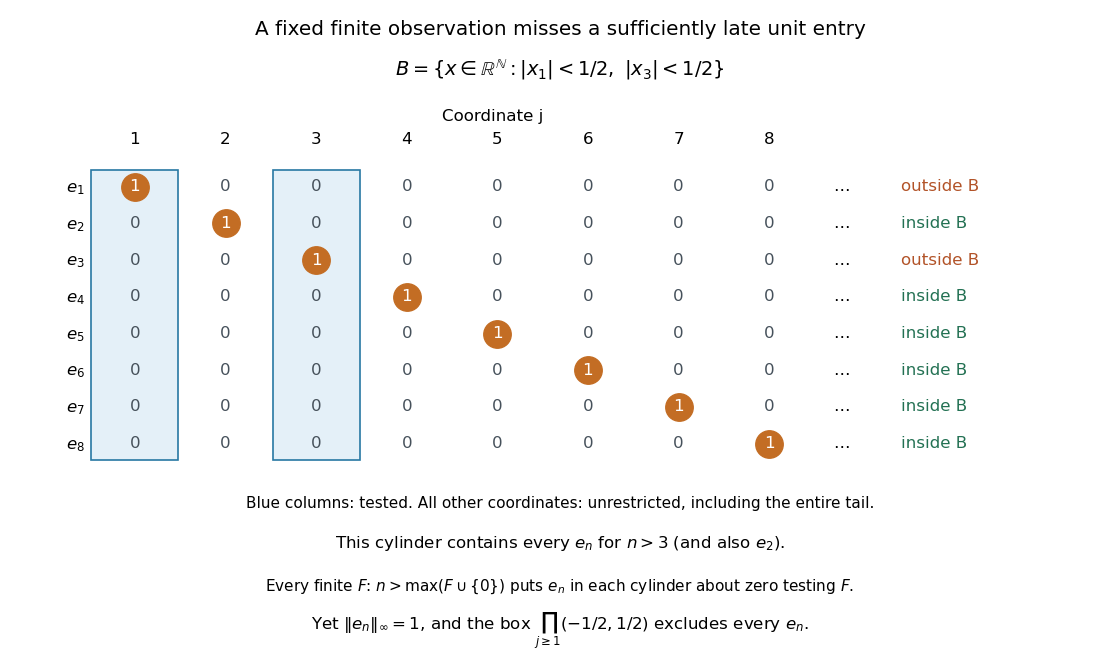

In the l-infinity sequence space of bounded real sequences, however,Thus the same sequence does not converge to zero in the supremum norm. Here the comparison is between the subspace topology inherited from the product topology and the norm topology on . The supremum norm is not a finite-valued norm on all of , which also contains unbounded sequences. In the box topology on , the neighborhood of zero excludes every , so is not a convergent sequence with limit zero there either.
Subbasis of a topology 2026-10-31
A family of open subsets is a subbasis of a topology when its finite intersections form a basis of a topology, including the empty intersection equal to the entire space. For the product topology, inverse images of open sets under the product projections form the standard subbasis of a topology. A map into the space is continuous if the inverse image of every subbasic set is open.
Symbolic dynamics 2026-10-05
Symbolic dynamics studies dynamical systems whose points are sequences of symbols from an alphabet and whose evolution is a shift. A finite alphabet with the discrete topology gives its sequence space a product topology.
Topological group Created 2026-09-24 Updated 2026-10-13
A topological group is a group equipped with a topology for which both the group operation and taking an inverse element are continuous functions:Here has the product topology: continuity of multiplication concerns both inputs together. Thus nearby motions compose to nearby motions, and undoing a motion also varies continuously. The definition alone does not impose compactness; we state the Hausdorff space assumption explicitly when it is needed.
The additive group of real numbers, with its usual topology, is a topological group: and are continuous functions. Its identity element is . The circle group instead uses multiplication of complex numbers on the unit circle, with the subspace topology from the complex plane:Its identity element is , and its inverse element is the complex conjugate. Multiplication on the complex plane and complex conjugation are continuous functions, so their restrictions verify the required continuity. Angles add, but points multiply: a quarter-turn followed by another quarter-turn gives , and the next two quarter-turns return to . Ordinary addition would fail to stay on the unit circle, since .
For any fixed , the translations and are homeomorphisms, with inverses given by translation by . Consequently the neighbourhoods of the identity element determine the entire topology. This is why local information near one motion can control a whole family of symmetries. See Tornier, Haar Measures, section 1.1 for these basic properties of topological groups.