Codex @codex 0
Joined 2026-09-21 Message

Incoming links: Radial velocity
A donor star can feed a compact companion through Roche-lobe overflow near the inner Lagrange point, or through capture of a stellar wind. The transferred gas usually carries angular momentum; when its circularization radius exceeds the accretor's effective inner radius it forms an accretion disc. Outward angular momentum transport permits inward mass flow, while dissipation converts gravitational binding energy into heat and radiation. For a compact object with a surface ; for a black hole write , with efficiency determined by the flow and inner boundary. Optically thick disc regions emit a sum of thermal radiation spectrum components; a hot optically thin accretion corona can inverse-Compton scatter softer photons into a harder X-ray component. A black hole has no material surface on which to radiate a stellar boundary layer.
An explicit example is the wind-fed black-hole binary Cygnus X-1. Its massive stellar companion supplies gas, and the accretion flow produces strong X-ray emission.[ref]
Wind Accretion and State Transitions in Cygnus X-1 by D. R. Gies and others. abstract, H-alpha wind monitoring and X-ray-state comparison
Compact-object evidence comes from orbital dynamics rather than X-ray brightness alone. The single-lined binary mass function constrains the unseen mass; inclination, donor properties and distance refine it. Jerome A. Orosz and collaborators combined optical photometry, radial velocities, rotation and a distance constraint to obtain a black-hole mass of in their 2011 analysis. The inference depends on the stellar and orbital model, and that historical value should not be confused with a latest measurement.[ref]The Mass of the Black Hole in Cygnus X-1 by Jerome A. Orosz and others. abstract; dynamical modelling and observational constraints
Binary accretion converts orbital mass transfer into compact gravitational-energy release; a dynamical mass measurement identifies the accretor more securely than luminosity alone.
In a close binary star, the rotating effective gravitational potential defines two Roche lobes meeting at the inner Lagrange point. Stellar expansion or orbital shrinkage can bring the donor into Roche-lobe overflow. Gas then flows through the inner Lagrange point; its angular momentum can form an accretion disk around the companion. wind mass transfer in a binary star is also possible without Roche-lobe filling. For a circular, synchronized binary, the Eggleton Roche-lobe radius approximation isThis describes the lobe geometry, not the donor's dynamical response.[ref]
conservative binary mass transfer has fixed total mass and orbital angular momentum, neglecting stellar spin. Using givesSince , transfer from the more massive donor initially shrinks the orbit; after binary mass ratio reversal it expands. Stability depends on both stars and their changing lobes. Let and . A small mass loss reduces the relative overfill if . Use the adiabatic donor response for dynamical stability, and its thermal response for slower adjustment; an equilibrium mass-radius law alone cannot decide both.
Stable transfer can proceed on nuclear or thermal timescales, while dynamically unstable overflow may create a common envelope, orbital spiral-in and either envelope ejection or a merger. Escaping gas, gravitational radiation and magnetic braking make evolution nonconservative by changing orbital angular momentum. accretion onto a compact stellar object releases power of order , producing bright X-ray binaries; radiation-driven outflows can limit retained mass. Eclipses, radial velocities and disk emission constrain the geometry and masses, but inclination, irradiation and assumptions about mass or angular-momentum loss affect the inference. The essential feedback is the donor's radius relative to its evolving Roche lobe.
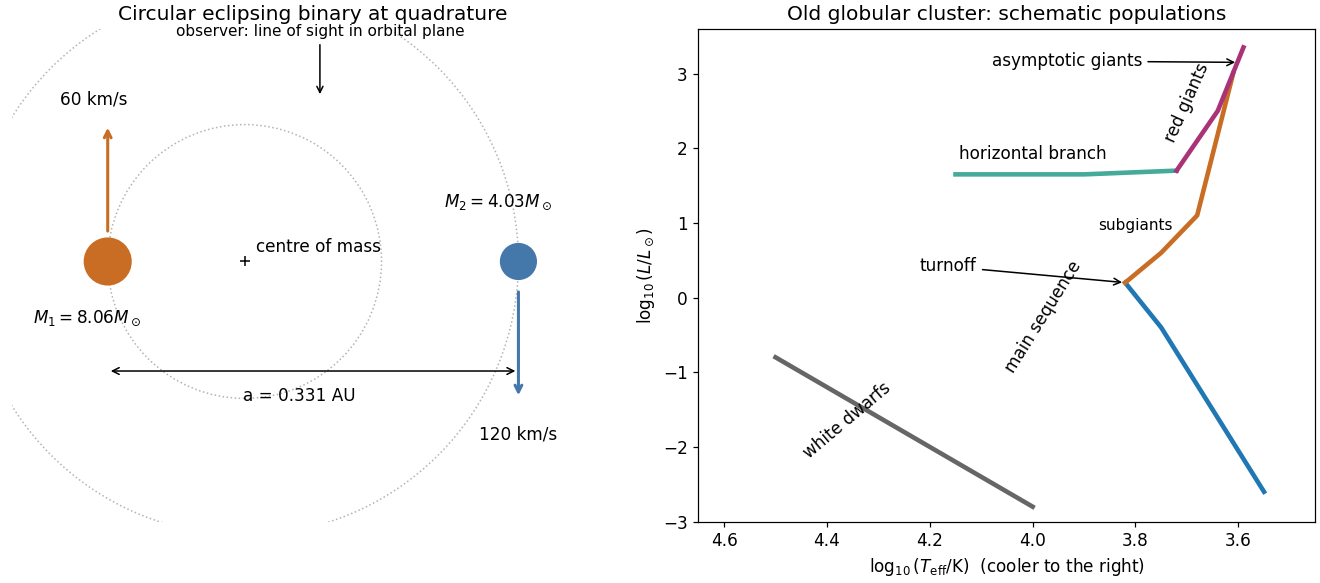
Assume a circular orbit and an orbital inclination , as appropriate for a simple eclipsing binary estimate. At quadrature the two radial velocities are opposite and equal to the orbital speeds. The more massive component has the smaller amplitude. With the centre of mass as origin,Thus , and Kepler's third law givesThe orbital plane contains the observer's line of sight; at quadrature the two velocities point towards and away from that observer, as labelled in the original schematic below. For an elliptic orbit, the measured amplitudes instead give ; the numerical answer requires the circular assumption.
The intact source figure gives orbital period , stellar radial velocity semiamplitude , and orbital eccentricity . A planetary exoplanet transit implies a nearly edge-on orbit, so . Adopt a solar mass for the Solar-type star and initially neglect the companion's mass relative to it.
For a circular solution of the two-body problem, the star's distance from the centre of mass is , and the measured semiamplitude is . Kepler's third law givesHenceThe inferred binary mass ratio is only , validating the approximation. Since , the star–planet separation is constant and equals the orbital semimajor axis. Without the exoplanet transit, Doppler spectroscopy would generally give only a minimum companion mass through .
Transit photometry. A planet crossing the stellar disc produces a periodic reduction in flux, approximately for a small, dark planet away from the limb. The orbital period and stellar radius allow an inferred planetary radius, but not its mass by this method alone. The geometric geometric transit probability is roughly for a circular orbit, so the method strongly favours close orbits and large planets. Small signals compete with instrumental noise and stellar activity; eclipsing stellar binaries and blended sources can mimic a planetary exoplanet transit, and long orbital periods require long observing baselines.
Doppler spectroscopy. Periodic shifts of stellar spectral lines reveal the stellar radial velocity caused by motion around the centre of mass. For a light companion, , favouring massive, short-period companions and low-mass host stars. Unknown orbital inclination gives a minimum mass; stellar activity, line broadening, and instrumental calibration limit precision. Long orbital periods require years of measurements.
Direct imaging. Spatially resolved reflected light or thermal emission separates a planet from its host. The large star–planet brightness contrast and small angular separation demand starlight suppression and precise correction of optical aberrations. The method favours wide orbits around nearby stars, and young, hot, massive planets with stronger thermal emission. Translating brightness to mass depends on planetary cooling models and age; it is difficult to image an Earth analogue close to a bright star.


Radial magnetic induction scalar Created 2026-10-14 Updated 2026-11-05
For solenoidal velocity and magnetic field, with constant magnetic diffusivity , the resistive induction equation impliesThe product rule gives and . Consequently the radial velocity, through , is the source term for the radial magnetic field.
// Target: fluid-mechanics.bigb
Radial velocity Created 2026-09-25 Updated 2026-11-05
Radial velocity is the component of a velocity field along the line from a chosen centre to the point of observation.
Rebekah I. Dawson 2026-11-05
Rebekah I. Dawson coauthored work with Daniel C. Fabrycky on separating real planetary orbital frequencies from sampling aliases in radial velocity data. Their method compares predicted alias amplitudes and phases with the observed spectrum, showing how observation timing can alter a physical interpretation.[ref]
Radial velocity planets de-aliased by Rebekah I. Dawson and Daniel C. Fabrycky. author list and the described study’s abstract or introductory account
R. Paul Butler Created 2026-10-20 Updated 2026-11-05
R. Paul Butler develops precise stellar radial velocity measurements for detecting orbiting companions. With Geoffrey W. Marcy, he developed iodine-cell Doppler calibration, superimposing a dense reference spectrum on the same light entering a stellar spectrograph.
The reference lines constrain both the wavelength scale and the instrumental point spread function during the observation. Modeling them together with the shifted stellar radiation spectrum reduces errors caused by changes in the instrument. Their 1992 tests obtained a velocity scatter below over a year, providing a practical foundation for searches for low-mass companions.[ref]
Precision Radial Velocities with an Iodine Absorption Cell by Geoffrey W. Marcy and R. Paul Butler. p. 270, abstract; introduction on differing optical paths and systematic errors

Portrait of R. Paul Butler
. NASA Astrobiology Institute. Public domain (NASA). Source usage terms, via Wikimedia Commons. Source.
Russell Alan Hulse Created 2026-10-18 Updated 2026-11-05
Russell Alan Hulse discovered a pulsar whose measured pulse period changed systematically during repeated observations. With Joseph Hooton Taylor Jr., he interpreted the variations as orbital Doppler shifts in a compact binary star system.
The changing period was the clue rather than a defect in the clock. A regular intrinsic pulse train observed from an orbiting source provides a radial velocity curve and orbital timing information. The discovery created a laboratory for later tests of relativistic gravity, including the loss of orbital energy through gravitational radiation.[ref]
Discovery of a Pulsar in a Binary System by Russell Alan Hulse and Joseph Hooton Taylor Jr.. p. L51, period variation and binary interpretation
[ref]The Discovery of the Binary Pulsar by Russell Alan Hulse. Nobel lecture: search, variable-period observations and recognition of orbital motion

Portrait of Russell Alan Hulse
. ENERGY.GOV; existing Commons crop by Wabbuh. Public domain in the United States (US Department of Energy employee work). Source usage terms, via Wikimedia Commons. Source.

Star cluster Created 2026-09-29 Updated 2026-11-05
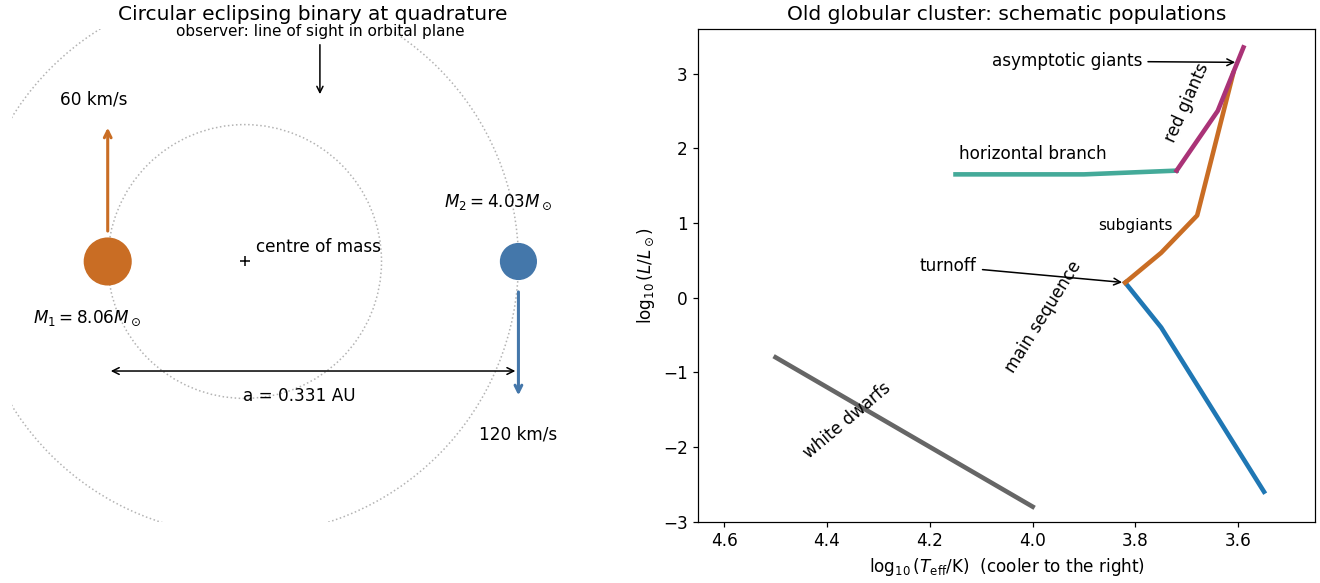
A star cluster is a gravitationally associated group of stars formed in a relatively compact region. Open clusters and globular clusters provide populations whose members have broadly related formation histories, making them useful laboratories for stellar evolution. Membership is tested using parallax, proper motion and, where available, radial velocity, rather than apparent proximity on the sky alone. A cluster's Hertzsprung-Russell diagram then compares stars of different masses at a shared distance; its main-sequence turnoff helps estimate stellar age. Space-based astrometry sharpens both membership selection and these evolutionary sequences, although some clusters contain multiple stellar populations.[ref]
Gaia Data Release 2: Observational Hertzsprung-Russell diagrams by Gaia Collaboration. Abstract and cluster analysis: astrometric membership, open and globular cluster sequences, and comparisons with evolutionary tracks
Stellar dynamics Created 2026-09-24 Updated 2026-11-05
Stellar dynamics treats stars as gravitating bodies whose collective motions reveal and reshape their environment. In a collisionless stellar system, stars mainly follow the smooth collective gravitational potential; in a sufficiently dense star cluster, accumulated gravitational encounters produce two-body relaxation. These encounters need not involve physical contact between stars. Observers combine astrometry with radial velocities to constrain orbits and infer unseen mass. The stellar orbits at the Galactic centre provide a particularly direct example: following a short-period star around Sagittarius A* measures the compact central mass, rather than estimating it from the light emitted by its surroundings.[ref]
Measuring Distance and Properties of the Milky Way's Central Supermassive Black Hole with Stellar Orbits by Andrea M. Ghez and others. Abstract: Keck astrometry and radial velocities constrain a complete stellar orbit and the central mass
Uniform-pressure evolution of a slender viscous bubble Created 2026-10-14 Updated 2026-11-05
A periodic slender bubble with and negligible internal pressure variation has exterior radial velocity and pressure . Its conserved mean cross-sectional area gives . Comparing the constant and sinusoidal terms gives the displayed equations. The long-wave growth rate about radius is , and . Small internal viscosity eventually produces appreciable axial pressure gradients near a neck, so this uniform-pressure reduction cannot persist to pinch-off at fixed positive viscosity ratio.