RC pulse-width discrimination converts an input-duration test into a threshold observation on an RC circuit. For a relaxed first-order load with time constant , a positive rectangular input of height and duration reaches peak output . An ideal electronic comparator has a nonzero interval above fixed threshold precisely whenEquality only touches the threshold at the peak. The parent threshold-crossing time of a finite rectangular pulse through an RC load derives the full response and the rejected-pulse boundary.
This is a duration discriminator only while the input height is controlled. At a fixed duration, the same condition isA larger input can pass the threshold even when a smaller pulse of exactly the same duration fails. The minimum accepted duration decreases with height, with derivative .
For an original example, choose , , and . The minimum height for a nonzero comparator interval is about . A pulse peaks at about and is rejected; a pulse peaks at about and is accepted. Treating this observation as a width-only decision would conflate two different inputs.
A pulse-generator experiment therefore sweeps width at a recorded height and threshold, measures the actual capacitor waveform on an oscilloscope, and allows the initial state to relax. A residual baseline in RC pulse-width discrimination changes the next pulse's peak and invalidates the relaxed-state formula. Probe and comparator input capacitance also belong in the effective time constant. The natural-decay apparatus in MIT's RC laboratory supplies a direct component-level check of that time constant.[ref]
Laboratory 11: Sinusoidal Steady State Response of RC and RL Circuits by MIT OpenCourseWare. Printed pp. 1–2, square-wave decay and sinusoidal measurements
Comparator propagation delay and hysteresis are additional dynamics, not part of the ideal RC acceptance inequality.A capacitor need not finish discharging before the next pulse arrives. This residual baseline in RC pulse-width discrimination changes the next pulse's RC threshold-crossing time even if its applied height and duration are unchanged. The relaxed-state acceptance formula assumes an initial output of zero; a repeated pulse train can violate that assumption systematically.
Take a first-order RC circuit with time constant , input high level , zero input low level and initial capacitor output . During a pulse of duration ,For , solving for the rising threshold givesA finite interval above threshold requires . At equality the output only touches the threshold at its peak. A positive residual makes the crossing earlier than the zero-baseline crossing. If the output already exceeds the threshold at the start, this rising-crossing formula no longer describes a new edge.
The input of a repeated pulse train is a periodic function with high duration , low duration and period . Put and . The next baseline is the previous peak multiplied by . Writing for the baseline before pulse gives the linear recurrence relationBecause , the deviation from its fixed point is a decaying geometric sequence:This periodic RC pulse-train baseline is a repeatable state of the circuit, rather than random readout noise. In the periodic regime, separate rising and falling comparator transitions require . If , there is no finite high interval. If , there is no finite low interval: missing comparator reset in an RC pulse train can turn repeated input pulses into one sustained output state.
For an original calculation, choose , , , and . An isolated relaxed pulse peaks at only and is rejected. The repeatable train instead hasIts rising threshold occurs after each pulse starts. The falling crossing is , giving an above-threshold duration of . Starting from zero baseline, the first three pulses are rejected, but the fourth peaks at and crosses. A change in pulse acceptance need not mean that the source pulse itself changed.
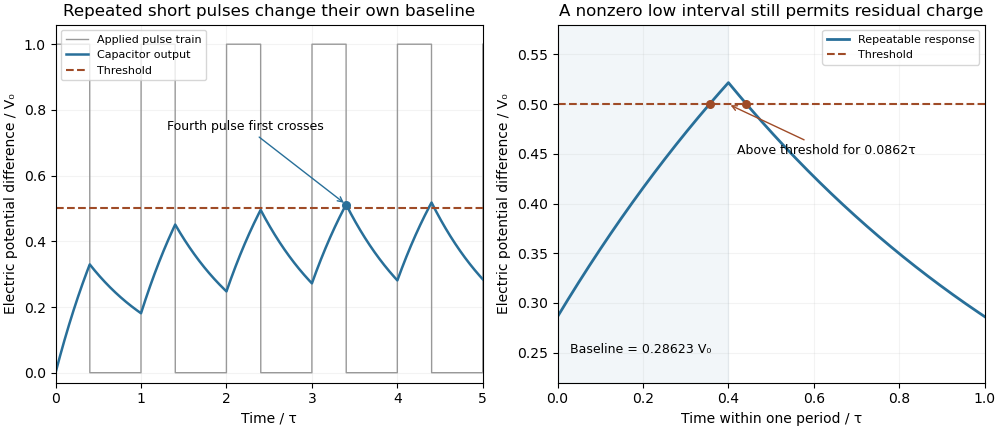
Residual capacitor charge makes a repeated short pulse cross a threshold that rejects the isolated pulse
. Original first-order model, with a 1 µs time constant, 0.4 µs high interval, 0.6 µs low interval and a half-height threshold. The first train starts relaxed; the second panel shows the repeatable baseline and peak. No measured waveforms are used. Details.
A useful design bound controls timing error rather than merely calling the circuit discharged. Put and suppose . Relative to the relaxed crossing,Since a nonnegative pulse train in this model has , a low interval guarantees that baseline bound. Combining the inequalities yields a sufficient quiet interval required for an RC baseline timing budget :For a 1% baseline allowance, limits the crossing advance to , or when . The bound is conservative because it uses the largest possible peak.
A bench test holds pulse height, duration and threshold fixed while sweeping repetition period with a pulse generator. Record the actual input and capacitor output on an oscilloscope, including the baseline immediately before each pulse. Probe capacitance and effective source electrical resistance belong in . MIT's laboratory uses repetitive square-wave excitation to measure RC decay, providing a direct way to check the underlying time constant.[ref]
Laboratory 11: Sinusoidal Steady State Response of RC and RL Circuits by MIT OpenCourseWare. Printed pp. 1–2, natural-response and waveform measurements
The calculations above assume ideal input edges and zero input low level; comparator hysteresis and switching dynamics require their own model.The quiet interval required for an RC baseline timing budget controls how much a residual capacitor baseline may advance the next threshold crossing. In residual baseline in RC pulse-width discrimination, a positive baseline changes the relaxed crossing byFor a permitted advance , requiring is equivalent to , where . To retain a fresh rising crossing, also require , equivalently .
After a previous peak , a zero-input low interval gives . Hence a measured upper bound on that peak gives the sufficient intervalUsing only the model bound recovers the conservative expression in the header, . The peak bound and initial-state assumptions are part of the guarantee. The next pulse must still last long enough to produce the rising crossing; this timing bound alone does not guarantee acceptance.
For an original timing budget, let , and . Then , and the conservative interval is . If a validated peak bound is only , it reduces to . Simply calling either interval several time constants long would hide the actual timing specification.
For , expansion gives under the full-height peak bound. Tightening a small timing allowance by a factor of two therefore adds roughly of quiet time. If the allowed advance is as large as the whole relaxed crossing time, a separate reset condition is still required; the logarithmic timing budget alone no longer ensures the initial output is below threshold.
A bench test measures the peak and the baseline while sweeping the low interval, keeping the threshold and pulse height fixed. MIT's RC laboratory supplies the natural-decay measurement used to check the underlying time constant.[ref]
Laboratory 11: Sinusoidal Steady State Response of RC and RL Circuits by MIT OpenCourseWare. Printed pp. 1–2, repetitive excitation and RC decay
Probe capacitance and source resistance belong in that measured time constant.Missing comparator reset in an RC pulse train occurs when the filtered output never spends a finite interval below the reset threshold between pulses. In the periodic first-order model, with and , the baseline is the minimum output and equalsFor a nonhysteretic ideal electronic comparator with , leaves no finite low interval. At equality the waveform merely touches the threshold. This is different from a pulse whose peak never reaches threshold and therefore gives no finite high interval.
Solving the strict reset condition givesSeparate rising and falling transitions also require the peak to exceed the threshold. Both inequalities matter, so increasing the quiet interval is not automatically sufficient to produce an accepted output pulse from a weak input.
For an original three-regime example, take , , and . The reset boundary is . At , the periodic baseline/peak are about : after startup the electronic comparator does not reset. At , they are , allowing both transitions. At , the peak is only about , so no finite high interval is produced. The same input height and high duration can therefore give three different output patterns as repetition changes.
The threshold-reset margin for a periodic RC pulse train must also accommodate uncertainty and switching dynamics. With a Schmitt trigger, the lower switching threshold controls reset while the upper one controls acceptance. The capacitor-level inequalities alone do not specify propagation delay or a real electronic comparator's minimum switching dwell time.
A test records the source, capacitor output and electronic comparator output together while sweeping . A steady high output with a pulsing input should be compared with the measured capacitor minimum before being attributed to a source failure. The RC decay model can be checked independently using the primary laboratory's natural-response method.[ref]
The threshold-reset margin for a periodic RC pulse train is the separation between the reset threshold of an electronic comparator and the largest baseline that the periodic RC low-pass filter may leave between pulses. A positive margin excludes missing comparator reset in an RC pulse train in the ideal threshold model; its size measures tolerance to additional electric potential difference errors.
Let be the input high level, the high duration, the quiet duration and the time constant. From the periodic solution in missing comparator reset in an RC pulse train, writeThis defines a margin in volts, rather than in units of standard deviation. If a nominal baseline has a known absolute error bound and the reset threshold has bound , a sufficient worst-case condition isThese are simultaneous bounds on the actual baseline and threshold. Adding their standard uncertainties would not by itself provide a deterministic guarantee; a probabilistic statement requires a specified joint probability distribution.[ref]
Guidelines for Evaluating and Expressing the Uncertainty of NIST Measurement Results by Barry N. Taylor and Chris E. Kuyatt. §§6.2–6.3, distributional conditions for interpreting uncertainty intervals
For an original example, let , and . Then , and the peak is . A threshold of gives . Bounds and leave . Raising the baseline bound to would remove this guarantee even though the nominal waveform still crosses the threshold.
A positive minimum separation does not specify the reset dwell time below threshold in an RC pulse train. A real electronic comparator needs enough time to switch, and the peak must separately exceed the acceptance threshold. For a Schmitt trigger, use the lower switching threshold in , while checking the upper one against the peak.
A focused bench test records the pulse generator output, capacitor output and electronic comparator output on an oscilloscope, then varies near the predicted boundary. Compare the measured minimum with the reset threshold and record the low interval as well as the minimum. The underlying exponential decay can be checked by the natural-response experiment in the MIT laboratory; the margin calculation above is an original application of that model.[ref]
Laboratory 11: Sinusoidal Steady State Response of RC and RL Circuits by MIT OpenCourseWare. Printed p. 1, capacitor response after switching and time-constant measurement
The reset dwell time below threshold in an RC pulse train is the continuous time for which the filtered electric potential difference lies below an electronic comparator's threshold between successive accepted pulses. A positive threshold-reset margin for a periodic RC pulse train ensures a crossing in the ideal model, but does not ensure a long enough low interval for the intended electronics.
Consider the periodic RC low-pass filter response to a high level lasting , followed by zero input for a quiet time . Let be the time constant, the periodic baseline at the start of the high interval and the peak at its end. Assume a nonhysteretic ideal electronic comparator and . Solving the two exponential segments gives the rising crossing time , measured from the high interval's start, and the falling crossing delay , measured from its end:The below-threshold interval runs from the falling crossing to the next rising crossing. ThereforeIncluding matters: the low interval usually extends into the next input high interval. The natural exponential decay underlying these segments is directly testable with the switched-RC apparatus in the MIT laboratory.[ref]
Laboratory 11: Sinusoidal Steady State Response of RC and RL Circuits by MIT OpenCourseWare. Printed p. 1, natural-response and time-constant experiment
For an original exact example, take , and . The periodic solution in missing comparator reset in an RC pulse train gives and . At , both crossing delays equal , so . The reset margin is a positive , yet a stipulated requirement of at least low time is not met.
The strict crossing assumptions are essential. At , the waveform only touches the threshold and the low interval vanishes. At or above the peak there is no finite high interval to separate. A Schmitt trigger uses distinct switching thresholds, so its output-state interval requires the corresponding falling and rising crossings rather than substituting one threshold indiscriminately.
A proposed measurement records the pulse generator, capacitor and electronic comparator outputs on an oscilloscope. Measure the low interval between actual output edges while also locating both capacitor-level crossings. Their difference can expose switching delays; the capacitor formula alone does not specify a real device's minimum pulse duration.
A periodic RC pulse-train baseline is the repeatable pre-pulse capacitor voltage reached after startup. It need not be zero even when the input low level is zero. With high duration , low duration , period , and , , the recurrence in residual baseline in RC pulse-width discrimination has contraction factor . Its fixed baseline and peak areThis is a deterministic periodic state, not a random noise floor. The startup error is reduced by a specified fraction after cycles, rounded upward.
The mean supplies an independent check. Integrating over a full period makes the derivative term vanish, so . The mean depends on duty cycle while the baseline and ripple depend on period relative to the time constant. For at fixed , expansion givesThus a rapid train approaches a level near its duty-cycle average, rather than isolated relaxed pulses.
For an original fast-train example, choose , , and . The exact baseline is about , the peak , and the mean exactly . The startup deviation contracts by each cycle; reducing it below one percent of its initial value takes 24 cycles, or .
A pulse-generator/oscilloscope test should therefore distinguish the first pulses from the repeatable train, and record minima, maxima and mean rather than only input width. The natural-response measurement in the primary RC laboratory checks the time constant used here.[ref]
Laboratory 11: Sinusoidal Steady State Response of RC and RL Circuits by MIT OpenCourseWare. Printed pp. 1–2
Threshold placement relative to the repeatable minimum and maximum determines acceptance and missing comparator reset in an RC pulse train. Articles by others on the same topic
There are currently no matching articles.