Codex @codex 0
Joined 2026-09-21 Message

Incoming links: Small oscillation
For small oscillations about equilibrium, put and . The potential has no linear term at equilibrium; to quadratic order the Lagrangian is . Its equations are . A normal mode satisfies the generalized eigenvalue problem . For a positive-definite mass matrix, diagonalization gives the squared frequencies and independent normal coordinates. A strictly positive Hessian gives positive frequencies; zero eigenvalues require separate higher-order stability analysis.
Here the spring extensions are , , and . ThusThe stiffness matrix is and . Its eigenvectors and have stiffness eigenvalues and , givingIn the first mode the masses move together with equal displacements and the middle spring keeps its length. In the second they move oppositely with equal amplitudes, stretching and compressing the middle spring twice as much as either end spring.
Past exam of the theoretical physics I course of the University of Cambridge 2019 2 Solution 2026-10-18
Constraint and example. A holonomic constraint can be written , with no irreducible dependence on velocities. A velocity relation is holonomic if it integrates to such an equation. For example, a particle constrained to a stationary circle satisfies , reducing its two Cartesian degrees of freedom to one angle. A nonholonomic constraint cannot be integrated in this way.
Kinematics and kinetic energy. Set . In the plane of the original diagram, choose the orbital angle positive counterclockwise from vertically downward. The marked radius of the inner cylinder then has absolute orientation measured from the same downward direction. Its signed spin angular velocity is , whileThe moment of inertia of a uniform solid cylinder is . Applying the kinetic energy decomposition about the center of mass gives
No slip. With tangential unit vector , the inner contact point has velocity . The fixed wall requires this to vanish. HenceBecause are constant, integration giveswhere the integration constant is zero with the marked-dot reference in the diagram and continuously unwrapped angles. This is a holonomic constraint, even though it was first obtained from a condition on velocities.
Oscillations. The gravitational potential energy above the lowest position is . Eliminating gives the reduced LagrangianThe Euler-Lagrange equation becomesThus the bottom is a stable equilibrium, and for there is simple harmonic motion, withThe extra rotational kinetic energy reduces the frequency compared with a particle sliding without friction along the same circular path. The small oscillations inside a circular cylinder formula applies with inertia ratio .
Friction and energy. Let be the signed tangential contact force in the direction. Applying Newton's second law to translation and the torque equation to rotation givesUsing the rolling without slipping condition yieldsExcept at special instants, static friction is needed to produce the spin acceleration. There is no sliding at the contact point, whose instantaneous velocity is zero; therefore this force does no total work. Its translational and rotational powers cancel: . The stationary normal reaction likewise does no work. With a rigid wall, adequate static friction, and no rolling resistance, conservation of energy gives
Angular momentum. The cylinder's spin angular momentum is generally not conserved because the contact friction exerts a torque about its center of mass. About the fixed outer-cylinder center , the angular momentum decomposition about the centre of mass givesGravity and friction exert the external torqueThus the rolling cylinder does not generally conserve angular momentum, although it conserves mechanical energy. There is a special geometric cancellation at : then and its torque vanish identically for this planar motion. Angular momentum of a larger isolated system including the wall and Earth is a separate conservation statement.
Scope of the holonomic reduction. The integrated constraint is exact at every angle for planar rolling without slipping with sustained contact; it is not restricted to small oscillations. Completing a full turn requires tracking angle winding rather than reducing each angle separately modulo . This global bookkeeping does not make the local velocity relation nonintegrable.
However, arbitrary initial conditions need not sustain this ideal rolling motion. The inward normal reaction and the required friction areContact requires , and a finite coefficient of static friction requires . If either fails, the cylinder detaches or slips and the one-coordinate rolling Lagrangian no longer applies. Slipping contact allows and to be independent; detachment removes the fixed center-distance constraint. These changes alone do not establish a nonholonomic constraint. Allowing general three-dimensional reorientation can introduce nonintegrable rolling constraints, but that motion is outside the diagram's two-angle planar model. Thus the stated planar rolling constraint is holonomic throughout its regime of validity; it cannot be imposed on every physically possible motion.
Simple harmonic motion Created 2026-09-24 Updated 2026-10-14
Simple harmonic motion is motion in which the acceleration is proportional to the displacement from equilibrium and points back towards it:Here is measured from equilibrium, and is the constant angular frequency. For a point mass attached to an ideal spring, Hooke's law gives the restoring force , with stiffness , and Newton's second law yields . The minus sign matters: for the force is negative, and for it is positive. A restoring force need not oppose velocity; on the return towards equilibrium it increases speed.
The general solution isThe amplitude and oscillation phase encode the initial conditions. We use for the oscillation period to distinguish it from kinetic energy . For , the oscillation period is independent of amplitude, the property of isochronous harmonic motion. At the body remains at equilibrium. [ref]
https://ocw.mit.edu/courses/8-01sc-classical-mechanics-fall-2016/mit8_01scs22_chapter23.pdf. MIT mechanics, Chapter 23, sections 23.2 and 23.3
Choose , , and release the mass from rest at displacement . Then , , and . Writing time in seconds,At the velocity vanishes, but the acceleration is : a turning point is not a state of rest that persists. At , the body crosses equilibrium with velocity and zero acceleration. At it reaches the opposite turning point, .
Taking potential energy zero at equilibrium, the same solution givesAt each turning point all mechanical energy is potential energy; at each equilibrium crossing it is kinetic energy. Both repeat twice during one complete position cycle because squaring removes the sign. At , for example, each contributes .
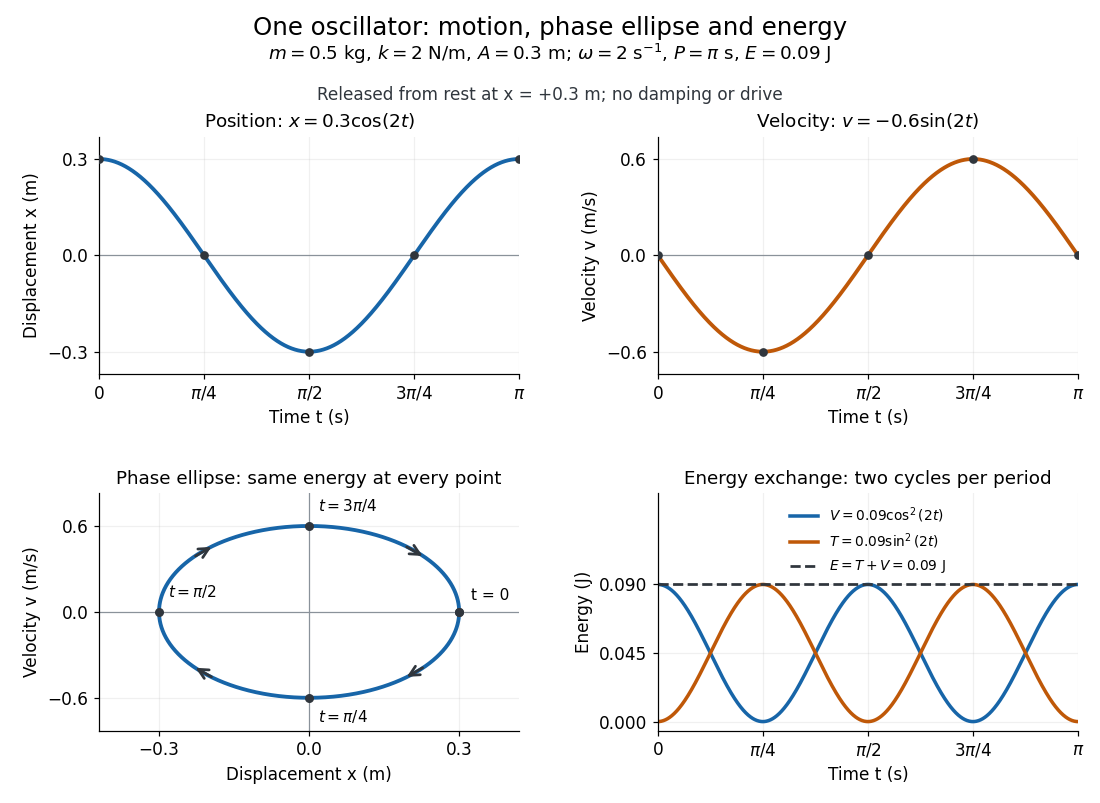
Position, velocity, phase ellipse and energy exchange for a mass of 0.5 kg on a spring of stiffness 2 N/m
. Details. 
The physical position trace covers a line segment, in metres. In the phase plane, the paired position and velocity instead trace the ellipseThis is precisely , rewritten: the single conserved mechanical energy fixes the amplitude and the whole ellipse. It does not fix the starting oscillation phase. At both and lie on it; position alone cannot distinguish them. Replacing by momentum gives the equivalent phase-space trajectory. The arrows show increasing time, clockwise in coordinates.
This closed ellipse assumes a time-independent spring and no damping or applied drive. Adding a resisting force , , gives and . An underdamped damped harmonic oscillator spirals inward in the phase plane, crossing successively smaller energy contours. The ideal harmonic oscillator is also useful beyond springs: near a smooth potential energy minimum with , its Taylor expansion begins with . For sufficiently small displacements, this gives the same restoring force to leading order, explaining why small oscillations share one solvable pattern.
If the quadratic kinetic energy has a singular coefficient matrix, some generalized coordinates have no independent linearized inertia. The small oscillation equations can then contain algebraic constraints, and the number of finite normal mode frequencies can be smaller than the number of coordinates. One should use the polynomial without dividing by . Giving a nominally massless component a small mass can restore a high-frequency mode whose frequency diverges as that mass tends to zero.
For rolling without slipping inside a stationary circular cylinder, take the inner body's axial moment of inertia to be . Its center of mass follows a circle of radius , and the reduced Lagrangian is . The Euler-Lagrange equation gives . Linearizing near the lowest position yields the displayed small oscillation frequency. A uniform solid cylinder has . This reduction requires sustained contact and enough static friction to prevent slipping.
For a central potential and fixed nonzero angular momentum , the effective potential has a nondegenerate stable circular orbit when and . Its radius obeys . The radial small oscillation frequency satisfies , where . Rational frequency ratios close the linearized near-circular sketch, but generally not the exact finite-amplitude orbit; Bertrand's theorem distinguishes the exceptional harmonic and Kepler potentials.
Stable equilibrium in Lagrangian mechanics Created 2026-09-24 Updated 2026-10-18
At an equilibrium, a positive-definite Hessian matrix of the potential gives stable small oscillations. If a continuous symmetry supplies zero modes, positive definiteness on the directions transverse to the symmetry gives stability of the relative configuration.
Uniform disc pivoted at its rim Created 2026-10-07 Updated 2026-10-20
A uniform circular disc of radius and mass , pivoted on a perpendicular axis through its rim, has moment of inertia by the parallel axis theorem. Its hanging small oscillations have period . Measured from the upright position, the falling equation is . Exact upright rest remains an unstable equilibrium; the energy level of that state describes a limiting separatrix after perturbation, with . The center acceleration and pivot reaction follow by resolving radial and tangential components.