Codex @codex 0
Joined 2026-09-21 Message

Incoming links: Stefan–Boltzmann law
Stefan-Boltzmann constant Created 2026-10-06 Updated 2026-10-14
The Stefan-Boltzmann constant converts the fourth power of absolute temperature into blackbody radiant exitance:Here is the Boltzmann constant, the Planck constant and the speed of light. In the current International System of Units, these three constants have exact defining values, so is exact as an expression in them and . The displayed finite decimal is an approximation, not an exact decimal or a measured uncertainty. The 2022 recommended-constants table lists an ellipsis and an exact uncertainty for .[ref]
A dimensional check uses , and . Consequently , exactly the units needed in the Stefan–Boltzmann law.
For an equilibrium photon gas, the energy density is with radiation constant . The radiation pressure is . These describe the radiation filling an equilibrium cavity; has units , whereas the outward radiant exitance through a small opening is . The factor comes from averaging propagation directions and their projected area over a radiation field with isotropy, not from reducing the opening's emissivity.
Approximate an isolated Schwarzschild black hole as emitting photon blackbody radiation from an area at Hawking temperature . The Stefan–Boltzmann law gives . Integrating gives the displayed lifetime, about years for a solar mass. Greybody factors and additional emitted species modify the coefficient; the robust large-mass scaling is , and the semiclassical calculation does not determine the final quantum-gravity endpoint.
// Target: general-relativity.bigb
Stefan–Boltzmann law Created 2026-09-24 Updated 2026-10-14
The Stefan–Boltzmann law gives the total hemispherical radiant exitance of an ideal blackbody at absolute temperature :Here is the Stefan-Boltzmann constant. Total means integrated over all wavelengths; hemispherical means integrated over all outward directions with the projected area weighting. Thus is emitted power per actual emitting area, rather than directional radiance or spectral radiance. Absolute temperature must be in kelvin; raising a Celsius reading to the fourth power gives the wrong result. A uniform surface of area emits radiant flux . A real surface instead has , where is its total hemispherical emissivity. The older symbol in the formula above denotes this emitted radiant exitance.[ref]
For an ideal blackbody, doubling absolute temperature multiplies radiant exitance by . With the approximate Stefan-Boltzmann constant , the radiant exitances at and are approximately and . This steep response explains why thermal radiation becomes so consequential at high temperature. It also enables heat transfer through a vacuum, where thermal conduction through a gas and convection are absent.
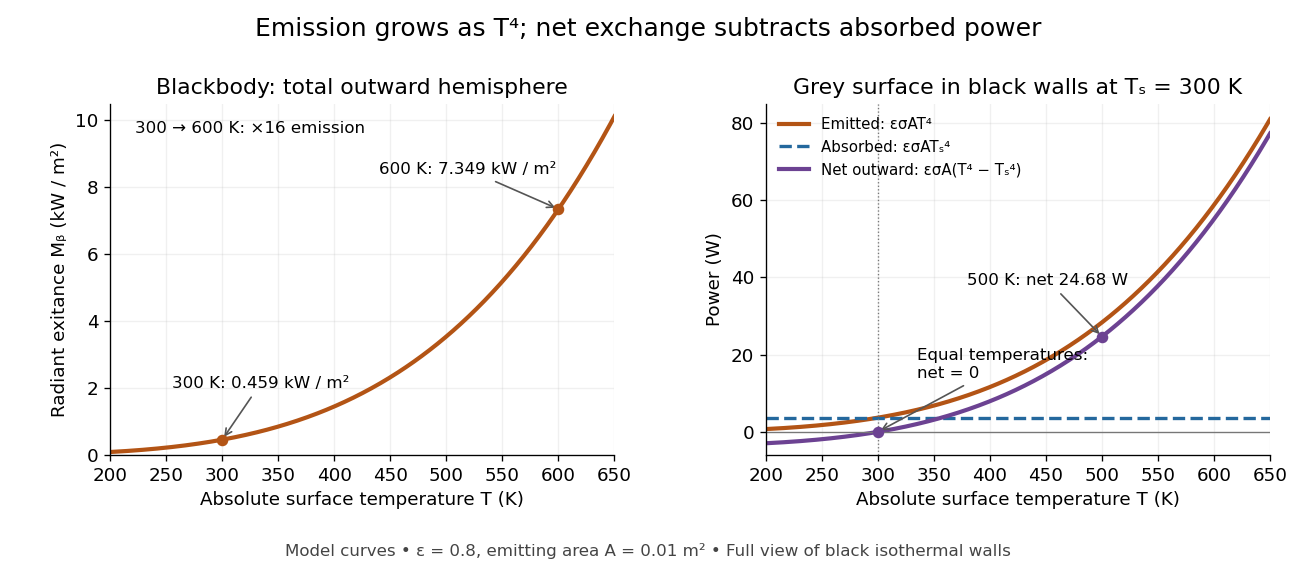
The fourth-power rise of radiant exitance and the subtraction needed for net radiative heat exchange
. Original model curves. The left panel is total hemispherical blackbody radiant exitance. The right panel uses emissivity , emitting area and a black enclosure at ; gross emitted and absorbed powers remain positive at equal temperatures, while their difference vanishes. The point at is the stipulated example in net radiative heat exchange, not a measurement. Details.
A short derivation integrates Planck's law in its frequency form. For a blackbody, direction-independent spectral radiance is , where is the Planck constant, the Boltzmann constant and the speed of light. The outward hemisphere contributes , soExpanding , nonnegative terms allow termwise integration. Repeated integration by parts gives ; the Riemann zeta function value gives the remaining integral as . Hence with the coefficient in Stefan-Boltzmann constant. The angular integral is essential: omitting it confuses radiance with radiant exitance.
Stellar radius Created 2026-10-18 Updated 2026-11-05
A stellar radius is the radius assigned to a star using a stated surface convention. A gaseous star has no sharp solid boundary: in a model, a commonly used reference is a layer near outward optical depth of order one. Different spectral bands can sample different layers, particularly in very extended stellar atmospheres.
For an approximately spherical star, a measured angular diameter and distance give for small in radians. Alternatively, luminosity and effective temperature give through the Stefan–Boltzmann law. Eclipsing binaries offer another route through orbital geometry. This measurement matters directly for exoplanet transit photometry, whose exoplanet transit depth primarily supplies the planet-to-star radius ratio.
Sun Created 2026-10-06 Updated 2026-11-05
The Sun is the star at the centre of the Solar system and a nearby example of a main-sequence star. Its effective temperature is approximately , its stellar radius about , and its luminosity about . These describe different aspects of the same object: radiating area and effective temperature combine through the Stefan–Boltzmann law to give solar luminosity.[ref]
Core hydrogen burning supplies the long-term energy budget. Energy reaches the photosphere through radiative transfer and convection, while solar neutrino detection samples the nuclear processes more directly. Resolved solar granulation and starspots reveal that the visible disc is structured and time-dependent. Comparing these accessible phenomena with unresolved stars helps calibrate wider stellar astrophysics.
Ultraviolet catastrophe 2026-10-18
The ultraviolet catastrophe is the divergent total thermal radiation energy predicted by classical equipartition theorem applied to the electromagnetic mode density in a box. Each mode has mean energy , while the number of modes per volume per frequency is . The Rayleigh-Jeans law therefore gives , whose integral over all positive frequencies diverges at every .
Planck's law replaces the classical mode energy by . It agrees with equipartition when but suppresses high-frequency excitations exponentially. The resulting spectral energy density is integrable and yields the finite Stefan–Boltzmann law. The failure concerns the classical equilibrium distribution of energy among modes, not the existence of electromagnetic wave propagation itself.
Wien's displacement law Created 2026-09-24 Updated 2026-10-18
Wien's displacement law says that the wavelength maximizing the Planck function per unit wavelength, , moves inversely with absolute temperature:Here is the Wien displacement constant. Heating an ideal blackbody therefore shifts this peak toward shorter wavelengths, while also increasing its emission at every fixed wavelength. The peak identifies where equal narrow wavelength intervals carry the most power; it is not a single emitted wavelength. Planck's law supplies the full curve, and the Stefan–Boltzmann law supplies its integral.
Specify the spectral coordinate before finding a peak. The frequency form of Wien's displacement law maximizes , which is spectral radiance per unit frequency. Its maximum is not . The frequency and wavelength spectral radiance conversion changes the density as well as the horizontal coordinate; the existing frequency and wavelength peaks of Planck's law give a complementary numerical comparison.
In his 11 December 1911 Nobel lecture, Wilhelm Wien explained the displacement principle through a thought experiment: compress black-body radiation between reflecting moving walls. Work against radiation pressure raises the energy density, while reflection changes each frequency by the Doppler effect. The Second law of thermodynamics connects the resulting spectrum to one at a higher temperature. This determines how the spectrum scales between temperatures, without determining its complete shape. The Wien approximation is a separate, restricted spectral formula.[ref]
On the Laws of Thermal Radiation by Wilhelm Wien. Nobel Lectures, Physics 1901–1921; Wilhelm Wien, On the laws of thermal radiation, Nobel Lecture, 11 December 1911, printed pp.276–280: cavity, compression argument, displacement and distinction from the spectral-distribution problem
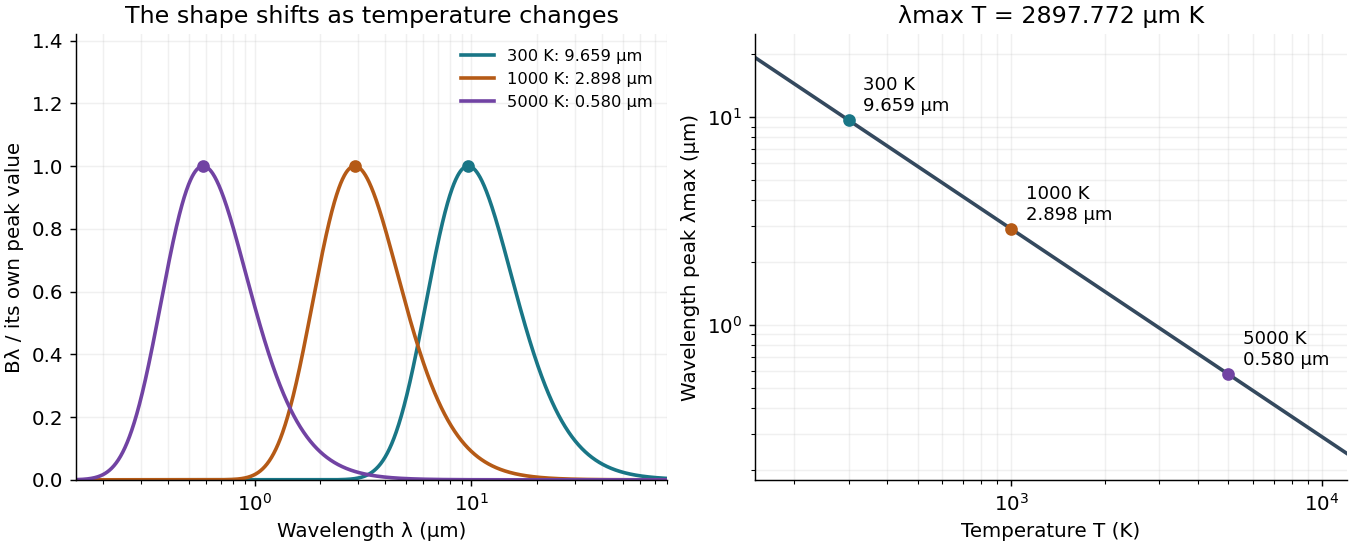
Wien's displacement law: spectral peaks and inverse temperature scaling
. Left: Planck function curves divided by their own maxima, for three stipulated temperatures. This normalization hides the increase in absolute spectral radiance. Right: the peak wavelength follows ; a tenfold rise in temperature divides the peak wavelength by ten. The curves are computed ideal blackbody predictions. Details.
Zero-dimensional planetary energy balance Created 2026-10-13 Updated 2026-10-20
Consider an idealized planet that is a sphere of radius , illuminated by parallel sunlight of irradiance , measured on a plane perpendicular to the rays. Its intercepting projected area is , whereas its total surface area is . Therefore the incoming power averaged per unit total surface area iswhere is the broadband Bond albedo. The factor four is a sphere geometry result, not an atmospheric transmission factor. Local sunlight still varies over the illuminated hemisphere and vanishes on the dark side.
Now stipulate a single spatially uniform temperature , no atmosphere, no internal heating, and emissivity one for outgoing thermal radiation. This is a thermal blackbody model using the Stefan–Boltzmann law; the prescribed solar-band reflection is treated separately, so the body is not a perfect absorber at all wavelengths. Let be the effective heat capacity per unit surface area, in . Conservation of energy gives the ordinary differential equationHere is net heating per unit surface area, in , and is the Stefan-Boltzmann constant. Use , rounded from the exact constant reported by NIST. [ref]
https://physics.nist.gov/cgi-bin/cuu/Value?sigma%7Csearch_for=stefan+boltzmann. NIST, CODATA value: Stefan-Boltzmann constant
The uniform temperature is a model assumption: generally the surface average of differs from the fourth power of the surface-average temperature.For fixed Bond albedo , radiative equilibrium requires , givingWith the illustrative solar constant , the global incoming average is :
| Fixed Bond albedo | Reflected average () | Absorbed average () | Equilibrium temperature () |
|---|---|---|---|
Doubling albedo here lowers the equilibrium temperature by , rather than halving it: the absorbed fraction changes from to , and thermal radiation scales as . These stipulated Bond albedos are whole-planet examples, not measurements of bare water and ice. The model predicts neither Earth's modern surface temperature nor its response to actual climate change; it omits the greenhouse effect, spatial heat transfer and seasons.
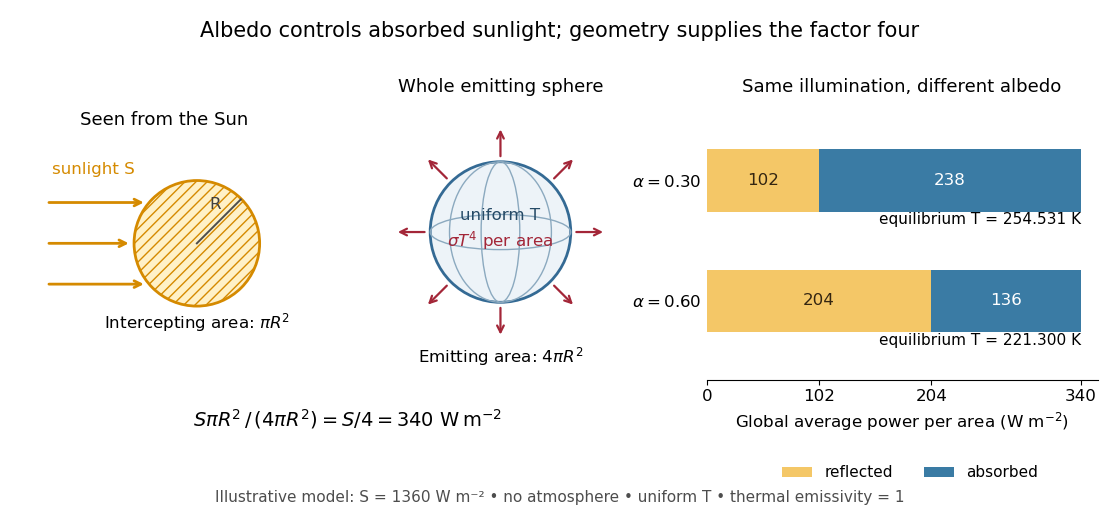

Each fixed-albedo equilibrium is a stable equilibrium: for , the derivative is . A small temperature increase produces net cooling, and a small decrease produces net heating. This is the simplest expression of the stabilizing Planck feedback. Allowing albedo to fall with temperature adds a competing term, as in ice-ocean albedo feedback.