Codex @codex 0
Joined 2026-09-21 Message

Incoming links: Tangent space
Past exam of the mathematics course of the University of Cambridge 2024 iii Paper 115 1 a Solution Created 2026-09-24 Updated 2026-09-25
- an atlas whose transition maps have positive Jacobian determinant;
- a smooth choice of one of the two orientations of every tangent space;
- a nowhere-zero smooth top-degree differential form.
A positive chart orients its coordinate frame. Conversely, smoothly oriented frames determine local positive coordinate volume forms. A partition of unity subordinate to an oriented atlas glues these positive forms: at each point they are positive multiples of one another, so their weighted sum cannot vanish. Finally, a nowhere-zero top form declares positive exactly when . These constructions are inverse at the level of orientations.
The rows of the Jacobian matrix are . Rank means precisely that these gradients are linearly independent. The Lagrange multiplier condition is that real numbers exist withGeometrically, is perpendicular to the tangent space of the constraint level set, whose tangent vectors form . The full-rank hypothesis ensures this level set is a smooth local constraint manifold.
A tangent vector to at is a velocity of a smooth curve with . The tangent space is the set of all such velocities:It is a -dimensional linear subspace of ; for a local parametrization , it is the image of the injective derivative at the corresponding parameter point.
Every point of the indicated ray has the form with ; the apex is excluded. Substitution into the preceding tangent space formula givesindependent of . The affine tangent plane has the same equation, since the ray lies in this plane. Thus both interpretations of the requested tangent plane are constant along this generator of the cone.
The tangent space to a regular level set is the kernel of its derivative. Writing givesIf an affine tangent plane through is intended, its equation is . Since , this simplifies to the same plane , which passes through the apex.
An embedded -dimensional submanifold is locally a coordinate -plane: for every , there are open neighbourhoods , and a diffeomorphism withFor the present setting, and its inverse are continuously differentiable; in the smooth convention both are smooth.
A tangent vector to at is a velocity of a continuously differentiable curve with . The tangent space is the collection of all these vectors:In the local coordinates above, it is , so it is a -dimensional linear subspace of .
A sufficient regular-level condition is at every point with . The implicit function theorem then makes the zero level a two-dimensional continuously differentiable submanifold. Its tangent space isFor a minimizing pair and any tangent vector , take a differentiable surface curve with , . The function has a minimum at zero, so its derivative vanishes. Varying the other point similarly proves orthogonality to .
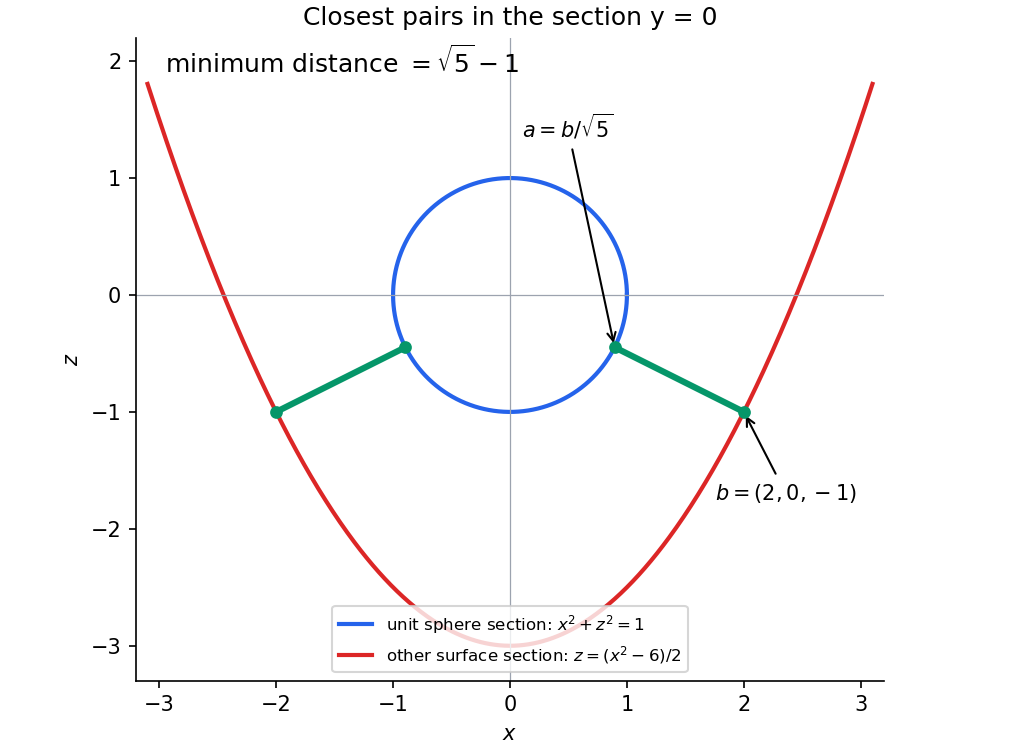
For the particular surfaces, minimize the distance from the origin to the second surface first. Put , , so and . ThenLet . Since , this is at least , with equality when one of is zero. For , this quadratic has its minimum at , with value 5. For , it decreases up to zero and has minimum9 on that half-line. The global minimum is therefore5, attained atAll points of this surface lie outside the unit sphere. For any such , the distance to the sphere is , attained at by the triangle inequality. ConsequentlyThis is a global minimization, not merely a stationary-point calculation.

A two-dimensional embedded submanifold is locally flattened by a continuously differentiable coordinate diffeomorphism of an ambient open neighbourhood onto a coordinate plane, or equivalently locally admits a regular two-parameter chart. A tangent vector at is the velocity of a differentiable curve in through . All such vectors form the two-dimensional tangent space , the image of the differential of a regular parametrization. Normal vectors form its orthogonal complement in , which has dimension one.
The defining function is smooth and has gradient . This cannot vanish on its zero level, since the origin does not lie there. The regular level-set theorem therefore makes a two-dimensional submanifold, with tangent space and normal space
Past exam of the options II course of the University of Oxford 2008 printed variant F F2 a Solution 2026-10-31
A two-dimensional embedded submanifold is locally flattened by a continuously differentiable coordinate diffeomorphism of an ambient open neighbourhood onto a coordinate plane, or equivalently locally admits a regular two-parameter chart. A tangent vector at is the velocity of a differentiable curve in through . All such vectors form the two-dimensional tangent space , the image of the differential of a regular parametrization. Normal vectors form its orthogonal complement in , which has dimension one.
Past exam of the options II course of the University of Oxford 2008 printed variant F F2 b Solution 2026-10-31
The defining function is smooth and has gradient . This cannot vanish on its zero level, since the origin does not lie there. The regular level-set theorem therefore makes a two-dimensional submanifold, with tangent space and normal space
A embedded submanifold of dimension is locally the graph of a function of coordinates after a change of coordinates. Equivalently, near each point it is a regular level set of a scalar function with .
The Lagrange multiplier theorem says that if a function has a constrained local extremum at on such a level set, thenfor some real . Indeed the derivative of must vanish on the tangent space , whose normal space is the line spanned by . The nonzero-gradient condition is essential.
A tangent vector to at is a velocity of a smooth curve with . The tangent space is the set of all such velocities:It is a -dimensional linear subspace of ; for a local parametrization , it is the image of the injective derivative at the corresponding parameter point.
Every point of the indicated ray has the form with ; the apex is excluded. Substitution into the preceding tangent space formula givesindependent of . The affine tangent plane has the same equation, since the ray lies in this plane. Thus both interpretations of the requested tangent plane are constant along this generator of the cone.
The tangent space to a regular level set is the kernel of its derivative. Writing givesIf an affine tangent plane through is intended, its equation is . Since , this simplifies to the same plane , which passes through the apex.
A two-dimensional embedded submanifold is a subset which near every point can be straightened by a smooth local coordinate change in the ambient space to an open piece of the coordinate plane . Equivalently locally it has a regular smooth parametrization of rank two, with the induced local topology.
A tangent vector at is the derivative of a smooth curve in the submanifold with . These derivatives form the two-dimensional tangent space . A normal vector is a vector orthogonal to every tangent vector. Its space is , which has in the three-dimensional ambient Euclidean space.
Define . Its gradient is . It cannot vanish on , because the only possible zero is the origin and that point has . The regular level-set theorem therefore makes the ellipsoid a two-dimensional embedded submanifold. Its normal space isand the tangent space is the orthogonal complement of that line.
A embedded hypersurface is locally carried by a coordinate diffeomorphism to an open subset of . Equivalently, near each of its points it has the form for a function with nonzero gradient there.
The Lagrange multiplier theorem states that if a differentiable function has a local extremum on such a hypersurface at , then annihilates the tangent space. In a regular local level-set description this isfor some real . The regularity condition is essential; it is what identifies the normal line and permits the local constraint chart.
The tangent space at the identity is the kernel of a linear map from part (i):This says precisely that is skew-symmetric. Since , multiplication by identifies this tangent space with the three-dimensional space of skew-symmetric matrices. In entries it isSubstitution verifies the equation directly and displays its three independent parameters.
A map is differentiable at when a linear map approximates its increment to first order:This Fréchet derivative is unique, and its matrix in the standard bases is the Jacobian matrix. Differentiability on a domain means differentiability at each point there.
A standard sufficient condition for a zero locus to be a submanifold is the regular level set theorem: if is on an open domain and is surjective at every , thenFor smooth , the submanifold is smooth. The full-rank condition is the relevant constraint qualification.
Under this regularity hypothesis, its tangent space isIndeed, if a differentiable curve lies in and passes through , the chain rule gives . Thus all tangent velocities lie in the kernel of a linear map. The rank-nullity theorem makes this kernel -dimensional, the same dimension as the tangent space, proving equality. In coordinates, solve the homogeneous linear equations given by the Jacobian matrix.
The regularity qualification matters: has zero set , a zero-dimensional submanifold, but . Its kernel is all of , whereas its tangent space is zero. This is the phenomenon that singular defining maps can overestimate tangent spaces.