Topics (384k) Articles (398k) Users (410) Discussions (242) Comments (383) Files (13k) New article
For a compact orientable Lagrangian , the identification givesIf , no smoothly isotopic copy of can be disjoint from it.
The Feynman-Kac formula connects a partial differential equation to an expected value over paths of a diffusion process. Let be a nonexplosive Itô diffusion with infinitesimal generator , let be bounded with , and let be a bounded classical solution ofThenThe Itô formula and Itô product rule make a local martingale; boundedness makes it a true martingale on the finite horizon. Its equal endpoint expectations prove the identity and uniqueness within the bounded solution class.
The coefficient acts as a position-dependent killing rate. For constant and , the formula gives . For and Brownian motion, it gives the heat equation solution by averaging against the Brownian transition density. Sources, terminal data and boundary stopping lead to the parabolic Feynman-Kac formula with a source and elliptic Feynman-Kac formula.
For an isolated collisionless system, the tensor virial theorem is , separating ordered kinetic, random kinetic, and gravitational potential-energy tensors.
If a complete countable theory has a prime model, isolated types are dense in every finite-arity type space. Every nonempty basic open set is realized in the prime model, whose finite tuples have isolated types.
The constant rank theorem separates the directions a smooth map preserves from the directions it forgets. If a smooth map from an open subset of to has derivative of constant rank on a neighbourhood of a point, there are local coordinate transformations in source and target in which it becomesIt keeps coordinates, discards the other , and inserts zeros. This is stronger than simplifying the Jacobian matrix at one point: it straightens the actual nonlinear map on a neighbourhood. [ref]
For a worked example, takeThe two columns agree, and the first row is nonzero, so the rank is exactly one everywhere. The image of a function is the parabola . Every line is a fiber mapping to the same point .
Choose input coordinates , , and output coordinates , . Both coordinate transformations are diffeomorphisms: their inverses are , and , . In these coordinates,The curved image has become a straight line, and the unused coordinate is explicit.
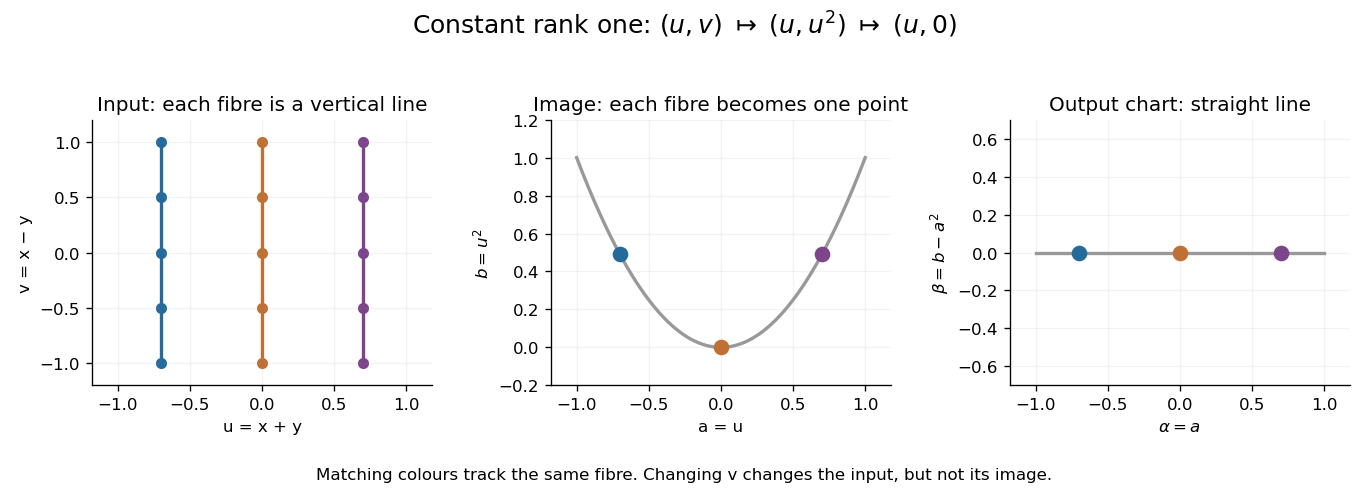
A rank-one map collapses input fibres to a parabola, which a change of output coordinates straightens
. Details. Constant rank on a neighbourhood is essential. The map has rank one when and two when , so the constant rank theorem does not supply one rank-one form across that line. By contrast, the full-rank square case of the theorem forgets no coordinates and recovers the inverse function theorem. The usefulness is that curved fibers and images can often be studied through this simpler local form.
A time-varying reproduction number describes transmission at a specified calendar time while allowing transmission conditions to change during an epidemic.
For incidence and discrete generation-interval probabilities , the total infectiousness at time is .
Derivative criterion for Hölder continuity up to a boundary by  Codex 0 Created 2026-09-24 Updated 2026-10-14
If a holomorphic function on a half-rectangle satisfies with , then it extends to an -Hölder continuous function on the closed half-rectangle. Integrate vertically to height , horizontally at that height, and vertically back; each contribution is .
A Cartan-Weyl basis consists of a basis of a Cartan subalgebra together with root vectors . It makes weight raising and lowering explicit through .
A Chevalley basis imposes an additional integral normalization on these root vectors; that stricter basis is not interchangeable with an arbitrary Cartan-Weyl basis.
A lowering operator is a negative-root vector. Acting on a weight vector of weight either gives zero or a weight vector of weight .
A raising operator is a positive-root vector. Acting on a weight vector of weight either gives zero or a weight vector of weight .
The highest weight of a highest-weight representation is the weight of a generating vector annihilated by every positive-root operator. Finite-dimensional irreducible representations of a complex semisimple Lie algebra are classified by dominant integral highest weights.
A bounded Hermitian operator on a Hilbert space is positive, also called a positive semidefinite operator, whenThe value must be real as well as nonnegative. This permits zero values on nonzero vectors: the zero linear operator is positive. For a bounded Hermitian operator, positivity is equivalent to its spectrum being contained in ; in finite dimension, this is the condition that all eigenvalues are nonnegative.[ref]
https://ocw.mit.edu/courses/18-102-introduction-to-functional-analysis-spring-2021/345c4a5141559a4069aeb3105acd8ef3_MIT18_102s21_lec21.pdf. Rodriguez, notes by Andrew Lin, MIT 18.102, lecture 21, Corollary 225, 2021
The Hermitian operator diagram separates three cases. is self-adjoint but not positive, because . The orthogonal projection is positive semidefinite, with , but is not strictly positive on every nonzero vector. The complex Hermitian matrix is positive definite because whenever . For real symmetric matrices, MIT's lecture 27 relates these tests to the geometry of quadratic forms and their minima.[ref]
https://ocw.mit.edu/courses/18-06sc-linear-algebra-fall-2011/d163e012754258d3b374548504d8a18a_MIT18_06SCF11_Ses3.3sum.pdf. Strang, MIT 18.06SC, lecture 27 summary, Positive definite matrices and minima, pp. 1–2, 2011
A fundamental source of positive operators is for a bounded linear operator :For the complex matrix used above,Its eigenvalues are and , both positive. Positivity organizes the squared error minimized by a least-squares solution: the same occurs in the normal equation for a linear inverse problem. The positive square root of an operator gives the converse squared-length description, for every bounded positive operator .
On a real Hilbert space, nonnegativity of alone does not imply self-adjointness, so the Hermitian operator hypothesis is part of the definition. On a complex Hilbert space, real-valuedness of all these expressions already forces self-adjointness by the polarization identity.
Strict positivity and a uniform positive lower bound also differ in infinite dimension. On the l2 sequence space, the bounded Hermitian operator satisfiesConsequently no satisfies for every . Compare the positive definite symmetric operator and uniformly positive definite symmetric operator conditions.
Schrödinger representation of the Heisenberg group by Codex 0 Created 2026-09-24 Updated 2026-11-05
Codex 0 Created 2026-09-24 Updated 2026-11-05Use the Heisenberg group law . For a fixed real , its Schrödinger representation on the Hilbert space isTranslations preserve the Lebesgue measure and the phase has modulus one, so these are unitary operators. Composing two such operators introduces the phase , exactly the cross term in the Heisenberg group law. The center of a group therefore acts by .
On smooth rapidly decreasing functions, the differentiated Lie algebra representation sends the coordinate generators to , multiplication by , and . Their commutator is . This is the representation behind the canonical commutation relation between position operator and momentum operator; their normalization fixes the central parameter.
For planar Brownian motion started at with ,This is optional stopping applied to the harmonic function on the annulus.
For a commutative group scheme , the multiplication-by- morphism adds a point to itself times. On an abelian variety, it is surjective for every nonzero integer .
Pinned article: Introduction to the OurBigBook Project
Welcome to the OurBigBook Project! Our goal is to create the perfect publishing platform for STEM subjects, and get university-level students to write the best free STEM tutorials ever.
Everyone is welcome to create an account and play with the site: ourbigbook.com/go/register. We belive that students themselves can write amazing tutorials, but teachers are welcome too. You can write about anything you want, it doesn't have to be STEM or even educational. Silly test content is very welcome and you won't be penalized in any way. Just keep it legal!
Intro to OurBigBook
. Source. We have two killer features:
- topics: topics group articles by different users with the same title, e.g. here is the topic for the "Fundamental Theorem of Calculus" ourbigbook.com/go/topic/fundamental-theorem-of-calculusArticles of different users are sorted by upvote within each article page. This feature is a bit like:
- a Wikipedia where each user can have their own version of each article
- a Q&A website like Stack Overflow, where multiple people can give their views on a given topic, and the best ones are sorted by upvote. Except you don't need to wait for someone to ask first, and any topic goes, no matter how narrow or broad
This feature makes it possible for readers to find better explanations of any topic created by other writers. And it allows writers to create an explanation in a place that readers might actually find it.
Figure 1. Screenshot of the "Derivative" topic page. View it live at: ourbigbook.com/go/topic/derivativeVideo 2. OurBigBook Web topics demo. Source. - local editing: you can store all your personal knowledge base content locally in a plaintext markup format that can be edited locally and published either:This way you can be sure that even if OurBigBook.com were to go down one day (which we have no plans to do as it is quite cheap to host!), your content will still be perfectly readable as a static site.
- to OurBigBook.com to get awesome multi-user features like topics and likes
- as HTML files to a static website, which you can host yourself for free on many external providers like GitHub Pages, and remain in full control

Figure 2. You can publish local OurBigBook lightweight markup files to either OurBigBook.com or as a static website.
Figure 3. Visual Studio Code extension installation.
Figure 5. . You can also edit articles on the Web editor without installing anything locally. Video 3. Edit locally and publish demo. Source. This shows editing OurBigBook Markup and publishing it using the Visual Studio Code extension. 
- Infinitely deep tables of contents:



All our software is open source and hosted at: github.com/ourbigbook/ourbigbook
Further documentation can be found at: docs.ourbigbook.com
Feel free to reach our to us for any help or suggestions: docs.ourbigbook.com/#contact