Topics (384k) Articles (398k) Users (410) Discussions (242) Comments (383) Files (13k) New article
A group automorphism is a bijective group homomorphism . It preserves the group operation, the identity element, and inverse elements; its inverse is another group homomorphism. Thus it is a group isomorphism with identical source and target. These maps form the automorphism group under function composition.[ref]
For the additive finite cyclic group , take . Its output list on is , a permutation of all six elements. It preserves addition because , and applying it twice gives . Hence it is a group automorphism and its own inverse function. Compare the collapsing in the figure under endomorphism. The general criterion under endomorphism of a finite cyclic group says exactly when such a map is reversible: its multiplier must be coprime to the size of the finite cyclic group.
A permutation need not be a group automorphism, even if it fixes the identity element. Let exchange and in and fix . It is a bijection, and , butThus it fails to preserve addition and is not even a group homomorphism. Reversibility alone does not preserve the group operation.
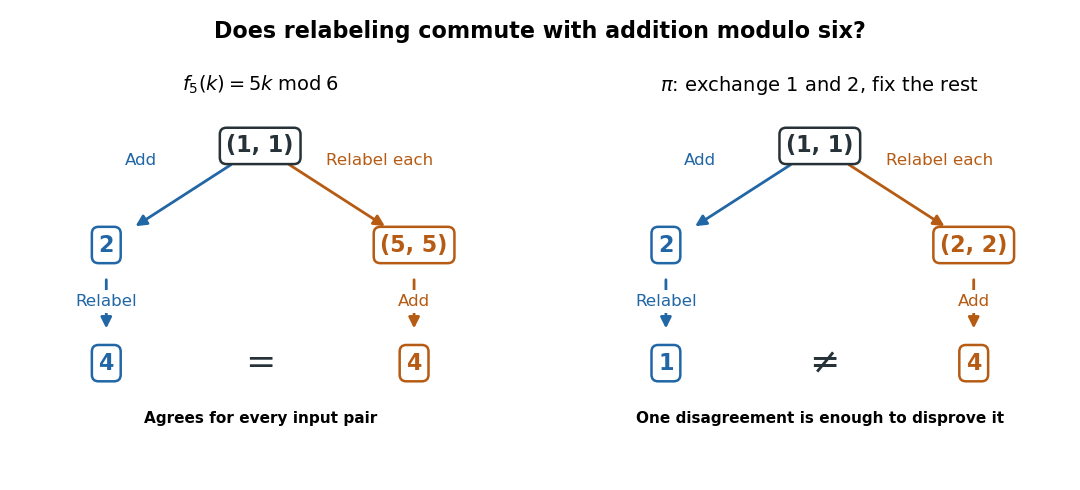
A group automorphism carries each cyclic subgroup onto the cyclic subgroup generated by the image of its defining element, preserving the order of a group element. In particular, it carries a generator of a group to another generator of a group. For , the existing calculation of generators of a finite cyclic group leaves only the images and for , so its automorphism group consists exactly of the identity function and . This turns the problem of compatible relabeling into a much smaller choice than enumerating arbitrary permutations.
For finite subsets of an abelian group, with nonempty, suppose . Then some satisfiesChoose a maximal family of pairwise disjoint translates with . Their union has size inside , proving the cardinality bound. Maximality means that every meets some . An equation gives , proving the covering. If is empty choose empty. An empty is excluded: it would make the assumed inequality vacuous while remained empty.
Geodesic slicing chooses unit lapse and zero shift, so the hypersurface normals are affinely parametrized timelike geodesics. It is simple but commonly develops coordinate singularities in finite time.
Relative to a future unit normal , the stress-energy tensor decomposes aswhere and both indices of are spatial.
A timelike curve has a nonzero tangent vector with negative Minkowski norm in metric signature at every regular point. A physical massive observer's world line is also future-directed. Parametrizing it by coordinate time gives , or : the local tangent condition is exactly the subluminal speed condition. It is stronger than checking only that two endpoints have timelike separation.
WKB approximation for a slowly varying oscillator by  Codex 0 Created 2026-09-24 Updated 2026-10-06
The second virial coefficient is the leading interaction correction to the ideal gas law: at fixed temperature, , where and is number density. For identical classical particles in a homogeneous three-dimensional gas, with an isotropic pair potential and the centre-to-centre separation,The function is the Mayer f-function. The factor counts the volume of a thin spherical shell; the factor counts each unordered pair once. The result has units of volume. Repulsive regions, , contribute positively, while attractive regions, , contribute negatively. [ref]
This is a striking bridge from a microscopic pair potential to a macroscopic pressure reading. At sufficiently small number density, raises pressure relative to an ideal gas at the same temperature and number density, while lowers it. A single value of , however, cannot determine the entire pair potential: many different functions have the same weighted integral. Measurements over several temperatures supply more information.
The integral must exist. For example, a bounded short-range attraction outside a hard core has no difficulty. If instead as , then and the radial tail behaves like : it converges only for . A bare unscreened Coulomb potential therefore falls outside this formula's ordinary short-range setting. This condition on the tail does not by itself establish the stability or convergence of the full virial expansion.
For an exactly integrable toy attraction, choose the following square-well pair potential, with diameter , attraction depth , and range multiplier :Set and , the second virial coefficient of a hard-sphere gas. Integrating the core and attractive shell separately gives the exact toy resultThe core contributes ; the shell contributes . Heating weakens the relative Boltzmann factor enhancement of attractive configurations, so approaches the positive hard-core value as . For the illustrative choice , the zero occurs atAt this temperature, : cancellation removes the linear correction, not every correction. At low , the negative shell contribution becomes large, requiring a correspondingly smaller number density for a useful truncated virial expansion. The square well is a deliberately chosen model, not a fit to the carbon dioxide experiment.
Spline approximation represents a function by low-degree polynomial pieces joined at specified knots. Smoothness conditions control the agreement of neighboring pieces. This permits local changes without fitting one high-degree polynomial across the entire domain.
The simplest example is piecewise-linear interpolation on a uniform grid. If on each cell of width , the interpolation remainder gives . More regular cubic splines impose derivative continuity as well. Spline quasi-interpolation uses local functionals instead of solving for a global interpolating fit, making locality useful in both analysis and computation.
Uniform convergence of positive linear operators on implies uniform convergence on every continuous function on a compact interval.
For periodic uniform approximation,
A heated wall plume is a one-sided plume adjacent to a wall. A uniform wall heat flux makes its buoyancy flux grow linearly with height.
The Batchelor entrainment hypothesis takes the inward mean edge velocity of a turbulent plume to be in the Boussinesq approximation. Its density-corrected non-Boussinesq form is , where and are plume and ambient mass densities and is the entrainment coefficient.
With Total variation distance defined by and relative entropy computed using natural logarithms, Pinsker's inequality statesIf is not absolutely continuous with respect to , the relative entropy is infinite and the bound is vacuous. A small relative entropy therefore forces small discrepancies in probabilities of all events. For example, and have Total variation distance and relative entropy , giving an upper bound about .
A short proof reduces to a binary event. Grouping the probability mass inside and outside , the log-sum inequality gives , with and . For , the binary relative entropy as a function of has minimum zero at and second derivative . Integrating this derivative bound twice gives . Endpoint cases follow by limits. Taking the supremum over proves the inequality. Using base-two logarithms changes the constant by a factor of .
A topological -manifold without boundary is a topological space satisfying three conditions: it is Hausdorff, it is second countable, and every point lies in an open set with a homeomorphism onto an open set . Here is a fixed dimension of a manifold, and has the usual topology of Euclidean space. The pair is a coordinate chart. Unless explicitly qualified, “topological manifold” here means without boundary.[ref]
The Hausdorff condition requires disjoint open neighbourhoods for distinct points. Second countability requires a countable basis of a topology. Neither follows merely from the local homeomorphisms: non-Hausdorff manifolds fail the first condition, while an uncountable disjoint union of copies of the real line fails the second. Indeed, a basis of a topology must supply a different nonempty member inside each copy, so it cannot be countable.
The circle and the real line are both one-dimensional topological manifolds, with the same local model. Their global topologies differ: the circle is compact, while the real line is not. By contrast, the junction of a topological tripod already fails the local test. Thus local coordinate charts specify what kind of small pieces are allowed; global topological invariants distinguish how those pieces fit together.[ref]
Introduction. Introduction to Topological Manifolds by John M. Lee, second edition, Chapter 1, pages 1–3 on local models and pages 5–6 on topological invariants
The usefulness of a topological manifold is that local questions about continuity can be transported into Euclidean space, while compactness, connectedness, and the fundamental group still record global information. For calculus, further structure is needed: a smooth atlas requires smooth transition maps, letting the chain rule reconcile derivatives computed in different coordinate charts. A topological atlas by itself only guarantees homeomorphisms between coordinates.[ref]
Week 2 course notes. Topology I: smooth manifolds, Week 2, Section 1.2, equation (11) and Definitions 1.15–1.16, pages 5–6
A nonempty Hausdorff space is the continuous image of exactly when it is compact, connected, locally connected, and second-countable.
Period survival analysis estimates survival under the event hazards operating during a recent calendar period by combining appropriately left-truncated and right-censored portions of several follow-up cohorts.
Pinned article: Introduction to the OurBigBook Project
Welcome to the OurBigBook Project! Our goal is to create the perfect publishing platform for STEM subjects, and get university-level students to write the best free STEM tutorials ever.
Everyone is welcome to create an account and play with the site: ourbigbook.com/go/register. We belive that students themselves can write amazing tutorials, but teachers are welcome too. You can write about anything you want, it doesn't have to be STEM or even educational. Silly test content is very welcome and you won't be penalized in any way. Just keep it legal!
Intro to OurBigBook
. Source. We have two killer features:
- topics: topics group articles by different users with the same title, e.g. here is the topic for the "Fundamental Theorem of Calculus" ourbigbook.com/go/topic/fundamental-theorem-of-calculusArticles of different users are sorted by upvote within each article page. This feature is a bit like:
- a Wikipedia where each user can have their own version of each article
- a Q&A website like Stack Overflow, where multiple people can give their views on a given topic, and the best ones are sorted by upvote. Except you don't need to wait for someone to ask first, and any topic goes, no matter how narrow or broad
This feature makes it possible for readers to find better explanations of any topic created by other writers. And it allows writers to create an explanation in a place that readers might actually find it.
Figure 1. Screenshot of the "Derivative" topic page. View it live at: ourbigbook.com/go/topic/derivativeVideo 2. OurBigBook Web topics demo. Source. - local editing: you can store all your personal knowledge base content locally in a plaintext markup format that can be edited locally and published either:This way you can be sure that even if OurBigBook.com were to go down one day (which we have no plans to do as it is quite cheap to host!), your content will still be perfectly readable as a static site.
- to OurBigBook.com to get awesome multi-user features like topics and likes
- as HTML files to a static website, which you can host yourself for free on many external providers like GitHub Pages, and remain in full control

Figure 2. You can publish local OurBigBook lightweight markup files to either OurBigBook.com or as a static website.
Figure 3. Visual Studio Code extension installation.
Figure 5. . You can also edit articles on the Web editor without installing anything locally. Video 3. Edit locally and publish demo. Source. This shows editing OurBigBook Markup and publishing it using the Visual Studio Code extension. 
- Infinitely deep tables of contents:



All our software is open source and hosted at: github.com/ourbigbook/ourbigbook
Further documentation can be found at: docs.ourbigbook.com
Feel free to reach our to us for any help or suggestions: docs.ourbigbook.com/#contact