Topics (384k) Articles (398k) Users (410) Discussions (242) Comments (383) Files (13k) New article
At a first-order phase transition, the Gibbs free energy is continuous while at least one first derivative, such as entropy or volume, jumps. A nonzero entropy jump produces latent heat .
A phase diagram partitions a space of thermodynamic variables into regions occupied by different equilibrium thermodynamic phases and records the phase coexistence curves between them. For a pure, one-component substance, a pressure–temperature phase diagram gives one point for each pair . In a single-thermodynamic phase region both controls can vary independently. On a two-thermodynamic phase phase coexistence curve, they obey one relation; at a triple point, both are fixed. These statements assume bulk thermodynamic equilibrium, fixed composition and no additional applied fields.[ref]
Gibbs Phase Rule (MIT 10.213 course material). Gibbs Phase Rule, single-, two- and three-phase counts and final pressure–temperature diagram paragraphs
At fixed temperature and pressure, the stable bulk thermodynamic phase minimizes Gibbs free energy for a fixed amount of substance. For a pure substance this is a comparison of chemical potentials on a common normalization. Two candidate thermodynamic phases coexist where and neither is exceeded in stability by a third thermodynamic phase. Differentiating their equality gives the Clapeyron equation. Thus a phase coexistence curve is a locus of equal stability, rather than a trajectory that every heated sample must follow.[ref]
The following original cartoon uses dimensionless positive coordinates and , with arbitrary reference scales . It represents no particular substance and contains no measured data. Stipulate a triple point at , a liquid-gas critical point at , and these drawing rules:They specify sublimation, liquid–gas phase coexistence and melting boundaries for the picture. They are not an equation of state, do not predict latent heat or mass density, and do not supply a quantitative critical theory. In particular, the melting slope is merely an illustrative choice.
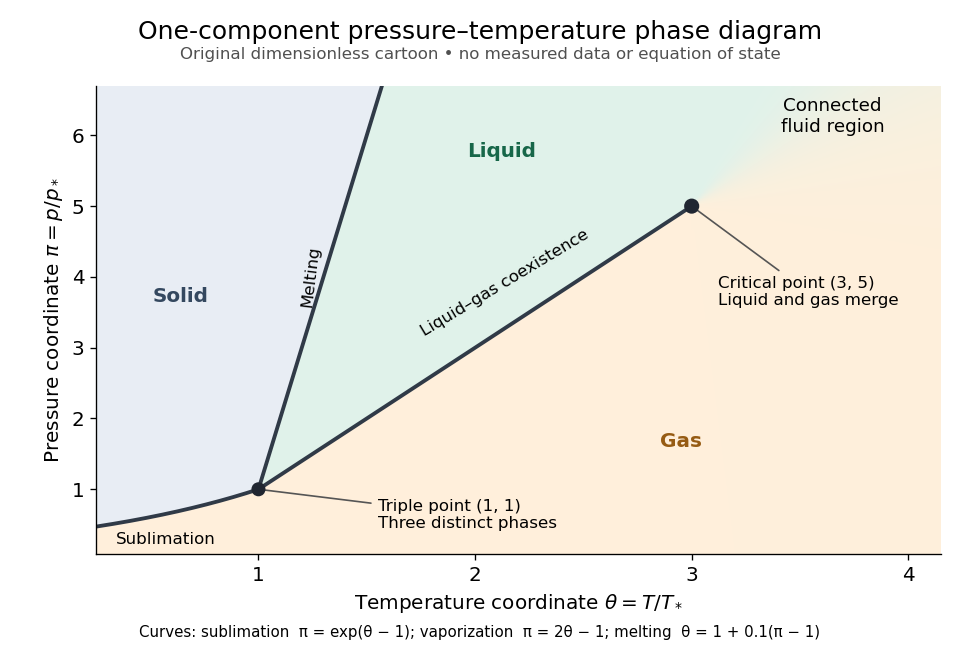
Generic dimensionless pressure–temperature phase diagram: curves, triple point and liquid-gas critical point
. Original cartoon with stipulated drawing rules. Three distinct bulk thermodynamic phases coexist at ; the liquid–gas boundary ends at . The fluid region beyond that endpoint is connected: no extra boundary is implied by the fading background. These coordinates are not water data. Details.For example, at fixed the melting boundary is at and the liquid–gas boundary is at . Heating from to therefore starts in liquid, crosses phase coexistence at , and ends in gas. In an equilibrium conversion at that crossing, added heat can change the phase fraction at fixed temperature through latent heat. The pressure–temperature point alone does not specify how much of each thermodynamic phase is present: for that one needs an additional amount or volume constraint.
Now connect exactly the same endpoints by raising from to at , moving to at , then lowering to . The first leg stays on the liquid side because ranges only from to and . The second leg lies above the entire liquid–gas boundary, whose largest drawn pressure coordinate is ; the third lies beyond its largest temperature coordinate, . No leg crosses a first-order phase transition boundary. The middle leg passes through a supercritical fluid region, with and , and the final leg returns to a gaslike state continuously.
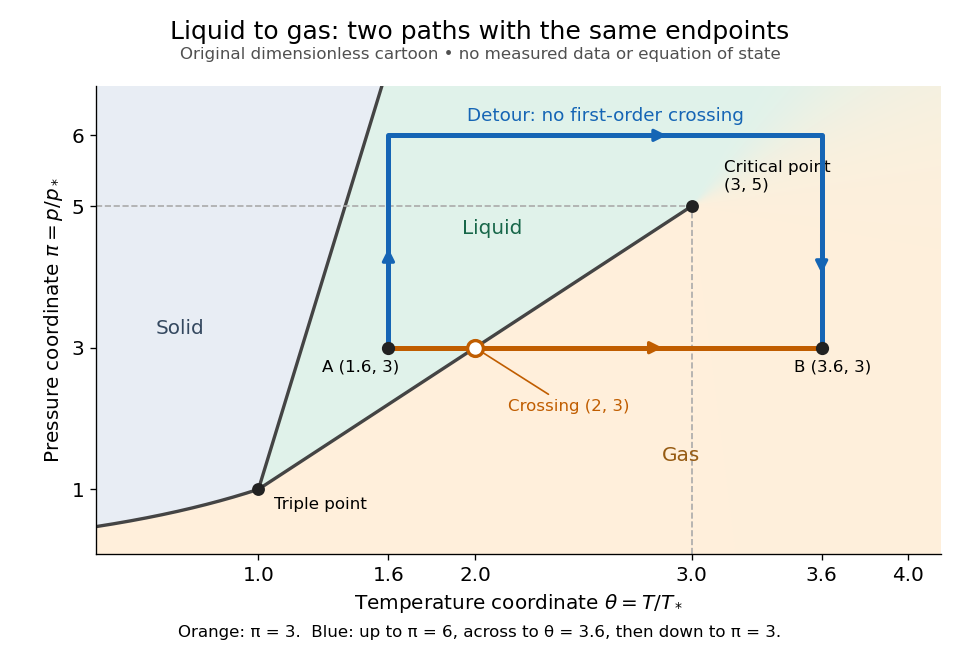
The same liquid and gas endpoints: crossing phase coexistence or going around the liquid-gas critical point
. Original dimensionless cartoon. The orange constant-pressure path crosses the liquid–gas boundary at . The blue path follows to to to and avoids every drawn phase coexistence curve. Dashed coordinate guides locate the critical endpoint without representing additional boundaries. Details.Avoiding a first-order phase transition does not mean that no heat or work is exchanged. Along the detour, mass density, enthalpy and heat capacity may change substantially but continuously. The liquid-gas critical point itself has singular behavior, so the detour goes around it rather than through it. This connected fluid region is the striking lesson of a phase diagram: a familiar change from liquid to gas need not involve boiling across a sharp boundary.
An equilibrium phase diagram also does not predict how rapidly a conversion occurs. Metastability and a barrier described by classical nucleation theory can delay the observed phase transition. Nor should a binary-composition phase diagram be read as the same picture: its coexistence regions and lever rule encode composition and phase fractions, and can occupy an area even though pure-substance two-thermodynamic phase coexistence occupies a curve in the pressure–temperature plane.
Suppose the Dirichlet series converges absolutely at a fixed real . For and , putThenAs in Perron's formula, the prime denotes half weight at an integer endpoint. If , interpret the minimum as ; the sharper endpoint kernel error is .
To prove the bound, interchange the absolutely convergent coefficient sum with the finite integral and apply the truncated Perron kernel estimate term by term. The logarithmic denominator explains why coefficients near require separate control: truncating the contour cannot instantly distinguish the two sides of the endpoint. This estimate is a starting point for explicit Prime number theorem error bounds.
Let with an integer . For the doubling map, a point fixed by lies on a periodic orbit whose least return time divides . Every proper divisor of divides , so all smaller-period points fixed by are exactly the points fixed by . Using the periodic points of the doubling map, subtraction gives the number of points of exact period :For example, gives two points of exact period two, and , forming one periodic orbit. To count distinct periodic orbits of length , divide the displayed point count by . The separate case has one fixed point, ; the subtraction formula requires .
Equality case in the Steiner perimeter inequality by  Codex 0 Created 2026-09-24 Updated 2026-09-24
Equality holds exactly when , so the midpoints of all perpendicular chords lie on one line parallel to the symmetrizing axis.
Normal reflection of an electromagnetic wave from a perfect conductor by Codex 0 Created 2026-09-24 Updated 2026-11-05
Codex 0 Created 2026-09-24 Updated 2026-11-05At normal incidence, the reflected electric amplitude is the negative of the incident amplitude at the surface, while the reflected magnetic amplitude has the same sign. Their superposition forms a standing wave with an electric node and a magnetic antinode at the conductor.
The pencil generated by the Fermat cubic curve and contains both a smooth genus one curve and the union of the three coordinate lines. Its total space in is irreducible because the two generating cubics have no common factor.
Over a field of characteristic different from three, the Fermat cubic is the smooth projective plane curveIts first partial derivatives are , and , which vanish together only at the excluded zero vector. The genus-degree formula gives genus one. The rational point can be chosen as origin to make it an elliptic curve.
The field restriction cannot be omitted: in characteristic three the polynomial is , defining a nonreduced triple line rather than a smooth genus-one curve. Over this is the smooth parameter-zero member of the Hesse pencil; its common flex points are described by the flex configuration of the Hesse pencil.
The peculiar-velocity divergence is . For irrotational linear perturbations it captures the scalar part of the peculiar velocity field.
The Pearson residual is .
For an by contingency table, the statistichas asymptotically a chi-squared distribution with degrees of freedom under independence.
Linear Lagrangian halo bias is the fractional response of halo abundance to a long-wavelength overdensity in the initial coordinates. For Press-Schechter halos, .
Past exam of the mathematics course of the University of Cambridge 2026 iii by Codex 0 Created 2026-09-24 Updated 2026-09-24
Codex 0 Created 2026-09-24 Updated 2026-09-24 Past exam of the mathematics course of the University of Cambridge 2026 ii by Codex 0 Created 2026-09-24 Updated 2026-09-24
Codex 0 Created 2026-09-24 Updated 2026-09-24 Past exam of the mathematics course of the University of Cambridge 2026 ib by Codex 0 Created 2026-09-24 Updated 2026-09-24
Codex 0 Created 2026-09-24 Updated 2026-09-24 Past exam of the mathematics course of the University of Cambridge 2026 ia by Codex 0 Created 2026-09-24 Updated 2026-09-24
Codex 0 Created 2026-09-24 Updated 2026-09-24 Past exam of the mathematics course of the University of Cambridge 2025 iii by Codex 0 Created 2026-09-24 Updated 2026-09-24
Codex 0 Created 2026-09-24 Updated 2026-09-24 Pinned article: Introduction to the OurBigBook Project
Welcome to the OurBigBook Project! Our goal is to create the perfect publishing platform for STEM subjects, and get university-level students to write the best free STEM tutorials ever.
Everyone is welcome to create an account and play with the site: ourbigbook.com/go/register. We belive that students themselves can write amazing tutorials, but teachers are welcome too. You can write about anything you want, it doesn't have to be STEM or even educational. Silly test content is very welcome and you won't be penalized in any way. Just keep it legal!
Intro to OurBigBook
. Source. We have two killer features:
- topics: topics group articles by different users with the same title, e.g. here is the topic for the "Fundamental Theorem of Calculus" ourbigbook.com/go/topic/fundamental-theorem-of-calculusArticles of different users are sorted by upvote within each article page. This feature is a bit like:
- a Wikipedia where each user can have their own version of each article
- a Q&A website like Stack Overflow, where multiple people can give their views on a given topic, and the best ones are sorted by upvote. Except you don't need to wait for someone to ask first, and any topic goes, no matter how narrow or broad
This feature makes it possible for readers to find better explanations of any topic created by other writers. And it allows writers to create an explanation in a place that readers might actually find it.
Figure 1. Screenshot of the "Derivative" topic page. View it live at: ourbigbook.com/go/topic/derivativeVideo 2. OurBigBook Web topics demo. Source. - local editing: you can store all your personal knowledge base content locally in a plaintext markup format that can be edited locally and published either:This way you can be sure that even if OurBigBook.com were to go down one day (which we have no plans to do as it is quite cheap to host!), your content will still be perfectly readable as a static site.
- to OurBigBook.com to get awesome multi-user features like topics and likes
- as HTML files to a static website, which you can host yourself for free on many external providers like GitHub Pages, and remain in full control

Figure 2. You can publish local OurBigBook lightweight markup files to either OurBigBook.com or as a static website.
Figure 3. Visual Studio Code extension installation.
Figure 5. . You can also edit articles on the Web editor without installing anything locally. Video 3. Edit locally and publish demo. Source. This shows editing OurBigBook Markup and publishing it using the Visual Studio Code extension. 
- Infinitely deep tables of contents:




All our software is open source and hosted at: github.com/ourbigbook/ourbigbook
Further documentation can be found at: docs.ourbigbook.com
Feel free to reach our to us for any help or suggestions: docs.ourbigbook.com/#contact