Topics (384k) Articles (398k) Users (410) Discussions (242) Comments (383) Files (13k) New article

A sphingoglycolipid, also called a glycosphingolipid, is a glycolipid whose lipid portion has a sphingoid backbone. A common arrangement is a carbohydrate headgroup linked to a ceramide, which contains a long-chain amino alcohol and an amide-linked fatty acid. The sugar portion and lipid portion can vary independently, so a class name does not usually specify one unique molecular formula.[ref]
Nomenclature of Lipids by the IUPAC-IUB Commission on Biochemical Nomenclature. Lip-3, General Considerations and generic/individual glycolipid names
Glucosylceramide is a useful example: one glucose residue forms the headgroup, while the ceramide supplies the hydrophobic portion. Changing the sugar headgroup changes the exposed carbohydrate structure; changing the fatty acid chain changes the lipid portion. Two samples described as glucosylceramide can therefore differ in their detailed chain composition.[ref]
Nomenclature of Lipids by the IUPAC-IUB Commission on Biochemical Nomenclature. Lip-3: glucosylceramide example and heterogeneity of fatty acids/long-chain bases
These molecules are also experimentally useful markers. The1990 study proposing Sphingomonas combined cellular sphingoglycolipid observations with 16S ribosomal RNA comparisons and ubiquinone composition. Agreement between chemical and sequence observations supported the taxonomic proposal; a lipid measurement was one part of the evidence, rather than a substitute for all other comparisons.[ref]
Sphingomonas genus and species proposals by E. Yabuuchi and others. Primary Abstract: three lines of evidence for the proposed genus
A pitch contour describes how perceived pitch varies over an utterance. For speech with voicing, a common measurable correlate is the fundamental frequency of vocal fold vibration. A rising estimated indicates increasing repetition rate; stretches without sufficiently periodic vibration need not have a meaningful estimate.[ref]
Pitch Analysis in the Praat Manual by Paul Boersma. Intro4: the pitch contour and its configuration
For an ideal periodic segment whose repetitions are separated by , . Detecting repetition at instead produces an erroneous 50 hertz estimate, illustrating why a visually smooth pitch contour can still contain an octave error. Noise, the analysis interval and the allowed frequency range affect the estimate. Current Praat documentation distinguishes methods intended for speech intonation from methods intended for other periodicity measurements.[ref]
Pitch Analysis in the Praat Manual by Paul Boersma. How to choose a pitch analysis method: autocorrelation, filtering and octave errors; uvafon.hum.uva.nl/praat/manual/how_to_choose_a_pitch_analysis_method.html
A pitch contour is not the same as a formant contour: changing the fundamental frequency changes the repetition rate, whereas formants describe the resonant spectral structure shaped by the vocal tract.
Speech synthesis generates an artificial speech signal from a specified representation. Text-to-speech starts from writing, while a research synthesizer can instead take a phonetic specification or directly controlled acoustic parameters. The distinction separates the input representation from the mechanism producing the sound.
In a source-filter model of speech production, a researcher can set an excitation's fundamental frequency and independently adjust the filter's formants. Holding the first parameter fixed while moving a formant tests whether listeners' responses depend on the spectral change rather than a change in voice pitch. Gunnar Fant's work at KTH used synthesis to test hypotheses about speech production.[ref]
Human Speech and Communication at KTH. research history, synthesis as a test of production hypotheses
Generated stimuli permit controlled comparisons in speech perception, but intelligibility and similarity to a natural speaker are different outcomes. Recording the parameter settings makes a synthesis experiment reproducible.Joint speech occurs when two or more people utter the same thing at the same time. The definition includes choral recitation and chanting, and can extend across the boundary between ordinary speech and song. Shared timing and shared utterance content distinguish it from people merely talking simultaneously about different things.[ref]
The topic has a tractable scientific core: how do separate speakers coordinate the timing of one utterance? A laboratory synchronous speech task can give two speakers the same text and record their voices separately. Corresponding acoustic landmarks then provide measurements rather than relying only on a listener's impression that the group sounds unified.[ref]
Practice and performance in speech produced synchronously by Fred Cummins. experimental design, paired prepared-text readings
Two properties need separate measurements. Speakers may produce identical words with a persistent time offset, or align their onsets while producing different words. Neither observation alone establishes both components of joint speech. A useful protocol therefore specifies the text, the events used to assess timing and the accepted deviation.
This turns a social activity into questions about speech perception, production and mutual adjustment. Findings from a controlled reading task identify what happened under those conditions; transferring them to a large spontaneous chant additionally requires evidence about that setting.
The spectral-diffusion frequency-increment variance quantifies how much a transition frequency changes between two observation times. For a real stationary process with mean and autocovariance function ,The mean increment is zero under these assumptions, so its second moment is also its variance. Expanding the square proves the identity: the two squared-frequency deviations each contribute and their cross term contributes .
If , thenFor an original example with and , and the root-mean-square increment is about . The single-time frequency spread remains ; temporal decorrelation does not require the stationary distribution to broaden.
The long-time value assumes that the autocovariance function tends to zero. It is not a universal upper bound. For a random-phase sinusoid with phase uniform over a full cycle,At half a cycle, the frequencies are anticorrelated and ; at a complete cycle the increment vanishes. Thus a nonmonotone increment statistic can reflect recurring frequency memory.
For nonstationary observations , the general identity instead isDrift of the mean must not be silently assigned to stationary spectral diffusion. Likewise, under an explicit model of independent zero-mean endpoint measurement errors with variance , the observed second moment gains . This spectral frequency-increment measurement noise term changes when the endpoint errors are correlated.
Primary two-dimensional infrared spectroscopy work uses controlled frequency labeling and later readout to constrain frequency memory.[ref]
Frequency-frequency correlation functions and apodization in two-dimensional infrared vibrational echo spectroscopy: A new approach by Kyungwon Kwak and others. Introduction, pulse delays and frequency-frequency correlation function
The identity above is a model relation; a measured 2D IR center-line slope needs the stated response assumptions before it supplies .The main asteroid belt is a population of asteroids and other Small Solar System body objects orbiting chiefly between Mars and Jupiter. Its members occupy many separate orbits, rather than forming a solid ring. Their orbital distribution records both the history of planet formation and continuing gravitational perturbations.
A particularly clear observation is the series of Kirkwood gaps, deficits in asteroid counts at certain semi-major axes. The JPL Solar System Dynamics histogram, constructed in June 2007 from 156,929 numbered asteroids with well-determined orbits, shows gaps associated with mean-motion resonances with Jupiter.[ref]
https://ssd.jpl.nasa.gov/diagrams/mb_hist.html. Asteroid Main-Belt Distribution, data selection and resonance labels
For the resonance, an asteroid makes three revolutions during one Jovian revolution, so . Using Kepler's third law and Jupiter's semimajor axis of about astronomical units givesRepeated gravitational forcing can change orbital elements and remove bodies from parts of this region. A resonance label specifies the ratio of orbital frequencies here, so reversing it into a period ratio would give the wrong location. The histogram shows the observed distribution under a stated selection, rather than a complete census of every small asteroid.
A Small Solar System body is an object orbiting the Sun that is neither a planet nor a dwarf planet nor a natural satellite, in the classification adopted by the International Astronomical Union in 2006. The category includes most asteroids, most trans-Neptunian objects and comets. The definition is tied to the Solar system; it is not a general classification of every small astronomical object.[ref]
The categories encode physical distinctions. A dwarf planet has enough self-gravity to assume a nearly round equilibrium figure but has not cleared its orbital neighborhood. A Small Solar System body does not satisfy both planetary shape and orbital-clearing conditions. A natural satellite is classified separately even if it is small and irregular.
For example, Ceres lies in the asteroid belt but is a dwarf planet, whereas Vesta is classified as an asteroid. Merely being in the asteroid belt therefore does not determine which formal category an object occupies.[ref]
Ceres: Facts by NASA. Dwarf-planet classification
[ref]The individual-weighted mean group size is the expected size of the social group containing an individual chosen uniformly from all individuals in the groups being studied. Larger groups receive more weight because they contain more potential sampled individuals. For positive group sizes , the probability of selecting someone in group is , giving the weighted meanThe focal individual is included; its expected number of group companions is .
For an original example, groups of sizes contain six individuals. Their group-based arithmetic mean is 2, but . Four of the six individuals experience a group of four, so an individual-based observation gives the larger group more influence.
Write and , using a divisor of for this finite collection. Expanding the squares gives and thereforeEquality holds precisely when all groups have equal size. The difference is determined by group-size variance, rather than a contradiction between two legitimate averages.
An experiment reporting numbers of animals and numbers of groups supplies both levels of description. For instance, a finch study used 70 Bengalese finches in seven groups and 58 white-rumped munias in six groups.[ref]
Effects of domestication on neophobia: A comparison between the domesticated Bengalese finch and its wild ancestor, the white-rumped munia by Kenta Suzuki and others. Birds used in this study: group membership counts
Choosing the appropriate average depends on whether the scientific question concerns typical groups or the social setting experienced by typical individuals.The internal anal sphincter is a ring of smooth muscle at the lower end of the rectum and around the upper anal canal. It contributes involuntary resting closure. The surrounding external anal sphincter is a different muscle system with voluntary control, so the two should not be treated as one anatomical ring.[ref]
Small and Large Intestine in SEER Training by the National Cancer Institute. Anal canal: internal smooth-muscle sphincter and involuntary control
Rectal distension can trigger relaxation of the internal anal sphincter, the rectoanal inhibitory reflex. Researchers can inflate a rectal balloon while recording anal pressure, separating this relaxation from other contractile responses and from reported sensation. A study of 23 subjects observed inhibitory and contractile reflexes during graded balloon distension.[ref]
Rectoanal sensorimotor response in humans during rectal distension by Sherrie De Ocampo and others. 2007, abstract: distension protocol and pressure/sensory responses
A continuous pressure trace therefore reveals coordinated components of continence that are difficult to infer from static anatomy alone.The 30S ribosomal subunit is the bacterial small ribosomal subunit, an assembly containing 16S ribosomal RNA and ribosomal proteins. It binds messenger RNA and helps position transfer RNA anticodons relative to the message during biological translation. The large ribosomal subunit supplies the peptidyl transferase center; a small subunit alone is not a complete elongating ribosome.[ref]
Structure of the 30S ribosomal subunit by B. T. Wimberly and others. Abstract and functional interpretation of the bacterial small-subunit structure
The 30S label refers to a sedimentation coefficient, not a count of 30 molecules or a molecular mass of 30 units. A svedberg is a unit of that transport coefficient. Shape, mass and interaction with the surrounding liquid all affect sedimentation.[ref]
A short reading-frame example explains the subunit's positioning role. Grouping
AUGAAACCC from its first base gives AUG|AAA|CCC. Shifting the grouping by one base gives UGA|AAC|CC, with an incomplete final group. The nucleotide inventory is unchanged, but the triplets presented for decoding differ. Position and pairing therefore matter alongside simple RNA attachment.30S initiation complex experiments examine an assembled state involving the subunit, message and initiator transfer RNA. Reconstituting the subunit with or without ribosomal protein S1 has separated message binding from productive placement in the decoding channel.[ref]
Escherichia coli Ribosomal Protein S1 Unfolds Structured mRNAs Onto the Ribosome for Active Translation Initiation by Mélodie Duval and others. Figure5 and FigureS2, simplified initiation complexes and toeprinting
A vibroscope measures the vibration of a tensioned material fibre. In fibre testing, the measured fundamental frequency, suspended length and applied tension can be used to estimate linear mass density; known mass density then permits an area estimate. The physical measurement complements the single-fibre tensile test, whose conversion from force to engineering stress requires cross-sectional area.
The 2024 study by Bo Madsen, Rajnish Kumar and Hans Lilholt compared area-analysis procedures using measured frequencies of tensioned glass and carbon strands.[ref]
Vibroscope method for determination of cross-sectional area of glass and carbon fibres – Experiments and analyses by Bo Madsen and others. Public abstract, frequency measurements and simple/direct/iterative area analyses
A practical arrangement holds a known strand length, applies a known tension, excites small transverse oscillations and detects the frequency of its response. The supports and identification of the vibration mode enter the interpretation.For an original idealization, treat the strand as a uniform flexible string with fixed endpoints, length , tension and linear mass density . Its wave speed is and its fundamental wavelength is , giving the vibroscope area estimatorThe string wave-speed and fixed-end standing-wave relations supply this model.[ref]
University Physics Volume 1 by William Moebs and others. §16.3, wave speed on a stretched string; §16.6, fixed-end standing-wave modes
Choose , , and . The model gives and . Only if a circular area is assumed does this correspond to diameter .
These are stipulated model values, not published fibre data. Checking several tensions tests the predicted proportionality of to . Finite bending resistance, uncertain effective length and changes in strand dimensions under tension can invalidate the flexible-string estimate. A resonance peak alone does not establish that all of its assumptions hold.
The Favimat+ fibre testing machine combines measurements on individual material fibres, including a single-fibre tensile test and vibroscopic estimation of linear mass density. Its useful feature is the association of the force-extension record with a measurement of the same strand, rather than with a batch-average geometry.
In the reported glass- and carbon-fibre study, a magazine held the prepared strands and a robotic device transferred each to the grips. The built-in vibroscope used acoustic excitation and a frequency sweep to identify resonance; a load cell measured tension and grip separation supplied the suspended length. Tensile measurements followed vibroscope measurements on the same still-gripped fibre.[ref]
Vibroscope method for determination of cross-sectional area of glass and carbon fibres – Experiments and analyses by Bo Madsen and others. §§3.2–3.3, semi-automated handling, acoustic resonance measurement and same-fibre tensile sequence
An original pairing example shows why strand identity matters. Suppose two strands have independently established material areas and , and each carries . Their engineering stresses areUsing the common mean area would assign both , concealing the difference. These are chosen values, not measured instrument data.
Frequency first supports a mass-per-length estimate under the vibration model; converting it into area also needs compatible mass density and deformation conventions. The vibroscope area estimator explains that inference and its limitations. Force and displacement readout resolution are likewise not complete statements of measurement uncertainty or specimen extension: machine compliance and grip motion must be assessed when extracting a modulus.
An original counterexample explains why a Sholl profile does not determine rooted tree topology. Construct two embedded rooted trees whose distance from the root increases along every edge. Both have one initial segment, three branch points of a tree at distances , and four rooted tree leaves at distance . In tree A the second and third branch points lie on different children of the first; in tree B all three branch points lie along one lineage. Their common profile isAt a branch-point radius the shared endpoint is counted once. This convention also gives equal profiles at all three branch-point radii, not just between them.
The multiset of numbers of branch points of a tree along the four root-to-leaf paths is for tree A and for tree B. A graph isomorphism preserving the root would preserve those path counts. The different multisets prove that the rooted trees are different despite identical profiles. The radial summary loses connectivity information.
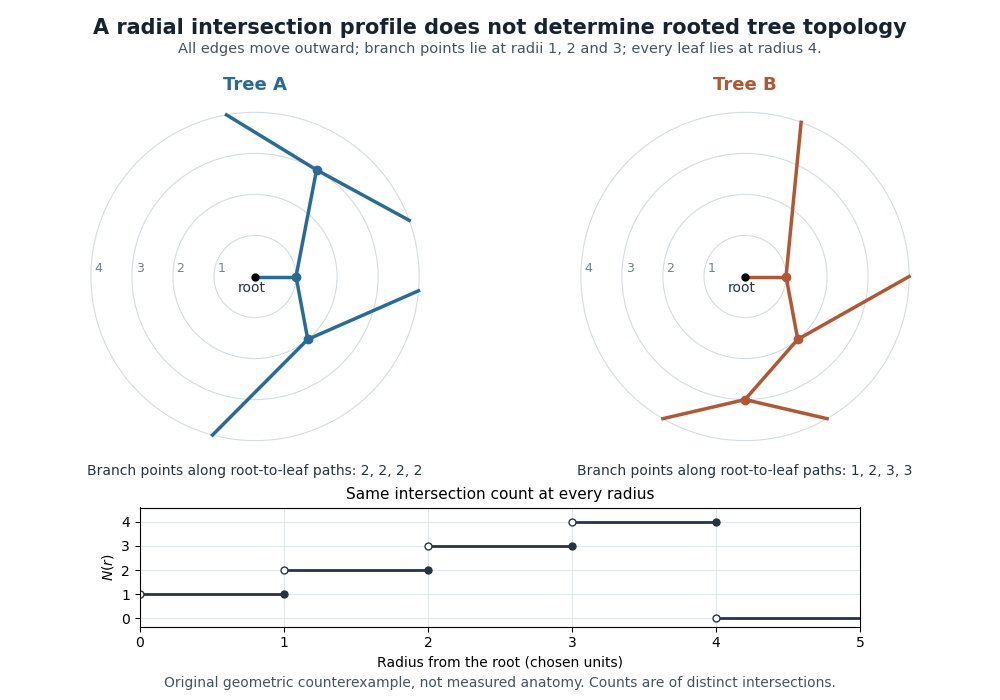
Different rooted trees with identical radial intersection profiles
. Original geometric counterexample with checked outward edges, noncrossing embeddings and distinct-intersection counts. Chosen coordinates, not measured anatomy. Details. Pinned article: Introduction to the OurBigBook Project
Welcome to the OurBigBook Project! Our goal is to create the perfect publishing platform for STEM subjects, and get university-level students to write the best free STEM tutorials ever.
Everyone is welcome to create an account and play with the site: ourbigbook.com/go/register. We belive that students themselves can write amazing tutorials, but teachers are welcome too. You can write about anything you want, it doesn't have to be STEM or even educational. Silly test content is very welcome and you won't be penalized in any way. Just keep it legal!
Intro to OurBigBook
. Source. We have two killer features:
- topics: topics group articles by different users with the same title, e.g. here is the topic for the "Fundamental Theorem of Calculus" ourbigbook.com/go/topic/fundamental-theorem-of-calculusArticles of different users are sorted by upvote within each article page. This feature is a bit like:
- a Wikipedia where each user can have their own version of each article
- a Q&A website like Stack Overflow, where multiple people can give their views on a given topic, and the best ones are sorted by upvote. Except you don't need to wait for someone to ask first, and any topic goes, no matter how narrow or broad
This feature makes it possible for readers to find better explanations of any topic created by other writers. And it allows writers to create an explanation in a place that readers might actually find it.
Figure 1. Screenshot of the "Derivative" topic page. View it live at: ourbigbook.com/go/topic/derivativeVideo 2. OurBigBook Web topics demo. Source. - local editing: you can store all your personal knowledge base content locally in a plaintext markup format that can be edited locally and published either:This way you can be sure that even if OurBigBook.com were to go down one day (which we have no plans to do as it is quite cheap to host!), your content will still be perfectly readable as a static site.
- to OurBigBook.com to get awesome multi-user features like topics and likes
- as HTML files to a static website, which you can host yourself for free on many external providers like GitHub Pages, and remain in full control

Figure 2. You can publish local OurBigBook lightweight markup files to either OurBigBook.com or as a static website.
Figure 3. Visual Studio Code extension installation.
Figure 5. . You can also edit articles on the Web editor without installing anything locally. Video 3. Edit locally and publish demo. Source. This shows editing OurBigBook Markup and publishing it using the Visual Studio Code extension. 
- Infinitely deep tables of contents:



All our software is open source and hosted at: github.com/ourbigbook/ourbigbook
Further documentation can be found at: docs.ourbigbook.com
Feel free to reach our to us for any help or suggestions: docs.ourbigbook.com/#contact