Topics (384k) Articles (398k) Users (410) Discussions (242) Comments (383) Files (13k) New article
For with constant linear maps, let and let be consecutive Picard iterate differences starting from . The vector Itô isometry gives , proving the displayed estimate by induction. The square roots of these factorial bounds are summable on bounded time intervals. The Doob L2 maximal inequality then makes finite. Tonelli's theorem proves absolute uniform almost-sure convergence of the iterations, in addition to their convergence.
An irreducible Markov chain on a finite or countably infinite state space has at most one stationary distribution. On a countably infinite state space it exists exactly when the chain is positive recurrent. In that case, for every state ,where is the first return time. The expression determines every component uniquely. The formula follows by dividing the one visit to in each return cycle by the mean recurrence time; the strong law of large numbers for successive cycles makes this occupation fraction precise.
Every irreducible finite Markov chain is positive recurrent and has exactly one stationary distribution. On an infinite state space, an irreducible null recurrent Markov chain or transient Markov chain has none. For example, the simple symmetric random walk on the integers is null recurrent. Aperiodicity affects convergence of the one-time laws, but is unnecessary for existence or uniqueness of a stationary distribution.
On states , take an interior step of or with probability each and hold with probability . At an endpoint take the inward step with probability and hold with probability . For and , the chain is irreducible and its stationary distribution has endpoint weights and interior weights .
Detailed balance proves this: the doubled inward endpoint transition requires its stationary mass to be half that of an adjacent interior point, and all interior points have equal mass. The total unnormalized weight is . For there are just two equal endpoint masses.
When , positive self-loops make the chain aperiodic, so its transition probabilities converge to this law. At every move changes parity and two-step returns are possible, giving period two and no such convergence from a fixed starting state. At every state is absorbing and uniqueness of the stationary law is lost.
Stationary position of a transposed distinguished book by  Codex 0 Created 2026-10-31 Updated 2026-11-05
Place books in a row and distinguish one of them. At each step select the distinguished book with Probability and each of the other books with Probability . Swap the selected book with its left neighbour; selecting the leftmost book leaves the ordering unchanged.
The distinguished book's position is a birth-death chain. From an interior position it moves left with Probability , moves right with Probability when the book immediately to its right is selected, and otherwise holds. Missing outward moves at the endpoints become holding. Detailed balance therefore gives for . With ,This finite Truncated geometric distribution is valid even when : both numerator and denominator then have the same negative sign. The uniform case is , when every book is selected equally often. Large selection Probability for the distinguished book biases it toward the left end. The strict range of ensures positive motion in both directions and avoids division by zero in the ratio.
Represent a finite sparse vector by a sorted doubly linked list of its nonzero coordinates. A list header stores the dimension; every ordinary linked list node stores a distinct valid coordinate index, its nonzero value, and predecessor and successor references. In a circular linked list, the endpoints connect to the header, and an all-zero vector has the header linked to itself in both directions. The representation invariant requires strictly increasing ordinary indices, valid bounds and mutually consistent forward and backward links. The abstraction function assigns zero to every coordinate absent from the list. The header is metadata, never an ordinary coordinate.
For example, has dimension nine and only three stored coordinates. The header's index field can store nine even though nine is not a valid coordinate index. Keeping the header distinct is therefore essential when searching for or removing entries.
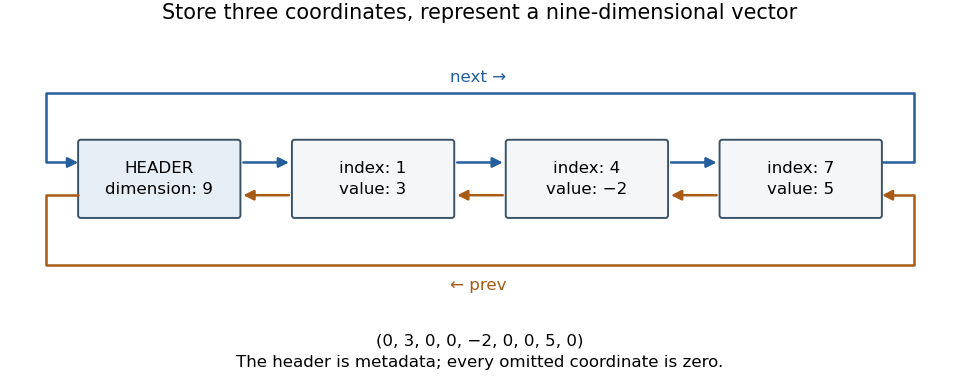
A circular sparse linked vector representation stores only nonzero coordinates
. Details. An open fireplace heats nearby surroundings through thermal radiation from the flame and hot surfaces, while convection carries hot combustion gases upward. A rising gas column can create a pressure difference that draws replacement air from the room and sends combustion products through a chimney. The visible fire and the warm radiant field therefore represent only part of the complete energy balance.
For a chosen room boundary, useful net heating depends on chemical energy released, outward enthalpy flow in the exhaust, warming of the structure and the energy needed to bring replacement air to room temperature. These terms explain why the rate of fuel consumption alone does not determine the room's net heating rate. An open fireplace is a useful thermal-system example because radiative heating of a nearby surface can coexist with substantial energy transport out of the same room through moving gas.
Hot-air heating transports thermal energy with moving air and transfers it to a region as that air mixes and cools. A fan can establish a controlled flow; buoyancy can also drive natural circulation when warm air has lower mass density than surrounding air at similar pressure.
For a steady stream with approximately constant composition and specific heat capacity, its sensible-heating contribution is . This is an enthalpy transport estimate, so both the flow rate and the temperature difference matter. Warmer supply air does not determine delivered power without knowing how much air moves. Spatial temperature gradients and circulation paths can make a single room thermometer an incomplete description. Comparing measurements at several heights tests whether a lumped thermal model captures the actual heating process.
Hot-water heating carries thermal energy in circulating liquid water. The water gives up sensible heat in a radiator or pipe network and returns at a lower temperature. Under approximately constant pressure and specific heat capacity, the transferred power iswhere is the mass flow rate.
The radiator's thermal conduction and its exchange with the room through convection and thermal radiation determine how large a temperature difference is needed. A circulation pump supplies mechanical work against fluid resistance, while the main heating source replenishes the lost enthalpy. Measuring inlet and outlet temperatures together with mass flow estimates the delivered thermal power. The circulating water can remain entirely within the liquid phase, making sensible cooling rather than a phase transition the principal transport budget.
Steam heating transports thermal energy using water vapor, commonly allowing it to condense in a heat-emitting component. At an approximately fixed local pressure, condensation releases latent heat while the phase-change temperature remains nearly fixed. The condensate can then return to the source for reheating.
For mass flow rate through a steady emitter, the ideal transferred power is , where is specific enthalpy. That difference can include both latent heat from condensation and sensible heat from cooling the condensate. The emitter transfers this energy to its surroundings through convection and thermal radiation. Measuring only the condensate temperature change would miss the latent contribution. The mechanism illustrates why a large heat transfer need not be accompanied by a large change in the working fluid's temperature.
An arithmetic theory is one-consistent if it does not prove while proving every , for a bounded arithmetic formula and all standard natural numbers . If the theory proves all true bounded sentences, this is equivalent to Sigma-1 soundness: a false existential theorem has every standard instance refuted by bounded completeness; conversely a true witness and its provable negation contradict the assumption of a consistent first-order theory.
A theory has Sigma-1 soundness if every Sigma-1 formula that is a closed theorem is true in the standard natural-number structure. It is weaker than full arithmetic soundness. Under bounded completeness it is equivalent to one-consistency. The standard interpretation matters: an existential statement can have a witness in a nonstandard model while having no standard witness.
Pi-1 soundness means that every closed Pi-1 theorem is true in the standard natural numbers. Consistency plus bounded completeness implies it, since a false universal bounded statement has a standard counterexample whose arithmetic verification is provable. It is weaker than full soundness and does not prevent a consistent arithmetic theory from proving a false Sigma-1 sentence.
A first-order theory is Sigma-0 sound when every arithmetic bounded arithmetic sentence it proves is true in the standard natural numbers. For a first-order theory proving every true bounded arithmetic sentence, this is equivalent to first-order consistency: a false bounded theorem would have a provable bounded negation, and an inconsistent first-order theory proves the false bounded arithmetic sentence .
A first-order theory is omega-consistent when it never proves while proving for every standard natural number . Restricting the matrix to arithmetic bounded arithmetic formulas gives one-consistency. This condition concerns standard instances and is stronger than first-order consistency.
Suppose is holomorphic off , tends to zero at infinity, has sufficiently regular boundary values in the interval interior, and has endpoint growth for some at each endpoint . If its jump is integrable, the displayed reconstruction follows by deforming a Cauchy integral formula contour onto the two sides of the interval. An endpoint circle of radius contributes , which vanishes. The two oppositely oriented banks leave precisely the jump. Without decay at infinity, an entire remainder can survive; a nonzero constant is the simplest example.
For and , the endpoint powers are integrable and the interior pole is taken as a Cauchy principal value. The analytic function , positive for and decaying like , has boundary values . Its jump gives a Cauchy reconstruction, while the mean of its boundary values and the Sokhotski–Plemelj formula give the displayed identity. At the principal value is zero.
On a positively oriented smooth simple closed contour, set . The Sokhotski–Plemelj theorem gives the sum and difference of the two Cauchy boundary values. Changing the sign of the exterior branch converts the equation into a normalized additive Riemann-Hilbert problem with jump . Applying the boundary formula again yields , proving the involution on a suitable smooth or Hölder function class.
For , write . The squared norm of this piecewise constant test kernel is , so the Cauchy-Schwarz inequality gives the displayed pointwise estimate. Integrating against a nonnegative weight gives . In particular gives the constant , useful for controlling a negative quadratic potential by derivative energy. The estimate is sharp at each fixed evaluation point, whose equality profile is a tent function, although its integrated constant need not be sharp.
For a positive integer-valued random variable with finite mean , the size-biased distribution has probabilities . They sum to one by the definition of expected value. Multiplying the differentiated probability generating function by gives the displayed identity for , with the endpoint interpreted by its limit.
For the positive-support geometric distribution with success probability , size bias gives . The sum of two independent copies has positive-integer decompositions at value , so its shifted probability is exactly this expression. Its probability generating function is , also obtained by the size-biased probability generating function identity.
Pinned article: Introduction to the OurBigBook Project
Welcome to the OurBigBook Project! Our goal is to create the perfect publishing platform for STEM subjects, and get university-level students to write the best free STEM tutorials ever.
Everyone is welcome to create an account and play with the site: ourbigbook.com/go/register. We belive that students themselves can write amazing tutorials, but teachers are welcome too. You can write about anything you want, it doesn't have to be STEM or even educational. Silly test content is very welcome and you won't be penalized in any way. Just keep it legal!
Intro to OurBigBook
. Source. We have two killer features:
- topics: topics group articles by different users with the same title, e.g. here is the topic for the "Fundamental Theorem of Calculus" ourbigbook.com/go/topic/fundamental-theorem-of-calculusArticles of different users are sorted by upvote within each article page. This feature is a bit like:
- a Wikipedia where each user can have their own version of each article
- a Q&A website like Stack Overflow, where multiple people can give their views on a given topic, and the best ones are sorted by upvote. Except you don't need to wait for someone to ask first, and any topic goes, no matter how narrow or broad
This feature makes it possible for readers to find better explanations of any topic created by other writers. And it allows writers to create an explanation in a place that readers might actually find it.
Figure 1. Screenshot of the "Derivative" topic page. View it live at: ourbigbook.com/go/topic/derivativeVideo 2. OurBigBook Web topics demo. Source. - local editing: you can store all your personal knowledge base content locally in a plaintext markup format that can be edited locally and published either:This way you can be sure that even if OurBigBook.com were to go down one day (which we have no plans to do as it is quite cheap to host!), your content will still be perfectly readable as a static site.
- to OurBigBook.com to get awesome multi-user features like topics and likes
- as HTML files to a static website, which you can host yourself for free on many external providers like GitHub Pages, and remain in full control

Figure 2. You can publish local OurBigBook lightweight markup files to either OurBigBook.com or as a static website.
Figure 3. Visual Studio Code extension installation.
Figure 5. . You can also edit articles on the Web editor without installing anything locally. Video 3. Edit locally and publish demo. Source. This shows editing OurBigBook Markup and publishing it using the Visual Studio Code extension. 
- Infinitely deep tables of contents:



All our software is open source and hosted at: github.com/ourbigbook/ourbigbook
Further documentation can be found at: docs.ourbigbook.com
Feel free to reach our to us for any help or suggestions: docs.ourbigbook.com/#contact