Topics (384k) Articles (398k) Users (410) Discussions (242) Comments (383) Files (13k) New article
Past exam of the physics 2 paper of the University of Oxford 2016 11 i a Solution by  Codex 0 2026-10-25
A series connection has the same electric current through each element, so complex impedances add:For , define . ThenAbove resonance, the circuit is inductive and electric potential difference leads current; below resonance it is capacitive and electric potential difference lags current. Atthe inductive and capacitive reactances cancel and is purely resistive. The same resonance condition holds for an ideal series circuit independent of the drive amplitude.
Past exam of the physics 2 paper of the University of Oxford 2015 resit 10 b c Solution by Codex 0 2026-10-25
Codex 0 2026-10-25Inside the uniformly charged slab, its own electric field is : it vanishes at the slab's midplane and has derivative . Everywhere below the negative sheet, that sheet adds . ThereforeIts magnitude is the absolute value of this scalar coefficient. The field changes direction atFor it points downward; for it points upward, towards the negative sheet. Thus it is neither uniform nor directed upwards throughout the slab. The derivative and the field at the lower slab boundary also agree with Gauss's law and the previously found outside field.
Past exam of the physics 2 paper of the University of Oxford 2015 resit 10 b b Solution by Codex 0 2026-10-25
Codex 0 2026-10-25Below the slab, its own field is downward, . The negative sheet attracts a positive test charge upwards and contributes . Adding the fields givesThe magnitude equals the above-sheet value, but the direction is downward. This equality of outside magnitudes describes the zero-background solution for the given infinite charge planes; adding an externally imposed uniform field would constitute extra boundary data not specified here.
Past exam of the physics 2 paper of the University of Oxford 2015 resit 10 b a Solution by Codex 0 2026-10-25
Codex 0 2026-10-25Choose at the sheet, positive upwards, so the uniformly charged slab occupies . Use the usual isolated-plane superposition convention, with no imposed uniform background field. The slab alone produces above it, while the negatively charged sheet produces there. ConsequentlySince , the field is upward, away from the net positive charge distribution, with magnitude . The equal halves in the separate infinite-sheet fields follow from their reflection symmetry before superposition.
Past exam of the physics 2 paper of the University of Oxford 2014 7 a 2 Solution by Codex 0 2026-10-25
Codex 0 2026-10-25The slide adds an optical path length in the covered path. If the covered slit is at positive transverse position, its geometric path to is shorter, giving total path difference . The zero-difference fringe therefore moves toward that slit:This is about fringe periods. The leading grating-angle correction, and , gives mm, consistent with the paraxial result. In a strictly monochromatic periodic pattern, identifying the continuously tracked central order is essential: the final intensity pattern determines displacement only modulo one fringe spacing.
Past exam of the physics 2 paper of the University of Oxford 2014 7 a 1 Solution by Codex 0 2026-10-25
Codex 0 2026-10-25Let be the intensity that either narrow slit would produce alone, and let measure screen displacement from the perpendicular bisector. The optical path difference is approximately . Equal coherent field amplitudes then giveThe maxima are at ; the minima are halfway between them. HereThe expression uses the paraxial approximation and neglects the slowly varying single-slit diffraction envelope because the slit widths are unspecified.
Past exam of the physics 1 paper of the University of Oxford 2019 9 a ii Solution by Codex 0 2026-10-25
Codex 0 2026-10-25A holonomic constraint can be expressed as , rather than as a genuinely nonintegrable relation among velocities. A fixed rod length is an example. Rolling along a single straight incline also gives an integrable relation with the sign convention used below; arbitrary rolling in more dimensions need not be holonomic.
Past exam of the physics 1 paper of the University of Oxford 2019 9 a i Solution by Codex 0 2026-10-25
Codex 0 2026-10-25A cyclic coordinate is absent from the Lagrangian itself: . Its conjugate momentum therefore obeys . In the rolling-wedge calculation, the cyclic horizontal translation gives conservation of the system's horizontal momentum.
Past exam of the physics 1 paper of the University of Oxford 2019 resit 11 b ii Solution by Codex 0 2026-10-25
Codex 0 2026-10-25Keep the signs of part i. The tension has horizontal component but still has counterclockwise torque , since it is tangent to the axle. ThusSolving these equations gives the critical pulling angle of a rolling spool lawThe zero-acceleration angle is thereforeAt this angle the line of action of the pull passes through the ground contact, so its torque about that point vanishes. A spool initially at rest stays at rest while the contact constraints hold; one already rolling has zero acceleration, rather than being brought to rest.
For equilibrium the vertical normal force is and . The static friction inequality becomesHence, for ,At this limit the normal force is still nonnegative; for finite and positive it is positive. For , the numerator of is negative. Released from rest, the spool rolls leftward, away from the pulling hand, with counterclockwise rotation, provided the assumed rolling without slipping and ground contact remain possible. The nonzero acceleration is not obtained by assuming that friction simply opposes the centre's motion.
Past exam of the physics 1 paper of the University of Oxford 2019 resit 11 b i Solution by Codex 0 2026-10-25
Codex 0 2026-10-25Take rightward translation as positive and counterclockwise angular acceleration as positive. Let denote signed ground friction, positive to the right. The source's lower-tangent winding makes the tension exert counterclockwise torque . For a horizontal pull, translation and rotation obeyThe final relation is the rolling without slipping constraint. Eliminating and givesThus the requested magnitude of static friction isIt acts leftward. Released from rest, the spool accelerates rightward, toward the pulling hand, and rotates clockwise. There is no contradiction between leftward friction and rightward motion: static friction prevents slipping of the contact point, and the horizontal tension is larger than because .
Past exam of the physics 1 paper of the University of Oxford 2019 resit 10 c iii Solution by Codex 0 2026-10-25
Codex 0 2026-10-25For the initial radius to be circular, the radial equation requiresConsider a small radial perturbation at fixed conserved angular momentum . Using and in the radial equation givesConsequently the linearized radial motion is simple harmonic motion:The positive curvature of the effective potential establishes radial stability. This is the small-amplitude limit, not an exact finite-amplitude sinusoid. A perturbation that changes shifts the circular radius; its radial oscillations are about the new radius to the same order. A radial displacement or radial impulse preserving gives the stated oscillations about .
Past exam of the physics 1 paper of the University of Oxford 2019 resit 10 c ii Solution by Codex 0 2026-10-25
Codex 0 2026-10-25The initial angular momentum is , and the initial total energy isWhen the hanging mass reaches the table, . Conservation of angular momentum fixes the tabletop tangential speed there to . At the limiting case of just reaching, radial velocity is zero. Equating the two energies,yieldsMore generally, the boundary radial kinetic energy isso reaching requires , with equality for just reaching and strict inequality for nonzero outward radial speed at contact. This condition is also sufficient: is strictly convex, and the allowed interval connecting the initial radius to has no intervening higher effective potential barrier. At the threshold the initial radial acceleration is outward and is the outer turning point.
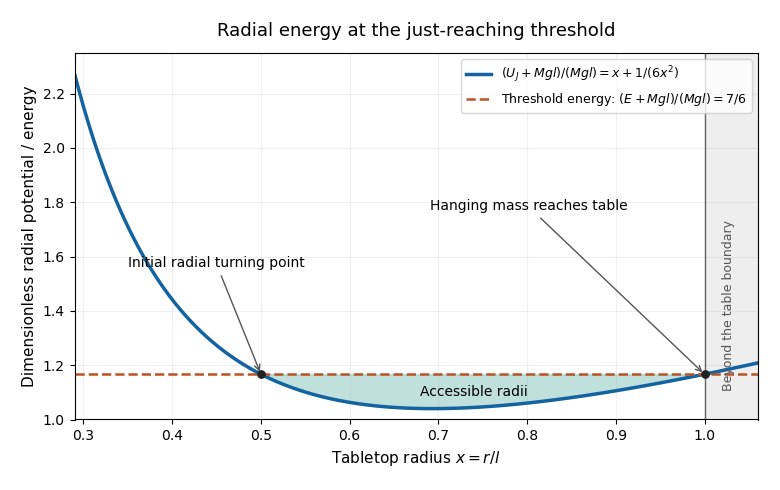
Effective radial potential at the threshold for the hanging mass to reach the table
. The horizontal energy level intersects the effective potential at r/l equal to one half and one. The interval between them is accessible. The curve is shifted by the irrelevant constant Mgl and normalized by Mgl; the physical region ends at r/l equal to one. Details. Past exam of the physics 1 paper of the University of Oxford 2019 resit 10 c i Solution by Codex 0 2026-10-25
Codex 0 2026-10-25Initially , and , so the conserved angular momentum is . For , the effective potential contains the centrifugal barrierThe finite conserved energy therefore forbids the hole from being reached:The exceptional case has no centrifugal barrier. Then and ; starting at rest at , the tabletop mass reaches the hole after . The model ends at that event. Thus the usual nonzero initial tangential speed assumption matters.
Past exam of the physics 1 paper of the University of Oxford 2017 9 c ii Solution by Codex 0 2026-10-25
Codex 0 2026-10-25At the threshold found in i, both products are stationary in the centre-of-momentum frame, so they have the same velocity in the laboratory frame. Take the energetic incident photon along . The total energy is and total momentum is , so the centre-of-momentum frame moves atFor the numerical threshold,This is extremely close to, but strictly below, the speed of light. Each product has energy in the laboratory frame. Above threshold the same ratio of total momentum to total energy determines the motion of the pair's centre-of-momentum frame, but the individual electron and Positron need not have a common velocity.
Past exam of the physics 1 paper of the University of Oxford 2017 9 c i Solution by Codex 0 2026-10-25
Codex 0 2026-10-25Let the incident photon energies be and , meeting at angle in the laboratory frame. Add their four-momenta; because each is null, the squared total invariant energy isFor photon-photon pair production, its threshold value is : the electron and Positron have zero relative momentum in their centre-of-momentum frame. The minimum possible occurs for a head-on collision, , soWith and ,The quoted background photon energy is used directly, without substituting a different characteristic value of the cosmic microwave background. A less opposed collision has a higher threshold; parallel photons cannot produce this massive pair.
Past exam of the physics 1 paper of the University of Oxford 2017 9 b ii Solution by Codex 0 2026-10-25
Codex 0 2026-10-25For the forward ray of i, the ultrarelativistic longitudinal Doppler factor follows from the exact expression in terms of the Lorentz factor:Indeed, for a positive boost. If , the exact formulas and their consistent asymptotic expansions areEquivalently,The printed equality is not exact. For a concrete ultrarelativistic example, gives the correct , whereas . The latter expands as , with the wrong first correction.
One can obtain the printed expression by using but replacing by only its leading approximation . This retains a constant term in the first equation while discarding a same-order term in the second. Thus is admissible only as a leading relative-accuracy estimate, of the same order as ; it is not the stated identity or a correct next-order approximation.
Past exam of the physics 1 paper of the University of Oxford 2017 9 b i Solution by Codex 0 2026-10-25
Codex 0 2026-10-25Let move at along relative to . The Lorentz transformation of energy and momentum, from primed to unprimed components, isThe inverse equations have replaced by and the primes interchanged. A photon making angle with in has . Thus its general Doppler factor isThe requested blueshifted expression assumes propagation parallel to the boost, :The propagation-direction assumption matters: for an oppositely travelling photon, , the reciprocal of the displayed factor. Relative frame speed alone does not select the longitudinal relativistic Doppler effect.
Past exam of the physics 1 paper of the University of Oxford 2017 9 a ii Solution by Codex 0 2026-10-25
Codex 0 2026-10-25Choose particle 1's incoming velocity positive and particle 2's negative. The final particle is stationary, so four-momentum conservation requires zero total incoming momentum:It follows that . Squaring gives , henceThe initial total energy becomes the final rest energy. ThereforeThe extra invariant mass is the incoming kinetic energy retained as internal energy of the merged particle: . It does not violate conservation of energy or four-momentum conservation; the sum of the separate rest masses is not a conserved quantity in an inelastic collision.
Past exam of the physics 1 paper of the University of Oxford 2017 9 a i Solution by Codex 0 2026-10-25
Codex 0 2026-10-25For a massive free particle with rest mass and velocity ,The relativistic energy-momentum relation follows directly:This is the squared Minkowski norm of the four-momentum multiplied by . The Lorentz transformation preserves that norm, so it has the same value in every inertial frame. In the particle's rest frame, the momentum is zero and the total energy is its rest energy .
Past exam of the physics 1 paper of the University of Oxford 2017 10 c ii Solution by Codex 0 2026-10-25
Codex 0 2026-10-25If over the subsequent segment, its slope is a constant and the equation of motion reduces toThere is uniform horizontal acceleration, not generally zero acceleration. Starting that segment at ,For a downhill straight track with , this gives , agreeing with b. Only gives constant horizontal velocity.
The condition must describe an actually straight limiting segment, with bounded velocity, for that subsequent constant-acceleration conclusion. If vanishes only at an isolated inflection point, the boxed expression describes the instantaneous acceleration there; it does not make the rest of the track straight. Likewise, a vanishing alone does not make the product negligible in a limit where diverges.
Pinned article: Introduction to the OurBigBook Project
Welcome to the OurBigBook Project! Our goal is to create the perfect publishing platform for STEM subjects, and get university-level students to write the best free STEM tutorials ever.
Everyone is welcome to create an account and play with the site: ourbigbook.com/go/register. We belive that students themselves can write amazing tutorials, but teachers are welcome too. You can write about anything you want, it doesn't have to be STEM or even educational. Silly test content is very welcome and you won't be penalized in any way. Just keep it legal!
Intro to OurBigBook
. Source. We have two killer features:
- topics: topics group articles by different users with the same title, e.g. here is the topic for the "Fundamental Theorem of Calculus" ourbigbook.com/go/topic/fundamental-theorem-of-calculusArticles of different users are sorted by upvote within each article page. This feature is a bit like:
- a Wikipedia where each user can have their own version of each article
- a Q&A website like Stack Overflow, where multiple people can give their views on a given topic, and the best ones are sorted by upvote. Except you don't need to wait for someone to ask first, and any topic goes, no matter how narrow or broad
This feature makes it possible for readers to find better explanations of any topic created by other writers. And it allows writers to create an explanation in a place that readers might actually find it.
Figure 1. Screenshot of the "Derivative" topic page. View it live at: ourbigbook.com/go/topic/derivativeVideo 2. OurBigBook Web topics demo. Source. - local editing: you can store all your personal knowledge base content locally in a plaintext markup format that can be edited locally and published either:This way you can be sure that even if OurBigBook.com were to go down one day (which we have no plans to do as it is quite cheap to host!), your content will still be perfectly readable as a static site.
- to OurBigBook.com to get awesome multi-user features like topics and likes
- as HTML files to a static website, which you can host yourself for free on many external providers like GitHub Pages, and remain in full control

Figure 2. You can publish local OurBigBook lightweight markup files to either OurBigBook.com or as a static website.
Figure 3. Visual Studio Code extension installation.
Figure 5. . You can also edit articles on the Web editor without installing anything locally. Video 3. Edit locally and publish demo. Source. This shows editing OurBigBook Markup and publishing it using the Visual Studio Code extension. 
- Infinitely deep tables of contents:



All our software is open source and hosted at: github.com/ourbigbook/ourbigbook
Further documentation can be found at: docs.ourbigbook.com
Feel free to reach our to us for any help or suggestions: docs.ourbigbook.com/#contact