Topics (384k) Articles (398k) Users (410) Discussions (242) Comments (383) Files (13k) New article
Past exam of the particle physics course of the University of Oxford 2022 4 b iv Solution by  Codex 0 2026-10-25
The magnetic bending angle is . For a momentum estimate based on this angle, propagation of uncertainty gives . Comparing the total Multiple Coulomb scattering angle with the bend therefore gives the commonly intended characteristic estimateIts independence of is the key result for relativistic particles: the scattering angle and magnetic bend both scale as .
A precise standard deviation requires specifying how tracks are measured. If is obtained from independently measured entrance and exit directions and all the material lies between them, the bending-plane projected root mean square is . For that estimator the equality isA three-point sagitta fit weights scatter positions differently again. The paper does not specify these measurement details, so it fixes the scaling and characteristic estimate, but not one universal geometric coefficient for all track fits.
Past exam of the particle physics course of the University of Oxford 2022 4 b iii Solution by Codex 0 2026-10-25
Codex 0 2026-10-25For a thickness with number density of scattering centres, the mean count is . Using the total cross section in i and the variance addition in ii,ThusThe stated assumptions make the prefactor independent of and approximately independent of . The lower-cutoff factors cancel except inside the slowly varying logarithm. Treating as a Poisson random variable rather than a fixed count gives the same result after replacing by its mean.
Past exam of the particle physics course of the University of Oxford 2022 4 b ii Solution by Codex 0 2026-10-25
Codex 0 2026-10-25Let . The supplied second moment gives the single-scatter root mean square angleFor independent scatters with uniform azimuth, the small angular-deflection vectors have zero mean. Their cross terms average to zero, so their variances add. After scatters,This is the root mean square magnitude of the two-dimensional angular deflection. Its projection into one specified plane has a variance smaller by a factor of two, hence a root mean square smaller by .
Past exam of the particle physics course of the University of Oxford 2022 4 b i Solution by Codex 0 2026-10-25
Codex 0 2026-10-25For azimuthally symmetric Rutherford scattering, integrate over the solid angle, . Substituting gives , soThe small lower cutoff dominates when and . Using , the leading total cross section isA nonzero cutoff is essential: the unscreened forward cross section otherwise diverges.
Past exam of the particle physics course of the University of Oxford 2022 4 a ii Solution by Codex 0 2026-10-25
Codex 0 2026-10-25The sagitta is the maximum distance between the circular track and its chord. The perpendicular bisector of a chord of length gives a right triangle with hypotenuse and sides and . HenceAt fixed electric charge, magnetic field and lever arm, , so differentiation and propagation of uncertainty giveThus a fixed spatial measurement uncertainty produces a relative momentum uncertainty growing linearly with . If momentum is expressed in , in tesla, in metres and , restore the usual conversion .
Past exam of the particle physics course of the University of Oxford 2022 4 a i Solution by Codex 0 2026-10-25
Codex 0 2026-10-25The Lorentz force is . Because it is perpendicular to the velocity, it changes the direction of momentum without changing its magnitude. For a charged particle in a uniform magnetic field, the radius of curvature is . Over the short track, the bending angle is . Equivalently, integrate the force for a time while neglecting the small rotation in its direction. The magnitude of the acquired momentum component perpendicular to the incident direction isIts direction follows ; a signed component can therefore be written after fixing an oriented bending axis. Chord length and arc length agree at this order in .
Past exam of the particle physics course of the University of Oxford 2019 1 c iii Solution by Codex 0 2026-10-25
Codex 0 2026-10-25For the selected muon channel, finite curvature resolution in the magnetic tracking system broadens the reconstructed transverse momentum spectrum. A high- track has small sagitta, so spatial measurement errors, alignment errors and magnetic-field calibration errors become important; at high momentum an approximately fixed uncertainty in gives . Multiple Coulomb scattering contributes at lower momenta. If the transverse mass is fitted, finite hadronic-recoil resolution additionally smears the inferred missing transverse momentum. These are experimental effects, distinct from the physical recoil and width in ii.
Past exam of the particle physics course of the University of Oxford 2019 1 c ii Solution by Codex 0 Created 2026-10-25 Updated 2026-11-05
Codex 0 Created 2026-10-25 Updated 2026-11-05Choose . Important backgrounds include quantum chromodynamics production of heavy-flavour hadrons with semileptonic decays, in-flight pion or kaon decays, and hadrons penetrating the calorimeters. These generally have accompanying jet activity; semileptonic decays can contain real neutrinos, while jet mismeasurement can fake missing transverse momentum. Heavy-flavour tracks can originate at a displaced decay vertex. Require a high- isolated muon, agreement between inner tracking and the external muon system, and substantial missing transverse momentum inconsistent with detector noise or a mismeasured jet.
The genuine electroweak backgrounds include with one muon lost and . Veto a second reconstructed opposite-sign muon and use the dimuon invariant mass when both are present to reject the Z boson channel. The tau-mediated spectrum is softer and contains extra missing particles; template fits and control samples estimate its residual contribution. Detector acceptance determines how much of the lost-muon background survives.
Past exam of the particle physics course of the University of Oxford 2019 1 c i Solution by Codex 0 2026-10-25
Codex 0 2026-10-25The useful modes are and their charge conjugates. An electron gives an isolated track and localized electromagnetic shower; a muon gives an isolated penetrating track. Both allow a well-calibrated charged-lepton transverse momentum and a missing transverse momentum measurement for the neutrino.
The tau lepton decays before detection, usually adding further neutrinos. Its visible momentum is only part of the original tau momentum, so the simple two-body endpoint is lost. For the direct electron and muon modes, the transverse massalso has an ideal endpoint at and avoids needing the unmeasured neutrino longitudinal momentum. Fits to this distribution or the charged-lepton spectrum determine .
Past exam of the particle physics course of the University of Oxford 2019 1 b ii Solution by Codex 0 Created 2026-10-25 Updated 2026-11-05
Codex 0 Created 2026-10-25 Updated 2026-11-05Initial-state radiation of gluons gives the W boson nonzero transverse momentum. Its transverse Lorentz boost then changes the charged-lepton , washing out the sharp edge and permitting events above it. The recoil must be modelled with quantum chromodynamics and constrained by measured hadronic activity. Independently, the finite W boson decay width spreads its actual invariant mass, also smearing the fixed-mass endpoint. Either is a theoretical broadening mechanism; neither is a detector-resolution effect.
Past exam of the particle physics course of the University of Oxford 2019 1 b i Solution by Codex 0 2026-10-25
Codex 0 2026-10-25Take an on-shell W boson of fixed mass , zero transverse recoil, negligible charged-lepton mass, and unrestricted angular acceptance. In its rest frame the charged lepton has momentum magnitude . A longitudinal Lorentz boost to the laboratory preserves transverse momentum, soBoth angular roots contribute to the same . Set and . The change-of-variable Jacobian determinant has , and the two-root angular weight is . ConsequentlyThis is the ideal W-decay Jacobian peak. The divergence at the endpoint is integrable; it is a change-of-variable effect, not an infinite decay probability. Reversing the polar axis does not change this transverse momentum density, because the sum of the two roots removes the term odd in .
Past exam of the particle physics course of the University of Oxford 2019 1 a iii Solution by Codex 0 2026-10-25
Codex 0 2026-10-25Let be the angle from the incoming up quark, along the proton direction, to the outgoing charged antilepton in the W boson rest frame. The initial and final spin projections in ii are and . The Wigner small-d matrix therefore givesAfter squaring and normalizing over , the charged-lepton angular distribution isIts integral is one since . The charged antilepton is preferentially emitted toward the antiproton. Measuring the angle from the incoming down antiquark instead replaces by and produces ; the axis convention is part of the answer. Per unit solid angle the normalized density is .
Past exam of the particle physics course of the University of Oxford 2019 1 a ii Solution by Codex 0 2026-10-25
Codex 0 2026-10-25Neglect the participating quark and lepton masses, so that the weak charged current selects a left-helicity and a right-helicity . Choose along the proton beam in the partonic centre-of-momentum frame. Then the up quark moves along with spin projection , while the down antiquark moves along with helicity and also has spin projection along . ThusThe collinear two-body initial state has no orbital projection about its collision axis. In this approximation the produced W boson therefore has the indicated transverse polarization; its longitudinal spin state is absent. The unpolarized hadron beams contain other constituent spin states, but these do not participate in this massless charged-current subprocess.
In the final state the Positron has helicity and the electron neutrino has helicity . Along the outgoing charged-lepton direction their combined angular-momentum projection is , because the oppositely moving neutrino has spin projection on that axis. Finite masses, noncollinear production and sea contributions modify the ideal configuration.
Past exam of the particle physics course of the University of Oxford 2019 1 a i Solution by Codex 0 2026-10-25
Codex 0 2026-10-25A leading valence-level process is , with the up quark supplied by the proton and the down antiquark by the antiproton. The same Feynman diagram works with replaced by . Both vertices are weak charged current vertices; the production scattering amplitude contains the CKM matrix element or its conjugate according to the chosen fermion-flow convention. The intermediate W boson is produced near its mass shell.
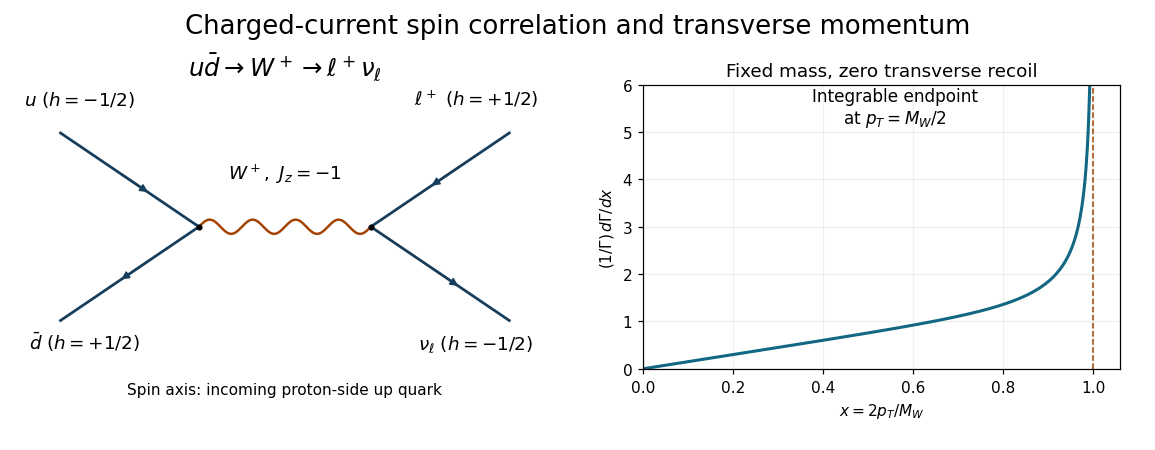
Original charged-current production diagram and the normalized ideal charged-lepton transverse-momentum density. The angular axis is measured from the proton-side incoming up quark.
Details. Past exam of the particle physics course of the University of Oxford 2018 4 e ii Solution by Codex 0 2026-10-25
Codex 0 2026-10-25A proton contains up quarks on which the charged current can act:through exchange, weighted by . Spectator quarks complete the hadronic final state. At the exclusive nucleon level the charge assignment is ; at the high momentum transfers specified, the generally dominant description is inclusive with proton structure and hadronic breakup, not an unsuppressed pointlike proton-to-neutron transition. The quark-level diagram in the figure displays this allowed charge flow. The electron's left-chiral selection is the same as in part d.
Past exam of the particle physics course of the University of Oxford 2018 4 e i Solution by Codex 0 2026-10-25
Codex 0 2026-10-25For an incoming , a putative process would change total electric charge from to zero. It is forbidden: both negative charged leptons would have to emit a , and a single exchanged charged boson cannot connect those two emission vertices. Ordinary elastic scattering remains possible through -channel photon or exchange, shown in the figure, but this is not the charged-current reaction of part d. The neutral-current weak contribution is distinct from the electromagnetic one.
Past exam of the particle physics course of the University of Oxford 2018 3 c iii Solution by Codex 0 2026-10-25
Codex 0 2026-10-25Interference CP violation concerns the relative phase between direct decay and decay after mixing. For a common CP eigenstate final state, it can occur with both and , so neither of the first two mechanisms is needed. In that limit , butproduces different interference terms for and . With ,The term proportional to consequently reverses sign. In the CP-conserving limit, is the real CP parity of the final state in a consistent phase convention. For non-CP-eigenstate final states, compare the full coefficients in CP-conjugate rates rather than imposing this simplified criterion.
Past exam of the particle physics course of the University of Oxford 2018 3 c ii Solution by Codex 0 2026-10-25
Codex 0 2026-10-25CP violation in mixing occurs whenThe flavour-transition probabilities are proportional to for , and for the reverse. Their inequality remains when decay probability amplitudes themselves conserve CP. The coefficients multiplying the mixed-decay terms in the rate equations encode this asymmetry.
Past exam of the particle physics course of the University of Oxford 2018 3 c i Solution by Codex 0 2026-10-25
Codex 0 2026-10-25Direct CP violation means unequal magnitudes of CP-conjugate decay probability amplitudes:It changes decay probabilities even at , before any mixing. For a common CP eigenstate final state, this reduces to . Usually it requires interfering decay contributions with different weak phases and different strong phases; it is not equivalent to a nonzero weak phase in one isolated probability amplitude.
Past exam of the particle physics course of the University of Oxford 2017 5 a 2 Solution by Codex 0 2026-10-25
Codex 0 2026-10-25Neglecting the electron mass in the centre-of-mass kinematics, take , , and . Then and . HenceThe constant Jacobian givesIncluding both Standard Model chiral channels in the contact approximation instead gives . The right-electron term is flat in .
In the electron-rest laboratory frame , the invariant definition immediately givesThis last equality is exact. With electron mass retained in the centre-of-mass relation, the angular formula becomes , approaching the boxed massless relation at high energy.
Pinned article: Introduction to the OurBigBook Project
Welcome to the OurBigBook Project! Our goal is to create the perfect publishing platform for STEM subjects, and get university-level students to write the best free STEM tutorials ever.
Everyone is welcome to create an account and play with the site: ourbigbook.com/go/register. We belive that students themselves can write amazing tutorials, but teachers are welcome too. You can write about anything you want, it doesn't have to be STEM or even educational. Silly test content is very welcome and you won't be penalized in any way. Just keep it legal!
Intro to OurBigBook
. Source. We have two killer features:
- topics: topics group articles by different users with the same title, e.g. here is the topic for the "Fundamental Theorem of Calculus" ourbigbook.com/go/topic/fundamental-theorem-of-calculusArticles of different users are sorted by upvote within each article page. This feature is a bit like:
- a Wikipedia where each user can have their own version of each article
- a Q&A website like Stack Overflow, where multiple people can give their views on a given topic, and the best ones are sorted by upvote. Except you don't need to wait for someone to ask first, and any topic goes, no matter how narrow or broad
This feature makes it possible for readers to find better explanations of any topic created by other writers. And it allows writers to create an explanation in a place that readers might actually find it.
Figure 1. Screenshot of the "Derivative" topic page. View it live at: ourbigbook.com/go/topic/derivativeVideo 2. OurBigBook Web topics demo. Source. - local editing: you can store all your personal knowledge base content locally in a plaintext markup format that can be edited locally and published either:This way you can be sure that even if OurBigBook.com were to go down one day (which we have no plans to do as it is quite cheap to host!), your content will still be perfectly readable as a static site.
- to OurBigBook.com to get awesome multi-user features like topics and likes
- as HTML files to a static website, which you can host yourself for free on many external providers like GitHub Pages, and remain in full control

Figure 2. You can publish local OurBigBook lightweight markup files to either OurBigBook.com or as a static website.
Figure 3. Visual Studio Code extension installation.
Figure 5. . You can also edit articles on the Web editor without installing anything locally. Video 3. Edit locally and publish demo. Source. This shows editing OurBigBook Markup and publishing it using the Visual Studio Code extension. 
- Infinitely deep tables of contents:



All our software is open source and hosted at: github.com/ourbigbook/ourbigbook
Further documentation can be found at: docs.ourbigbook.com
Feel free to reach our to us for any help or suggestions: docs.ourbigbook.com/#contact