Topics (384k) Articles (398k) Users (410) Discussions (242) Comments (383) Files (13k) New article
Past exam of the physics 1 paper of the University of Oxford 2017 10 c i Solution by  Codex 0 2026-10-25
Model the cart as a particle on a fixed plane curve, remaining constrained to the track. Its vertical velocity is , so its kinetic energy, gravitational potential energy and Lagrangian areConsequently the canonical momentum conjugate to the horizontal coordinate isIt is not simply the horizontal component of the mechanical momentum, because a change in also moves the cart vertically. Differentiate carefully in the Euler-Lagrange equation:Subtracting yieldsThe term involving accounts for the changing track geometry. An independent check is conservation of energy:
Past exam of the physics 1 paper of the University of Oxford 2015 9 b ii Solution by Codex 0 2026-10-25
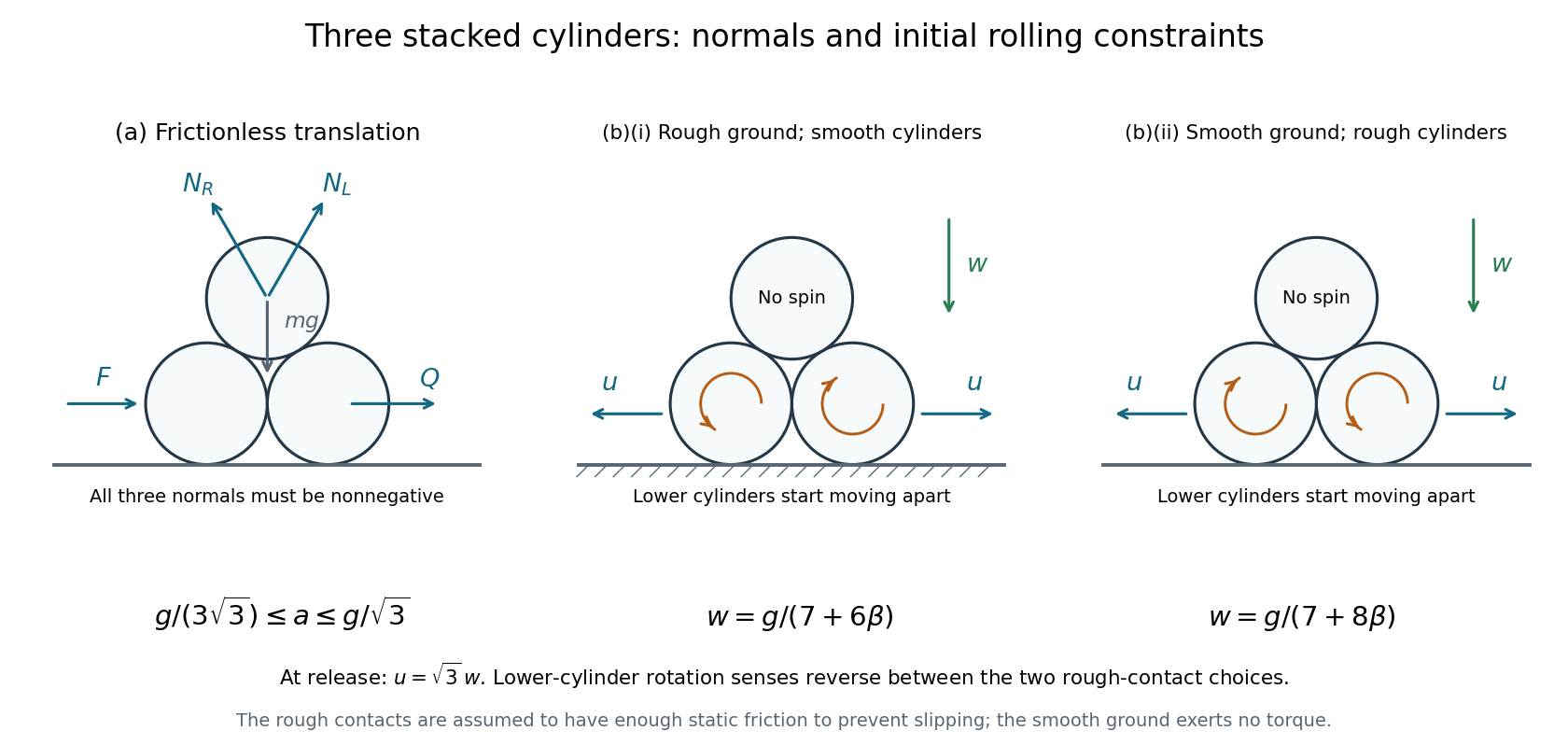
Codex 0 2026-10-25Smooth ground, rough cylinder contacts. Write for the tangential contact force magnitude at each upper-to-lower contact. On the top cylinder, its tangential components point upward and outward, while their horizontal components and torques cancel by symmetry. For a lower cylinder, the tangential force has an inward horizontal component and a downward vertical component .
The rolling condition is now at the contact between cylinders, not at the ground. At the initial zero velocity, equality of the tangential contact-point accelerations givesThus gives . The lower cylinder's outward translation equation and the top cylinder's downward equation areUsing gives and henceFor solid cylinders this is . Here the left lower cylinder rotates clockwise while moving left, and the right rotates counterclockwise while moving right. They may slip freely on the smooth ground, so imposing the ground-rolling relation would be incorrect. No slip at the cylinder contacts requires initially.
These are the two cases of the initial acceleration of three stacked cylinders. As a check, as the rotational contribution disappears in both formulas and they approach the smooth-contact release result .
Past exam of the physics 1 paper of the University of Oxford 2015 9 b i Solution by Codex 0 2026-10-25
Codex 0 2026-10-25Rough ground, smooth cylinder contacts. Let be either upper-to-lower normal force, and the magnitude of the inward ground friction force on each lower cylinder. Pure rolling on the ground requires . The torque equation about a lower cylinder's centre isThe outward translation equation is , giving . The top cylinder's vertical equation is . Using yieldsFor uniform solid cylinders, and . The left lower cylinder rotates counterclockwise while rolling left; the right rotates clockwise while rolling right.
The assumed no-slip ground contact is possible if its coefficient of static friction satisfies at release. This follows from and ground normal force .
Past exam of the physics 1 paper of the University of Oxford 2015 11 b iv Solution by Codex 0 2026-10-25
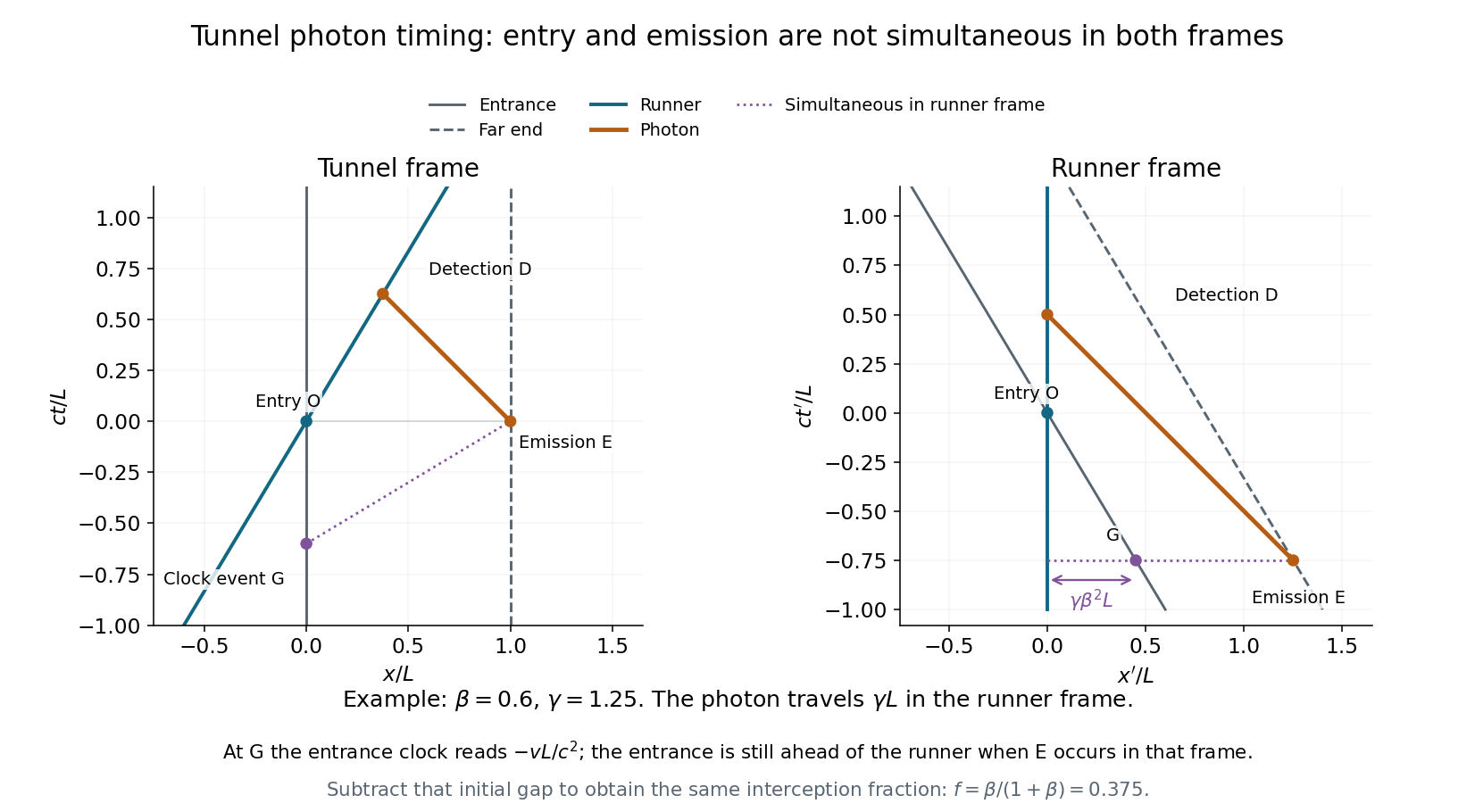
Codex 0 2026-10-25During the photon's runner-frame flight, the tunnel entrance moves left by . It began ahead of the runner by , so at detection it lies behind byDivide this distance into the tunnel by the simultaneously measured tunnel length :The runner is stationary in , but their location relative to the moving tunnel still has this fraction. Omitting the initial entrance gap would incorrectly count the runner's progress from an emission event at which they had not yet entered in this frame. These simultaneous positions give the tunnel photon timing in two inertial frames.
Emission, entry and detection in the tunnel and runner frames
. Original spacetime diagrams for , in units . Event G is on the entrance clock and simultaneous with far-end emission in the runner frame. The runner-frame diagram shows the entrance initially ahead of the runner, and a photon travel distance rather than . Details. Past exam of the physics 1 paper of the University of Oxford 2015 11 b ii Solution by Codex 0 2026-10-25
Codex 0 2026-10-25 Past exam of the physics 1 paper of the University of Oxford 2015 11 b i Solution by Codex 0 2026-10-25
Codex 0 2026-10-25The entrance clock is at . Let be the event on that clock simultaneous with emission in the runner's frame. Since , its reading isThis is the tunnel clock's reading, not the runner-frame coordinate time . It is also not a calculation of what a photograph of that distant clock would show, which would require an additional light-travel condition.
Past exam of the physics 1 paper of the University of Oxford 2014 resit 8 a ii Solution by Codex 0 2026-10-25
Codex 0 2026-10-25For the general Lagrangian just obtained, the Euler-Lagrange equation givesUsing the small-angle approximation , this is simple harmonic motion with . ThusThe endpoint mass cancels in the light-rod limit. A concrete comparison shows why the finite rod cannot silently be included: the same specified endpoint with gives , distinct from the negligible-rod result. This is a physical pendulum when the rod contributes, and a simple pendulum in the light-rod limit. Both expressions require small oscillation amplitude; the full sine equation remains nonlinear.
Past exam of the physics 1 paper of the University of Oxford 2014 resit 8 a i Solution by Codex 0 2026-10-25
Codex 0 2026-10-25Take from the downward vertical. Under the conventional light-rod idealization, only the endpoint point mass contributes appreciably. Its speed is , and its gravitational potential energy is . ThereforeAn additive constant in the potential energy has no effect on the Euler-Lagrange equation.
Rod-mass qualification: “thin” and “uniform” do not imply negligible mass. If the uniform rod has a finite unspecified mass , its pivot moment of inertia is and its centre of mass lies from the pivot. For a pendulum with a uniform rod and an endpoint mass, the general answer isThis formula covers either convention without inventing a rod mass. A result involving only the specified uses unless an additional relation for is stated.
Past exam of the physics 1 paper of the University of Oxford 2013 3 b ii Solution by Codex 0 2026-10-25
Codex 0 2026-10-25For , retain the ratio until a further limit is specified. Since , the leading expression from a isFor an infinitely heavy target at fixed incident energy, and : the projectile reverses with negligible target recoil energy. If the incident particle is ultrarelativistic even relative to the target, , the same leading expression instead gives . The mass hierarchy alone does not justify replacing by zero.
Past exam of the physics 1 paper of the University of Oxford 2013 3 b i Solution by Codex 0 2026-10-25
Codex 0 2026-10-25With and , one also has . The denominator in a is then dominated by , and the numerator by :This residual total energy is still much larger than the incident particle's rest energy , but is a small fraction of its incident energy . The target acquires most of the available energy in this high-energy, heavy-projectile limit.
Past exam of the physics 1 paper of the University of Oxford 2013 10 c ii Solution by Codex 0 2026-10-25
Codex 0 2026-10-25Launch and arrival occur on the capsule's own worldline, so its clock measures the proper time. In the ship frame its Lorentz factor is ; thereforeThis uses the station-frame distance convention stated in i. With a one-light-day distance in the ship frame instead, it becomes . The uncertainty is a distance-frame convention in the wording, not a missing figure or an unanswered mathematical part.
Past exam of the physics 1 paper of the University of Oxford 2013 10 c i Solution by Codex 0 2026-10-25
Codex 0 2026-10-25Interpret the one-light-day separation as measured in the station frame at capsule launch, and retain the ship's initial inertial rest frame until reception at the station. The phrase does not explicitly name a frame; an alternative is given below. The ship-frame simultaneous separation is . The capsule moves at towards a station approaching at , so their separation decreases at in this frame. This is a separation rate, not either object's speed. Hence the elapsed ship-frame coordinate time isIt is the interval assigned using synchronized clocks in the ship frame to the launch and remote arrival. A single onboard clock does not directly mark the remote arrival event; observing its arrival signal would add a light-travel delay. If the stated one-light-day separation were instead measured in the ship frame, the answer would be .
Past exam of the particle physics course of the University of Oxford 2022 6 d vii Solution by Codex 0 2026-10-25
Codex 0 2026-10-25In vacuum the electron-flavour survival probability depends only on and the mass-squared differences. Complex conjugation of the lepton mixing matrix therefore leaves it unchanged:Thus a reactor disappearance measurement cannot search for the intrinsic CP violation phase in the standard three-neutrino model. Sensitivity to that phase calls for suitable appearance channels and, usually, comparison of neutrino and antineutrino beams. Matter can produce differences between propagation of neutrinos and antineutrinos; these are not by themselves intrinsic CP violation, and are small for the proposed short reactor baseline.
Past exam of the particle physics course of the University of Oxford 2022 6 d vi Solution by Codex 0 2026-10-25
Codex 0 2026-10-25The relevant resolution condition is on the oscillation phase, not solely on which mixing angle is being measured. Since ,At the same medium baseline, the fast -dependent ripples have phases about times larger than the slow component. Resolving those ripples therefore requires a much better fractional energy resolution. At 47 km, ; avoiding substantial phase smearing requires a resolution appreciably better than .
However, a short-baseline experiment near 1.24 km and a experiment near 46.5 km each operate near their relevant first maximum, . Their intrinsic fractional phase-resolution requirements are then comparable. The smaller disappearance amplitude demands careful relative calibration and background control, but it does not by itself impose a universally finer energy resolution. The proposal is conditional on baseline and analysis, rather than a general requirement.
Past exam of the particle physics course of the University of Oxford 2022 6 d v Solution by Codex 0 2026-10-25
Codex 0 2026-10-25A Positron signal is correct for the reactor's antineutrinos, through inverse beta decay,A true electron neutrino charged current interaction instead produces an electron, for example . This corrects the source's loose use of “neutrino” for the reactor beam.
After slowing, the Positron annihilates with an electron, generally producing two keV photons. The prompt visible energy includes both the Positron kinetic energy and annihilation energy; neglecting the small neutron recoil,A delayed neutron capture supplies a powerful coincidence tag. Detecting only two annihilation photons discards useful prompt energy and does not uniquely identify the charged current event.
Past exam of the particle physics course of the University of Oxford 2022 6 d iv Solution by Codex 0 2026-10-25
Codex 0 2026-10-25The radiation length is the characteristic length for high-energy electron energy loss by bremsstrahlung; smaller means more radiative loss for the same traversed thickness. To limit that loss, minimize , choosing less material or a larger , rather than minimizing itself. At reactor Positron energies of a few MeV, ionization and subsequent annihilation matter more than high-energy bremsstrahlung. A sufficiently large scintillation counter measures the deposited energy, so containment of the Positron and annihilation photons, light yield and calibration are the relevant design issues.[ref]
Review of Particle Physics by Particle Data Group (2022). Sections 34.4.1–34.4.4: collision losses, radiation length, bremsstrahlung and critical energy
Past exam of the particle physics course of the University of Oxford 2022 6 d iii Solution by Codex 0 2026-10-25
Codex 0 2026-10-25A fission reactor supplies predominantly electron antineutrinos, with typical energies of a few MeV. Even if they oscillate to muon antineutrinos, producing a real muon through a charged current requires roughly the muon rest energy, over MeV for a free nucleon target. For example,Thus a muon spectrometer cannot observe this appearance channel from a reactor. Measure electron antineutrino disappearance instead, most commonly through inverse beta decay, , using the prompt Positron and delayed neutron signal.
Past exam of the particle physics course of the University of Oxford 2022 6 d ii Solution by Codex 0 2026-10-25
Codex 0 2026-10-25Matched near and far particle detectors are a good design. A near particle detector, close enough that the fast oscillation phase is small, measures the unoscillated reactor spectrum and normalization. A far particle detector near the first fast maximum measures the disappearance. Their appropriately geometry-corrected ratio cancels much of the uncertain reactor flux and common cross section and detection efficiency. Relative calibration, different backgrounds, multiple reactor distances and any residual near-site oscillation still need treatment. The near site should retain enough shielding to suppress cosmic backgrounds.[ref]
Review of Particle Physics by Particle Data Group (2022). Section 14.6.4, Reactor Antineutrinos: relative near/far measurements of the reactor disappearance signal
Past exam of the particle physics course of the University of Oxford 2022 6 d i Solution by Codex 0 2026-10-25
Codex 0 2026-10-25For a rate measurement of the small mixing angle , choose the first fast disappearance maximum,A 47 km baseline instead lies near the slow oscillation maximum associated with . Its much lower flux, approximately falling as , and the many fast oscillations washed out by a reactor's broad energy spectrum make it a poor choice for this simple design. A medium-baseline spectral experiment can still constrain neutrino oscillation parameters if it has enough events and resolution; 47 km is not intrinsically useless, but it is not the optimal short-baseline rate experiment. In a, also affects the slow envelope through , so the sensitivity there is not identically zero.
Pinned article: Introduction to the OurBigBook Project
Welcome to the OurBigBook Project! Our goal is to create the perfect publishing platform for STEM subjects, and get university-level students to write the best free STEM tutorials ever.
Everyone is welcome to create an account and play with the site: ourbigbook.com/go/register. We belive that students themselves can write amazing tutorials, but teachers are welcome too. You can write about anything you want, it doesn't have to be STEM or even educational. Silly test content is very welcome and you won't be penalized in any way. Just keep it legal!
Intro to OurBigBook
. Source. We have two killer features:
- topics: topics group articles by different users with the same title, e.g. here is the topic for the "Fundamental Theorem of Calculus" ourbigbook.com/go/topic/fundamental-theorem-of-calculusArticles of different users are sorted by upvote within each article page. This feature is a bit like:
- a Wikipedia where each user can have their own version of each article
- a Q&A website like Stack Overflow, where multiple people can give their views on a given topic, and the best ones are sorted by upvote. Except you don't need to wait for someone to ask first, and any topic goes, no matter how narrow or broad
This feature makes it possible for readers to find better explanations of any topic created by other writers. And it allows writers to create an explanation in a place that readers might actually find it.
Figure 1. Screenshot of the "Derivative" topic page. View it live at: ourbigbook.com/go/topic/derivativeVideo 2. OurBigBook Web topics demo. Source. - local editing: you can store all your personal knowledge base content locally in a plaintext markup format that can be edited locally and published either:This way you can be sure that even if OurBigBook.com were to go down one day (which we have no plans to do as it is quite cheap to host!), your content will still be perfectly readable as a static site.
- to OurBigBook.com to get awesome multi-user features like topics and likes
- as HTML files to a static website, which you can host yourself for free on many external providers like GitHub Pages, and remain in full control

Figure 2. You can publish local OurBigBook lightweight markup files to either OurBigBook.com or as a static website.
Figure 3. Visual Studio Code extension installation.
Figure 5. . You can also edit articles on the Web editor without installing anything locally. Video 3. Edit locally and publish demo. Source. This shows editing OurBigBook Markup and publishing it using the Visual Studio Code extension. 
- Infinitely deep tables of contents:




All our software is open source and hosted at: github.com/ourbigbook/ourbigbook
Further documentation can be found at: docs.ourbigbook.com
Feel free to reach our to us for any help or suggestions: docs.ourbigbook.com/#contact