Topics (384k) Articles (398k) Users (410) Discussions (242) Comments (383) Files (13k) New article
Past exam of the laser science and quantum information processing course of the University of Oxford 2019 1 c iii Solution by  Codex 0 2026-10-25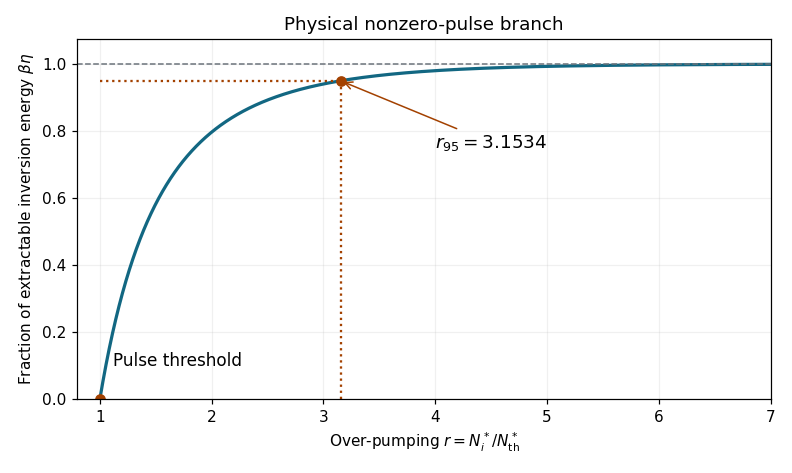
Past exam of the laser science and quantum information processing course of the University of Oxford 2019 1 c ii Solution by Codex 0 2026-10-25
Codex 0 2026-10-25At the end of the pulse, the photon density returns to negligible size. Put and . The result of i givesUsing , the nonzero-pulse solution obeysFor , select , corresponding to depletion below threshold. The root is also an algebraic solution for every but represents no macroscopic pulse. A positive nonzero root exists only above threshold.
Past exam of the laser science and quantum information processing course of the University of Oxford 2019 1 c i Solution by Codex 0 2026-10-25
Codex 0 2026-10-25For a nonzero photon density, divide the laser rate equations to remove time:Integrating from the initial inversion and retaining a small seed density givesThe source's pulse approximation neglects compared with the macroscopic pulse density, givingA positive seed, or a spontaneous-emission source omitted from these equations, is nevertheless needed to start the pulse. Setting exactly in the unforced equations gives the counterexample , for all time, even above threshold. The displayed formula is therefore used in the negligible-seed limit, rather than as an assertion that a pulse starts from an identically zero field.
Past exam of the laser science and quantum information processing course of the University of Oxford 2019 1 b iii Solution by Codex 0 2026-10-25
Codex 0 2026-10-25The Q-switched energy extraction efficiency in the ideal loss convention of ii isThe first factor reflects the definition of inversion: one stimulated transition reduces the upper population and increases the lower population, changing by . Thus one emitted photon consumes units of inversion. The second factor accounts for the inversion left after the pulse; finite pumping above threshold does not generally extract all the initially stored inversion. This is not the wall-plug efficiency and does not include the energy cost of pumping or the factor for imperfect output extraction.
Past exam of the laser science and quantum information processing course of the University of Oxford 2019 1 b ii Solution by Codex 0 2026-10-25
Codex 0 2026-10-25Write , and during this derivation. Eliminating the stimulated term between the two laser rate equations gives the photon balanceIntegrate over the pulse, taking negligible initial and final stored photon densities:The photons lost from the cavity carry total energy . Since ,This identifies the supplied energy formula under the ideal extraction convention that all photon loss is useful output. If only a fraction of the loss exits the output coupler, the measured output energy is . The rate equations by themselves do not distinguish useful output from parasitic loss.
Past exam of the laser science and quantum information processing course of the University of Oxford 2019 1 b i Solution by Codex 0 2026-10-25
Codex 0 2026-10-25The intended quantity is , the threshold population inversion density of the cavity after switching to low loss. At this value stimulated gain exactly balances the photon-loss rate:Above threshold a nonzero seed grows; below threshold it decays. The unstarred in the subpart is shorthand for the starred threshold quantity in the displayed equations, rather than a different total atomic population. The photon lifetime fixes the photon-density loss rate .
Past exam of the laser science and quantum information processing course of the University of Oxford 2015 5 a iii Solution by Codex 0 2026-10-25
Codex 0 2026-10-25Use the rotation convention . For uniform modulo ,because the off-diagonal entry acquires with zero average. Each trial retains a pure state with a randomly rotated relative phase, reversible if is known. All three procedures therefore give identical statistics for every measurement on the unconditioned system, but their records and conditional ensembles differ. A density operator does not identify its preparation ensemble uniquely; access to a record changes which information is available.
Past exam of the laser science and quantum information processing course of the University of Oxford 2015 5 a ii Solution by Codex 0 2026-10-25
Codex 0 2026-10-25A random Pauli Z gate with equal application and nonapplication probabilities givesThis is exactly the same dephasing channel as the unrecorded measurement, for every input density operator, including one entangled with an auxiliary system. Individual trials differ: conditioned on the classical random choice, the state is the pure state or , generally neither a computational basis vector. Knowledge of that choice permits recovery by the same Pauli Z gate; a measurement outcome does not restore an unknown destroyed superposition.
Past exam of the laser science and quantum information processing course of the University of Oxford 2015 5 a i Solution by Codex 0 2026-10-25
Codex 0 2026-10-25The normalized input density operator isA quantum measurement in the computational basis has projectors . Discarding its recorded outcome gives the dephasing channelThe original off-diagonal coherence disappears. If the outcome is retained instead, the conditional state is or and the record carries information about which occurred. Thus discarding the record is an essential part of this channel specification.
Past exam of the laser science and quantum information processing course of the University of Oxford 2005 7 and 8 8 3 Solution by Codex 0 2026-10-25
Codex 0 2026-10-25Keep the actual odd- GHZ state from the preceding calculation. Resolving its first qubit in the Hadamard basis givesThus the outcome leaves and the outcome leaves , each with probability . Conditional on a known result the remaining qubits share a maximally entangled state.
When the result is not revealed, the appropriate density matrix is the probability-weighted mixture from a nonselective quantum measurement:The cross terms cancel. The displayed convex combination of product states proves directly that this is a separable quantum state. It still has perfect computational-basis measurement anticorrelation, so it is not itself a product state. It also equals the partial trace , as required by the no-communication theorem: a local quantum measurement with an unobserved outcome cannot change the remote reduced density matrix.
Past exam of the laser science and quantum information processing course of the University of Oxford 2005 7 and 8 8 2 Solution by Codex 0 2026-10-25
Codex 0 2026-10-25Define the Hadamard basis and write . After the two-qubit quantum state isApplying the Hadamard gate to the first qubit gives the normalized quantum stateFor , , soThe first is a product state. The second is exactly the minus Bell state in the printed phase gate convention; its reduced density matrices are .
For three qubits, let use the ordered pair and the ordered pair . The two diagonal quantum gates commute. For their action before the final Hadamard gates isIf is even this is , and gives . If is odd, group the quantum superposition by the middle qubit:Since and , the final states areThe odd case is a GHZ state: each individual qubit has reduced density matrix , and it is related to by the local Pauli gates . Conversely, applying those gates converts to that standard form. They have not been applied in the printed network, so the actual output used in the next part is .
Past exam of the laser science and quantum information processing course of the University of Oxford 2005 7 and 8 8 1 Solution by Codex 0 2026-10-25
Codex 0 2026-10-25A universal quantum gate set can implement any unitary operator on any finite number of qubits, exactly when arbitrary continuous gate parameters are allowed, or to arbitrary accuracy with a suitable finite gate alphabet. More precisely, for every target and there is a finite quantum circuit with in operator norm. This ignores only an overall global phase of the complete operation. Universality lets a fixed collection of controllable elementary operations run arbitrary quantum algorithms rather than requiring a different physical interaction for each algorithm.
All single-qubit unitary gates, together with the controlled-NOT gate between selectable pairs, form an exact universal quantum gate set. One way to see sufficiency is to eliminate entries of a finite unitary matrix by two-level rotations between computational basis vectors; these rotations decompose into controlled single-qubit rotations, which in turn decompose into single-qubit gates and controlled-NOT gates. Single-qubit gates alone preserve product states and cannot supply general quantum entanglement. A finite approximate universal example is the Hadamard gate, the T gate , and the controlled-NOT gate; finite exact words over a finite alphabet cannot represent every continuously parameterized unitary operator exactly.
Distinguish the Hamiltonian operator from the Hadamard gate . For the printed collisional phase gate,As written, has units of energy. The Schrödinger equation givesbecause only has a nonzero energy eigenvalue. In the ordered computational basis , defineIf an interaction strength is instead quoted as an angular frequency , the Hamiltonian operator is and . An alternative definition with would have . The minus sign above follows the usual time-evolution operator convention. At these conventions give the same .
For the quantum circuit, use on the first qubit to move the selective minus sign from to :Conjugating the target of this Controlled-Z gate by the Hadamard gate gives the required controlled-NOT gate:The rightmost matrix acts first. Thus the network applies , then , then , and maps to , where is exclusive or.
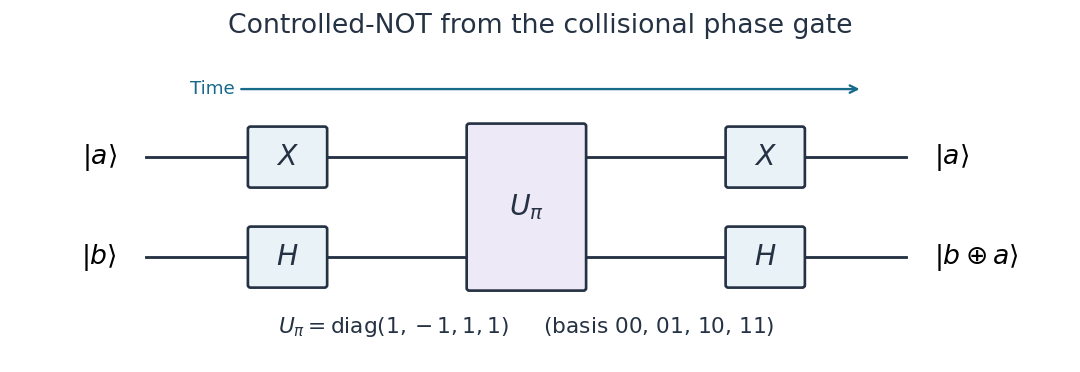
Controlled-NOT from the printed collisional phase gate
. Time runs from left to right. Pauli X gates act on the first wire and Hadamard gates on the second, before and after the selective phase gate. The phase gate changes the sign of 01 only. Details. Past exam of the laser science and quantum information processing course of the University of Oxford 2005 7 and 8 7 c Solution by Codex 0 2026-10-25
Codex 0 2026-10-25For quantum key distribution with Bell pairs, a source distributes one photon to Alice and its partner to Bob. One implementation is the Ekert protocol, using the spin singlet state . Each party independently chooses a polarization measurement setting after distribution. Equal settings give opposite outcomes; Bob reverses his outcome-to-bit assignment so these rounds give matching random bits. Other setting pairs test a Bell inequality, with ideal spin singlet state correlation for the corresponding Bloch sphere axes. The optical polarizer angles correspond to twice those angles on the appropriate Bloch sphere great circle.
Over an authenticated public classical channel, Alice and Bob announce settings and detection times, select coincident detection rounds, and perform key sifting. They reveal a test sample to estimate the quantum bit error rate and the chosen Bell inequality signal, discarding all revealed bits. Excess disturbance causes an abort. Otherwise information reconciliation makes the retained strings agree and privacy amplification shortens them to remove an adversary's residual information, including information disclosed during reconciliation. The tested quantum entanglement supplies correlations unavailable to an independently prepared classical mixture; a security claim also requires stated detector and sampling assumptions.[ref]
Quantum cryptography based on Bell's theorem by Artur K. Ekert. 1991, entanglement-based key distribution and Bell-correlation test
Each photon polarization analyzer uses a setting-dependent waveplate followed by a polarizing beam splitter. A single-photon detector on each output converts the routed photon into an electrical click, recording the outcome and its time. For example, a single-photon avalanche diode is a reverse-biased photodiode operated above breakdown: absorption creates a charge carrier, impact ionization triggers an avalanche, and the resulting pulse is registered. A quenching circuit lowers the bias to stop the avalanche and then resets the device. The detector dead time during recovery limits the count rate; dark counts produce false clicks, and imperfect detection loses rounds. The polarization information comes from the preceding analyzer, while the detector registers which output fired. Coincidence timing associates Alice's and Bob's records with the same emitted pair. [ref]
https://www.thorlabs.co.jp/images/Catalog/V21/V21_7_LightAnalysis.pdf. Thorlabs, Light Analysis catalogue, Single Photon Counter Modules: Geiger-mode operation, active quenching, blind time and dark counts
Past exam of the laser science and quantum information processing course of the University of Oxford 2005 7 and 8 7 b Solution by Codex 0 2026-10-25
Codex 0 2026-10-25In entanglement swapping, start with independent Bell pairs . Send qubits 2 and 3 to a central Bell state analyzer, retaining 1 and 4 at separate endpoints. Reordering the tensor product factors to group 23 and 14 gives the identityConsequently each ideal Bell-basis measurement outcome has probability and projects 14 onto the corresponding Bell state, even though those two photons have never interacted. Communicating the two-bit result permits an endpoint Pauli gate to convert every outcome into the same chosen Bell pair. Without that record, the endpoints have , a product state, rather than a known entangled state.
The optical Bell state analyzer overlaps photons 2 and 3 at a balanced beam splitter, with matched spatial modes, spectra and arrival times, and resolves the output photon polarizations using polarizing beam splitters and single-photon detectors. Two-photon interference maps Bell states to different output patterns. The antisymmetric gives one photon in each output with opposite polarizations. The symmetric gives two opposite-polarization photons in the same output; the two polarization detectors there can resolve this pattern. The states give same-polarization pairs and remain mutually ambiguous in this basic setup. The detected pattern therefore heralds a particular endpoint Bell state. With ideal detection this arrangement succeeds unambiguously on two of four equally likely inputs, with probability ; the successful events can be selected. A complete analyzer would accept all four outcomes. The endpoint quantum entanglement is conditional on the measurement record, so it enables no instantaneous signalling.[ref]
Experimental Entanglement Swapping: Entangling Photons That Never Interacted by Jian-Wei Pan and others. 1998, experimental Bell projection and conditional endpoint correlations
Past exam of the laser science and quantum information processing course of the University of Oxford 2005 7 and 8 7 a Solution by Codex 0 2026-10-25
Codex 0 2026-10-25In quantum dense coding, a shared Bell pair lets Alice send two classical bits by transmitting one qubit. Use photon polarization as the computational basis, , , and define the Bell statesAlice and Bob initially share . Alice encodes a two-bit message by applying the Pauli operator to her qubit:The last minus sign is a global phase. Alice transmits her photon to Bob, who now holds both qubits and uses a Bell-basis measurement to identify the message. The four Bell states are orthogonal, so an ideal Bell state analyzer decodes them without error. The resource cost is one previously shared Bell pair and one transmitted qubit per two classical bits; the shared quantum entanglement is consumed. Before transmission Bob's reduced density matrix is for every message, consistent with the no-communication theorem.
The BBO crystal supplies the polarization-entangled photon pair. An ultraviolet laser pumps this nonlinear optical crystal; spontaneous parametric down-conversion produces signal and idler photons with and phase matching . In a noncollinear type-II phase matching arrangement, collect the intersections of the two emission cones. The alternatives and must be indistinguishable in arrival time, spectrum and spatial mode. Compensation of birefringence and adjustment of the relative quantum phase then give ; a local Pauli X gate converts it to . Half-wave plates and other waveplates implement Alice's Pauli gates. The BBO is the pair source; the message is encoded subsequently by the local optical elements.[ref]
New High-Intensity Source of Polarization-Entangled Photon Pairs by Paul G. Kwiat and others. 1995, Figures 1 and 2: intersecting type-II emission cones and compensation; Table I: four Bell states
A basic passive linear optics Bell state analyzer with no extra resources identifies only two of the four polarization Bell states unambiguously. Thus the ideal two-bit capacity presupposes complete Bell-basis measurement; that basic optical implementation alone does not attain it deterministically.
Past exam of the laser science and quantum information processing course of the University of Oxford 2005 7 and 8 7 2 Solution by Codex 0 2026-10-25
Codex 0 2026-10-25For teleportation with an ambiguous Bell-state phase label, write . The Bell-basis measurement outcomes and each occur with probability . In either case a correct guess gives Bob , while the wrong guess differs by the Pauli Z gate and gives . The other two Bell states are identified correctly. Since Alice guesses each ambiguous label with probability , the overall wrong-correction probability is . Averaging over the actual quantum measurement outcome and her guess gives the phase-flip channelConditional only on an ambiguous analyzer result, the output is ; that conditional channel has weight in the displayed unconditional result. There is no rejection of those rounds.
Use the teleportation fidelity for a pure state target, namely the squared quantum fidelityThis compares the input with the resulting mixed state; averaging state vectors before forming a density matrix would give a different, incorrect answer. Direct substitution givesThus the maximum is , attained by and up to a global phase, because these are eigenstates of the Pauli Z gate. The minimum is , attained by every equal-weight quantum superpositionon the equator of the Bloch sphere. The unsquared quantum fidelity is if that alternative convention is used. No average over different input quantum states is needed for the requested state-dependent answer.
Past exam of the laser science and quantum information processing course of the University of Oxford 2005 7 and 8 7 1 Solution by Codex 0 2026-10-25
Codex 0 2026-10-25Let the unknown input qubit be , with . Alice holds , Bob holds , and the shared Bell pair is . All three-qubit strings below use the order . Initially,The Bell-basis teleportation identity givesThus a perfect Bell state analyzer on Alice's two qubits identifies the Pauli operator affecting Bob's quantum state.
To display the intermediate three-qubit states explicitly, realize that Bell-basis measurement by a controlled-NOT gate , a Hadamard gate on , and two computational-basis measurements. After the controlled-NOT gate,After the Hadamard gate,Measuring gives with probability for each outcome, independently of . Conditional on that result, the normalized three-qubit post-measurement state isIf the Bell state analyzer is instead regarded as an ideal direct projective measurement preserving the measured qubits, replace here by the corresponding Bell state; Bob's factor is identical. A destructive optical analyzer records the same label but absorbs Alice's photons.
Alice sends the two classical bits to Bob. During transmission the above conditional three-qubit state is unchanged. Bob then applies the inverse Pauli operator :The final conditional three-qubit state is therefore . The protocol transmits two classical bits per teleported qubit, consuming one shared Bell pair. Without Alice's record Bob averages over four Pauli operators and has density matrix , so quantum teleportation respects the no-communication theorem. Alice's input has been measured and is no longer an independent copy, consistent with the no-cloning theorem.
Past exam of the kinetic theory course of the University of Oxford 2025 3 f ii Solution by Codex 0 2026-10-25
Codex 0 2026-10-25For , the selected orbital resonances satisfyFor near-circular stellar orbits, is the radial epicyclic frequency. Thus is the inner Lindblad resonance, , and is the outer Lindblad resonance, .
The flux is driven by , and each resonant harmonic exchanges both angular momentum and radial action in the ratioThese terms can therefore produce galactic disk heating as well as angular momentum transport. In the usual absorbing response, stars losing angular momentum at the inner Lindblad resonance gain radial action, and stars gaining angular momentum at the outer Lindblad resonance also gain radial action. The actual direction of flux follows from the displayed derivatives of ; it is not fixed by the resonance condition alone. A finite pulse replaces exact Lindblad resonance selection by a band of detunings of width of order .
Past exam of the kinetic theory course of the University of Oxford 2025 3 f i Solution by Codex 0 2026-10-25
Codex 0 2026-10-25For , the detuning is . The Gaussian resonance broadening factor selects the corotation resonance, where the star's azimuthal frequency matches the pattern speed. The derivative driving the flux is just . In fact this contribution alone has the formA single Fourier series harmonic changes the action variables in the direction , because plus its conjugate. For this harmonic, : stars change angular momentum and shift their epicyclic guiding center without a leading-order increase of random radial motion. This is stellar radial migration driven by the corotation resonance. The resonance condition explains the absence of leading heating: at the corotation resonance.
Pinned article: Introduction to the OurBigBook Project
Welcome to the OurBigBook Project! Our goal is to create the perfect publishing platform for STEM subjects, and get university-level students to write the best free STEM tutorials ever.
Everyone is welcome to create an account and play with the site: ourbigbook.com/go/register. We belive that students themselves can write amazing tutorials, but teachers are welcome too. You can write about anything you want, it doesn't have to be STEM or even educational. Silly test content is very welcome and you won't be penalized in any way. Just keep it legal!
Intro to OurBigBook
. Source. We have two killer features:
- topics: topics group articles by different users with the same title, e.g. here is the topic for the "Fundamental Theorem of Calculus" ourbigbook.com/go/topic/fundamental-theorem-of-calculusArticles of different users are sorted by upvote within each article page. This feature is a bit like:
- a Wikipedia where each user can have their own version of each article
- a Q&A website like Stack Overflow, where multiple people can give their views on a given topic, and the best ones are sorted by upvote. Except you don't need to wait for someone to ask first, and any topic goes, no matter how narrow or broad
This feature makes it possible for readers to find better explanations of any topic created by other writers. And it allows writers to create an explanation in a place that readers might actually find it.
Figure 1. Screenshot of the "Derivative" topic page. View it live at: ourbigbook.com/go/topic/derivativeVideo 2. OurBigBook Web topics demo. Source. - local editing: you can store all your personal knowledge base content locally in a plaintext markup format that can be edited locally and published either:This way you can be sure that even if OurBigBook.com were to go down one day (which we have no plans to do as it is quite cheap to host!), your content will still be perfectly readable as a static site.
- to OurBigBook.com to get awesome multi-user features like topics and likes
- as HTML files to a static website, which you can host yourself for free on many external providers like GitHub Pages, and remain in full control

Figure 2. You can publish local OurBigBook lightweight markup files to either OurBigBook.com or as a static website.
Figure 3. Visual Studio Code extension installation.
Figure 5. . You can also edit articles on the Web editor without installing anything locally. Video 3. Edit locally and publish demo. Source. This shows editing OurBigBook Markup and publishing it using the Visual Studio Code extension. 
- Infinitely deep tables of contents:




All our software is open source and hosted at: github.com/ourbigbook/ourbigbook
Further documentation can be found at: docs.ourbigbook.com
Feel free to reach our to us for any help or suggestions: docs.ourbigbook.com/#contact