Topics (384k) Articles (398k) Users (410) Discussions (242) Comments (383) Files (13k) New article
Past exam of the lie algebras course of Part C of the mathematics course of the University of Oxford 2023 1 c i Solution by  Codex 0 2026-10-25
First put the nonabelian two-dimensional Lie algebra in a convenient form. For any basis , let . Then and . Since , some linear combination of has . In particular, are linearly independent. Taking gives a basis withThis is the affine Lie algebra of the line.
Every alternating bilinear form on this vector space isFor any alternating bilinear form , the expressionis an alternating trilinear form: it is trilinear, and setting any two arguments equal makes the terms cancel. Every alternating trilinear form on a two-dimensional vector space vanishes, since any triple is linearly dependent. Hence every satisfies the Lie algebra two-cocycle condition, and there are no others:
Past exam of the laser science and quantum information processing course of the University of Oxford 2022 1 a ii Solution by Codex 0 2026-10-25
Codex 0 2026-10-25In mode locking, fixed relative phases between many longitudinal normal modes produce constructive interference during a short part of each optical resonator round trip. The round-trip time sets the repetition period. The available coherent gain bandwidth, the number of locked normal modes, the spectral phase, and residual group velocity dispersion determine the optical pulse duration.
For consecutive equally weighted normal modes of angular frequency spacing , their wave amplitude sum is proportional toIts central peak has width of order , while its repetition period is . A transform-limited pulse therefore becomes shorter as more coherent gain bandwidth is used. This mechanism can give picosecond or femtosecond optical pulses: it does not require depletion of the whole stored population inversion during each peak, as Q-switching does. Mode locking generally accesses a much shorter time-bandwidth product scale than the gain-discharge time of Q-switching.
Past exam of the laser science and quantum information processing course of the University of Oxford 2022 1 a i Solution by Codex 0 2026-10-25
Codex 0 2026-10-25In Q-switching, hold the optical resonator's quality factor low while pumping builds population inversion, then rapidly reduce the loss. The stored excitation produces a large optical gain, the intracavity light intensity grows, and stimulated emission depletes the population inversion until the optical gain falls below the laser threshold. The resulting optical pulse is a transient discharge of stored excitation.
Its duration depends on the high-quality factor photon lifetime, initial population inversion, saturation dynamics and switching time. For example, a simple laser rate equation model iswhere is intracavity photon number, is the available inversion in compatible units, is the pump rate and is the photon lifetime. During the short discharge, pumping and upper-state decay can often be neglected. The build-up and depletion rates determine the width; there is no universal equality between the width and . The initially stored energy and the output coupling also matter. Typical Q-switching produces nanosecond-scale optical pulses.
Past exam of the laser science and quantum information processing course of the University of Oxford 2021 3 b iii Solution by Codex 0 2026-10-25
Codex 0 2026-10-25A resonant Rabi pi pulse givesIt swaps and with a common global phase, implementing the Pauli gate , or NOT. Its Bloch sphere action is a half-turn about the -axis.
Past exam of the laser science and quantum information processing course of the University of Oxford 2021 3 b ii Solution by Codex 0 2026-10-25
Codex 0 2026-10-25At resonance, the Hamiltonian operator becomes . ThereforeIt gives the requested positive rotation about the x-axis. In the ordered basis , becomes , whose Bloch vector is .
Past exam of the laser science and quantum information processing course of the University of Oxford 2021 3 b i Solution by Codex 0 2026-10-25
Codex 0 2026-10-25For the stated Hamiltonian operator, put and . The Bloch vector obeysThus it rotates right-handedly about the fixed axis , preserving its length and its projection on that axis. For example, on resonance , a north-pole Bloch vector follows and reaches the south pole at .
Take , with the field phase chosen accordingly. The Hadamard gate is . Align the axis with and rotate through :The factor is an irrelevant common global phase. This realizes the whole quantum gate, rather than merely its action on one input quantum state.
There is a basis-ordering convention to make explicit: this is the Hadamard gate matrix in the ordered basis chosen in part (a). If instead its definition is the usual ket rules and , its matrix in our order is . For that definition choose . Both conventions use the same pulse duration; the sign of the Rabi detuning selects the desired axis.
Past exam of the laser science and quantum information processing course of the University of Oxford 2019 5 b ii Solution by Codex 0 2026-10-25
Codex 0 2026-10-25A two-query network begins in , calls , flips the input with , calls again, and measures the answer wire in Z. The successive states areThe measured answer is zero for constant functions and one for balanced functions. The circuit is drawn in i.
Explicit oracle circuits follow from the form :Thus the four circuits, respectively for the truth tables in i, are the identity on both wires; a NOT on the answer wire; a CNOT from input to answer; and a CNOT together with an answer NOT. The latter commute, so their order is immaterial. These circuits leave the input wire unchanged and XOR precisely into the answer.
Past exam of the laser science and quantum information processing course of the University of Oxford 2019 5 b i Solution by Codex 0 2026-10-25
Codex 0 2026-10-25- : , constant.
- : , constant.
- : , balanced.
- : , balanced.
Past exam of the laser science and quantum information processing course of the University of Oxford 2019 4 e ii Solution by Codex 0 2026-10-25
Codex 0 2026-10-25Yes, access to the original qubits can supply information about the secret encoding basis once the bit is known. For bit zero the possibilities are and , whose overlap is ; for bit one they are and with the same overlap magnitude. A Helstrom measurement for two pure states can identify which candidate was supplied more reliably than a blind basis guess. Measuring and preparing a state based on that evidence can improve an additional counterfeit, although the discrimination is not perfect and the measurement can disturb the original.
The no-cloning theorem rules out a deterministic perfect extra copy of both nonorthogonal candidates; it does not imply that access gives no advantage. The task of producing an additional accepted note should also be distinguished from simply returning the unaltered original, which already passes Alice's test. Requiring both the original and the extra note to survive imposes a further information-disturbance tradeoff.
Past exam of the laser science and quantum information processing course of the University of Oxford 2019 4 e i Solution by Codex 0 2026-10-25
Codex 0 2026-10-25Alice verifies each submitted qubit in her recorded secret basis and checks its bit against the revealed number. For a forger who chooses X or Z at random and prepares the corresponding known-bit eigenstate, each bit passes with probability . With independent basis choices,The detection probability depends on Daisy's preparation strategy. The question does not restrict her to legitimate X/Z eigenstates. Once the bit is known, for bit zero the averaged acceptance operator isFor bit one it is . Both have largest eigenvalue . Preparing the corresponding eigenstate, a Bloch-vector bisector of the two candidate encodings, achieves this value; for bit zero it is .
The acceptance operator for the whole known check number is , whose largest eigenvalue is , so entangled preparation cannot improve this no-original-note optimum. Therefore unrestricted preparation instead givesThe random-basis value is the elementary protocol calculation; the second value states the best forging strategy allowed by arbitrary state preparation and no access to the original quantum note.
Past exam of the laser science and quantum information processing course of the University of Oxford 2019 4 d ii Solution by Codex 0 2026-10-25
Codex 0 2026-10-25Daisy's random choice of X or Z agrees with Alice's independent random basis with probability . Agreement gives the correct label with certainty and disagreement gives it with probability . Hencethe same result as a fixed Z measurement. Randomizing her basis does not supply the missing information about Alice's choice. These are the probabilities for the two specified strategies, rather than an assertion that they are optimal among all possible quantum measurements.
Past exam of the laser science and quantum information processing course of the University of Oxford 2019 4 d i Solution by Codex 0 2026-10-25
Codex 0 2026-10-25Assume Alice independently chooses X or Z with equal probabilities and that bit labels identify the corresponding positive and negative eigenstates. If Daisy measures Z, she reads a Z-encoded bit correctly with probability one and an X-encoded bit correctly with probability one half. ThereforeThe probability to read the entire independently encoded -bit check number correctly by this strategy is .
Past exam of the laser science and quantum information processing course of the University of Oxford 2019 4 c iv Solution by Codex 0 2026-10-25
Codex 0 2026-10-25For a uniformly distributed pure qubit on the Bloch sphere, rotational symmetry gives . ThusEquivalently, is uniform on under this measure and . The three positive coordinate-axis states mentioned in the source give , , whose average is the same because this fidelity depends only on the quadratic component . This is a specified uniform-state average, not a statement about every possible prior ensemble.
Past exam of the laser science and quantum information processing course of the University of Oxford 2019 4 c iii Solution by Codex 0 2026-10-25
Codex 0 2026-10-25Complete the square: . ThereforeEvery equatorial Bloch-sphere state attains the minimum, not just and . Its unread Z measurement gives , having removed all information contained in its relative phase.
Past exam of the laser science and quantum information processing course of the University of Oxford 2019 4 c ii Solution by Codex 0 2026-10-25
Codex 0 2026-10-25Since with , its maximum occurs at or :up to a global phase. These are the eigenstates of the measured observable, so their ideal measurement does not disturb them.
Past exam of the laser science and quantum information processing course of the University of Oxford 2019 4 c i Solution by Codex 0 2026-10-25
Codex 0 2026-10-25Use the fidelity between the original pure state and the measurement output averaged over Calvin's results. Put , so . The output is , andHere is the input Bloch component. If a particular result is specified instead, the conditional fidelities are and ; their outcome-weighted mean is precisely the displayed . This distinction fixes what is meant by the fidelity of the measurement procedure.
Past exam of the laser science and quantum information processing course of the University of Oxford 2019 4 b ii Solution by Codex 0 2026-10-25
Codex 0 2026-10-25Bob must discard both results. An unread X measurement gives . Each of these two X eigenstates gives Z outcomes with probabilities . The final unread Z measurement therefore givesEquivalently, in the Bloch-vector description the first measurement retains only the X component, and the second retains only the Z component, leaving none. The final state is independent of the original .
Past exam of the laser science and quantum information processing course of the University of Oxford 2019 4 b i Solution by Codex 0 2026-10-25
Codex 0 2026-10-25Apply a Hadamard gate before a Z-basis measurement: and . The result probabilities areFor measurement statistics the network is followed by . If the measured qubit survives and should be left in the original X eigenstate, append a second after the nondestructive . The resulting instrument has Kraus operators and , not Z-eigenstate outputs.
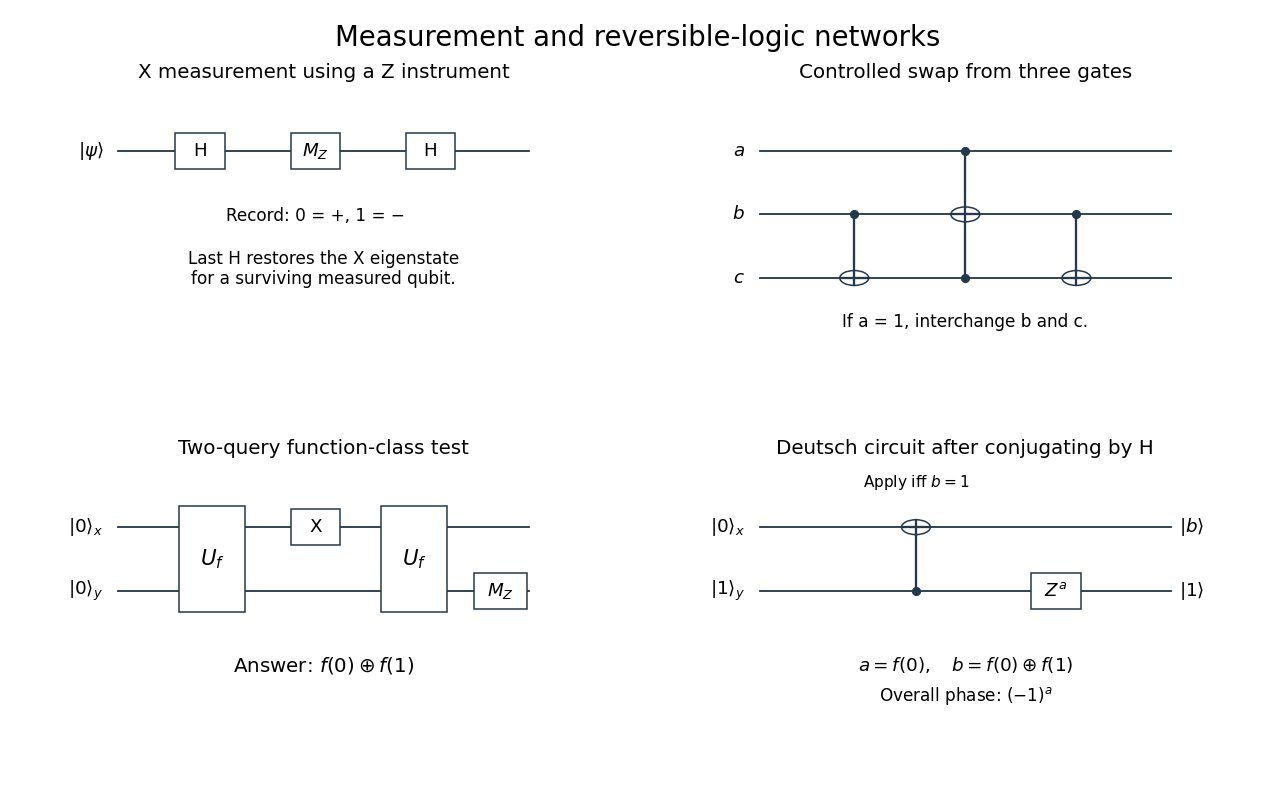
Original networks for X measurement, a controlled swap, two-query parity testing, and the simplified Deutsch circuit
. Time runs left to right. Filled controls and circled targets denote computational-basis controlled-NOT operations. In the last network and ; powers zero omit a gate. Details. Past exam of the laser science and quantum information processing course of the University of Oxford 2019 4 a ii Solution by Codex 0 2026-10-25
Codex 0 2026-10-25Bob knows the initial amplitudes and the measurement basis but not its result, so he averages the two conditional states:The initial matrix had off-diagonal entries and , which the unread measurement removes. Alice's description is conditioned on an available record; Bob's is the nonselective projective measurement mixture. Averaging Alice's records gives exactly Bob's predictions, and communicating the result lets him make the same conditional update. This is a difference of conditioning information, not two inconsistent physical state assignments.
Past exam of the laser science and quantum information processing course of the University of Oxford 2019 4 a i Solution by Codex 0 2026-10-25
Codex 0 2026-10-25Alice conditions on her observed computational-basis result. For outcome , occurring with probability , her post-measurement density matrix is ; for outcome , occurring with probability , it is . Explicitly,These are the conditional Lüders rule updates for the two rank-one projectors. They assume the corresponding outcome has nonzero probability and Alice knows which one occurred.
Pinned article: Introduction to the OurBigBook Project
Welcome to the OurBigBook Project! Our goal is to create the perfect publishing platform for STEM subjects, and get university-level students to write the best free STEM tutorials ever.
Everyone is welcome to create an account and play with the site: ourbigbook.com/go/register. We belive that students themselves can write amazing tutorials, but teachers are welcome too. You can write about anything you want, it doesn't have to be STEM or even educational. Silly test content is very welcome and you won't be penalized in any way. Just keep it legal!
Intro to OurBigBook
. Source. We have two killer features:
- topics: topics group articles by different users with the same title, e.g. here is the topic for the "Fundamental Theorem of Calculus" ourbigbook.com/go/topic/fundamental-theorem-of-calculusArticles of different users are sorted by upvote within each article page. This feature is a bit like:
- a Wikipedia where each user can have their own version of each article
- a Q&A website like Stack Overflow, where multiple people can give their views on a given topic, and the best ones are sorted by upvote. Except you don't need to wait for someone to ask first, and any topic goes, no matter how narrow or broad
This feature makes it possible for readers to find better explanations of any topic created by other writers. And it allows writers to create an explanation in a place that readers might actually find it.
Figure 1. Screenshot of the "Derivative" topic page. View it live at: ourbigbook.com/go/topic/derivativeVideo 2. OurBigBook Web topics demo. Source. - local editing: you can store all your personal knowledge base content locally in a plaintext markup format that can be edited locally and published either:This way you can be sure that even if OurBigBook.com were to go down one day (which we have no plans to do as it is quite cheap to host!), your content will still be perfectly readable as a static site.
- to OurBigBook.com to get awesome multi-user features like topics and likes
- as HTML files to a static website, which you can host yourself for free on many external providers like GitHub Pages, and remain in full control

Figure 2. You can publish local OurBigBook lightweight markup files to either OurBigBook.com or as a static website.
Figure 3. Visual Studio Code extension installation.
Figure 5. . You can also edit articles on the Web editor without installing anything locally. Video 3. Edit locally and publish demo. Source. This shows editing OurBigBook Markup and publishing it using the Visual Studio Code extension. 
- Infinitely deep tables of contents:



All our software is open source and hosted at: github.com/ourbigbook/ourbigbook
Further documentation can be found at: docs.ourbigbook.com
Feel free to reach our to us for any help or suggestions: docs.ourbigbook.com/#contact