Topics (384k) Articles (398k) Users (410) Discussions (242) Comments (383) Files (13k) New article
Past exam of the theoretical physics major option course of the University of Oxford 2016 2 d Solution by  Codex 0 2026-10-25
Choose the positive- reference ground state and use the cyclic rotationThis is a right-handed permutation, so it preserves the spin commutation relations. It puts the ordered direction along the Holstein–Primakoff transformation's quantization axis. To the required order,The longitudinal exchange contributes . The transverse terms contributeDropping the constant and all terms of order or smaller gives the stated linear spin-wave approximation, withThe anomalous pair terms are present because the two transverse couplings differ. A different right-handed choice of transverse axes can change the sign of by a boson phase convention, while leaving the dispersion relation unchanged.
Past exam of the theoretical physics major option course of the University of Oxford 2016 2 c Solution by Codex 0 2026-10-25
Codex 0 2026-10-25The Holstein–Primakoff transformation replaces each finite-dimensional spin algebra by a bosonic creation operator and annihilation operator, while restricting the local occupation number to . The number counts deviations from the fully polarized reference quantum state. Its zero-boson Fock vacuum has .
The representation is exact on this physical subspace: the ordered square root gives and , reproducing the spin commutation relations. For ,so the leading Hamiltonian is quadratic in bosons and describes spin waves.
The square root generates boson interactions beyond leading order and its operator ordering matters. Truncation also enlarges the Hilbert space to unphysical occupations unless the low-density approximation remains self-consistent. Large fluctuations, particularly near a gap closing or in low dimensions, can invalidate the linear spin-wave approximation even when its algebraic manipulation is straightforward.
Past exam of the theoretical physics major option course of the University of Oxford 2016 2 b Solution by Codex 0 2026-10-25
Codex 0 2026-10-25The Hamiltonian has the discrete symmetry described in solution, whereas either selected easy-axis ground state has a nonzero order parameter and is not invariant under it. This is spontaneous symmetry breaking: the equations preserve the symmetry while the selected macroscopic quantum state does not.
An infinitesimal longitudinal magnetic field selects one orientation. The defining order of limits isin the ordered zero-temperature phase, with the opposite sign for . A symmetric finite-volume quantum state can instead have zero magnetization. Quantum ordered states are generally dressed by fluctuations rather than exact fully polarized product states, because unequal transverse exchange can create pairs of spin waves. Discrete easy-axis symmetry does not imply a gapless Goldstone mode; indeed solution finds a nonzero spin wave gap. Nor does this argument assert positive-temperature order in a one-dimensional short-range chain.[ref]
Statistical Field Theory by David Tong. Section 1.2.1, spontaneous symmetry breaking and the order of thermodynamic and zero-field limits
Past exam of the theoretical physics major option course of the University of Oxford 2016 2 a Solution by Codex 0 2026-10-25
Codex 0 2026-10-25For a uniform classical spin with , the energy per bond isThe strict inequalities among the couplings make the direction the unique easy axis. ThusThese uniform configurations are also global classical minima: the largest singular value of the diagonal exchange matrix is , so each bond has energy at least , and both configurations saturate that bound.
A global rotation by about the axis sends to , preserves every exchange product, and exchanges the two ground states. A rotation about does the same. The broken discrete symmetry can be represented by either operation.
Past exam of the theoretical physics major option course of the University of Oxford 2016 1 d Solution by Codex 0 2026-10-25
Codex 0 2026-10-25Let be the base-spin insertion matrix. In the eigenbasis from solution, its diagonal matrix elements vanish: . Hencenot only at large but for every finite ring at zero field.
This vanishing is not merely an averaging artifact hiding a finite-temperature ordered phase. The two-point correlation function is . In the thermodynamic limit it becomes , with finite correlation length for every and . Thermal domain walls destroy long-range alignment in this one-dimensional short-range system. At zero temperature, the two fully aligned ground states are degenerate; that limiting case must be distinguished from any fixed positive temperature.
Past exam of the theoretical physics major option course of the University of Oxford 2016 1 c Solution by Codex 0 2026-10-25
Codex 0 2026-10-25For the sawtooth Ising chain, each apex spin occurs in only one triangle. Put . Summing that spin first gives the effective transfer matrixIn the ordered basis this isIts symmetric and antisymmetric eigenvectors are and , with eigenvaluesConsequentlyAt , the result is , correctly counting independent Ising spins. As , , the energy of three satisfied ferromagnetic bonds per two sites.
Past exam of the theoretical physics major option course of the University of Oxford 2016 1 b Solution by Codex 0 2026-10-25
Codex 0 2026-10-25For each pair of adjacent spins, define the transfer matrix for a classical spin chain by . Multiplying its entries gives the Boltzmann factor of a whole configuration. The periodic boundary condition identifies the last index with the first, soThe assumed interchange symmetry of makes a real symmetric matrix, hence it has an orthonormal eigenbasis. At finite positive temperature, every matrix entry is strictly positive, so the Perron–Frobenius theorem supplies a unique positive largest eigenvalue , larger in modulus than every other one. Therefore .
Local observables become matrix insertions. For example, with ,Thus partition functions and correlation functions reduce to a fixed-dimensional eigenvalue problem, rather than a sum over exponentially many microstates.
Past exam of the theoretical physics major option course of the University of Oxford 2016 1 a Solution by Codex 0 2026-10-25
Codex 0 2026-10-25Let and sum over all configurations of the Ising spins. The canonical partition function and Helmholtz free energy per site areBoth spins in each cell count as sites. In particular the denominator is , rather than .
The mean spin magnetization per site is the Boltzmann distribution averageEquivalently introduce a uniform magnetic field through and differentiate:This convention absorbs the microscopic magnetic moment into . Simultaneous reversal of every spin leaves invariant and changes the sign of the numerator, so at zero field for finite .
Past exam of the theoretical physics major option course of the University of Oxford 2015 8 d Solution by Codex 0 2026-10-25
Codex 0 2026-10-25The scalar potential is . Minimizing it with respect to givesChoose a gauge with constant condensate phase and take the homogeneous-amplitude London limit, . Then c reduces toThe London screening with an unnormalized complex condensate has a factor of two from the complex-field kinetic term as printed; no has been included in the definition of the real positive . Equivalently, the gauge mass is .
For a planar surface at and conductor in , take a tangential field . The solution bounded at large depth isThe exponentially growing solution is excluded. The screening current is nonzero near the surface, demonstrating the Meissner effect through a persistent surface current. The constant-amplitude approximation describes London screening away from any region where the condensate itself is strongly suppressed.
In the stipulated static gauge, . Where this equilibrium screening current is nonzero, the assumed local Ohm's law therefore demands . The simultaneous equality deep in the bulk would by itself place no constraint on ; it is not a valid standalone proof of superconductivity.
The lossless condensate also supplies the dynamical check. With fixed amplitude and phase in temporal gauge, differentiating the London relation gives . A steady field accelerates the supercurrent rather than producing a stationary dissipative current. Thus the ideal condensate has zero electrical resistivity, or an infinite electrical conductivity, consistent with the static screening solution. This is the superconducting component of the toy model; normal carriers and dissipation are not included. The nonzero field expectation is understood in a gauge-fixed description of the Higgs phase, not as a gauge-invariant local observable.
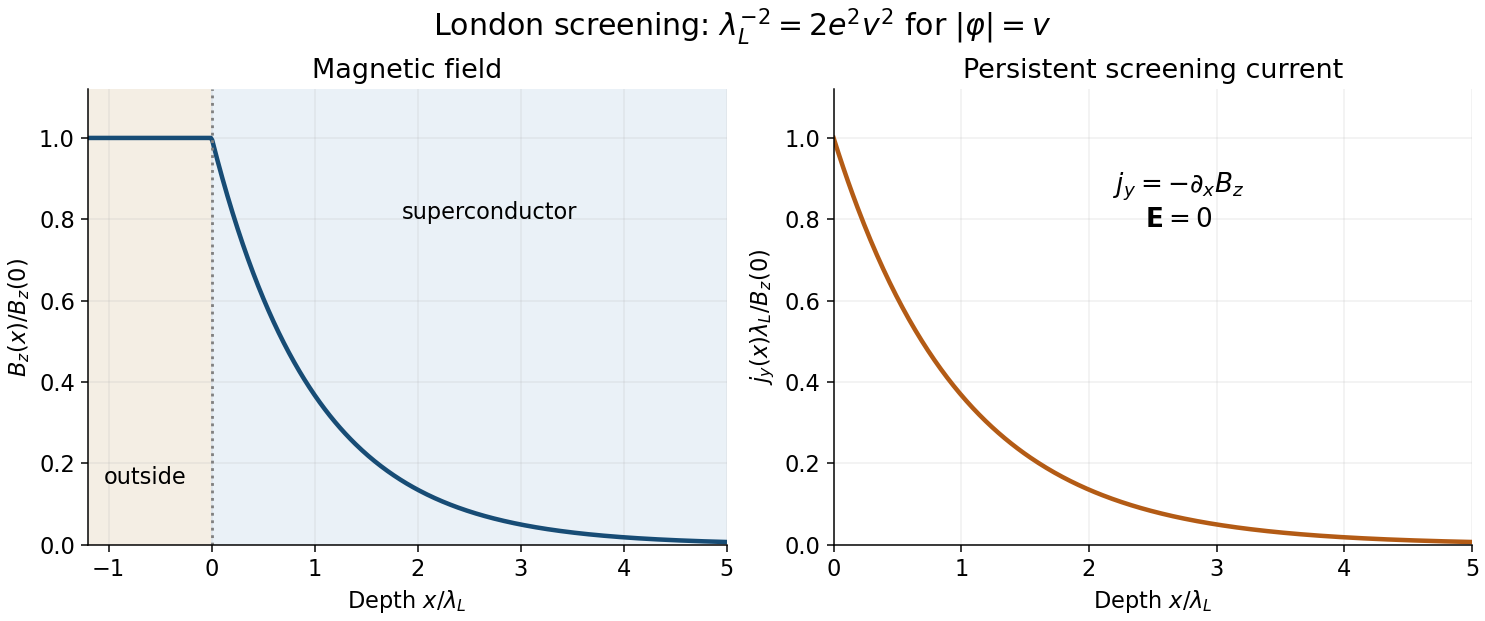
Exponential magnetic screening and the persistent surface current
. Original London-limit half-space solution. The magnetic field and screening-current magnitude share the decay length lambda L; their boundary values set the plotted normalization. Details. Past exam of the theoretical physics major option course of the University of Oxford 2015 8 c Solution by Codex 0 2026-10-25
Codex 0 2026-10-25Keep the index convention of b: , so and the spatial gauge covariant derivative is . The physical three-current is the spatial part of :Equivalently, writing gives . Under the gauge transformation in a, and , so this expression is manifestly invariant. Switching to a convention with the opposite spatial gauge sign reverses the phase-gradient term, not the screening term proportional to .
For static fields the spatial Ampère-Maxwell equation is , while . Taking its curl yields the general magnetic-field equationNo uniform-condensate approximation has yet been used. For a varying scalar amplitude the gradient terms must be kept; simply replacing by a constant before deriving the current would conceal their origin. The homogeneous-condensate limit supplies the London screening equation in d.
Past exam of the theoretical physics major option course of the University of Oxford 2015 8 b Solution by Codex 0 2026-10-25
Codex 0 2026-10-25Use and define the physical electromagnetic source by . For a constant infinitesimal phase , the matter Noether current isA definition using phase parameter instead divides this expression by ; the Maxwell source includes the electric coupling shown here. Current signs must be tied to the printed convention.
To verify the equation of motion, vary the matter kinetic term with respect to :Varying and integrating by parts gives . The stationary action therefore requiresThe potential has no explicit dependence on and contributes no extra source term. Antisymmetry of implies on the equations of motion; the same conservation law follows from the scalar equations. The source current is gauge-invariant although its expanded derivative and vector-potential pieces are not separately invariant.[ref]
Quantum Field Theory by David Tong. §§6.1.1 and 6.3.2, gauge symmetry and scalar coupling; the sign here follows the source's minus-sign covariant derivative
Past exam of the theoretical physics major option course of the University of Oxford 2015 8 a Solution by Codex 0 2026-10-25
Codex 0 2026-10-25The continuous internal symmetry is local gauge invariance. With the source's gauge covariant derivative convention it acts asso transforms like and is unchanged. Constant phases are its global subgroup, not an additional independent internal rotation group.
In flat four-dimensional space-time the continuous external symmetry is the Poincaré group: four translations and six Lorentz transformations. Noether's theorem associates translations with conserved energy and momentum, spatial rotations with angular momentum, and boosts with the relativistic center-of-energy/boost charges. In tensor notation the latter two are the six components of the conserved total angular-momentum tensor , including field spin contributions where appropriate. The nonzero dimensionful parameter prevents exact scale invariance. Discrete transformations, such as parity, are outside the requested continuous-symmetry list.
Past exam of the theoretical physics major option course of the University of Oxford 2015 7 d Solution by Codex 0 2026-10-25
Codex 0 2026-10-25On the unbounded line the momentum density of states in a reference length is . Count both signs of , each with zero-point energy and the same frequency regulator:The extensive divergent term agrees exactly with c. Subtract it before taking the cutoff away:The force tending to change the interval length isIts negative sign means attraction: separating the boundaries increases this negative vacuum-energy difference toward zero. The bulk subtraction must be made before interpreting the force, otherwise differentiating an unphysical cutoff-dependent bulk energy would contaminate it.
This is the one-dimensional scalar Dirichlet Casimir force. The source's name “Casimir-Polder” normally refers to a retarded atom–atom or atom–surface dispersion force, whose geometry and power law differ. No atom polarizability or electromagnetic mode multiplicity enters the scalar result derived here.
Past exam of the theoretical physics major option course of the University of Oxford 2015 7 c Solution by Codex 0 2026-10-25
Codex 0 2026-10-25For , the frequencies are . The stipulated spectral regulator therefore supplies . With ,The sum identity follows by differentiating the convergent geometric series with . Its small- expansion issoIn the frequency-regulated Dirichlet Casimir energy, the inverse-length scale suppresses modes with frequency much above in units . It is an ultraviolet cutoff, removed after comparing the same underlying vacuum convention in the two geometries. Physically an ideal perfectly reflecting boundary also ceases to be adequate at sufficiently high frequency, but that material scale is not specified here. The source calls this heat-kernel regularization; its explicit regulator is exponential in frequency, rather than the alternative exponential in frequency squared.
Past exam of the theoretical physics major option course of the University of Oxford 2015 7 b Solution by Codex 0 2026-10-25
Codex 0 2026-10-25The Hamiltonian density is . In the vacuum only contributes. HenceSubstitution, using , yieldsThis Dirichlet scalar vacuum energy density illustrates why a massive field's local unregularized energy density need not be uniform. The cosine integrates to zero over the interval, soThese divergent expressions are understood with a common regulator before exchanging sums, integrals or derivatives. Normal ordering the Hamiltonian operator separately in each geometry would erase the vacuum terms one is trying to compare; a common regulated subtraction is used instead in c and d.
Past exam of the theoretical physics major option course of the University of Oxford 2015 7 a Solution by Codex 0 2026-10-25
Codex 0 2026-10-25Separate the Klein-Gordon equation as . The spatial equation is , with . The first Dirichlet boundary condition removes the cosine solution, and the second requires . ThusThere is no nonzero Dirichlet mode. The real field is built from both complex-conjugate time dependences, with mode functionsThe sine functions satisfy . Consequently the factor gives unit Klein-Gordon inner product for each positive-frequency mode and the canonical equal-time field commutator after quantization. A general solution is a superposition of these modes, rather than a claim that a single mode exhausts all solutions.
Past exam of the theoretical physics major option course of the University of Oxford 2015 6 d Solution by Codex 0 2026-10-25
Codex 0 2026-10-25The leading decay is into one complex particle and its antiparticle, which are distinguishable. Using in a givesIn four space-time dimensions a canonically normalized scalar has mass dimension one, so has mass dimension one. The amplitude starts at order , a rate is quadratic in that amplitude, and the only mass scale in the massless-daughter decay is . Those facts already require , leaving only a dimensionless numerical factor to calculate.
For low-energy charged-scalar scattering through a neutral scalar, label the incoming particle and antiparticle as and their outgoing counterparts as . Charge flow allows -channel annihilation and exchange of the real massive scalar. It forbids a separate -channel graph for this fixed assignment of distinguishable final charges. The tree amplitude isAt low energy it is approximately angle independent. The massless two-body scattering formula then givesIn particular the requested scale estimate is , not with the incoming-energy dependence omitted. Integrating out gives at this order, whose complex-scalar four-leg combinatorics reproduce the same amplitude. These are weak-coupling perturbative results about the specified vacuum; possible ultraviolet stabilizing interactions are not determined by the cubic term alone.
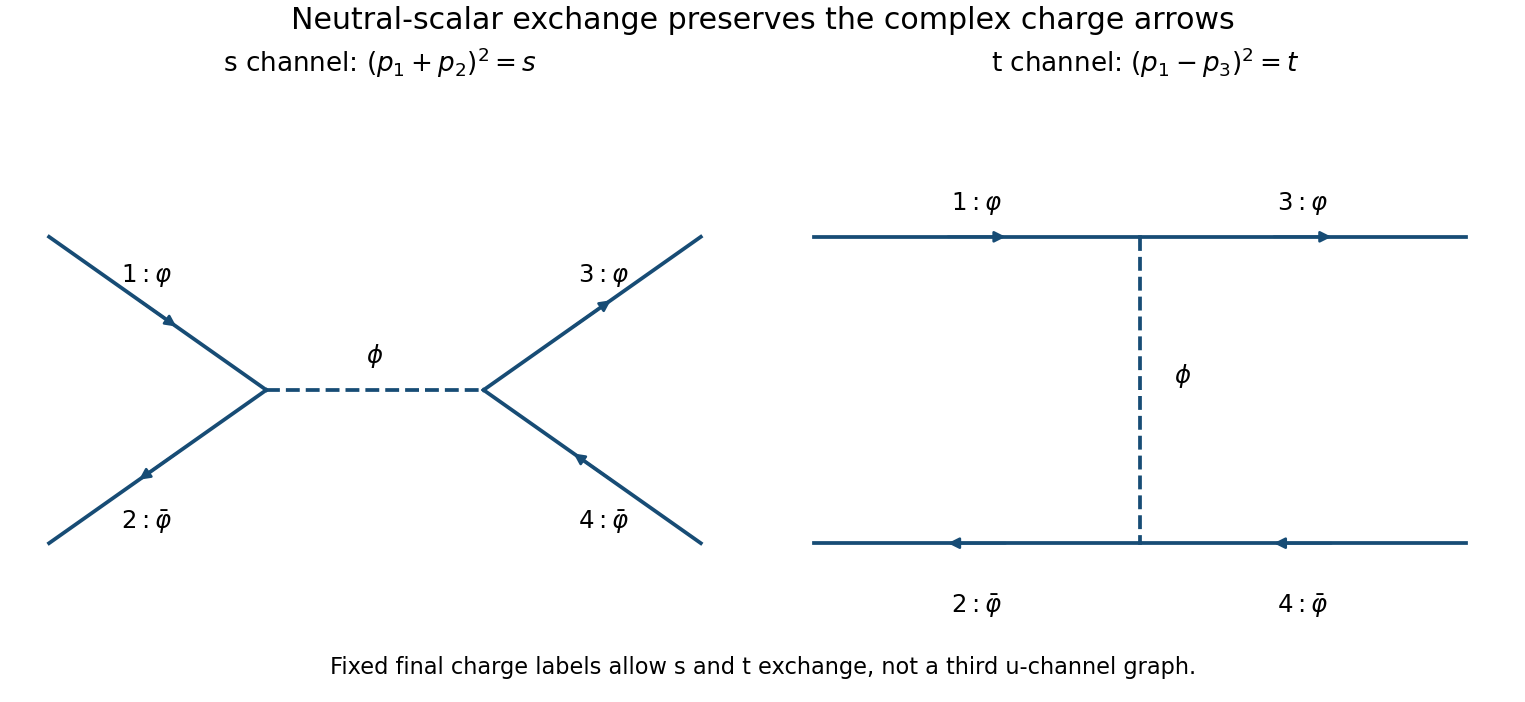
The two allowed leading particle-antiparticle scattering diagrams
. Original s-channel annihilation and t-channel exchange graphs. The internal dashed line is the massive neutral scalar; solid arrows show conserved complex charge. A u-channel graph would connect the wrong final charges for the fixed labeling. Details. Past exam of the theoretical physics major option course of the University of Oxford 2015 6 c Solution by Codex 0 2026-10-25
Codex 0 2026-10-25At a single interaction insertion, the Dyson series supplies . Amputating the three external propagators in b gives the momentum-space ruleIf the momentum-conservation factor is included in the vertex convention, append , with all momenta incoming. There is one charged line entering and one leaving the vertex, and a neutral real-scalar line. The absence of a factorial in the interaction is appropriate because its three fields are distinct. The amputated decay amplitude has magnitude with the usual convention that a graph computes .
Past exam of the theoretical physics major option course of the University of Oxford 2015 6 b Solution by Codex 0 2026-10-25
Codex 0 2026-10-25Define the free Feynman propagators byThe interaction preserves the global phase symmetry , with the real neutral. Therefore the charge-two correlator vanishes in a symmetry-invariant perturbative vacuum:In Wick contractions, a complex field contracts only with its conjugate; one vertex has one of each and cannot absorb both external fields. The symmetry shows this vanishing holds to all perturbative orders, not only first order.
The neutral connected correlator has one allowed contraction to each external point at order :The propagators are even functions of their separation; their orientations encode the conjugate-field contractions. Equivalently, with every external momentum Fourier transformed as incoming,No factor of two accompanies the vertex: and are distinct fields.
For the full correlator as literally written, a disconnected scalar three-point tadpole is also possible. Contract the two external complex fields with each other and contract the complex pair at the vertex into a loop. Unless normal ordering is imposed on the interaction or a tadpole counterterm fixes , addThe coincident propagator is regulator dependent; in dimensional regularization the massless scaleless tadpole diagram vanishes. More generally this is to this order and is removed by taking the connected correlator or imposing the stated vacuum-renormalization condition. Normalizing by vacuum bubbles alone does not remove an external-leg disconnected tadpole diagram. The charged correlator remains zero in every one of these conventions.[ref]
Quantum Field Theory by David Tong. §§3.3.2 and 3.7.1, Wick expansion, connected Green functions and vacuum normalization
Past exam of the theoretical physics major option course of the University of Oxford 2015 6 a Solution by Codex 0 2026-10-25
Codex 0 2026-10-25Evaluate the two-body Lorentz-invariant phase space in the decaying particle's rest frame, . The spatial delta function sets . Both massless particles have energy , leavingHere the factor in the second equality is the Jacobian of the energy delta function. Integrating the solid angle gives . If the decay is isotropic, the squared amplitude is angle independent, soThis uses distinguishable final particles or an amplitude/phase-space convention with any required identical-particle symmetry factor already included. Two genuinely identical final bosons require an additional if the full angular domain is integrated without such a factor. The complex particle and antiparticle in the following parts are distinct, so no such division is required there.
Pinned article: Introduction to the OurBigBook Project
Welcome to the OurBigBook Project! Our goal is to create the perfect publishing platform for STEM subjects, and get university-level students to write the best free STEM tutorials ever.
Everyone is welcome to create an account and play with the site: ourbigbook.com/go/register. We belive that students themselves can write amazing tutorials, but teachers are welcome too. You can write about anything you want, it doesn't have to be STEM or even educational. Silly test content is very welcome and you won't be penalized in any way. Just keep it legal!
Intro to OurBigBook
. Source. We have two killer features:
- topics: topics group articles by different users with the same title, e.g. here is the topic for the "Fundamental Theorem of Calculus" ourbigbook.com/go/topic/fundamental-theorem-of-calculusArticles of different users are sorted by upvote within each article page. This feature is a bit like:
- a Wikipedia where each user can have their own version of each article
- a Q&A website like Stack Overflow, where multiple people can give their views on a given topic, and the best ones are sorted by upvote. Except you don't need to wait for someone to ask first, and any topic goes, no matter how narrow or broad
This feature makes it possible for readers to find better explanations of any topic created by other writers. And it allows writers to create an explanation in a place that readers might actually find it.
Figure 1. Screenshot of the "Derivative" topic page. View it live at: ourbigbook.com/go/topic/derivativeVideo 2. OurBigBook Web topics demo. Source. - local editing: you can store all your personal knowledge base content locally in a plaintext markup format that can be edited locally and published either:This way you can be sure that even if OurBigBook.com were to go down one day (which we have no plans to do as it is quite cheap to host!), your content will still be perfectly readable as a static site.
- to OurBigBook.com to get awesome multi-user features like topics and likes
- as HTML files to a static website, which you can host yourself for free on many external providers like GitHub Pages, and remain in full control

Figure 2. You can publish local OurBigBook lightweight markup files to either OurBigBook.com or as a static website.
Figure 3. Visual Studio Code extension installation.
Figure 5. . You can also edit articles on the Web editor without installing anything locally. Video 3. Edit locally and publish demo. Source. This shows editing OurBigBook Markup and publishing it using the Visual Studio Code extension. 
- Infinitely deep tables of contents:




All our software is open source and hosted at: github.com/ourbigbook/ourbigbook
Further documentation can be found at: docs.ourbigbook.com
Feel free to reach our to us for any help or suggestions: docs.ourbigbook.com/#contact