Topics (384k) Articles (398k) Users (410) Discussions (242) Comments (383) Files (13k) New article
Past exam of the particle physics course of the University of Oxford 2018 3 e Solution by  Codex 0 2026-10-25
Assume the usual semileptonic flavour selection rule , negligible wrong-sign decay probability amplitudes, and equal magnitudes for CP-conjugate allowed probability amplitudes. Then is reached directly only from , and only from . Put . The four rates areThere is only one path to each tagged semileptonic channel, so no direct/mixed decay interference survives. The semileptonic wrong-sign mixing asymmetry isIt isolates CP violation in mixing under the stated assumptions. Allowing direct semileptonic CP violation or wrong-sign probability amplitudes would spoil that isolation.[ref]
Review of Particle Physics by Particle Data Group (2022). CP violation in the Quark Sector, §13.1.3, equations (13.22)–(13.24): mixing and semileptonic wrong-sign asymmetry
Past exam of the particle physics course of the University of Oxford 2018 3 d Solution by Codex 0 2026-10-25
Codex 0 2026-10-25Introduce all four physical probability amplitudes: . Under exchange of the flavour and final-state labels, defineThis CP-conjugate decay-amplitude ratio gives the conjugate-channel ratesCP is a unitary discrete transformation, so exchanging state labels does not mean complex-conjugating every strong phase by fiat. Nor should one assume that CP-conjugate probability amplitudes are equal while studying CP violation.
The equality holds whenin particular when and are the same CP eigenstate ray, with a consistent state phase. It is not automatic for two distinct CP-conjugate final states. For example, , and conserve the paired decay probability amplitudes but give , not inverse values.
Past exam of the particle physics course of the University of Oxford 2018 3 c Solution by Codex 0 2026-10-25
Codex 0 2026-10-25Starting with an antikaon instead givesThusThis factored form assumes ; otherwise use the preceding probability amplitude. The three mechanisms are separated below. Comparisons for distinct final states must pair with its CP conjugate .
Past exam of the particle physics course of the University of Oxford 2018 3 b Solution by Codex 0 2026-10-25
Codex 0 2026-10-25The two indistinguishable paths to the same final state must be added as probability amplitudes:Taking the squared modulus gives the time-dependent decay rate, with the common final-state phase-space normalization absorbed into the probability amplitudes:The cross term is the interference between direct decay and decay after flavour conversion. For reference, diagonal propagation gives , where and is proper time. The unfactored expression remains usable if , when the ratio itself is undefined.
Past exam of the particle physics course of the University of Oxford 2018 3 a Solution by Codex 0 2026-10-25
Codex 0 2026-10-25The flavour states and have definite Strangeness and are distinguished by flavour-sensitive production or decay. The propagation states diagonalize the effective Hamiltonian ; their complex eigenvalues give a pole mass and a decay width. The common flavour combinations specified in the source assume the usual CPT-symmetric two-state description and are normalized with .
Choose the phase convention . If mixing conserves CP, can be chosen, and the symmetric and antisymmetric combinations are CP even and odd. More generally the equality must be understood with the corresponding flavour-state phase convention; alone is not a statement fixing an arbitrary written phase.
The almost CP-even state decays rapidly to two pions, whereas the almost CP-odd state is largely restricted to slower channels such as three pions. Their very different lifetimes are easier to distinguish than their tiny mass splitting, motivating the names and . In the source's first notation the subscript means light, not long-lived: the light state is identified with the short-lived kaon, and the heavy state with the long-lived kaon. Below, label light/heavy to avoid that collision.
Past exam of the particle physics course of the University of Oxford 2018 2 e Solution by Codex 0 2026-10-25
Codex 0 2026-10-25Use leptonic decays: an isolated high transverse momentum positive electron or muon, together with substantial missing transverse momentum from the neutrino, provides a clean signature. The lepton transverse momentum has a Jacobian scale near , and the lepton–missing-momentum transverse mass has an edge near , broadened by width, recoil and resolution. Lepton identification, isolation and a prompt primary-vertex origin suppress Jets faking leptons and heavy-flavour decays. Missing-momentum quality requirements suppress mismeasured multijet events; a veto on a second oppositely charged lepton suppresses when both are reconstructed. Hadronic decays have a much larger ordinary-QCD background.
Past exam of the particle physics course of the University of Oxford 2018 2 d Solution by Codex 0 2026-10-25
Codex 0 2026-10-25At , both fractions equal . Reading the original plot near this value gives representative momentum densitiesThese are approximate graphical readings, not a precision PDF fit. Undo the sea-curve scale and divide by eight flavours/antiflavours:All products have the same factor, which cancels in the fractions. The three relative weights areTheir sum is , givingReading the central curves more finely changes these percentages by about a percentage point, well within what the plot supports. Omitting its factor would substantially underestimate the sea contribution.
Past exam of the particle physics course of the University of Oxford 2018 2 c Solution by Codex 0 2026-10-25
Codex 0 2026-10-25The leading subprocess is . There are two beam assignments, and charge conjugation relates antiproton PDFs to proton PDFs. ThereforeIn a narrow-width leading-order normalization the prefactor is when ; only the PDF dependence is needed for the fractions below.
Write the common sea PDF as . The Valence and sea decomposition of proton-antiproton W production gives the three parton luminositiesThe factor two in the sea-sea term includes both beam assignments. The antiproton's valence antiquarks make valence-valence Annihilation possible.
Past exam of the particle physics course of the University of Oxford 2018 2 b Solution by Codex 0 2026-10-25
Codex 0 2026-10-25At leading order, neglect the transverse momentum of the incoming partons and of the produced on-shell boson. In the hadron centre-of-mass frame,Then , andSolving these product and ratio equations givesOver , each momentum fraction ranges betweenThey are anticorrelated: increasing increases while decreasing . Higher-order recoil changes the simple two-to-one kinematics.
Past exam of the particle physics course of the University of Oxford 2018 2 a Solution by Codex 0 2026-10-25
Codex 0 2026-10-25The valence quark distributions describe net quark content: and for a proton. Their momentum densities are small at very small , peak at moderate momentum fractions, and vanish toward , where one parton carrying almost all proton momentum is unlikely. The larger distribution reflects two valence up quarks and its comparatively harder shape; its pointwise value need not be exactly twice the down distribution.
The sea quark distribution is generated largely by gluon radiation and splitting. It grows strongly toward small and falls at large . The plotted sea curve is scaled by , so it must be multiplied by twenty before numerical use. The total up-quark PDF isusing the valence-up distribution and the up-sea distribution. The summed sea curve alone does not fix without a flavour assumption. Under the later stated four-flavour symmetry, .
Past exam of the particle physics course of the University of Oxford 2018 1 e Solution by Codex 0 2026-10-25
Codex 0 2026-10-25Assume only Standard Model decay channels, negligible final-state masses, three lepton families, three quark colours and a unitary CKM matrix. The top-quark channels are kinematically closed. Summing the allowed quark channels gives times one leptonic width, while the leptons contribute three. Neglecting QCD and electroweak radiative corrections,The source's rounded CKM entries give almost the same factor; their tiny nonunitarity is not physically significant. ConsequentlyThe propagated uncertainty uses , taking as fixed. It is the measurement uncertainty within the stated tree-level approximation; omitted radiative corrections are an additional modelling limitation. In particular QCD increases the hadronic width and lowers the inferred coupling when included.
The printed electromagnetic comparison is , not the probability amplitude coupling . Compare like quantities:Equivalently exceeds . The weak interaction is weak at low energy primarily because of the massive propagator, rather than an exceptionally small fundamental coupling.
Past exam of the particle physics course of the University of Oxford 2018 1 d Solution by Codex 0 2026-10-25
Codex 0 2026-10-25At a hadron collider, select events and reconstruct the transverse massusing missing transverse momentum for the neutrino. Fit the shape, especially the region above the nominal Jacobian edge, with finite-width resonance templates convolved with detector resolution, recoil modelling and backgrounds. The Breit-Wigner width controls this off-shell tail. Calibrated momentum and missing-momentum resolutions must be separated from the physical width. This is a lineshape measurement; the lifetime is far too short for a direct flight-distance measurement.
Past exam of the particle physics course of the University of Oxford 2018 1 c Solution by Codex 0 2026-10-25
Codex 0 2026-10-25For the longitudinal state,Insert this and into the phase-space formula:Rotational invariance makes the integrated decay probability independent of the orientation of the initial spin. Both transverse polarizations therefore have the same rate. An unpolarized sample averages these three equal rates; it does not add three copies. Hence its width into one specified charged-lepton flavour is also .
Past exam of the particle physics course of the University of Oxford 2018 1 b Solution by Codex 0 2026-10-25
Codex 0 2026-10-25With relativistically normalized one-particle states, Fermi's golden rule becomesIn the parent rest frame, the three-momentum delta function fixes . The energy delta function fixes the common magnitude ; its radial Jacobian converts the remaining phase-space factor intoOnly one momentum magnitude remains because the two final momenta are constrained, not independent. Explicitly,For leptonic W boson decay both final masses are small compared with , including the tau mass at the precision requested, so .
Past exam of the particle physics course of the University of Oxford 2018 1 a Solution by Codex 0 2026-10-25
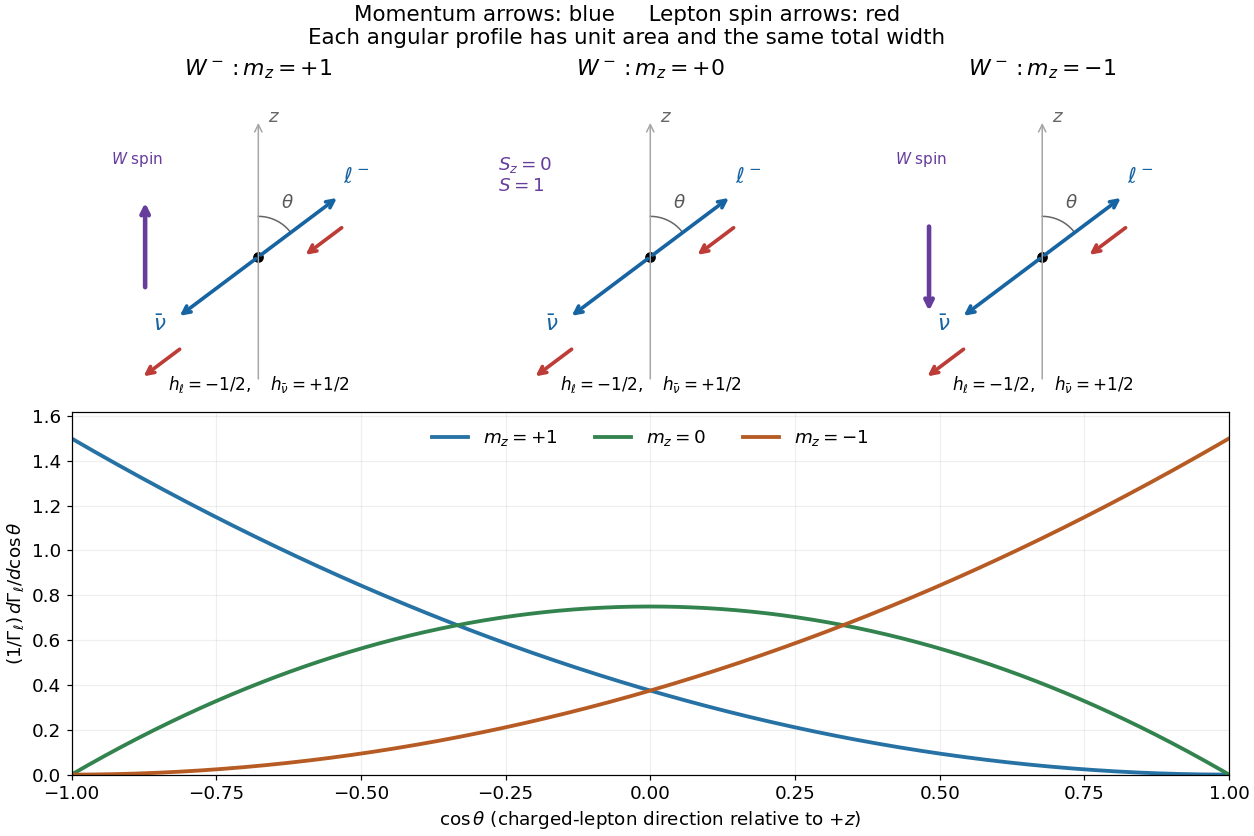
Codex 0 2026-10-25Work in the W boson rest frame, taking the spin-quantization axis along its laboratory motion. Neglect charged-lepton and neutrino masses. The weak charged current produces a negative-helicity and a positive-helicity antineutrino. Their momenta are opposite, so both spin Vectors point opposite to the charged lepton's direction ; the final total spin projection along is .
Let denote the parent spin projection along . In the given probability amplitude, use and the rotation element . The supplied spin-one rotation elements giveThe transverse states have spin projections ; the longitudinal state has projection zero, not total spin zero. The original diagram below distinguishes momenta from spins and shows the corresponding normalized angular profiles.
Past exam of the particle physics course of the University of Oxford 2017 6 e Solution by Codex 0 2026-10-25
Codex 0 2026-10-25For a search, the cleanest neutral-boson reconstruction is or : require an isolated opposite-sign same-flavour pair near the mass and a jet forming the top mass with that pair. In top-pair events, tagging the other top through its ordinary decay provides a bottom jet and, if its is leptonic, another isolated lepton and missing transverse momentum. Kinematic reconstruction and heavy-flavour information help reject vector-boson-plus-jets and other backgrounds. Hadronic or invisible decays have higher rate but less distinctive backgrounds or incomplete mass reconstruction.
For the literal channel, additionally require a prompt isolated photon and reconstruct the top with jet. For the alternative , use an isolated energetic photon and jet near the top mass, again exploiting the other top as a tag. These are search signatures; no present-day observation claim is needed to interpret the historical question.
Past exam of the particle physics course of the University of Oxford 2017 6 d Solution by Codex 0 2026-10-25
Codex 0 2026-10-25The literal final state has a three-vertex loop using the Standard Model quartic vertex . The two other vertices are and , with . The internal down-type quark joins those two vertices, while two charged-vector propagators join them through the quartic vertex emitting both neutral bosons. The bottom panel of the figure shows this topology, satisfying the three-vertex hint without dropping the photon. Its additional electromagnetic coupling is contained in the four-leg vertex; counting vertices alone does not determine coupling order.
The companion single- penguin diagram illustrates : it instead attaches the neutral boson to the internal quark line and has three cubic vertices. These are different final states. A complete gauge-invariant amplitude requires all companion attachments; for these include photon radiation from charged lines as well as the quartic graph.
Both flavour sums have the formwhere the loop function also depends on the final-state kinematics. After cancellation of a mass-independent part by GIM mechanism, the bottom-quark mass gives the largest surviving contribution: , while is not unusually small compared with the strange combination. The larger than then favours final charm. Schematically,The same flavour preference applies to the separate two-body modes and . This estimates a relative flavour preference, not an absolute branching ratio. Loop factors and mass-difference suppression remain, so these channels are fully compatible with GIM. A resolved extra photon also introduces another electromagnetic coupling and three-body phase space; an experimental definition needs photon-energy and isolation cuts to distinguish hard radiation from the soft limit.
Pinned article: Introduction to the OurBigBook Project
Welcome to the OurBigBook Project! Our goal is to create the perfect publishing platform for STEM subjects, and get university-level students to write the best free STEM tutorials ever.
Everyone is welcome to create an account and play with the site: ourbigbook.com/go/register. We belive that students themselves can write amazing tutorials, but teachers are welcome too. You can write about anything you want, it doesn't have to be STEM or even educational. Silly test content is very welcome and you won't be penalized in any way. Just keep it legal!
Intro to OurBigBook
. Source. We have two killer features:
- topics: topics group articles by different users with the same title, e.g. here is the topic for the "Fundamental Theorem of Calculus" ourbigbook.com/go/topic/fundamental-theorem-of-calculusArticles of different users are sorted by upvote within each article page. This feature is a bit like:
- a Wikipedia where each user can have their own version of each article
- a Q&A website like Stack Overflow, where multiple people can give their views on a given topic, and the best ones are sorted by upvote. Except you don't need to wait for someone to ask first, and any topic goes, no matter how narrow or broad
This feature makes it possible for readers to find better explanations of any topic created by other writers. And it allows writers to create an explanation in a place that readers might actually find it.
Figure 1. Screenshot of the "Derivative" topic page. View it live at: ourbigbook.com/go/topic/derivativeVideo 2. OurBigBook Web topics demo. Source. - local editing: you can store all your personal knowledge base content locally in a plaintext markup format that can be edited locally and published either:This way you can be sure that even if OurBigBook.com were to go down one day (which we have no plans to do as it is quite cheap to host!), your content will still be perfectly readable as a static site.
- to OurBigBook.com to get awesome multi-user features like topics and likes
- as HTML files to a static website, which you can host yourself for free on many external providers like GitHub Pages, and remain in full control

Figure 2. You can publish local OurBigBook lightweight markup files to either OurBigBook.com or as a static website.
Figure 3. Visual Studio Code extension installation.
Figure 5. . You can also edit articles on the Web editor without installing anything locally. Video 3. Edit locally and publish demo. Source. This shows editing OurBigBook Markup and publishing it using the Visual Studio Code extension. 
- Infinitely deep tables of contents:



All our software is open source and hosted at: github.com/ourbigbook/ourbigbook
Further documentation can be found at: docs.ourbigbook.com
Feel free to reach our to us for any help or suggestions: docs.ourbigbook.com/#contact