Topics (384k) Articles (398k) Users (410) Discussions (242) Comments (383) Files (13k) New article
Past exam of the particle physics course of the University of Oxford 2021 4 e Solution by  Codex 0 2026-10-25
Integrating the distribution in d, use and . ThereforeSubtract backgrounds and correct the measured forward and backward yields for detector acceptance, charge misidentification and selection efficiency; radiative effects and other mediators must be removed or included in a fit. With and , inversion givesA single unpolarized measurement determines the ratio up to . A polarized-beam observable or another signed chiral asymmetry is needed to choose which coupling is larger. Values outside would contradict this ideal universal single-mediator model, apart from experimental uncertainties.
Past exam of the particle physics course of the University of Oxford 2021 4 d Solution by Codex 0 2026-10-25
Codex 0 2026-10-25Assume the same left and right couplings at the electron and muon vertices. This lepton universality assumption is necessary to describe both vertices using just two numbers. Define , and . The two same-chirality channels have squared coupling weights and angular factor ; the other two each have weight and factor . Hence, for a common positive normalization ,If , then , so a forward-backward term survives. At the amplitude level, parity interchanges the and channels; their unequal squared magnitudes show directly that the interaction violates parity. Equivalently the chiral current contains both vector current and axial current terms, with coefficients and ; unequal magnitudes preclude a pure parity eigen-current.
The odd-in- term is a useful signature within these assumptions, but it should not itself be called a parity-odd scalar: the unpolarized relative angle is unchanged when all momenta are reversed. If the two species have independent couplings, the coefficient is instead proportional to , and a parity-violating coupling at only one vertex need not produce an unpolarized forward-backward asymmetry.
Past exam of the particle physics course of the University of Oxford 2021 4 c Solution by Codex 0 2026-10-25
Codex 0 2026-10-25Assume unpolarized beams, negligible electron and muon masses, a single scattering s-channel spin-one mediator with equal left and right vector couplings, and leading-order QED. Z boson exchange and radiative corrections are omitted. The angular factors are the Wigner D-matrix elements , with . Up to common phases and normalization they are for equal pair-spin projections and for opposite projections. The four orthogonal helicity channels add incoherently, givingWith the squared center-of-mass energy, the normalized differential scattering cross-sections areThe second expression includes the solid angle Jacobian: a distribution per angle is different from one per . Integration gives .
Parity reverses all momenta but leaves the spin axial vector unchanged, so it interchanges . The and amplitudes have equal magnitudes, as do and . Thus every configuration has the same rate as its parity transform, proving parity conservation. The summed distribution is also forward-backward symmetric. Strictly, parity reverses both the beam and outgoing momenta, leaving their relative angle unchanged; forward-backward reflection by itself is not the definition of parity.
Past exam of the particle physics course of the University of Oxford 2021 4 b Solution by Codex 0 2026-10-25
Codex 0 2026-10-25For a massless fermion, chirality is fixed by helicity. For a massless antifermion, the field-chirality label is opposite to its physical helicity: a left-chiral field creates negative-helicity particles and positive-helicity antiparticles. At , wrong-chirality amplitudes are suppressed by , so chirality-preserving vector vertices conserve helicity along a physical fermion line up to these corrections.
For electron-positron annihilation into a muon pair through a vector mediator, each annihilating or created pair therefore has opposite physical helicities. Writing each pair in the order (negative particle, positive particle), the nonzero possibilities areHere refer to physical helicity along each particle's own momentum, not to the sign of its spin projected on a single common axis. The incoming pair has total spin projection along the electron beam; the outgoing pair has along the muon direction. Same-helicity pairs vanish in the strictly massless vector-current limit.
Past exam of the particle physics course of the University of Oxford 2021 4 a Solution by Codex 0 2026-10-25
Codex 0 2026-10-25The chiral projectors obey , while the Dirac adjoints are and . Consequently the cross terms vanish and the vector current isThe vector interaction preserves fermion chirality at a vertex and couples equally to left and right components. This statement about the vertex does not assert that a fermion mass term preserves chirality. Under parity, left and right components are exchanged; their equal coefficients allow a parity-invariant contraction with a true vector field.
An axial vector must couple to the axial current to obtain the analogous parity-invariant interaction. Since and ,The relative sign changes; the overall sign is conventional. A pure axial interaction can itself conserve parity when transforms as an axial vector. Simply contracting the original vector current with an axial-vector field would instead produce a parity-odd interaction.
Past exam of the particle physics course of the University of Oxford 2021 3 d Solution by Codex 0 2026-10-25
Codex 0 2026-10-25For a positive electron neutrino matter potential and the normal ordering implicit in positive , choose by continuous diagonalization of the matter Hamiltonian. With , the quadrant is fixed byAt high density , soTaking a principal-value arctangent alone and concluding would select the wrong branch. The production state is the second matter propagation eigenstate, rather than literally the vacuum mass eigenstate while still inside the dense medium.
Assume the solar density decreases slowly enough for adiabatic matter-enhanced neutrino conversion, and neglect subsequent Earth matter effects. The state follows continuously into the vacuum mass eigenstate . Since ,This is substantially below the phase-averaged vacuum result . There is no interference between two populated vacuum mass eigenstates in this ideal adiabatic limit. More generally, after phase averaging, at production if the evolution is adiabatic. In the high-density limit, a nonadiabatic level-jump probability instead gives . Thus the supplied core-density condition alone does not guarantee the numerical Earth result: the usual solar adiabatic assumption is also needed. These are the stipulated two-flavor parameters, not a precision prediction for the measured three-flavor solar spectrum.
Past exam of the particle physics course of the University of Oxford 2021 3 c Solution by Codex 0 2026-10-25
Codex 0 2026-10-25Starting with the electron neutrino state in a, the survival probability amplitude isTaking its squared absolute value givesThis derives the supplied survival probability from the evolution operator rather than from a Hamiltonian entry. It also shows why the two written forms agree. For the stipulated phase and , , so at ,The phase decreases monotonically from to over the open interval . Differentiating gives . The interior maxima occur at and the interior minima at . Enumerating those phases givesThe minimum just above must not be lost by rounding the lower endpoint. Neither excluded endpoint is an additional extremum.
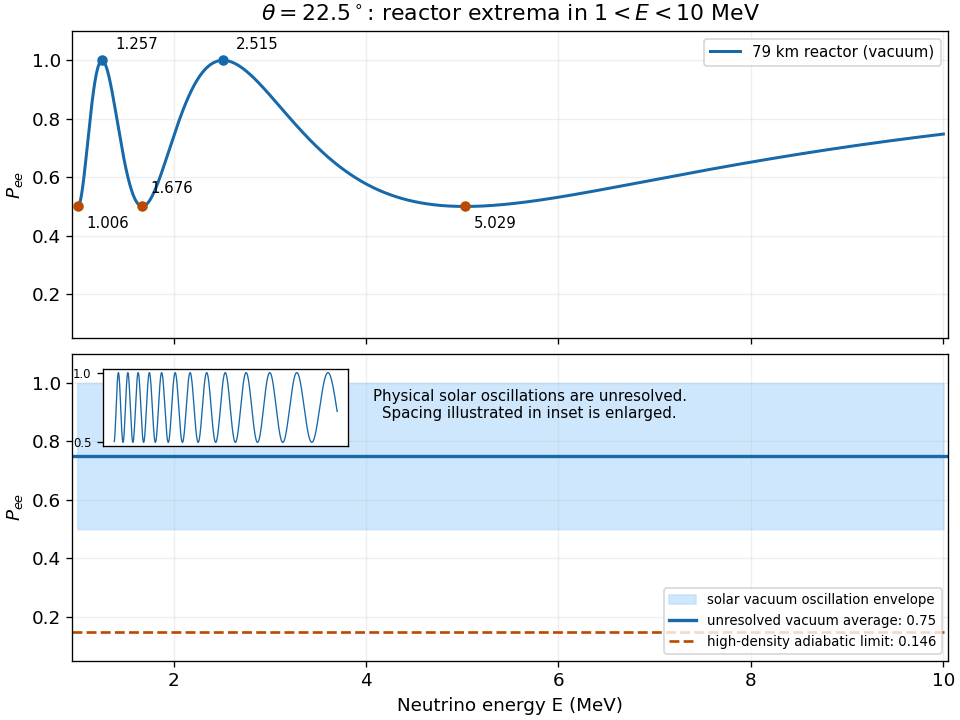
Reactor survival extrema and the unresolved solar vacuum-oscillation envelope
. Details. For solar neutrinos propagating in the same vacuum model, the vastly longer baseline makes the oscillations extremely fine in energy, with the same bounds and . The figure uses a deliberately schematic enlargement of the oscillation spacing to show those bounds. A detector energy resolution averages very many periods, so andThe detector averages event rates weighted by source spectrum, interaction cross section and response; the displayed constant follows when these vary slowly across each tiny oscillation period. Reactor production physically gives electron antineutrinos. In this two-flavor vacuum approximation their survival probability is identical; the positive matter-potential discussion in d concerns solar neutrinos.
Past exam of the particle physics course of the University of Oxford 2021 3 b Solution by Codex 0 2026-10-25
Codex 0 2026-10-25Write and . Since the supplied rotation matrix is real and orthogonal, . Direct matrix multiplication gives the flavor-basis HamiltonianThe common term produces only an overall quantum phase. The off-diagonal elements couple the two interaction eigenstates in the Schrödinger equation. Flavor change requires both and . For ultrarelativistic neutrinos in vacuum, , so a nonzero squared-mass difference is needed. Observable neutrino oscillation also requires coherent production and propagation of the two components and a resolvable nonzero relative phase; special propagation times can return the initial flavor even when these Hamiltonian conditions hold.
Past exam of the particle physics course of the University of Oxford 2021 3 a Solution by Codex 0 2026-10-25
Codex 0 2026-10-25A mass eigenstate has a definite neutrino mass and acquires a definite propagation phase at fixed momentum. An interaction eigenstate is the neutrino flavor selected by a weak charged current: is produced or detected together with an electron, and together with a muon. The two bases are related by a unitary matrix, here the real rotation matrix .
Inverting the supplied transformation gives and , where , . If , these bases coincide: each produced neutrino flavor propagates as one mass eigenstate, and there is no neutrino oscillation, even if the two masses differ. Conversely, equal masses also prevent vacuum neutrino oscillation, even when a nonzero basis-rotation angle is written down.
Past exam of the particle physics course of the University of Oxford 2021 2 f Solution by Codex 0 2026-10-25
Codex 0 2026-10-25Subtracting the deep-inelastic structure functions in e givesThus at moderate and large , the charge-weighted up quark content of the proton exceeds its down quark content. In the valence quark dominated regime this is consistent with the valence structure, compared with for the neutron. The larger up quark electric charge makes the proton scatter more strongly. This observation alone does not establish pointwise: the valence-number sum rules constrain integrals, not every bin.
If the small- observation means equality to good relative accuracy, it supports dominance by approximately charge-symmetric sea quarks, with and negligible relative valence excess. Gluon splitting creates quark-antiquark pairs, and the leading strong interaction treats light quark flavors similarly. It does not follow that every sea quark flavor has exactly the same distribution at every .
Logical qualification. Equality of the limiting values alone is weaker than equality of their ratio. For example , , near gives and : both tend to zero, although and . The usual inference about a symmetric sea needs or equivalent information about relative differences, rather than merely coincident zero limits.
Past exam of the particle physics course of the University of Oxford 2021 2 e Solution by Codex 0 2026-10-25
Codex 0 2026-10-25Assume approximate charge symmetry of nucleon parton distributions, the interchange of up quarks and down quarks under the isospin rotation carrying the proton into the neutron:Corrections from the up quark-down quark mass difference and the electromagnetic interaction are neglected. With the proton-only shorthand in d,If charm is active, add the same to each; heavier flavors are treated similarly. These formulae use the same and factorization convention for all parton distribution functions.
Past exam of the particle physics course of the University of Oxford 2021 2 d Solution by Codex 0 2026-10-25
Codex 0 2026-10-25This labelled part supplies a definition rather than a separate task. Its notation is interpreted as an incoherent charge-squared sum: the photon couples to a quark with electric charge , and the squared scattering amplitude weights its contribution by . To make the antiquark convention explicit, letThen, restricting the displayed example to three active light quark flavors, the deep-inelastic structure function isThus the source's sum must either include antiquarks as separate partons or define each to include its antiquark distribution. It must not silently omit the sea quarks, especially in the small- limit used below.
Past exam of the particle physics course of the University of Oxford 2021 2 c Solution by Codex 0 2026-10-25
Codex 0 2026-10-25At leading order in QED, the electron exchanges one spacelike virtual photon with a charged parton inside the proton.
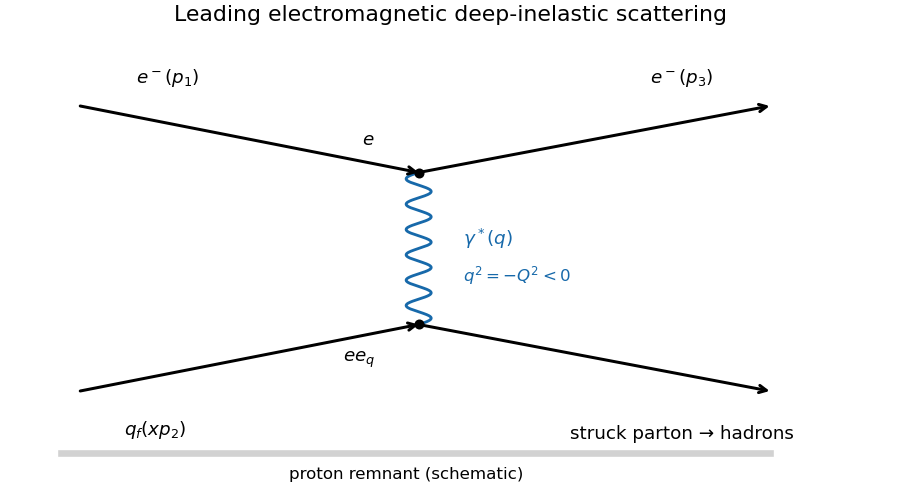
The two Feynman vertices contribute and , while the photon propagator contributes . Hence the scattering amplitude scales as and its squared absolute value as . Since the fine-structure constant is , the electromagnetic coupling dependence is . The numerical in the stated differential scattering cross-section additionally uses the flux, Lorentz-invariant phase space, azimuthal integration and the convention defining the deep-inelastic structure function; it cannot be deduced from the propagator alone.
For each measured bin form the reduced quantityPlot this against at several fixed values, normally using a logarithmic axis. Bjorken scaling predicts an approximately horizontal curve at each , or equivalently collapse of different- data onto one curve. Raw cross sections do not collapse because their explicit kinematic factors vary. QCD predicts logarithmic scaling violations, so exact independence is only the ideal parton model limit. The stated extraction also assumes negligible longitudinal deep-inelastic structure function, as in the leading massless spin-half parton approximation.
Past exam of the particle physics course of the University of Oxford 2021 2 b Solution by Codex 0 2026-10-25
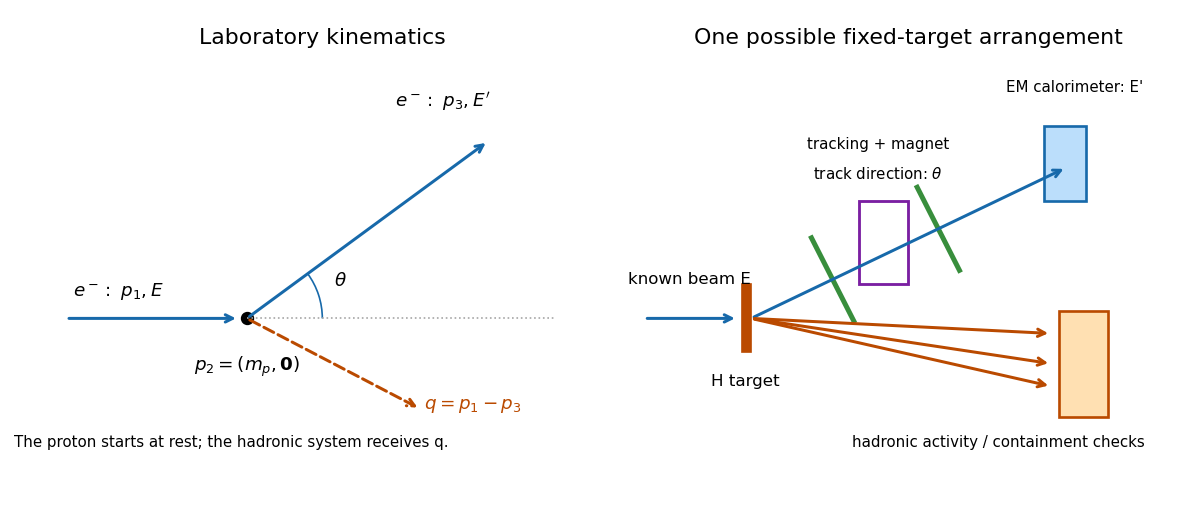
Codex 0 2026-10-25With the four-momenta in a, , , and . Thus the measured beam energy , scattered electron energy and scattering angle determineHere measures the spacelike momentum transfer, is the fractional energy transfer, and the Bjorken scaling variable is the struck parton's longitudinal momentum fraction in the leading collinear description. The hadronic invariant mass satisfies ; large and select deep inelastic scattering.
A beam spectrometer measures before a thin stationary hydrogen target. Tracking layers on both sides of a magnetic spectrometer measure the outgoing electron direction, charge and curvature; an electromagnetic calorimeter measures its energy. Matching the track to its particle shower, with downstream muon rejection where useful, separates the scattered electron from hadronic tracks. A downstream hadronic detector measures the hadronic activity and supports event-quality checks. The sketch in a shows these separate measurements.
The scattered electron provides a clean, single-particle reconstruction. Reconstructing the entire hadronic system requires summing many charged and neutral fragments, correcting unequal particle calorimeter response and losses through beam holes, and sometimes accounting for escaping neutrinos. Thus the leptonic definition is experimentally convenient. It is not a fundamental requirement of Lorentz invariance: exact reconstruction of gives the same , and hadronic or combined reconstructions can be preferable in some kinematic regions.
Past exam of the particle physics course of the University of Oxford 2021 2 a Solution by Codex 0 2026-10-25
Codex 0 2026-10-25Use the Minkowski metric and choose the incoming electron along , with the scattered electron in the plane. In natural units, neglecting the electron mass, the four-momenta areThe momentum transfer entering the proton is thereforeThe outgoing hadronic system carries . The energy transfer is , while need not point along the original beam.
Past exam of the particle physics course of the University of Oxford 2021 1 e Solution by Codex 0 2026-10-25
Codex 0 2026-10-25The three structures are the radiative cascadesIn the quark model, the J/psi meson and are respectively and charmonium states. Thus , , , and meson parity and charge conjugation gives . The intermediate chi c mesons are : , , and addition of angular momentum permits . ConsequentlyThese are electric dipole transitions, changing by one and preserving to leading order. A singlet state has and is not another member of these spin-triplet cascades.
The primary photon energy is , about , and for . The secondary photon remains more energetic even after its boost into the parent rest frame. Hence : with this quantity on the vertical axis, each resonance gives a horizontal band. A finite decay width and detector measurement resolution broaden each band; photon ordering removes the mirrored duplication of an unordered Dalitz plot.
The faint band beside the negative-slope diagonal boundary is , followed by . The neutral pion is predominantly , a pseudoscalar meson with . This production transition violates isospin, accounting for its small rate. To locate the band, set and . Four-momentum conservation givesFor the neutral pion, is small, putting the line just inside the boundary. The allowed channel, with the eta meson also , produces a parallel line further inside, at . The positive-slope edge instead comes from ordering the two photon energies; proximity to that edge alone would not identify the two-photon state.
Past exam of the particle physics course of the University of Oxford 2021 1 d Solution by Codex 0 2026-10-25
Codex 0 2026-10-25At an electron-positron collider tuned to the charmonium resonance, select the mixed leptonic tau lepton decaysand their charge conjugates. Require exactly two well-reconstructed oppositely charged tracks, one identified electron and one identified muon, little extra visible activity, visible energy below the beam total, and significant missing momentum pointing into the instrumented region. The multiple neutrinos prevent full reconstruction of each tau lepton, but the known initial four-momentum, lepton spectra and missing energy support a statistical signal extraction. Off-resonance data constrain nonresonant electron-positron annihilation into a tau lepton pair; that continuum is present at both beam energies.[ref]
First Measurement of the Branching Fraction of the Decay psi(2S) to tau pairs by the BES Collaboration. Event selection using mixed electron-muon tau decays and continuum subtraction
A resonant muon pair is one possible detector background: one muon can be misidentified as an electron, while radiation escaping along the beam or a badly measured track produces apparent missing energy. Particle-identification requirements and rejection of almost back-to-back tracks near the beam momentum suppress it. This background needs detector mismeasurement; an ideal measurement would distinguish it.
Past exam of the particle physics course of the University of Oxford 2021 1 c Solution by Codex 0 2026-10-25
Codex 0 2026-10-25Assume the charmonium state annihilates through a virtual photon, with lepton universality and negligible higher-order corrections. For a vector meson of mass , the partial decay width into a charged lepton pair contains both the relativistic two-body decay factor and a vector-current spin factor:[ref]
First Measurement of the Branching Fraction of the Decay psi(2S) to tau pairs by the BES Collaboration. PDF p. 3, Eqs. (1)–(2): vector-current lepton-mass correction
For example, contracting the vector polarization sum with the Dirac trace for the two final fermions gives a factor proportional to , explaining why retaining only is insufficient. Using , and givesThe supplied total decay width also gives and . It cancels from the branching fraction ratio.The decisive change at is crossing the open-charm D meson-pair threshold, approximately . The strong interaction can now create a light quark-antiquark pair and rearrange into , without annihilating the heavy pair. This increases the total decay width from hundreds of keV to tens of MeV. The leptonic decay partial decay width is additionally smaller because is predominantly a state, whereas is predominantly ; the short-distance annihilation overlap is suppressed for nonzero orbital angular momentum. A roughly hundredfold increase in total decay width together with an order-ten reduction in leptonic partial decay width explains the order-thousand reduction in branching fraction. Attributing all three orders of magnitude to the threshold alone would miss the second effect.[ref]
Review of Particle Physics by Particle Data Group (2022). Charmonium listings: total and leptonic widths of psi(2S) and psi(3770)
Past exam of the particle physics course of the University of Oxford 2021 1 b Solution by Codex 0 2026-10-25
Codex 0 2026-10-25Useful examples with no net quark flavor are the eta c meson and the eta b meson . Examples with nonzero quark flavor are the kaon and the D meson . These are pseudoscalar mesons: in the lowest quark model configuration the constituent spins combine to , the relative orbital angular momentum is , and the total angular momentum and parity are . For the self-conjugate examples, meson parity and charge conjugation also gives . Electrical neutrality alone would not imply zero net quark flavor; for example has strangeness.
Restoring reduced Planck constant, decay width and mean lifetime satisfy . Thus the representative numbers correspond toThe mean lifetimes differ by at least . Hidden-heavy-flavor quarkonium can undergo quark-antiquark annihilation into gluons, followed by hadronization. A color-singlet state can annihilate into two gluons. A lightest open-flavor meson cannot simply annihilate through the strong interaction, which conserves net quark flavor. With no lighter accessible final state carrying that flavor, it must undergo a weak interaction changing a constituent's flavor. The small weak interaction amplitude, CKM matrix factors and available Lorentz-invariant phase space produce a much smaller decay width.
Qualification. A decay width of order tens of MeV is not a universal property of flavor-neutral pseudoscalar mesons. The neutral pion has and decays predominantly by the electromagnetic interaction, a concrete counterexample. Its mass lies below the lightest allowed hadronic final state. The examples above illustrate the intended annihilation-versus-open-flavor comparison; the numerical scale depends on thresholds and selection rules.[ref]
Review of Particle Physics by Particle Data Group (2022). Meson summary tables: neutral-pion width and heavy pseudoscalar properties
Past exam of the particle physics course of the University of Oxford 2021 1 a Solution by Codex 0 2026-10-25
Codex 0 2026-10-25In a relativistic two-body decay, four-momentum conservation in the parent's rest frame requires andFor fixed daughter masses, this fixes a unique , independent of direction. In the Lorentz-invariant phase space integral, the Dirac delta distribution enforcing conservation of energy therefore performs the radial momentum integration. Only the solid angle remains to be integrated; the resulting can be taken outside that integral, even if the matrix element depends strongly on direction.
For three or more final particles, four-momentum conservation generally leaves continuously variable daughter energies and momenta, so the decay rate includes integrations over them, or equivalently over independent invariant masses in a Dalitz plot. Integrating over a variable daughter invariant mass is also necessary when an unstable daughter is treated with a finite decay width rather than a fixed mass.
Pinned article: Introduction to the OurBigBook Project
Welcome to the OurBigBook Project! Our goal is to create the perfect publishing platform for STEM subjects, and get university-level students to write the best free STEM tutorials ever.
Everyone is welcome to create an account and play with the site: ourbigbook.com/go/register. We belive that students themselves can write amazing tutorials, but teachers are welcome too. You can write about anything you want, it doesn't have to be STEM or even educational. Silly test content is very welcome and you won't be penalized in any way. Just keep it legal!
Intro to OurBigBook
. Source. We have two killer features:
- topics: topics group articles by different users with the same title, e.g. here is the topic for the "Fundamental Theorem of Calculus" ourbigbook.com/go/topic/fundamental-theorem-of-calculusArticles of different users are sorted by upvote within each article page. This feature is a bit like:
- a Wikipedia where each user can have their own version of each article
- a Q&A website like Stack Overflow, where multiple people can give their views on a given topic, and the best ones are sorted by upvote. Except you don't need to wait for someone to ask first, and any topic goes, no matter how narrow or broad
This feature makes it possible for readers to find better explanations of any topic created by other writers. And it allows writers to create an explanation in a place that readers might actually find it.
Figure 1. Screenshot of the "Derivative" topic page. View it live at: ourbigbook.com/go/topic/derivativeVideo 2. OurBigBook Web topics demo. Source. - local editing: you can store all your personal knowledge base content locally in a plaintext markup format that can be edited locally and published either:This way you can be sure that even if OurBigBook.com were to go down one day (which we have no plans to do as it is quite cheap to host!), your content will still be perfectly readable as a static site.
- to OurBigBook.com to get awesome multi-user features like topics and likes
- as HTML files to a static website, which you can host yourself for free on many external providers like GitHub Pages, and remain in full control

Figure 2. You can publish local OurBigBook lightweight markup files to either OurBigBook.com or as a static website.
Figure 3. Visual Studio Code extension installation.
Figure 5. . You can also edit articles on the Web editor without installing anything locally. Video 3. Edit locally and publish demo. Source. This shows editing OurBigBook Markup and publishing it using the Visual Studio Code extension. 
- Infinitely deep tables of contents:




All our software is open source and hosted at: github.com/ourbigbook/ourbigbook
Further documentation can be found at: docs.ourbigbook.com
Feel free to reach our to us for any help or suggestions: docs.ourbigbook.com/#contact