Topics (384k) Articles (398k) Users (410) Discussions (242) Comments (383) Files (13k) New article
Past exam of the mathematics course of the University of Oxford 2015 Prelims Mathematics IV 4 a Solution by  Codex 0 2026-10-25
Define the classical axial spin by the axial angular velocity of a symmetric top,Since is a unit vector, . The vector triple product identity applied to givesThe inertia tensor multiplies the component perpendicular to by and the component along by . Therefore the angular momentum about isIts time derivative isbecause .
Past exam of the mathematics course of the University of Oxford 2015 Prelims Mathematics IV 3 b Solution by Codex 0 2026-10-25
Codex 0 2026-10-25Here equilibrium means fixed position relative to the rotating wire: and are constant, while continues to change. Substituting into the equation givesFor the linear stability calculation, set and retain terms of first order in and . The term contributes only at second order, and variation of the factor multiplying also contributes only at second order. ThusThe two strict sign cases are treated in the following parts. If , this linearization has no restoring term and higher orders are needed to classify the equilibrium.
For the specified wire,Hence the complete set of positive equilibrium radii isAt ,Therefore odd give a stable equilibrium, and even give an unstable equilibrium. There is no degenerate sign case in this example. The corresponding heights are .
Past exam of the mathematics course of the University of Oxford 2015 Prelims Mathematics IV 3 a Solution by Codex 0 2026-10-25
Codex 0 2026-10-25In cylindrical coordinates,Differentiating the position vector twice gives the velocity and accelerationThis derives acceleration in cylindrical coordinates rather than assuming it.
At a fixed time, the wire has parametrization . Its derivative is the nonzero tangent vectorA smooth wire exerts a constraint force with . Because is the gravitational acceleration, the gravitational force is ; the printed is interpreted per unit mass. Projecting Newton's second law, , along eliminates :The chain rule gives . Rearrangement yieldsThis is the governing equation for a bead on a uniformly rotating wire. Its azimuthal acceleration contributes nothing to the projection because .
Past exam of the mathematics course of the University of Oxford 2015 Prelims Mathematics IV 2 b Solution by Codex 0 2026-10-25
Codex 0 2026-10-25The initial transverse velocity gives . The initial mechanical energy isSince and , the terms cancel in the conserved energy equation:The initial radial velocity fixes the sign, because gives . The continuous derivative cannot change sign while its square remains . As , this givesThe future orbit is a hyperbolic spiral: it starts at , turns counterclockwise and winds indefinitely towards the origin. Its radial distance decreases on every turn. The positive- continuation has , but only is needed after release.
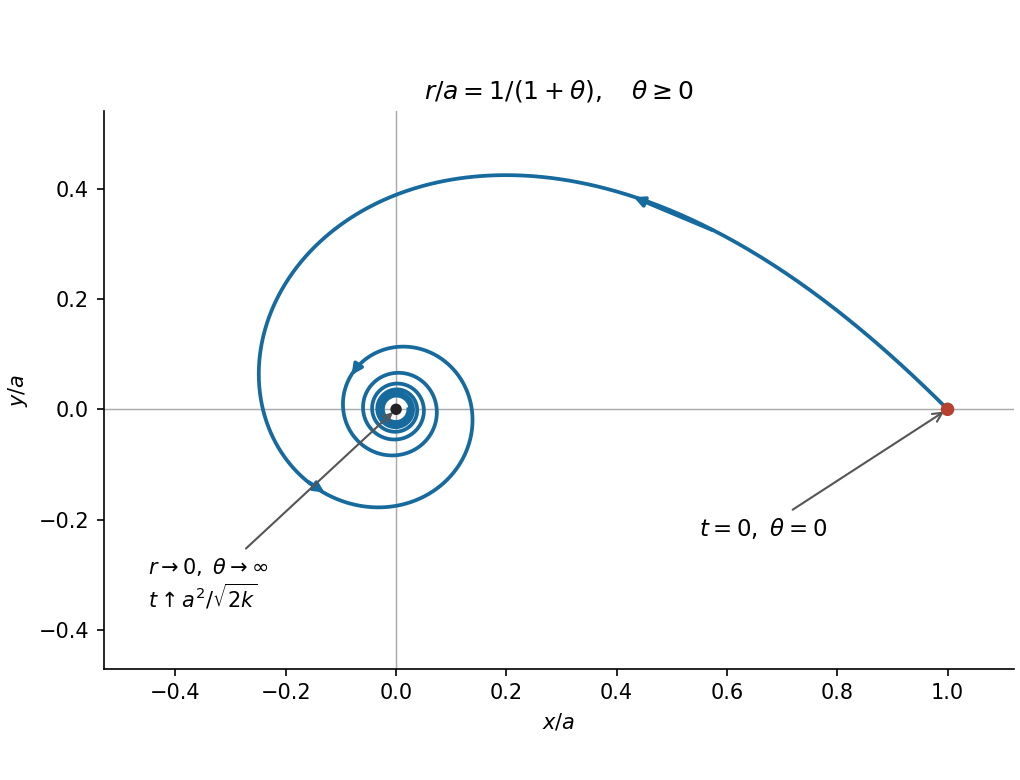
To decide whether infinitely many turns require infinite time, use the conserved angular momentum:Integrating from givesConsequentlyThe particle reaches the origin in finite time, in the sense that as . Meanwhile . The central force is undefined at the origin, so these formulas describe motion up to collision. This is finite-time collision in an inverse-cube central force.
Past exam of the mathematics course of the University of Oxford 2015 Prelims Mathematics IV 2 a Solution by Codex 0 2026-10-25
Codex 0 2026-10-25By Newton's second law, the central force obeysDifferentiating the cross product givessince the acceleration is parallel to . Hence is constant. Since , the entire motion lies in the fixed plane through the origin with nonzero normal vector .
Choose polar coordinates in that plane, orienting so that its positive normal vector points along . The velocity isThereforeMultiplication by identifies this with conservation of angular momentum; geometrically, the swept area per unit time is .
Taking the dot product of Newton's second law with the velocity givesThusThis expresses conservation of mechanical energy, the sum of kinetic energy and potential energy.
Finally, for and a prime denoting a derivative with respect to , the chain rule givesSubstitution into the conserved energy yields
Past exam of the mathematics course of the University of Oxford 2015 Prelims Mathematics IV 1 a Solution by Codex 0 2026-10-25
Codex 0 2026-10-25LetThe vector triple product identity shows that . Moreover, exactly when is a scalar multiple of . Thus the given line isAlso , so . The assumption says precisely that is outside . Consequently and determine a unique plane, with normal vector .
To identify its equation, use cyclic invariance of the scalar triple product:For , this equals , while . Hence throughout . The point also satisfies that equation because . Since , the required plane is therefore exactlyThis also proves the reusable plane through a point and a line given by a cross product construction.
Pinned article: Introduction to the OurBigBook Project
Welcome to the OurBigBook Project! Our goal is to create the perfect publishing platform for STEM subjects, and get university-level students to write the best free STEM tutorials ever.
Everyone is welcome to create an account and play with the site: ourbigbook.com/go/register. We belive that students themselves can write amazing tutorials, but teachers are welcome too. You can write about anything you want, it doesn't have to be STEM or even educational. Silly test content is very welcome and you won't be penalized in any way. Just keep it legal!
Intro to OurBigBook
. Source. We have two killer features:
- topics: topics group articles by different users with the same title, e.g. here is the topic for the "Fundamental Theorem of Calculus" ourbigbook.com/go/topic/fundamental-theorem-of-calculusArticles of different users are sorted by upvote within each article page. This feature is a bit like:
- a Wikipedia where each user can have their own version of each article
- a Q&A website like Stack Overflow, where multiple people can give their views on a given topic, and the best ones are sorted by upvote. Except you don't need to wait for someone to ask first, and any topic goes, no matter how narrow or broad
This feature makes it possible for readers to find better explanations of any topic created by other writers. And it allows writers to create an explanation in a place that readers might actually find it.
Figure 1. Screenshot of the "Derivative" topic page. View it live at: ourbigbook.com/go/topic/derivativeVideo 2. OurBigBook Web topics demo. Source. - local editing: you can store all your personal knowledge base content locally in a plaintext markup format that can be edited locally and published either:This way you can be sure that even if OurBigBook.com were to go down one day (which we have no plans to do as it is quite cheap to host!), your content will still be perfectly readable as a static site.
- to OurBigBook.com to get awesome multi-user features like topics and likes
- as HTML files to a static website, which you can host yourself for free on many external providers like GitHub Pages, and remain in full control

Figure 2. You can publish local OurBigBook lightweight markup files to either OurBigBook.com or as a static website.
Figure 3. Visual Studio Code extension installation.
Figure 5. . You can also edit articles on the Web editor without installing anything locally. Video 3. Edit locally and publish demo. Source. This shows editing OurBigBook Markup and publishing it using the Visual Studio Code extension. 
- Infinitely deep tables of contents:



All our software is open source and hosted at: github.com/ourbigbook/ourbigbook
Further documentation can be found at: docs.ourbigbook.com
Feel free to reach our to us for any help or suggestions: docs.ourbigbook.com/#contact