Topics (384k) Articles (398k) Users (410) Discussions (242) Comments (383) Files (13k) New article
Past exam of the mathematics course of the University of Oxford 2015 Prelims Mathematics V resit Question 6 c Solution by  Codex 0 2026-10-25
For separation of variables, set , with . The side Neumann boundary conditions give . As in the standard Sturm-Liouville problem, integration by parts shows . The zero eigenvalue gives constant , and together with makes constant too.
For positive eigenvalues, the side conditions give , , . The top condition chooses the hyperbolic cosine factor . Normalize it to one at , obtainingThe orthogonality of integer Fourier modes and the permitted interchange of summation and integration giveFor the remaining Fourier coefficients, integrate by parts twice. The sine boundary term vanishes, and with ,The last integral vanishes because and is a positive integer. Thus : only even Fourier modes survive, as expected from reflection symmetry about . Writing givesThe factor involving hyperbolic cosine lies between zero and one on the closed rectangle. Comparison with proves uniform convergence, so the solution is continuous on the entire boundary and takes the prescribed bottom values. On every strip , the Fourier coefficients have additional exponential decay, allowing differentiation and verifying Laplace's equation and all three Neumann boundary conditions.
To justify the endpoint calculation in b, differentiate at , in the interior-edge sense:Subtracting from the hyperbolic tangent leaves an absolutely convergent series. For the remaining part, the power series gives, by taking real parts at and then ,The same formula follows as the limit of the differentiated interior solution, since its leading multiplier is . This establishes the boundary normal derivative used in b. It also explains why the failure of the corner compatibility condition for mixed boundary data affects first derivatives at the bottom corners without spoiling continuity of itself.
Past exam of the mathematics course of the University of Oxford 2015 Prelims Mathematics V resit Question 6 b Solution by Codex 0 2026-10-25
Codex 0 2026-10-25For , define . Differentiate under the integral and use Laplace's equation:Thus is constant. The top Neumann boundary condition gives , soFor the included endpoint , the integral is interpreted as an improper integral at the bottom corners if necessary. The Fourier series constructed in c gives, on ,The second series is absolutely and uniformly convergent; the first term has only integrable logarithmic singularities. Its integral is zero since , while every cosine term also has zero integral. This proves the endpoint as well:For completeness, the logarithmic integral follows without any endpoint differentiation. Put and substitute to obtain . Adding and using gives , hence and the required full-interval result.
Past exam of the mathematics course of the University of Oxford 2015 Prelims Mathematics V resit Question 6 a Solution by Codex 0 2026-10-25
Codex 0 2026-10-25Let be the difference of two solutions. It is a harmonic function in the open rectangle, continuous on its closure, withInterpret these Neumann boundary conditions classically on the open edges, with the corresponding first derivatives extending there. We use the strong maximum principle for harmonic functions together with even reflection across a homogeneous Neumann boundary. This avoids imposing differentiability at the two bottom corners, where the original data fail a corner compatibility condition for mixed boundary data.
By continuity on the compact rectangle, attains a maximum . Suppose . It cannot occur on the bottom edge, where . If it occurs in the interior, the strong maximum principle for harmonic functions makes constant, contradicting its bottom value. If it occurs on an open vertical or top edge, the zero normal derivative allows an even reflection across that edge. The reflected harmonic function then has an interior maximum, giving the same contradiction.
The only remaining possibilities are the two top corners. Reflect evenly across both meeting edges. This gives a bounded harmonic function on a punctured neighbourhood of the corner. The removable singularity for a bounded harmonic function fills the centre with its continuous value. The corner is now an interior maximum, again impossible. Therefore . Applying the identical argument to gives .
Thus , and the solution is unique among the continuous classical solutions with the stated edge conditions.
Past exam of the mathematics course of the University of Oxford 2015 Prelims Mathematics V resit Question 5 c Solution by Codex 0 2026-10-25
Codex 0 2026-10-25Enforce the fixed-end Dirichlet boundary condition by taking the odd extension of the initial velocity to the whole line:This agrees with the specified initial condition for . To derive the relevant form of D'Alembert's formula, the zero initial displacement in b gives , up to a cancelling constant. The initial velocity then gives . HenceAn antiderivative, valid across , isEvaluation therefore gives the solution throughout :For , replace by ; for , replace it by . Thus the same expression includes the reflected wave after it reaches the fixed end.
At the two terms agree, so . At they again agree, so . Differentiating the integral with respect to giveswhich recovers . Since is a continuously differentiable function, the formula is twice continuously differentiable even across , and satisfies the wave equation there as well.
Past exam of the mathematics course of the University of Oxford 2015 Prelims Mathematics V resit Question 5 b Solution by Codex 0 2026-10-25
Codex 0 2026-10-25Write with , . The chain rule gives the differential operatorsTheir squared difference isConsequently the wave equation becomes . Integrating first in gives ; integrating in gives the general solutionThe arbitrary twice differentiable functions describe right-moving and left-moving waves, respectively. Conversely the chain rule shows that each such sum satisfies the wave equation.
Past exam of the mathematics course of the University of Oxford 2015 Prelims Mathematics V resit Question 5 a Solution by Codex 0 2026-10-25
Codex 0 2026-10-25Assume is mass per unit equilibrium length, the tension has constant magnitude , the string has negligible bending stiffness, and there is no damping or external transverse force. Assume small slopes and purely transverse motion. Then a short segment has mass to first order. If is the angle of its tangent, the small-slope approximation gives .
Past exam of the mathematics course of the University of Oxford 2015 Prelims Mathematics V resit Question 4 c Solution by Codex 0 2026-10-25
Codex 0 2026-10-25For separation of variables, put and set . The boundary conditions are , . Multiplying by and using integration by parts givesA nonzero solution therefore has : the zero case forces constant, and then forces . Writing , the eigenfunctions and their temporal factors areThese sine functions are orthogonal on , with squared norm . Expanding the initial condition and multiplying by gives, using the permitted interchange of the sum and integral,Here and . Thus the Fourier series solution isThe exponential decay permits differentiation of the series for , and each term satisfies both boundary conditions. At it is the mixed-end Fourier expansion of .
The gained heat is the increase in internal energy. Since the paper specifies no cross-sectional area, first give the answer per unit cross-sectional area; multiply by for a rod of cross-sectional area . The initial temperature has integral , whereas . At this givesNumerically . This is positive and less than the eventual gain , as expected from relaxation towards the uniform steady state.
Past exam of the mathematics course of the University of Oxford 2015 Prelims Mathematics V resit Question 4 b Solution by Codex 0 2026-10-25
Codex 0 2026-10-25A steady state has , so . The fixed temperature gives , and thermal insulation gives . ThusSubtracting this steady state produces the homogeneous mixed boundary conditionsThe partial differential equation and boundary conditions apply for . The initial condition is attained as . Its slope at is , so it does not satisfy the insulated-end condition at the instant . The resulting heat equation solution is smooth for and approaches the initial temperature continuously; its spatial derivative need not be continuous at .
Past exam of the mathematics course of the University of Oxford 2015 Prelims Mathematics V resit Question 4 a Solution by Codex 0 2026-10-25
Codex 0 2026-10-25Assume the rod has constant cross-sectional area , no internal source of heat, no bulk motion, and no lateral heat flux. Assume also that each section has a uniform temperature, so that depends only on , and that Fourier's law applies with the stated constant thermal conductivity . The longitudinal heat flux density is then .
By conservation of energy, the rate of increase of internal energy in a slice equals incoming minus outgoing heat:Divide by and take the limit . For a sufficiently differentiable temperature field this gives , and henceHere is mass density, is specific heat capacity, and is thermal diffusivity.
Past exam of the mathematics course of the University of Oxford 2015 Prelims Mathematics V resit Question 3 c Solution by Codex 0 2026-10-25
Codex 0 2026-10-25Start with the solid between the elliptic paraboloid and the upper plane . Its projection is the disksince their vertical separation is . The second lower bound, , removes the part between the elliptic paraboloid and this lower plane whereverCall this second disk . Its centre is distance from the centre of , andbecause . Thus lies wholly inside . In particular the lower plane never exceeds the upper plane on , so the subtraction describes exactly the requested solid.
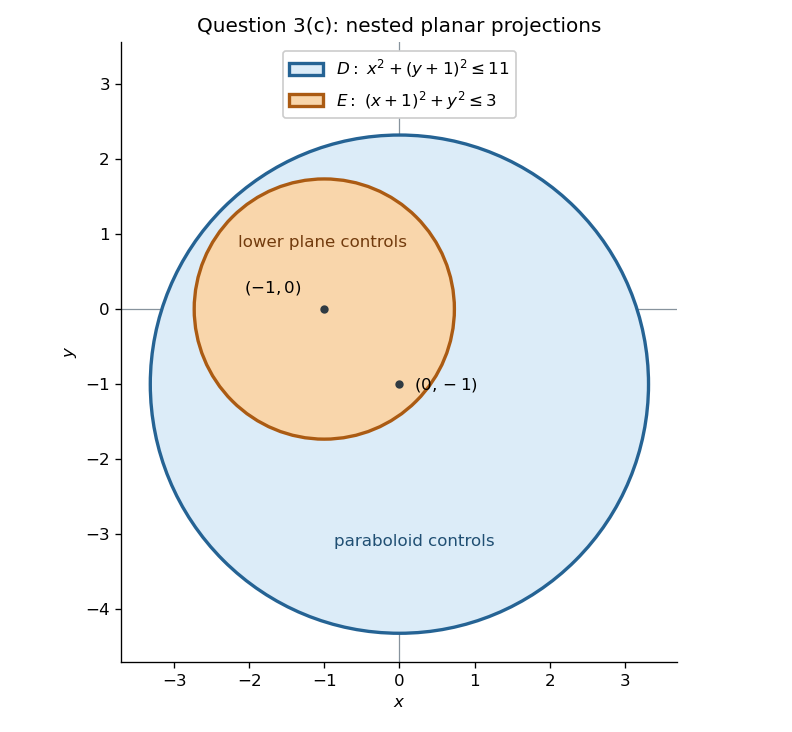
The nested-disk subtraction for paraboloid volumes therefore gives a difference of two double integrals:Translate polar coordinates to the centre of each disk. A general integral of this form isUsing and gives
Past exam of the mathematics course of the University of Oxford 2015 Prelims Mathematics V resit Question 3 b Solution by Codex 0 2026-10-25
Codex 0 2026-10-25The original double integral covers the triangle . By Fubini's theorem, after reversing the order, runs from to and from to . Since a continuous function is integrable on this bounded region,For the square pyramid, a horizontal section at height is a square of side : each vertex moves linearly from the base towards . Hence its cross-sectional area is , and its volume is . To use the identity just proved, choose :
Past exam of the mathematics course of the University of Oxford 2015 Prelims Mathematics V resit Question 3 a Solution by Codex 0 2026-10-25
Codex 0 2026-10-25 Past exam of the mathematics course of the University of Oxford 2015 Prelims Mathematics V resit Question 2 b Solution by Codex 0 2026-10-25
Codex 0 2026-10-25Use cylindrical coordinates. The real square root restricts the projection to , and there . Since , the volume integral isFor an independent boundary calculation, split into an upper hemisphere and a lower right circular conical surface . They meet in the circle and there is no additional planar face.
On , use the parametrizationThe outward unit normal vector is , and the surface area element is . The and components of vanish by the angular integrals of and . The component isOn , the parametrization has outward vector area elementIts negative vertical component points out below the solid. Multiplying by and using the same angular symmetry in integration givesTherefore the independently evaluated surface integral isin agreement with the volume integral. The isolated apex of the cone does not contribute to the surface integral.
Pinned article: Introduction to the OurBigBook Project
Welcome to the OurBigBook Project! Our goal is to create the perfect publishing platform for STEM subjects, and get university-level students to write the best free STEM tutorials ever.
Everyone is welcome to create an account and play with the site: ourbigbook.com/go/register. We belive that students themselves can write amazing tutorials, but teachers are welcome too. You can write about anything you want, it doesn't have to be STEM or even educational. Silly test content is very welcome and you won't be penalized in any way. Just keep it legal!
Intro to OurBigBook
. Source. We have two killer features:
- topics: topics group articles by different users with the same title, e.g. here is the topic for the "Fundamental Theorem of Calculus" ourbigbook.com/go/topic/fundamental-theorem-of-calculusArticles of different users are sorted by upvote within each article page. This feature is a bit like:
- a Wikipedia where each user can have their own version of each article
- a Q&A website like Stack Overflow, where multiple people can give their views on a given topic, and the best ones are sorted by upvote. Except you don't need to wait for someone to ask first, and any topic goes, no matter how narrow or broad
This feature makes it possible for readers to find better explanations of any topic created by other writers. And it allows writers to create an explanation in a place that readers might actually find it.
Figure 1. Screenshot of the "Derivative" topic page. View it live at: ourbigbook.com/go/topic/derivativeVideo 2. OurBigBook Web topics demo. Source. - local editing: you can store all your personal knowledge base content locally in a plaintext markup format that can be edited locally and published either:This way you can be sure that even if OurBigBook.com were to go down one day (which we have no plans to do as it is quite cheap to host!), your content will still be perfectly readable as a static site.
- to OurBigBook.com to get awesome multi-user features like topics and likes
- as HTML files to a static website, which you can host yourself for free on many external providers like GitHub Pages, and remain in full control

Figure 2. You can publish local OurBigBook lightweight markup files to either OurBigBook.com or as a static website.
Figure 3. Visual Studio Code extension installation.
Figure 5. . You can also edit articles on the Web editor without installing anything locally. Video 3. Edit locally and publish demo. Source. This shows editing OurBigBook Markup and publishing it using the Visual Studio Code extension. 
- Infinitely deep tables of contents:



All our software is open source and hosted at: github.com/ourbigbook/ourbigbook
Further documentation can be found at: docs.ourbigbook.com
Feel free to reach our to us for any help or suggestions: docs.ourbigbook.com/#contact